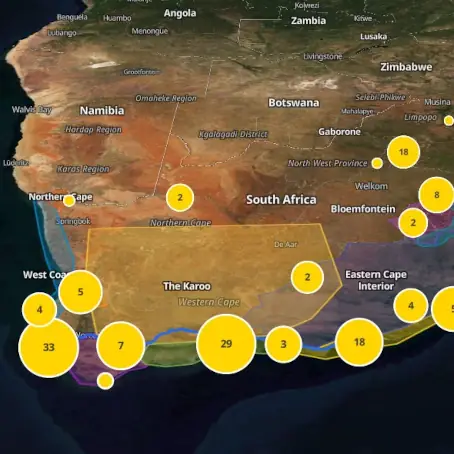
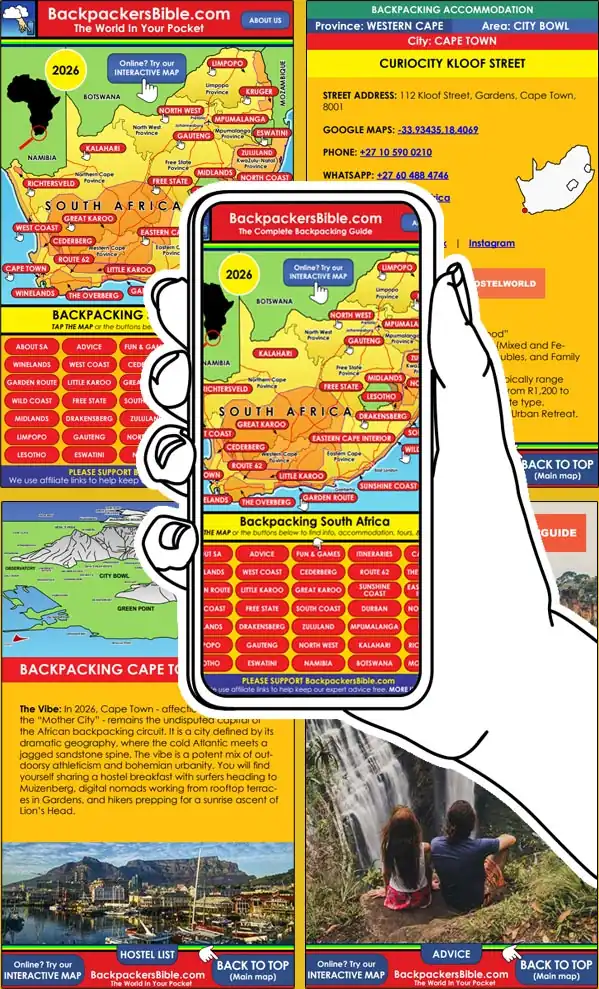
Backpacking South Africa: Use our interactive 3D map to find all the backpackers hostels in South Africa, with their full contact details and comprehensive reviews.
Interactive hostel map of South Africa — tap to load

Welcome to our guide to backpacking South Africa!

Discover more

Backpacking South Africa

Right. Let's be honest with you before we start: backpacking South Africa is not like going to Ibiza. It is not a two-week package holiday. It is not the sort of place where you follow a yellow line through a museum and tick things off a list. South Africa is a country where a baboon can steal your lunch, where you can watch a lioness chase down a wildebeest at dawn, where you can stand at the top of the world's highest commercial bungee jump and seriously consider whether this is a good idea, and then jump anyway. It is, by almost any measure, the most extraordinary backpacking destination on the planet — and this site exists to help you make the most of every single day of it.

For backpackers coming from Europe, Australasia, or the Americas, South Africa lands like another planet. The scale is different - it's roughly twice the size of France. The colours are different. The wildlife is not in a zoo. The food is different (boerewors, biltong, and a braai that puts every barbecue you've ever attended to shame). The people are different - warm, direct, funny, resilient, and possessed of an infectious "we'll make a plan" spirit that is completely unlike anything you'll find at home. And then there's the price. Your euros go so far here that you'll feel almost embarrassed. Almost.

This is the trip you'll talk about for the rest of your life. The one you'll describe to your children one day. The one that happened before the mortgage and the Monday morning commute. Let's make it count.

Backpacking South Africa heraldic cartouche featuring a male and female backpacker framing a globe map of Africa, surrounded by local wildlife including a lion, elephant, leopard, and crocodile.
CAPE TOWN - Table Mountain from Bloubergstrand ("Blue Mountain Beach"), on the other side of Table Bay | Photo: Tarryn Elliott

About South Africa

South Africa sits at the tip of Africa. It has more to offer than almost any country on earth. In a few weeks, you can watch the sun rise over the Drakensberg. You can eat Cape Malay curry in the Bo-Kaap. You can learn to surf at Jeffreys Bay. You can go eye to eye with a white rhino in Zululand. And you can do all of this on a budget that would barely cover a week in London.

The country has eleven official languages and three capital cities. Pretoria is the seat of the government. Cape Town is where the laws are made. Bloemfontein is the judicial capital. South Africa has never done things the simple way. The population is around 62 million people. As a backpacker, you will hear English everywhere. You will also hear Afrikaans in the Western Cape and Karoo, Zulu in KwaZulu-Natal, and Xhosa in the Eastern Cape. You do not need any other language to travel here comfortably. But learning a few words of Zulu or Xhosa will make people light up in a way that is truly lovely. Try "sawubona" (hello) and "ngiyabonga" (thank you).

The climate is broadly excellent. The Western Cape has warm, dry summers from November to March. Winters run from June to August and are cooler and wetter. The rest of the country has summer rainfall. This means warm, sometimes stormy weather from November to March. Winters are cool and dry from May to August. The Kruger National Park is best in the dry winter months. The bush thins out and animals gather around water. There is no bad time to visit South Africa. Some regions are better at certain times of year, but the country is worth visiting in any month.

The currency is the South African Rand. It has been weak against the euro, pound, and dollar for many years. In 2026, budget on roughly R20 to the euro — but check the rate before you go. The result is that South Africa is great value for European and American visitors. It is not ultra-cheap like some parts of South-East Asia. The standards are high and you pay for them. But compared to travel at home, it feels like a bargain.

Read More

Frequently Asked Questions

How much does a dorm bed cost?

At a good South African backpackers hostel, a dorm bed in 2026 costs between €8 and €18 per night. Cape Town is at the higher end. Expect to pay €12–€18 there. Smaller towns cost less. Places like Wilderness, Chintsa, or Sodwana Bay run €8–€12. The Baz Bus corridor — the main backpacking route from Cape Town to Johannesburg along the coast — has lots of hostels. This keeps prices fair.

What does a private room cost?

A private double room at a backpackers hostel usually has a shared bathroom. Prices run from around €25 to €60 per night. In Cape Town, expect €35–€60 for a good private room. If you travel as a couple and split the cost, this is outstanding value. Some hostels also offer en-suite rooms, which sit at the top of that range.

How do I get around?

This is the most important decision you will make. Think it through before you arrive. South Africa doesn’t really have one transport system — it has several overlapping ones, depending on budget, comfort, and how local you want the experience to feel.

The Baz Bus is a hop-on, hop-off backpacker bus. It once covered the whole country, but closed down in 2020. It was relaunched a few years later under new ownership, but as of 2026 it only runs between Cape Town and Gqeberha — the Garden Route and part of the Sunshine Coast — a few times a week, and is now a minibus rather than a bus service. It picks up and drops off directly at hostel doors. You pay once for a pass. You can get on and off as many times as you like. It is not the cheapest option. In fact if there are a few if you sharing, hiring a car will work out cheaper. Neither is it the most convenient option - you'll have to plan your holiday around its schedule. And you won't be able to go exploring like you can in a car. But it is a fairly safe way to see a limited part of the country.

Mainline buses (Intercape, Greyhound, Intercity Express) are much cheaper. A Cape Town to Johannesburg ticket can cost as little as €20–€35, although prices vary wildly, mainly according to when school holidays are. They stop at bus terminals, not hostel doors, sometimes in the middle of the night, and they are rarely on time. But they are the safest mode of transport - if there's an accident involving a smaller vehicle, the bus wins. If there's an accident involving a truck, you're better off in a bus than in a small car. They are a good choice if you are making long, direct runs between cities. But make sure you know beforehand what the options are for getting from the bus station to your hostel.

Car hire unlocks South Africa properly. A small car costs roughly €20–€35 per day all-in. Split between two or three people, this can work out cheaper per person than the Baz Bus — with far more freedom. South Africa drives on the left. The roads are good on main routes. A car lets you reach places the Baz Bus cannot go: the Cederberg, Route 62, the Karoo, the Drakensberg, Sani Pass, Hluhluwe-iMfolozi, Addo. One firm rule: do not drive at night outside of cities. Unlit people walking on the road, cattle, and sudden potholes make rural night driving genuinely dangerous. Plan your days to arrive before dark. And remember to drive on the left-hand side of the road.

Local Transport (Minibus Taxis) is the most authentic way to travel in South Africa. This is how the majority of the population gets around every day, so if you really want to experience the country properly, this is the way to do it. We use them often and have even travelled as far as Malawi using minibus taxis — it’s one of the most social and memorable ways to move through southern Africa. People are generally curious and open, and it’s very normal to end up in conversation with complete strangers, laughing together as if you’ve known each other for years.

However, minibus taxis do not operate according to a fixed timetable. They only depart once they are full — typically 15 passengers — which means that on longer routes you may be waiting for hours before the taxi actually leaves. This is an important factor to understand when planning intercity or long-distance travel, as flexibility is part of the system rather than punctuality.

Taxi ranks are where minibus taxis begin and end their journeys. They vary enormously. Some are large covered facilities with destination signs hanging from the roof, while others are little more than busy parking lots filled with taxis pulling in and out. To first-time visitors they can look chaotic and confusing, but don't be intimidated. South Africans are generally helpful, and if you're unsure where to go, simply ask someone where the taxi to your destination leaves from. Whether you're heading to Durban, Johannesburg, or the next town down the road, people will usually point you in the right direction.

Taxi ranks — along with major train stations — are also places where travellers are most likely to encounter South Africa's crime problem. Large crowds, people arriving and departing, and travellers carrying luggage create opportunities for pickpockets and thieves. Foreign visitors carrying large backpacks, cameras, laptops, and other valuables naturally attract attention. Most journeys pass without incident, but it pays to stay alert, keep valuables out of sight, and avoid displaying expensive phones or cameras unnecessarily. Safety can vary dramatically from one transport hub to another, sometimes even within the same city, so hostel staff and local residents are often the best source of current advice on which ranks are considered safest.

It’s also worth understanding how informal the stopping system is. Outside of taxi ranks (which exist in every town and city), minibus taxis do not stop at designated bus stops. Instead, they can stop almost anywhere along the route whenever someone signals them down. This makes the system highly responsive, but also unpredictable, and it creates a driving environment that can feel chaotic to visitors who are not used to it.

That unpredictability is something travellers — especially those hiring cars — should be aware of. Minibus taxis frequently pull over suddenly to pick up or drop off passengers, often with little warning. If you are driving behind or near one, you need to be prepared for abrupt stops and lane changes. It is part of the normal driving culture on South African roads, but it can be surprising if you are not expecting it.

Despite these challenges, the social experience is what makes minibus taxis so memorable. Conversations start easily, people are curious about where you are from, and long journeys often turn into shared experiences rather than just transport. It is not the most predictable or comfortable way to travel, but it is the most “South African” way to move through the country.

Uber is widely used in South Africa’s major cities, particularly Cape Town, Johannesburg, and Durban. It has become one of the most convenient and reliable ways for travellers to get around short distances without needing to negotiate fares or worry about routes. Unlike traditional metered taxis, the price is fixed in advance through the app, and drivers are generally rated, which improves accountability.

In Cape Town especially, Uber is often the preferred option for getting between neighbourhoods like the City Bowl, Camps Bay, Sea Point, and Observatory, particularly at night or when public transport options are limited. It is also widely used for airport transfers and short city trips. For safety, it is still recommended to check the car registration and driver details in the app before entering the vehicle, and to avoid sharing rides with strangers if that option is offered.

Internal flights are a fast and increasingly competitive way to cover long distances in South Africa. Major domestic airlines include FlySafair, Airlink, and Lift, with routes linking all major cities and several regional hubs.

Key airports include Cape Town International, OR Tambo (Johannesburg), King Shaka (Durban), and Gqeberha (Port Elizabeth). Regional airports such as Lanseria (Johannesburg’s secondary airport), George, East London, Mbombela (Kruger Mpumalanga International), Mthatha, and Pietermaritzburg (Oribi) also connect smaller cities and tourist regions. These smaller airports are especially useful for accessing the Garden Route, the Wild Coast, and safari regions without long overland transfers.

As of 2026, domestic flight prices typically range from around R800–R2,500 one way (approximately €40–€120), depending on route, demand, and how far in advance you book. Budget carriers can offer very competitive fares on busy routes like Cape Town–Johannesburg, while regional flights to smaller airports tend to be more expensive per kilometre. Luggage fees and seat selection are often extra, so it’s worth checking the full cost before booking. For long distances, however, flying is usually the quickest and sometimes surprisingly affordable option compared to multi-day bus or car journeys.

Rail travel in South Africa exists in two very different worlds. On one hand, there is the PRASA network, including Metrorail commuter services and the long-distance Shosholoza Meyl trains. In practice, long-distance rail is currently limited, slow, and often unreliable, with inconsistent schedules and reduced routes, so it is not a major option for most travellers moving between regions. Where it does run, it is extremely cheap and offers a very slow, old-school way of seeing the country, but it is not something most visitors rely on for structured travel itineraries.

For most travellers, it is generally not recommended to take mainline commuter trains on their own, particularly on unfamiliar routes, as service quality and on-the-ground security can vary significantly. A better option is to experience these routes with a local guide or organised tour, where the journey becomes both safer and more insightful.

One of the best examples is the Southern Line in Cape Town, a scenic coastal route running from the city through suburbs like Muizenberg and Kalk Bay down to Simon’s Town. It is a genuinely beautiful journey, with stops that are worth exploring on foot, especially Kalk Bay with its harbour, cafés, and tidal pools. In Durban, there is also a commuter line that runs south along the coast. It is extremely inexpensive and once extended much further, but has been shortened in recent years due to flood damage to sections of infrastructure. At present it runs as far as Warner Beach - just past Amanzimtoti, offering an experience of the areas immediately to the south of Durban.

As with taxi ranks, major train stations can attract opportunistic criminals, particularly in large cities. Travellers arriving with backpacks and luggage should remain aware of their surroundings and avoid wandering around unfamiliar station precincts, especially after dark.

We don't recommend using these commuter trains during peak morning hours — when they are used by local workers — for anyone but the most intrepid of travellers. Conditions can be very crowded. But if you do, they offer a powerful glimpse into everyday life — sometimes including unexpected moments such as entire train carriages participating in church services, complete with mass gospel singing. It is not as a comfort experience, but it can be one of the most memorable cultural journeys in the country when approached with awareness and respect.

FOR IN-DEPTH INFO ON TRANSPORT, SEE:

What does food and drink cost?

This is where South Africa really delivers. A big meal at a good restaurant — a proper main with a drink — costs €8–€15. Street food is even cheaper. A gatsby from a Cape Flats takeaway, a bunny chow in Durban, or a boerewors roll from a roadside stall costs €2–€5. Most hostels have shared kitchens. Self-catering is easy and cheap. A braai from the supermarket — boerewors, rolls, and a six-pack of local beer — feeds two people for around €10. A local beer in a bar costs €1.50–€2.50. A glass of South African wine costs €2.50–€4. South Africa makes outstanding wine and craft beer. It costs almost nothing to enjoy it.

What do activities cost?

Activities are where you will spend the most money. Budget for them. They are the heart of the South African trip. A rough guide for 2026:

Bungee jumping at Bloukrans (world's highest commercial bridge bungee) — ~€90.
Shark cage diving at Gansbaai (great white sharks, day trip from Cape Town) — ~€120–€140.
Tandem paragliding from Signal Hill, Cape Town — ~€85.
Cape Peninsula cycle and shuttle tour — ~€45–€60.
Abseiling Table Mountain — ~€65.
Surfing lesson with board hire, Muizenberg — ~€25.
White-water rafting, Storms River (Garden Route) — ~€40–€55.
Zip-lining, Tsitsikamma (Garden Route) — ~€45–€60.
Skydiving at Langebaan (West Coast) — ~€160–€180.
Soweto tour, Johannesburg (full day) — ~€30–€45.
Self-drive day in Kruger National Park (gate fees) — ~€25 per person.
Guided Kruger sunset game drive — ~€35–€50.
Hluhluwe-iMfolozi full-day guided safari — ~€60–€80.
Sani Pass 4x4 tour into Lesotho — ~€55–€70.
Whale watching at Hermanus (Aug–Nov) — ~€35–€50.
Table Mountain cable car (return) — ~€13–€16

What is a realistic daily budget?

Here are three honest benchmarks:

Budget traveller: €35–€50 per day. This covers a dorm bed (€10–€15), cheap meals (€8–€12 for food), a couple of local beers, and some local transport. You will eat well, sleep fine, and have a brilliant time.

Mid-range backpacker: €55–€80 per day. Dorm or private room. A mix of eating out and cooking. One paid activity every few days. Drinks. This is the sweet spot for most travellers.

Comfortable flashpacker: €80–€120+ per day. Private rooms, restaurant meals, regular activities, and car hire. You will not feel like you are roughing it at all.

One tip: even on a tight budget, do a few of the big activities. The bungee, the cage dive, the Kruger game drive, the township tour — these are things you cannot do at home. The memories will outlast any money you saved by skipping them.

FOR IN-DEPTH INFO, SEE:

Safety in South Africa

Let's be direct about this. It is what everyone asks before they leave home. And once people get here, most find they had it slightly wrong.

South Africa has a real crime problem. Violent crime — robbery, carjacking, assault — does happen. The murder rate is among the highest in the world. This is fact and it deserves respect. But hundreds of thousands of backpackers travel South Africa every year without any trouble. Most go home wanting to come back. The difference between them and the few who have a bad time comes down to awareness and behaviour.

The rules are simple. Once they become habit, they cause no stress at all.

Use Uber after dark in cities. In Cape Town, Johannesburg, Durban, and all large cities, Uber is cheap, safe, and easy to use. A trip across Cape Town costs €2–€5. Street taxis can involve negotiation and no route tracking. Use Uber. Every time.

Don't walk in unknown areas after dark. This applies to the Cape Town city centre outside of known safe zones. It applies to the Johannesburg city centre at any time. It applies to any area your hostel has not said is safe to walk. Ask your hostel manager. They know. Listen to them.

Keep your phone out of sight on city streets. Phones get snatched from hands very quickly. Keep yours in your pocket unless you are inside a building. This takes about two days to become second nature.

Don't drive on rural roads at night. People walking on unlit roads, cattle, and sudden potholes make rural night driving very dangerous. Plan each day to arrive before dark.

Use your hostel safe. All good hostels have safes in rooms or at the front desk. Use them. Carry a copy of your passport for daily use. Keep the real one locked away.

Trust your gut. If a street feels wrong, turn back. If a person makes you uneasy, move away. That instinct is almost always right. Acting on it is not rude — it is just good sense.

Get the right travel insurance. Make sure it covers medical transfer, theft, and adventure activities. Many standard policies do not cover bungee jumps or shark cage dives. Check before you go.

The bottom line: South Africa rewards the aware traveller. Read the safety notes your hostel gives you on arrival. They are locally specific and kept up to date. They are written by people who want you to have a great time and get home safely.

FOR IN-DEPTH SAFETY ADVICE, SEE:

KRUGER NATIONAL PARK - Self-drive safaris at a fraction of the cost of game drives in other African countries. See the Big 5 (lion, elephant, rhino, leopard, buffalo) | Photo: Fatih Turan

Things To Do in South Africa

The question isn't what to do in South Africa. The question is how to choose. In three weeks, you can learn to surf, watch elephants cross a river at dawn, eat the best braai of your life, abseil a cliff face, hike to the base of a waterfall that drops 948 metres, drink wine straight from the barrel in a cellar that's been there since 1685, and go to sleep in a thatched rondavel listening to lions. This is not an exaggeration. This is Tuesday through Thursday.

Read More

South Africa's appeal operates on multiple levels simultaneously. For the adrenaline hunters, the Garden Route alone offers more high-impact activities per kilometre than anywhere else in the world. For the wildlife obsessives, the Kruger National Park is simply the greatest game reserve on earth for independent self-driving — you go in with your own car and you find your own animals, and the encounters are genuinely wild, unmediated, and occasionally terrifying in the best possible way. For those who want culture and history and meaning beneath the fun, the Apartheid Museum in Johannesburg, a Soweto tour, the Robben Island ferry to Nelson Mandela's cell — these are not dry museum experiences. They are viscerally affecting in a way that will change how you think about a number of things. For the surfers, the hikers, the whale watchers, the shark divers, the stargazers in the Karoo, and anyone who just wants to sit on a beach that looks like the set of a film and eat grilled crayfish with a cold beer — South Africa delivers, consistently, at a price that feels almost impolite given how good it is.

The Classic Backpacker Routes

Most backpackers who visit South Africa follow one of a handful of well-established routes. These are not rigid itineraries - they're more like tramlines that you can jump off whenever something interests you — but they represent the accumulated wisdom of decades of travellers working out which bits of the country are best connected, most accessible, and most worth the journey.

The Garden Route Run (1–2 weeks): The most popular single stretch of South African backpacker travel, running between Cape Town in the southwest and either Port Elizabeth (Gqeberha) or Durban in the east. The route follows the southern coastline through the Winelands, over the mountains via Swellendam or through Route 62 (the inland alternative via the Karoo), and then along the coast through Wilderness, Knysna, Plettenberg Bay, Tsitsikamma, Jeffrey's Bay, and on to the Eastern Cape. The Baz Bus runs this route, and it is superb. Almost every backpacker who visits South Africa does at least part of this stretch. The combination of mountain scenery, beach towns, surf, adventure activities, and outstanding hostels makes it the most reliable single leg of any South African trip.

The Coastal Run to Durban (2–3 weeks): Extending the Garden Route all the way along the Wild Coast of the Eastern Cape (the former Transkei - one of the most spectacularly undeveloped stretches of coastline in Africa, where backpackers sleep in clifftop huts above deserted beaches) and into KwaZulu-Natal, ending in Durban. The Wild Coast section is for people who want to genuinely disconnect: no malls, no crowds, just wild ocean, red cliff faces, Xhosa villages, and horses on the beach. Durban is Africa's busiest port city, with a cosmopolitan food scene and excellent surf, and it makes a logical refuelling stop before heading north.

The Zululand and Kruger Loop (add 1–2 weeks from Durban): From Durban, head north through Zululand - iSimangaliso Wetland Park (hippos, crocodiles, whale sharks, leatherback turtles), Hluhluwe-iMfolozi Game Reserve (the oldest proclaimed nature reserve in Africa, and one of the best places in the world to see black and white rhino), and the Drakensberg mountains (Cathedral Peak, the Amphitheatre, Sani Pass into Lesotho) — before crossing into Mpumalanga and entering the Kruger National Park. Kruger is the centrepiece of most backpackers' wildlife ambitions and deservedly so. The loop from Kruger to Johannesburg closes the circuit.

The Cape Loop (1 week): For shorter trips, the Cape Peninsula and surroundings offer a complete and deeply satisfying experience without needing to travel further than 200km from Cape Town. Cape Town city, the Winelands (Stellenbosch, Franschhoek), the Cape Peninsula drive (Cape Point, Boulders Beach penguins, Chapman's Peak), and if time permits a day trip to Hermanus for whale watching. All of this is accessible by hire car or tour. It is one of the most beautiful weeks of travel available anywhere in the world.

For detailed suggested itineraries — from one week to three months — with day-by-day route planning, accommodation suggestions, and advice on combining these routes into a complete South African adventure, see:

Wildlife & Safari

Kruger National Park: There are larger game reserves in Africa, and there are more exclusive ones, and there are ones with more dramatic scenery. But for an independent backpacker with a hire car and a spirit of adventure, Kruger is incomparable. At nearly 20,000 square kilometres — roughly the size of Wales - it contains the Big Five (lion, leopard, elephant, rhino, and buffalo) plus over 500 species of bird, wild dog, cheetah, hyena, giraffe, zebra, hippo, crocodile, and a supporting cast of thousands. The park has a network of rest camps with budget accommodation (restcamp chalets and camping pitches at very reasonable prices) and a road system that you navigate yourself in your own car. The moment you encounter a pride of lions lying on the tarmac at 7 AM, or a bull elephant that stands in the road and decides whether or not to move for approximately four minutes while you sit very still and pretend to be very small, you will understand why people come back here year after year. Self-drive day admission runs approximately €25 per person; budget accommodation starts from around €30 per night in the rest camps.

Hluhluwe-iMfolozi: The oldest proclaimed game reserve in Africa (predating Kruger by several years), and one of the finest places on earth to see both black and white rhino — the reserve is credited with saving the white rhino from extinction in the mid-20th century. Smaller and more intimate than Kruger, it offers guided game drives and walking safaris, and the hilly, forested terrain gives it an atmosphere quite different from the flat bushveld of the north. A guided full-day drive costs approximately €60–€80 per person.

iSimangaliso Wetland Park: A UNESCO World Heritage Site on the KwaZulu-Natal coast that manages to combine coral reefs, hippo-filled lakes, crocodile-patrolled estuaries, turtle nesting beaches, and migratory whale sharks in a single reserve. St Lucia, the gateway town, is a lovely, low-key backpacker base. Night drives along the estuary — with hippos ambling along the road metres from your vehicle — are one of those experiences that cost very little and feel completely extraordinary.

Addo Elephant Park: If you're doing the Garden Route run and don't have time to get to Kruger, the Addo Elephant National Park outside Gqeberha is a credible alternative, with over 600 elephants and good Big Five sightings in a much more compact and accessible reserve. Day entry runs approximately €15 per person.

Adventure & Adrenaline

Bungee jumping at Bloukrans Bridge: 216 metres. The highest commercial bungee jump in the world. You stand on the underside of a bridge arch over a gorge in the Tsitsikamma forest, and then you jump off it face-first. The free fall lasts approximately 5 seconds. If you are the sort of person who responds to being terrified by laughing, you will love it. If you are the sort of person who responds to being terrified by crying, you will also love it, just slightly differently. Cost approximately €90. Non-jumpers can watch from a bridge walkway for about €15 — this is not a bad option if you want to see other people experience the most terrified three minutes of their lives.

Shark cage diving at Gansbaai: Two hours from Cape Town, off the Overberg coast, and one of the few places in the world where you can have a great white shark inspect you from a distance of about one metre while you are standing in a steel cage at sea level. The experience is controlled, safe, and completely surreal. Cost approximately €120–€140 including transport from Cape Town. See the Cape Town page for full details.

White-water rafting on the Storms River: Class III–IV rapids through the Tsitsikamma gorge. One of the best half-day activities on the Garden Route, at approximately €40–€55 per person.

Surfing at Jeffreys Bay: J-Bay is one of the five best right-hand point breaks in the world. If you can surf, you already know this. If you're a beginner, the beach break is gentle and the surf schools are good. Advanced surfers should time their visit for the annual Rip Curl Pro in July (when the break is at its most powerful and spectacular). Board hire runs from about €10 per day; lessons are approximately €25–€30.

Skydiving at Langebaan: Jumping from 10,000 feet with the full curve of the Cape Peninsula visible below you on a clear day. Approximately €160–€180 for a tandem jump. Deeply recommend it.

Zip-lining in Tsitsikamma: Multiple operators run zip-line courses through the forest canopy of the Tsitsikamma National Park, some covering over 400 metres in a single run above the tree canopy. Not the most extreme option on this list, but beautiful, and accessible for almost all fitness levels. Approximately €45–€60.

Abseiling Table Mountain: The highest commercial abseil in the world at 1,000 metres above sea level. See the Cape Town page for full details. Approximately €65.

Kiteboarding at Blouberg: Three days of IKO-certified instruction on Kite Beach, Bloubergstrand, with Table Mountain as the backdrop. One of the best investments you can make in Cape Town. Approximately €160–€200 for a full beginner's course.

Hiking & Mountains

The Drakensberg: The spine of southern Africa's interior, running through KwaZulu-Natal and into Lesotho, with peaks that reach nearly 3,500 metres. The scenery is mountain-dramatic in a way that is genuinely difficult to describe — think enormous basalt escarpments, cave paintings left by the San people 3,000 years ago, and waterfalls that drop off clifftops into gorges far below. The Amphitheatre section in the northern Drakensberg is the most iconic: the Tugela Falls (officially the second tallest waterfall in the world, at 948 metres) tumbles off the rim of the escarpment in five stages. The Chain Ladders route to the top is a half-day hike that ends with you standing on the Lesotho plateau at 3,200 metres, looking out over an emptiness that is almost incomprehensible in its scale. Absolutely do this.

Sani Pass: A 4x4 track that climbs from the KwaZulu-Natal foothills into the Kingdom of Lesotho via a series of hairpin switchbacks cut into the side of a mountain. The views on the way up are extraordinary. At the top, you are in one of the most isolated mountain kingdoms on earth, where the Basotho people still ride horses wrapped in blankets across a vast highland plateau. Several operators in Underberg run day tours for approximately €55–€70; some backpackers also arrange multi-day hiking itineraries into Lesotho from the top. The Sani Mountain Lodge at the summit is, for the record, the highest pub in Africa, and a hot chocolate there after the climb is one of the more satisfying simple pleasures available in this country.

Table Mountain: Yes, it's in the Cape Town write-up. But it belongs here too, because hiking Table Mountain via Platteklip Gorge and descending by cable car remains, per kilometre walked, the single highest-quality hiking experience available anywhere in South Africa. Do it on a clear morning, early. See the Cape Town page for full details.

The Otter Trail (Tsitsikamma): South Africa's most famous multi-day hiking trail, running 42 kilometres along the Garden Route coast through the Tsitsikamma National Park over five days. Permits are required and fill up months in advance, so this requires planning. If you can get on it, it is spectacular. If you can't, the day hikes in the same park are also excellent and require no advance booking.

To book tours, see the regional pages of this website

Culture, History & People

The Apartheid Museum, Johannesburg: This is the most important museum in Africa and one of the finest exhibition experiences anywhere in the world. Opened in 2001, it tells the story of South Africa's apartheid era — the systematic racial segregation that defined the country from 1948 to 1994 — through photographs, film footage, personal testimony, and physical artefacts that make the political viscerally human. It is harrowing in places and profoundly moving throughout, and it is completely essential context for understanding the country you are travelling through. Entry costs approximately €8. Allow at least two hours; most people spend three or four. You will leave changed.

Soweto: South Africa's most famous township - the sprawling urban settlement southwest of Johannesburg where Nelson Mandela and Desmond Tutu lived on the same street, where the 1976 student uprising began, and where the energy and creativity of the new South Africa is most palpably alive today. A guided Soweto tour is one of the most profoundly affecting experiences available to a traveller in this country. The best guides are locals who grew up here; their accounts of life under apartheid and their pride in what the community has built since 1994 are extraordinary. Full-day tours run approximately €30–€45 from Johannesburg and include visits to Vilakazi Street (Mandela's house is now a museum, and Tutu's is next door — it is the only street in the world to have housed two Nobel Peace Prize winners), the Regina Mundi church, Hector Pieterson Square, and a meal in a township shebeen. Do not skip Johannesburg because it sounds difficult. Joburg is where South Africa's story actually happened, and Soweto is the heart of it.

Robben Island: The maximum-security prison island in Table Bay, 12 kilometres from Cape Town's waterfront, where Nelson Mandela spent 18 of his 27 years in prison. The ferry crosses in 30 minutes. The tour of the island is led by former political prisoners - people who were actually incarcerated here - who show you Mandela's cell (a small rectangle of concrete with a thin mat and one bucket) and explain, in terms both calm and devastating, what life was like here during the apartheid years. Book online well in advance — this fills up weeks ahead during peak season. Approximately €22 including the ferry.

Bo-Kaap, Cape Town: The pastel-painted neighbourhood on the slopes of Signal Hill that was historically home to Cape Malay Muslims (descendants of enslaved people brought to the Cape by the Dutch East India Company from Indonesia, Malaysia, and the east African coast). Walking through Bo-Kaap is one of those experiences that reminds you how many different stories are woven into the fabric of a single city. The food - Cape Malay curry, bobotie, koeksisters - is exceptional, and the neighbourhood is one of the most photogenic places in South Africa. Free to explore; local food tours cost approximately €20–€30.

The Winelands (Stellenbosch, Franschhoek): South Africa has been producing wine since 1659, and it shows. The valleys around Stellenbosch and Franschhoek — a 45-minute drive from Cape Town - contain some of the most beautiful wine estates in the world, with mountains behind and perfectly maintained Cape Dutch homesteads in front and a Pinotage in a glass in your hand. Wine tasting at most estates runs approximately €6–€12 for a flight of five or six wines. Cycling between estates is the standard backpacker strategy, and it works extremely well (there are bike-hire operators in both towns). Tasting fees frequently include a food pairing. This is not a hardship.

To book tours, see the "Activities" section of the regional pages of this website.

Coast & Ocean

The Wild Coast: The stretch of coastline between the Kei River and Port Edward in the Eastern Cape - the former Transkei homeland - is unlike anywhere else in South Africa. Red cliffs, deserted beaches, Xhosa villages of round white-washed huts, horses, cows, and the occasional goat sharing the sand with backpackers who are a very long way from home. The walking trail between hostels along the Wild Coast is one of the great South African backpacker experiences: you move between isolated clifftop guesthouses and beachside camps, often by local boat or on foot across headlands, carrying your pack and having very little contact with the modern world. The internet is unreliable. The sunsets are not. The seafood - crayfish, crab, fresh fish grilled on an open fire - costs almost nothing and is extraordinary. This is a part of South Africa that many backpackers don't find, which is precisely why it's worth finding.

Whale watching at Hermanus: Between August and November, southern right whales enter Walker Bay on the Overberg coast to calve, and Hermanus has become the self-proclaimed "whale watching capital of the world." The whales come close enough to shore to be watched from the cliffside paths for free - they breach, blow, and loll about in the bay at distances of 50 to 200 metres from dry land. A boat-based whale watching trip gets you closer still (approximately €35–€50). The whale crier (yes, there is an official town whale crier, with a horn and a chalkboard reporting where the whales were seen that morning) is a genuinely South African institution. Hermanus is two hours from Cape Town by hire car and makes an excellent day trip.

iSimangaliso Whale Sharks (October–February): If whale sharks are on your list (and they should be), the waters off Sodwana Bay in the iSimangaliso Wetland Park offer some of the most reliable whale shark encounters in the world during the summer months. Snorkelling or diving with whale sharks here costs approximately €60–€90 per trip including equipment hire. Sodwana also has outstanding coral reef diving — it is one of the southernmost coral reef systems in the world - and the diving here is exceptional value compared to the Maldives or the Great Barrier Reef.

The Garden Route coast: Between George and Humansdorp, the coastline offers a near-continuous sequence of excellent surf breaks, river mouths, lagoons, and beaches. Wilderness, Knysna, Plettenberg Bay, Nature's Valley — each one is slightly different and each one has something excellent to offer. The Knysna Heads (the dramatic rocky entrance to the Knysna lagoon) are one of the most photographed pieces of coastline in South Africa. Plettenberg Bay's Central Beach is large, surf-able, and lined with the kind of uncrowded white sand that you would pay a small fortune to access in most of Europe. Entry is free.

To book tours, see the Activities sections on the Regional pages of this website.

Free Things To Do

South Africa is not expensive by any measure, but even here, sometimes the budget runs short and you need a good day that costs nothing at all. Fortunately, some of the very best experiences here are completely free.

Sunrise on Signal Hill or Lion's Head, Cape Town: Walk up in the dark, watch the sun come up over the mountains and the city and both oceans simultaneously. Zero cost. Absolutely extraordinary.

The Sea Point Promenade at sunset: Eleven kilometres of ocean-front path along the Atlantic Seaboard, packed at dusk with Cape Town's most diverse cross-section of humanity. Tidal pools, street food vendors, skateboarders, old men playing chess, families, dogs, and the occasional seal. Free.

Boulders Beach penguin colony (view from the road): The African penguin colony at Boulders Beach is inside a national park (entry approximately €5), but the penguins are also visible from the public beach at Boulders — outside the paid section — if you walk down the road a short distance. Free to watch from the fence, and they are very close.

Surfing the beach breaks (watching only — or bring your own board): Every surf beach in South Africa is a public beach. Watching expert surfers work a good break — at J-Bay, at Muizenberg, at Durban's North Beach, at Ballito — costs nothing and is more entertaining than most things on television.

Chapman's Peak Drive (driving): Yes, there's a small toll (approximately €2). But you can also walk or cycle the road. A late afternoon walk out to the viewing area above Hout Bay, looking north along the Atlantic Seaboard with Table Mountain filling the horizon, is free and completely beautiful.

Kalk Bay Harbour, Cape Town: On Saturday mornings, when the fishing boats come in and unload, Kalk Bay harbour is one of the most entertaining free spectacles in the Cape. Seals attempting to steal fish off the dock. Fishermen conducting a running argument with the seals. The fish market operating behind a screen of barely-controlled chaos. Eat a fish and chip lunch from the harbour restaurant for about €6. The rest is free.

First Thursdays, Cape Town: On the first Thursday of every month, galleries, studios, and creative spaces across the Cape Town CBD and Woodstock stay open until 9 PM and the streets become a free street party. Food trucks, live music on pavements, gallery openings with free wine. Free.

The Company's Garden, Cape Town: A shaded public park in the Cape Town CBD, free to enter, with oak trees planted by the Dutch East India Company in the 17th century and squirrels of genuinely alarming boldness. Buy a bag of peanuts from the vendor at the entrance for about €0.50 and feed them from your hand. This is one of those simple, slightly absurd, entirely lovely things that you will somehow remember longer than the bungee jump.

Viewing the sunset from the Waterfront, Cape Town: The V&A Waterfront has, as a backdrop to its restaurants and shops, Table Mountain turning pink and then orange and then purple as the sun goes down behind Signal Hill. The sunset itself is free. The glass of wine watching it is optional but encouraged.

Self-drive in the Karoo: If you have a hire car, driving through the Great Karoo - the vast semi-desert interior of the Western and Northern Cape — costs only the price of petrol and the occasional road toll. Stop the car on the N1 somewhere between Touws River and Matjiesfontein, get out, and stand in the silence for a while. The sky at night in the Karoo — no light pollution for hundreds of kilometres in any direction — is genuinely one of the greatest free spectacles on earth. The Milky Way is not a faint smudge here. It is a structure.

Hluhluwe village market (KwaZulu-Natal): The informal market outside the town of Hluhluwe on a Saturday morning is free to browse, excellent for handmade crafts and beadwork, and a good way to spend a morning if you're heading into iSimangaliso or Hluhluwe-iMfolozi reserve. Not a tourist trap - a real market.

SUGGESTED ITINERARIES, INCLUDING COST BREAKDOWNS AND DAILY DISTANCES:
Top-Rated South African Tours on GetYourGuide.com

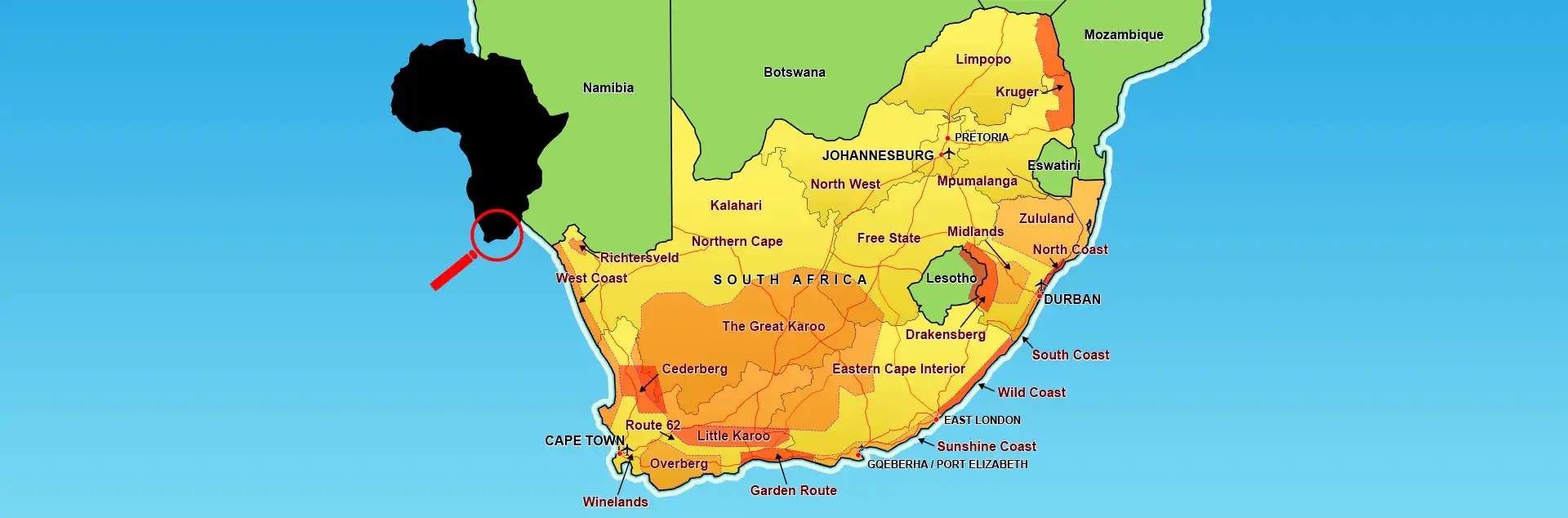
Map showing the backpacking regions of South Africa

Backpacker Hostels Directory

We're the only guide that lists all the hostels, with their full contact details, in case you want to book direct, plus useful info such as Safety Ratings and Value For Money, Solo Female Friendliness, and Digital Nomad scorecards.

SEE OUR

Hostels listed on Booking.com and Hostelworld

Top Picks

Some of our favourite hostels.

CAPE TOWN

CURIOCITY KLOOF STREET

Backpackers having a party at Curiocity Kloof Street

Boutique-hotel meets backpacker on Cape Town's trendiest street. Stunning Table Mountain views from the rooftop terrace, Bootlegger café downstairs, and female-only luxury dorms with en-suite bathrooms. The flashpacker's Cape Town base camp.

MORE about Curiocity Kloof Street

CAPE TOWN

BIG BLUE BACKPACKERS

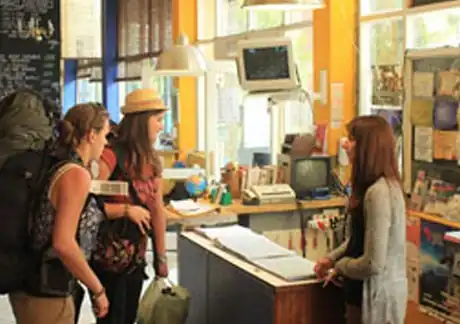
Big Blue Backpackers reception area / travel desk

A grand Victorian mansion five minutes' walk from the V&A Waterfront. Spacious enough that the party animals and the early-to-bed crowd find their own corners. Travel desk, pool, buzzing bar. Genuinely great location.

MORE about Big Blue Backpackers

CAPE TOWN

B.I.G.: BACKPACKERS IN GREEN POINT

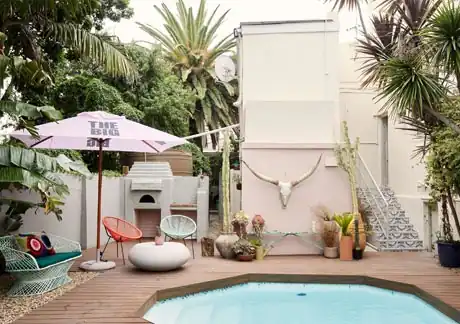
B.I.G. Backpackers swimming pool area

Modern, clean, and five minutes from the V&A Waterfront and Sea Point Promenade. Free breakfast, two fully-equipped kitchens, braai facilities, and a pool. One of the best-value smart hostels in Cape Town.

MORE about B.I.G. Backpackers

CAPE TOWN

AFRICAN SOUL SURFER

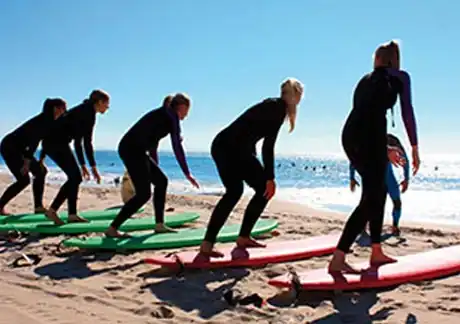
Surfing lesson on Muizenberg Beach

Right on the beach at Muizenberg's Surfer's Corner — the closest hostel to the waterline in all of Cape Town. Surf lessons, yoga, live music Fridays, and waves breaking fifty metres from your pillow.

MORE about African Soul Surfer Backpackers

EASTERN CAPE INTERIOR

TERRA KHAYA BACKPACKERS

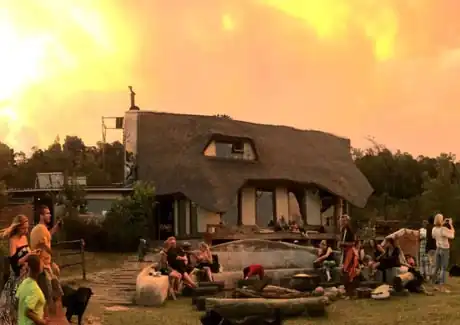
Terra Khaya eco backpackers lodge exterior view

A 100% off-grid eco-lodge high in the Amathole Mountains above Hogsback. Built from recycled materials, run on solar, and home to horses, dogs, cats, and communal dinners by firelight. Unlike anywhere else in South Africa.

MORE about Terra Khaya Eco Backpackers

GARDEN ROUTE

TUBE 'N AXE BACKPACKERS

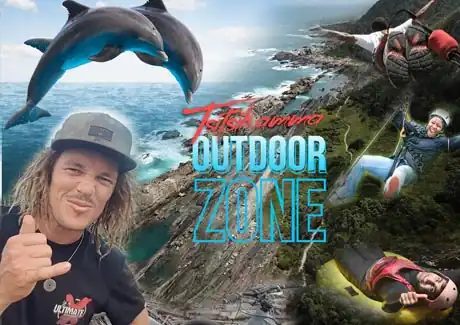
Tube 'n Axe Backpackers activities images - tubing, bubgy jumping and zip-lining

The definitive Tsitsikamma base: hot tubs, nightly bonfires, and a pool in the forest village of Storms River. Operators of the original Blackwater Tubing. Ten minutes from the Bloukrans bungee jump and Tsitsikamma National Park.

MORE about Tube 'n Axe Backpackers
THE DRAKENSBERG MOUNTAINS - The Amphitheatre, a 1km-high, 5km-long rock wall which is home to the Tugela Falls - the world's highest waterfall. | Photo: Wikimedia Commons (opens in a new tab)

Free Offline Backpacking Guide

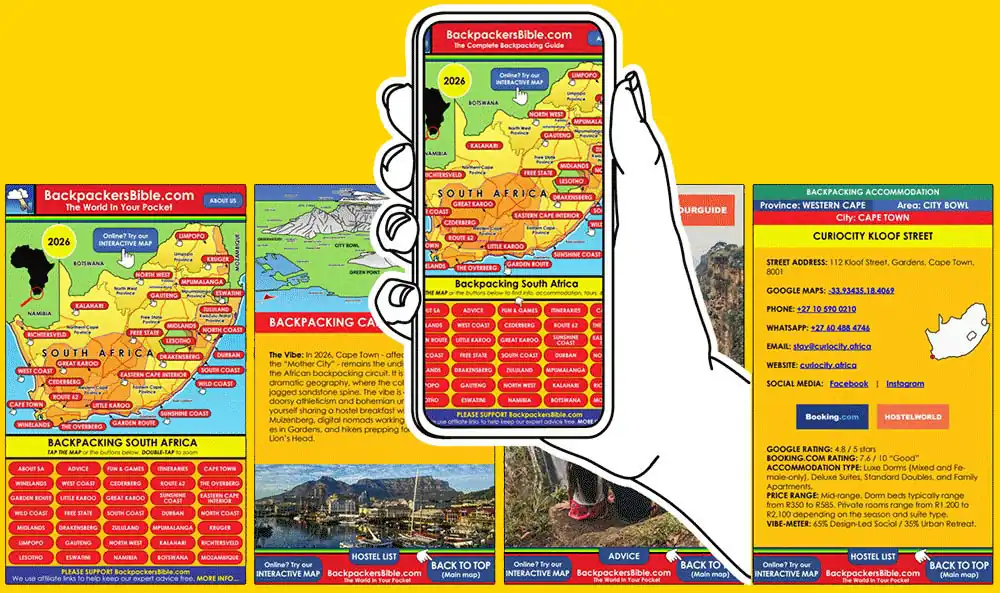
Here's a hostel guide - an interactive PDF - that you can use on your phone while touring South Africa. It works even in areas where there’s no signal or you’re out of data and offline. It contains an interactive map and contact details of all the country's backpacking hostels.

There's also an app - THE definitive guide to backpacking South Africa. It contains all the info on this website - interactive maps, regional info, advice, tours, hostel reviews and contact details - and can be used on- or offline.

Backpackers Bible Desktop Backpackers Bible Mobile
ABSOLUTELY FREE!
Backpackers Bible Lite

Backpacker's Bible Lite

Perfect for quick reference while you're on the road. A compact 3MB interactive PDF containing a clickable map and the contact details of every backpacking hostel in South Africa.

No wifi needed and no installation required—just save the PDF to your phone and go.

DOWNLOAD PDF (opens in a new tab)

(3mb)

QR code Backpackers Bible Lite
ABSOLUTELY FREE!
Full Backpackers Bible

The Full Backpacker's Bible

Our complete interactive experience. Unlike a PDF that disappears into your 'Files' folder, this installs as an app icon right on your home screen for one-tap access.

You’ll have every high-res map, image, and hostel detail available instantly—even in the middle of the Kalahari with zero signal.

(Progressive Web App - 60mb)

QR code Backpackers Bible Progressive Web App download
THE GARDEN ROUTE - An area of immense biodiversity and a hotspot for adrenaline adventure activities | Photo: South African Tourism Wikimedia Commons (opens in a new tab)