Pilanesberg National Park, Sun City, and the Magaliesberg. These are the reasons to come to North West. They sit within an hour of each other in the northeastern corner of the province, two to three hours from Johannesburg, and they attract very different kinds of visitors who share the same roads and occasionally the same bars without having very much else in common.
For backpackers specifically, North West Province presents a practical challenge: the hostel infrastructure is thin, the distances are significant, and the main attractions are either priced beyond the budget end of the market (Pilanesberg's self-drive day visitor fees, Sun City's everything) or require a car to access. This is not a province where you rock up with a daypack and figure it out on arrival. It rewards planning, and the two hostels covered in this guide serve very different functions on two very different circuits of the province. We review them both honestly, which in one case means the review is considerably more flattering than in the other. Readers of this guide are accustomed to us calling things what they are.
ABOUT THE MAIN ATTRACTIONS
Pilanesberg National Park: The Accessible Big Five
Pilanesberg is the fourth-largest game reserve in South Africa and the closest Big Five destination to Johannesburg and Pretoria, sitting approximately two and a half hours from Sandton on good roads. Its geological origin is singular: the park occupies the eroded root zone of an ancient alkaline volcano that erupted roughly 1.3 billion years ago, one of only three such formations in the world. The resulting landscape - concentric rings of hills radiating outward from a central lake, with the Magaliesberg range visible on clear days to the south - is visually unlike any other South African park. It does not look like Kruger. It does not look like the Karoo. It looks like something designed by geology with unusual aesthetic ambitions.
The park was not always wild. Until 1979, the land was occupied by farmers and the Bakgatla-ba-Kgafela people, who were evicted when Operation Genesis introduced more than 6,000 animals from across South Africa to populate the newly created reserve. The resettlement of those communities is a contested history that the park's literature addresses only briefly. It is worth knowing. The wildlife that now moves across that land - lion, leopard, elephant, buffalo, both black and white rhino, wild dog, cheetah, hippo, giraffe, spotted hyena, brown hyena - was shipped in from elsewhere. This does not diminish the experience of seeing a pride of lions moving through the hills at dawn, but context is part of understanding what you are looking at.
Two things distinguish Pilanesberg from Kruger in ways that matter practically for backpackers. First: it is entirely malaria-free. This is a significant consideration for travellers who are not taking malaria prophylaxis, who are travelling with children, or who have medical reasons to avoid the medication. Kruger in summer is a serious malaria area; Pilanesberg in any season is not. Second: the park is considerably smaller than Kruger (55,000 hectares versus Kruger's 2 million), meaning game concentrations are higher and sightings are more reliable. The trade-off is that Pilanesberg feels managed in a way that Kruger's genuine wilderness does not. But for a backpacker doing a two-week South Africa loop on a budget, a day in Pilanesberg delivers a Big Five experience at a fraction of the logistical complexity of a Kruger trip.
Lake Mankwe, the central alkaline lake, is the focal point of game activity. The walk-in hides overlooking the lake are underused by most visitors and consistently produce the park's best wildlife encounters - the patience required to sit quietly in a hide for an hour is richly rewarded by the animals that use the lake's edge throughout the day. The hippo pod at Mankwe is reliable year-round. The crocodiles are present and sometimes enormous. The elephant herds drink in late afternoon. Bring binoculars and more patience than you think you need.
Sun City: Crazy, Intentional, Worth It Once
Sun City is a casino-and-resort complex built in the late 1970s by hotel magnate Sol Kerzner on a piece of former Bophuthatswana homeland land, specifically chosen because it sat outside apartheid South Africa's borders and could therefore ignore the apartheid government's prohibitions on gambling, interracial mixing, and entertainment considered morally corrupting. It was, in other words, built as a deliberate act of regulatory arbitrage, and the political history of how a glamorous resort complex came to stand on dispossessed homeland land is not something that Sun City's promotional literature dwells on at length.
All of that said: Sun City in 2026, whatever its origins, is genuinely a spectacle worth experiencing for an afternoon, and the Valley of the Waves is one of the more absurd and enjoyable things available in South Africa regardless of your budget or your politics. The Valley of the Waves is a wave pool and beach complex inside a man-made tropical paradise, complete with actual sand beach, palm trees, a wave machine that generates 1.8-metre body-surfing waves, and a waterslide called the Temple of Courage that drops you 70 metres. It sits in the middle of African bushveld. There is a smoking volcano made of concrete. It makes no rational sense whatsoever, and an afternoon in it on a hot North West summer day is genuinely enjoyable in ways you will find difficult to justify intellectually and impossible to deny experientially. Day visitor entry to the Valley of the Waves runs approximately R480 per person (about €24) -- it is not cheap but it is a specific kind of experience unavailable anywhere else on earth.
The rest of Sun City - the casino, the Palace of the Lost City hotel, the restaurants, the golf courses - is expensive and built for a different kind of visitor. Walk through it for the architectural surrealism (the Palace genuinely looks like a Howard Hughes fever dream expressed in reinforced concrete and gold leaf), spend your afternoon at the Valley of the Waves, and drive back to Hodge Podge or your Pilanesberg base for the evening. That is the correct budget backpacker relationship with Sun City.
The Magaliesberg: Older Than Almost Everything
The Magaliesberg mountain range is approximately 2.3 billion years old - roughly half the age of the earth, 100 times older than the Himalayas, and 500 times older than the Alps. It is one of the oldest exposed mountain ranges on the planet, and the folded quartzite ridges that stretch for 120km between Pretoria and Rustenburg look exactly like what they are: the roots of something that was already ancient when the first complex life appeared on earth. Walking along a Magaliesberg ridge and looking out at the surrounding bushveld and the flat plains of North West and Gauteng stretching to every horizon, you are standing on geology of a scale and age that requires a serious effort of imagination to comprehend.
The range has been heavily developed along its southern and eastern flanks - weekend resorts, timeshares, adventure activity centres, and the Hartebeespoort Dam complex that has become a weekend escape valve for landlocked Gauteng. The Kgaswane Mountain Reserve, accessed from Rustenburg, preserves 40 square kilometres of the western Magaliesberg in something approaching its original state, with quartzite outcrops, mountain fynbos, 300 bird species, brown hyena, Cape mountain zebra, and the Cape vulture colony at Manyeleti. The Mountain Sanctuary Park, also accessible from the Rustenburg side, offers no-vehicle access to the range - walking trails only, which immediately separates it from most of the weekend resort infrastructure.
The Magaliesberg Canopy Tour is the activity that draws the adventure crowd: a series of 11 platforms connected by steel cables, ziplining through the kloofs and valleys of the northern escarpment with views of the ancient rock faces and indigenous bush at speeds of up to 60km/h. Cost approximately R750 per person (about €37). It departs from the Magaliesberg Canopy Tour Base Camp near the town of Magaliesberg and takes about three hours. Book in advance; it fills up at weekends.
Potchefstroom: The University Town
Potchefstroom sits 120km southwest of Johannesburg in the southern section of North West Province, well away from the Pilanesberg/Magaliesberg tourist triangle. It is primarily a university town - North-West University's Potchefstroom campus (known locally as PUK) dominates the social and economic life of the place - with a strong sports culture, an Afrikaner cultural character, and a history that most South Africans could recite and most international backpackers could not. The town was established in 1838 as the first permanent European settlement in the Transvaal, briefly served as the capital of the South African Republic, and is home to some of the oldest Dutch Reformed church architecture in the interior. The 2010 FIFA World Cup training camps used Potchefstroom's facilities; the cricket stadiums here are among the best in South Africa for non-Test matches.
For an international backpacker, Potchefstroom is almost entirely off the standard tourist circuit. The reasons to visit are few and specific: you are attending an event (a sporting fixture, a music festival, a university graduation), you are passing through on the N12 between Johannesburg and the Northern Cape, or you have been told about something local worth seeing. The town is pleasant, clean by South African urban standards, and has the student-population amenity set (cheap food, some decent bars near the university) without the tourist infrastructure. Paljas Backpackers on Esselen Street is the budget accommodation option. We review it below with the same honesty we apply to everything on this guide, and the review is not flattering. If you need to sleep in Potchefstroom, you now have the information required to decide whether Paljas is adequate for your standards or whether a guesthouse is the better call.
North West Province FAQs For Backpackers
When is the best time to go?
The Pilanesberg/Magaliesberg area follows the Highveld seasonal pattern. Summer (October to March) is hot - sometimes very hot, pushing 38 degrees C in January - with dramatic afternoon thunderstorms that build rapidly and clear by evening. The bush is green and dense, which makes game harder to spot but the landscape more beautiful. Winter (May to August) is dry, clear and cold at night (sub-zero on some evenings), with vegetation that thins enough to make game sightings at Pilanesberg significantly better. Dawn game drives in winter are extraordinary - cold air, low golden light, animals concentrated at waterholes. The tourist peak at Sun City is December to January (school holidays and the Joburg exodus). For backpackers, the shoulder months of April/May and September/October give the best combination of good weather, manageable crowds, and reasonable prices.
Do I need a car?
For the Pilanesberg/Sun City/Magaliesberg circuit: yes, essentially. There are shuttle options from Johannesburg to Sun City (several commercial operators run daily transfers), but moving between the attractions independently requires your own vehicle. Pilanesberg is a self-drive park with no public transport access to the gates. The Magaliesberg activities are spread across a 120km range with no connecting public transport. Hire a car from Johannesburg OR Lanseria International Airport (which is significantly closer to Pilanesberg than O.R. Tambo) before coming.
For Potchefstroom: the town is accessible by bus (Greyhound, Intercape and FlixBus all service the N12 route from Johannesburg to Kimberley and beyond). Within Potchefstroom, Bolt and Uber operate and the university campus, main street restaurants and Paljas Backpackers are within a few kilometres of the bus stop. No car required for the town itself.
Is it malaria-free?
Yes. The entire North West Province, including Pilanesberg, is malaria-free. This is one of the province's most significant practical advantages for travellers who want Big Five game viewing without the medical complexity of Kruger or Madikwe in summer. No prophylaxis required, no nets needed, no restriction on visiting with young children or immunocompromised travellers.
What does it cost?
Pilanesberg day visitor conservation fees: approximately R252 per person for international visitors (about €12.50). Guided game drives through the park from the Manyane or Bakubung camps: R650-R850 per person (about €32-€42). Sun City Valley of the Waves: approximately R480 per person (about €24). Magaliesberg Canopy Tour: approximately R750 per person (about €37). A dorm bed at Hodge Podge: approximately R200-R280 per person (about €10-€14). The big spends here are the activities rather than the accommodation.
Safety In North West Province
North West Province has a mixed safety profile that requires honest differentiation between its different areas. The tourist corridor - Pilanesberg, Sun City, the Magaliesberg resort strip - is well-managed, heavily visited, and has the safety characteristics of a major tourist area. The urban centres, including Rustenburg and Potchefstroom, have the crime profile of typical South African medium-sized cities. The rural areas in the western and northern parts of the province are largely irrelevant to the backpacker circuit.
Rustenburg: Real Urban Risk, Real Precautions Required
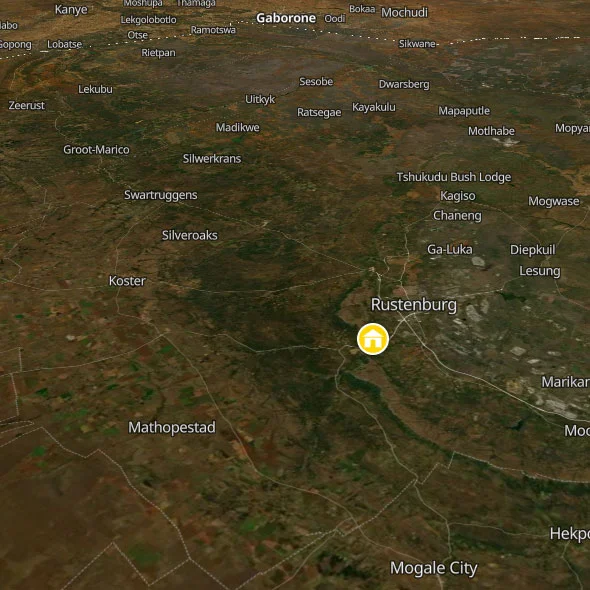
Rustenburg is a platinum mining town, and mining towns in South Africa carry specific social dynamics: significant migrant labour populations, uneven wealth distribution, and a crime rate that reflects both. The town itself is not a tourist destination and offers nothing that requires a backpacker to spend time in the CBD. Hodge Podge Backpackers is located outside the town proper, on the rural Oliphants Nek road against the Magaliesberg foothills, which improves the local crime picture. However, two serious security incidents have been recorded at the property itself over its operating history (detailed in the Hodge Podge entry below) and these must be read before booking. The standard urban precautions apply in Rustenburg town: phone in pocket, no cash visible, avoid the CBD at night, use Bolt rather than walking between venues after dark.
Pilanesberg: Wildlife Risk, Not Crime Risk
Pilanesberg is safe from a crime perspective -- the park is managed, fenced, and regularly patrolled. The risks are wildlife-related. This is a Big Five park with free-roaming lion, elephant and buffalo. The rules are not negotiable: stay in your vehicle on self-drive, do not get out except at designated picnic sites and hides, do not feed or approach animals. Elephant bulls in musth are unpredictable and have charged vehicles. Buffalo are statistically dangerous to humans. The walk-in hides require you to exit your vehicle; do so quietly, move slowly, and be aware that Mankwe Lake's crocodile population extends further up the shoreline than the visible waterline suggests.
Potchefstroom: University Town Precautions
Potchefstroom is a South African city with the standard urban crime profile - opportunistic phone theft, car break-ins, the occasional more serious incident in the wrong area at the wrong time. The university campus area and the main commercial streets are reasonably safe during the day. Apply standard precautions after dark: use Bolt, stay in lit areas, don't walk alone in unfamiliar streets. The Esselen Street area where Paljas Backpackers is located is residential and relatively low-risk but requires the usual vigilance.
Further Reading
Ready to map out the rest of your adventure? For more general info on backpacking South Africa, see our comprehensive home page. We also highly recommend checking out our expert backpacking advice section to make sure you stay safe and save money on the road. If you need help structuring your travel routes, take a look at our suggested itineraries for tours of South Africa. For more info on backpacking, including access to our offline app and interactive PDF guide, head over to our resources page.











 SHARE (opens in a new tab)