The easiest way to choose your KwaZulu-Natal Midlands hostel. Use our unique 3D map to filter nature escapes, solo women setups, and top safety.

Search KwaZulu-Natal Midlands Backpacker Hostels

Filter backpackers hostels by digital nomad suitability, solo female traveller friendliness, safety, surfing, camping, value for money, party atmosphere, african culture experiences, adventure activities and nature experiences.

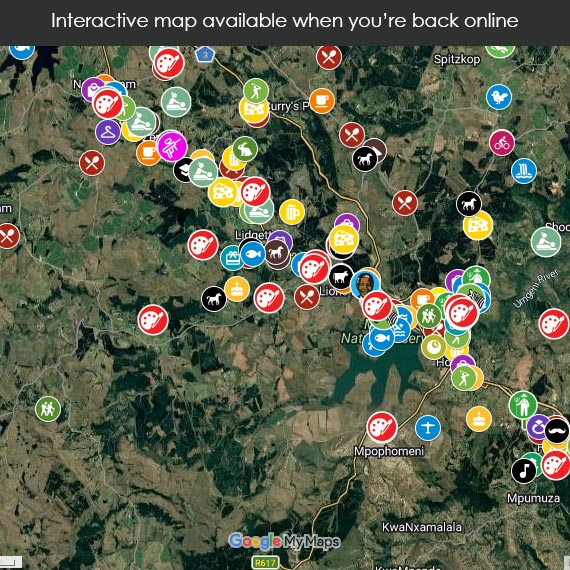
Interactive backpacker hostel map of the KwaZulu-Natal Midlands showing hostels that can be filtered by travel style, safety, digital nomad suitability, surfing, camping and budget travel preferences.

Where To Go, What To See and How Much It'll Cost

Use our wizard to plan your trip, based on what you want to see and do, and your budget. Costs calculated according to 2026 prices.

Welcome to our backpacking guide of the KwaZulu-Natal Midlands!

Discover more

Backpacking the KwaZulu-Natal Midlands

Almost every backpacker who comes through KwaZulu-Natal follows the same route: Durban for a night or two, then straight up the N3 to the Drakensberg, eyes forward, Midlands invisible on either side. It is one of the great missed opportunities in South African travel.

The KZN Midlands is the high country that sits between the coastal belt — which runs from Durban up through Pietermaritzburg — and the Drakensberg foothills to the west. It is not a single town or a single attraction. It is a landscape: a rolling, intensely green series of hills and valleys at altitude, dotted with small towns, dairy farms, trout streams, forests, and waterfalls. The air is cooler than the coast. The light is different. The pace is different. South Africans from Durban have known about it for decades — it has been a weekend-escape destination for coastal city dwellers since long before international tourists discovered the Drakensberg. International backpackers, by and large, have not caught on yet. This is still an advantage. Go now, before it becomes obvious.

Read More

The area stretches roughly from the top of Town Hill — the long escarpment above Pietermaritzburg — westward to the Drakensberg foothills. Its main artery for visitors is the Midlands Meander, a scenic route linking craft studios, food producers, and natural attractions across the region. But the Meander is a starting point, not the whole story. Howick Falls, the Karkloof forests, the Mandela Capture Site, the mountain biking trails of the Karkloof — these are experiences in their own right, and any one of them would justify the detour from the N3. Together, they make a compelling case for at least two or three nights.

Pietermaritzburg — PMB to everyone who lives there — is the regional capital and the most likely base for backpackers. It is a genuine city, South Africa's second-oldest, with Victorian architecture, a functioning downtown, and a population that gives it some real urban texture. It is also considerably cheaper than Durban. Most of the hostels in the region are either in PMB or within easy driving distance of it.

A word about getting here: the Midlands is best explored by hire car or motorbike. The Meander is exactly that — a meander. It winds through back roads that no minibus taxi route covers. If you are coming up from Durban without a vehicle, the most practical approach is to stay in Pietermaritzburg and do day trips. If you have wheels, the whole region opens up. One tank of petrol is enough to drive the main Meander loop, stop at Howick Falls, visit the Mandela Capture Site, and still make it back for supper.

Where Exactly Are The Midlands?

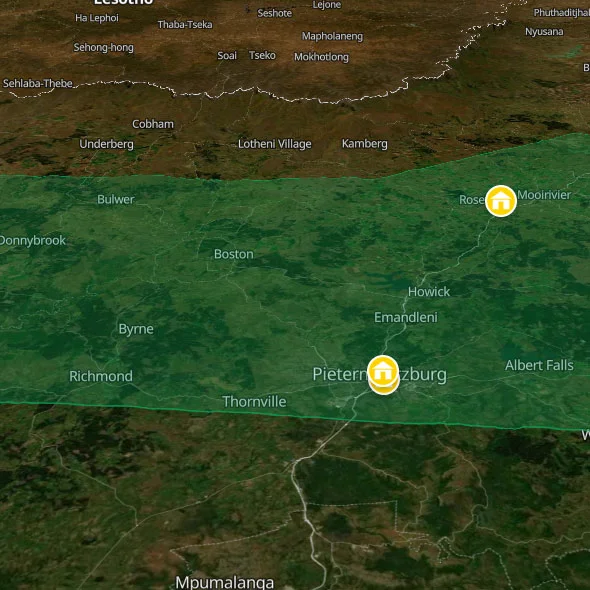
Most online sources get this wrong, placing the Midlands vaguely around Mooi River or even extending it into the Drakensberg itself. To be precise: the KZN Midlands begins at the top of Town Hill, the escarpment that rises above Pietermaritzburg on the N3, and extends westward to the foothills of the Drakensberg. The southern boundary is roughly the Pietermaritzburg–Durban corridor; the northern boundary stretches toward Mooi River and beyond. The towns of Howick, Hilton, Nottingham Road, Rosetta, and Balgowan are the main reference points. Pietermaritzburg itself sits on the eastern edge — more accurately described as the gateway to the Midlands than part of it, though it functions as the practical base for most visitors.

The Midlands Meander: What It Is and What It's Become

The Midlands Meander started as a genuinely remarkable idea: a group of local artists — potters, painters, sculptors, weavers — decided in 1985 to open their studios to the public and connect them with a self-guided driving route. You would follow the signs through the countryside, stop at a pottery here, a weaving studio there, meet the people making things with their hands, and buy directly from them. It was organic, artist-led, and entirely without precedent in South Africa.

It worked extraordinarily well. Durbanites started coming up for the day, then the weekend. Restaurants opened to feed them. B&Bs opened to house them. The Meander grew. And then, as tends to happen when a good thing grows, it changed. The artists who founded it found themselves increasingly outvoted by the B&B owners and food producers who had joined the route. The balance of power shifted from studios to accommodation. The art element — which was the whole point — gradually became a smaller proportion of the offering. Today the Meander includes artisanal cheese makers, German sausage and charcuterie producers, coffee roasteries, trout farms, and a great many B&Bs with craft shops attached. The original spirit has diluted somewhat. But the countryside it passes through is still beautiful, the food producers are genuinely excellent, and on a cool Midlands morning with mist on the hills, driving the back roads between Hilton and Nottingham Road with a map on the seat beside you still feels like exactly the right thing to be doing.

The best approach: don't try to do everything. Pick three or four stops — one artist studio, one food producer, one viewpoint — and take your time at each. The Meander is at its best when treated as a country drive with pleasant interruptions, not as a checklist.

KZN Midlands FAQs For Backpackers

When is the best time to go?

The Midlands has four distinct seasons and is genuinely worth visiting in any of them — each offers something different. Summer (November to February) is warm and very green, but comes with afternoon thunderstorms, sometimes heavy. These pass quickly. Autumn (March to May) is the pick of the seasons for many locals: the hills turn gold, the air is clear, the light is extraordinary, and the crowds from the festive season have gone. Winter (June to August) is cold — genuinely cold at altitude, with occasional frost and sometimes snow on the higher ground. It is also the dry season, which means clear skies, no rain, and the landscapes have a more open, spare quality. Spring (September to October) brings wildflowers, warming temperatures, and the trout fishing season into full swing.

The Meander itself has no bad season, but weekends from June to August can be busy with South Africans escaping the coast for a winter break. If you want the back roads to yourself, a Tuesday in May is your moment.

Do I need a car?

For the Midlands Meander and most natural attractions, yes. The Meander winds through back roads that are not served by public transport. Pietermaritzburg itself is navigable by taxi and on foot, and Howick is reachable by shared taxi from PMB. But to get to the Karkloof, Nottingham Road, Rosetta, or most of the Meander studios, you need a vehicle. Car hire in Pietermaritzburg is straightforward and reasonably priced — all the major companies (Avis, Budget, Europcar) have desks there. Alternatively, several of the hostels can arrange day tours or vehicle rental. A motorbike is arguably the perfect Midlands vehicle: the roads are mostly paved, the distances are modest, and the views from a bike are better than from inside a car.

How long do I need?

Two nights is the minimum to do the region justice. Three nights is comfortable. With two nights you can do Howick Falls, a half-day on the Meander, and the Mandela Capture Site. With three you can add Karkloof Falls, a mountain bike session in the Karkloof, and an evening in one of the Nottingham Road restaurants. A week is not too long if you want to fish, ride, and genuinely slow down. Many people who come for three days end up extending. The Midlands has a way of doing that.

What does it cost?

The Midlands is considerably cheaper than the Western Cape and comparable to or slightly cheaper than the Drakensberg. Dorm beds in Pietermaritzburg run from around R180–R300 per night. A decent sit-down lunch at a Meander restaurant will cost R120–R200. Entrance to Howick Falls viewpoint is free. The Mandela Capture Site museum has a small entrance fee. Karkloof Canopy Tour costs around R850 per person. Mountain bike trail fees at the Karkloof vary. Petrol for a full day's Meander loop from PMB and back is unlikely to exceed R200.

Is it safe?

The rural Midlands is among the safer parts of KwaZulu-Natal for travellers. The small towns — Howick, Hilton, Nottingham Road — are quiet and low-crime in the tourist-facing areas. Pietermaritzburg requires the same awareness you'd bring to any South African city: don't flash valuables, be alert at night, use Uber rather than walking after dark in the CBD. The hostels in PMB are well-established and can advise on which areas to avoid. The Meander roads themselves are rural and safe to drive. Standard South African road-safety cautions apply: watch for potholes, livestock, and pedestrians on country roads.

Safety In The KwaZulu-Natal Midlands

The Rural Midlands

The rural Midlands — the Meander roads, the Karkloof, the small towns of Howick and Nottingham Road — is among the safer parts of KwaZulu-Natal for travellers. Petty crime exists everywhere in South Africa, but the tourist-facing areas of the Midlands have a low crime profile. The main practical precaution: don't leave valuables visible in a parked car, and lock the vehicle even for short stops at viewpoints and trailheads. Car break-ins are the most common crime affecting tourists in the region.

Pietermaritzburg

PMB requires the standard urban awareness that any South African city demands. The CBD, particularly around Commercial Road and the taxi rank areas, is the highest-risk zone — not dangerous by global standards, but a place to be alert. The areas around Church Street and the historic centre are generally fine during the day. At night, use Uber rather than walking. The residential suburbs — Hilton, Athlone, Scottsville, around the university — are considerably calmer. Your hostel will be able to give specific, current advice on which areas to avoid. Always ask.

On the Road

The N3 between Durban and Pietermaritzburg is one of South Africa's busiest highways and has a reputation for aggressive driving, particularly among minibus taxis and heavy trucks. Drive defensively. The Meander back roads are largely quiet and pleasant, but watch for pedestrians, livestock on the road, and unmarked speed bumps in the small towns. Night driving in the rural Midlands is not recommended — pedestrians on unlit roads are a serious hazard throughout KZN.

Further Reading

Ready to map out the rest of your adventure? For more general info on backpacking South Africa, see our comprehensive home page. We also highly recommend checking out our expert backpacking advice section to make sure you stay safe and save money on the road. If you need help structuring your travel routes, take a look at our suggested itineraries for tours of South Africa. For more info on backpacking, including access to our offline app and interactive PDF guide, head over to our resources page.

Backpacking the KwaZulu-Natal Midlands heraldic cartouche featuring a male and female backpacker framing a globe map of the Midlands, surrounded by local attractions.

Quick Facts

Best Time To Visit: March to May and September to November for mild weather, green landscapes, and clear views. Winter (Jun–Aug) is dry but can be cold in the mornings and evenings.
Best For: Rolling green hills, waterfalls, farm stays, arts and crafts routes, slow travel, hiking, and peaceful countryside escapes away from the coast and cities.
Most Popular Experience: Driving the Midlands Meander — a network of craft, food, and art routes through small towns, farms, and scenic countryside between Pietermaritzburg and the Drakensberg foothills.
Most Under-rated Experience: Slow exploration of the quieter backroads between farm villages, waterfalls, and forested valleys — a deeply peaceful landscape that many travellers pass through without stopping.
Best Free Experiences: Scenic countryside drives, waterfall viewpoints, walking sections of the Midlands Meander routes, and exploring small creative towns and farm landscapes.
Ideal Stay: 2–4 days to properly explore the meander routes, or longer if using it as a slow travel base between Durban and the Drakensberg.
Budget Level: Mid. Expect around €50–€130 per day depending on accommodation type, with strong guesthouse, farm stay, and boutique rural options.
Getting Around: A car is essential. The Midlands Meander is a self-drive route spread across rural roads with limited public transport.
Best Photo Spots: Rolling green hills, waterfall stops along the Midlands Meander, misty farm valleys, and scenic rural viewpoints throughout the region.
MANDELA CAPTURE SITE - Photo: Magda Ehlers

Things To Do In The Midlands

Things To Do in the KwaZulu-Natal Midlands interactive map

1. Howick Falls (Non-Negotiable)

The Umgeni River drops 95 metres over a sheer basalt cliff into a deep, dark pool at Howick, and the result is one of the most genuinely impressive waterfalls in South Africa. It is not the tallest — the Drakensberg has taller — but there is something about the combination of scale, the town built right up to the edge, and the surrounding gorge that makes Howick Falls feel more dramatic than its height alone would suggest. On a misty morning the spray rises up the cliff face and the falls disappear into cloud. On a clear afternoon the light catches the water and turns the pool below a deep green-black.

Read More

The Zulu name for the falls is KwaNogqaza — "the place of the tall one." The Zulu spiritual tradition holds that the pool at the base is the home of an inkhanyamba, a vast serpentine creature of the water that the Zulu believe controls rainfall and storms. The inkhanyamba is KwaZulu-Natal's version of the dragon myth — a colossal, horse-headed water serpent that lives in deep pools beneath major waterfalls and whose movements bring tempests and floods. Local Zulu communities have long regarded the pool at Howick with deep reverence, and it was traditionally forbidden to approach it too closely. The story is that those who disrespect the falls or disturb the inkhanyamba's pool have been known to disappear. Whether you hold the spiritual belief or not, standing at the viewpoint above the gorge and looking down into that dark pool, with the falls thundering in front of you, the story does not feel entirely unreasonable.

There are two viewing points: a free public viewpoint at the top of the falls, easily accessible from the town of Howick, and a lower viewpoint within the Umgeni Valley Nature Reserve that requires an entrance fee but gets you significantly closer to the base. The top viewpoint is excellent and costs nothing. The bottom viewpoint is worth the fee if you have time.

2. Karkloof Falls and Forest

While Howick gets the visitors, Karkloof — about 20 kilometres north of Howick through indigenous forest — gets the people who know. The Karkloof Falls drop into a forested gorge that feels genuinely wild: the vegetation is dense, the light filters through the canopy in long shafts, and on a weekday you may well have the place to yourself. The falls are not signposted like a tourist attraction. You follow a dirt road through the forest, park where the road ends, and walk a short trail to the viewpoint. It takes about 20 minutes each way. Bring a picnic. This is the kind of place where two hours disappear without effort.

The Karkloof area more broadly is remarkable: one of the last remaining patches of mistbelt forest in KZN, home to rare birds including the Narina trogon and the crowned eagle, and the location of one of the country's best zip-line operations.

3. Karkloof Canopy Tour

Zip-lining through the Karkloof indigenous forest on an 11-platform canopy tour is, by most accounts, significantly better than zip-lining ought to be. The difference is the forest itself: the Karkloof canopy is tall, dense, and ancient, and the platforms are positioned to give you long glides between enormous trees rather than short hops over cleared hillside. You move through the forest rather than over it. The guides are excellent, the safety standards are high, and the whole experience takes about three hours. Bookings are essential, particularly on weekends and in the June–August high season. Budget around R850 per person. It is not cheap, but it is one of the better adventure experiences in KZN.

4. Mountain Biking in the Karkloof

The KZN Midlands is South Africa's mountain biking capital. This is not an exaggeration. The Karkloof area in particular has developed over two decades into one of the most significant MTB destinations on the continent, with hundreds of kilometres of singletrack winding through indigenous forest, grassland, and private farmland. Every weekend, particularly in the winter dry season, the Karkloof Country Club becomes a gathering point for MTB enthusiasts from across KZN and beyond. The trails range from flowing green-grade routes suitable for beginners to technical black-grade descents through forest that will test experienced riders.

The annual Karkloof Classic MTB race — a multi-day stage race held in the winter — draws the region's best riders and has a genuinely festive atmosphere. If you have your own bike or can hire one locally, a morning in the Karkloof is one of the most enjoyable ways to spend time in the Midlands. Several of the accommodation options in the area have bike storage and can advise on trail access.

5. The Mandela Capture Site

On the 5th of August 1962, Nelson Mandela was arrested on the R103 road between Howick and Nottingham Road, near the small town of Cedara. He had been travelling in the guise of a chauffeur for Cecil Williams, a white anti-apartheid activist and theatre director, having returned from a trip to Durban to meet with ANC President Albert Luthuli. The arrest followed a tip-off to the South African police — almost certainly provided, as subsequent investigations suggest, by an informer within the ANC who had passed the information to a local CIA operative. Mandela had been underground for 17 months at that point, moving around the country under various cover identities, and had become known in the press as the "Black Pimpernel." His arrest at this quiet rural roadside ended that period, and led directly to the Rivonia Trial and the life sentence that would keep him on Robben Island for 27 years.

The site today is managed as a heritage memorial. The centrepiece is a remarkable sculpture: a work by Marco Cianfanelli consisting of 50 tall steel columns that, from a specific viewing angle, resolve into a perfect portrait of Mandela's face. It is one of the most striking pieces of public art in South Africa, and the engineering behind it — the way the image appears and disappears as you move — is as impressive as the subject it depicts. The adjacent museum is small but well-curated, covering Mandela's years underground, the politics of the arrest, and the long road from that roadside to freedom.

The site is about 10 kilometres from Howick on the R103. Entrance fee is modest. Allow an hour, more if you want to read everything in the museum. It is, quietly, one of the most significant historical sites in post-apartheid South Africa, and almost entirely missed by international tourists who are already on the highway heading for the mountains.

6. The Midlands Meander: Best Stops

The Meander is not a single road but a network of marked routes across the region, divided into four sections: the Northern, Central, Southern, and Eastern Meanders. Each has its own character. For a first visit, the Central Meander — roughly the area between Hilton, Howick, and Nottingham Road — offers the best concentration of quality stops in a manageable distance.

Among the food producers, look out for: Summerhill Stud Farm near Mooi River, which produces some of the finest charcuterie and cured meats in the country; Ixopo's Dharma Farm for organic products; and the various artisanal cheese makers and coffee roasters scattered along the route. On the arts side, the original pottery and weaving studios still operate, though you may need to look for them amid the B&Bs. The Ardmore Ceramic Art Studio near Champagne Valley is one of the most celebrated craft enterprises in South Africa — vivid, fantastical, hand-painted ceramics that have ended up in collections worldwide. It is worth a specific trip.

7. Free Things To Do

The Midlands is unusually generous to the budget traveller when it comes to free experiences. The top viewpoint at Howick Falls costs nothing. The drive along the Meander roads is free — you pay only if you stop and buy something. The walk to Karkloof Falls through the forest is free (access via the Karkloof road, small parking area at the trailhead). Pietermaritzburg's Church Street, with its Victorian buildings, the Voortrekker Museum, and the old City Hall, can be explored entirely on foot at no cost. The Natal Museum in PMB has a small entrance fee but is one of the best natural history museums in the country. Several of the Meander studios offer free entry to browse; you pay only for what you buy. And the landscape itself — the hills, the light, the mist, the long views across the valley — is free in the purest sense.

8. Pietermaritzburg

PMB tends to be treated as a transit point, which does it a disservice. It is South Africa's last substantially intact Victorian city — the colonial-era buildings in the centre survived the 20th century's architectural redevelopment more completely than most — and walking the older streets gives a tangible sense of what the capital of the Colony of Natal once looked like. The City Hall, completed in 1900, is one of the largest red-brick buildings in the southern hemisphere. Church Street is the main historic thoroughfare. The Indian Quarter around Commercial Road reflects the city's substantial South Indian community, descendants of the indentured labourers brought to work the KZN sugar fields in the 19th century, and the food in that area — bunny chow, curry, roti — is outstanding and very cheap.

A small historical note: it was at Pietermaritzburg station in 1893 that a young Mahatma Gandhi, then a lawyer recently arrived from India, was ejected from a first-class train carriage by white officials, despite holding a valid first-class ticket. He spent the cold night on the station platform, and that night — by his own account in his autobiography — was the turning point at which he decided to stay in South Africa and fight racial injustice rather than return to India. PMB has a memorial plaque at the station. It is a quiet, easily-missed thing. The night that changed the political history of two nations happened here, on this platform, in this small city.

KWA-ZULU NATAL MIDLANDS - Photo: Antony Trivet

KZN Midlands Backpackers Hostels

Hostels listed on Booking.com and Hostelworld

All Hostels

Full contact details are included in case you want to book direct, plus useful info such as Safety Ratings and Value For Money, Solo Female Friendliness, and Digital Nomad scorecards.

SEE OUR

Where Do You Want To Go Next?