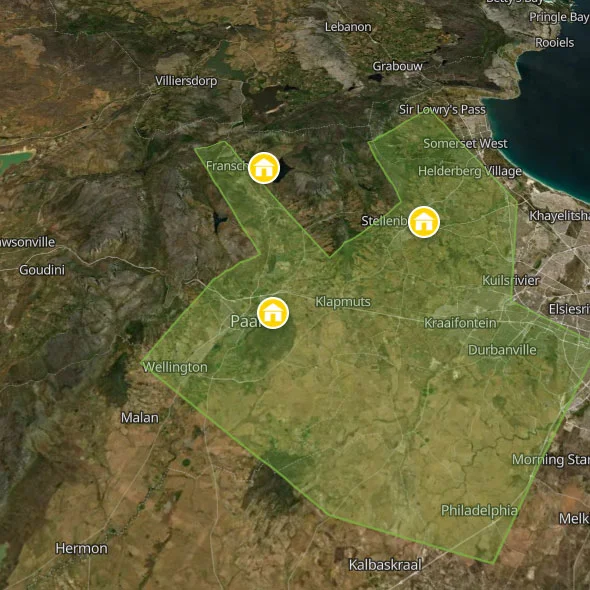
The Winelands is not one thing. Stellenbosch is a university town with 17,000 students, oak-lined streets of Cape Dutch and Victorian architecture, and a nightlife culture that ranges from sophisticated wine bar to cheerful chaos depending on which street you're on and what time it is. Franschhoek is a single long main street of restaurants, galleries, and wine estates in one of the most beautiful mountain valleys in the country — smaller, quieter, more expensive, and with a French Huguenot heritage that shows in the street names, the food, and the winery aesthetic. Paarl is the working town of the three — larger, less touristic, strung along the Berg River valley — and is where you go when you want the surrounding wine farms without the Stellenbosch prices, or when you are heading north toward the Cederberg or east toward Route 62.
The backpacker infrastructure in the Winelands is thinner than in Cape Town or on the Garden Route — this is fundamentally a wine tourism region, and most of the accommodation has been built for a different market entirely. But the three operations covered on this page each understand what travelling on a budget in this landscape actually requires, and each occupies a distinct position: Stumble Inn in Stellenbosch for the social, town-centre, wine-and-nightlife experience; Otter's Bend in Franschhoek for the riverside farmstay character of the valley's finest village; and Paarl Backpackers for the honest, no-frills option in the town that most backpacker guides overlook entirely.
Cape Winelands FAQ's For Backpackers
Do I need a car?
For Stellenbosch: not necessarily. The town centre is entirely walkable, and Uber works well for the wine farms within a 10–15 km radius. The Stellenbosch train station has a direct connection to Cape Town (about 50 minutes), making it the most accessible Winelands town for car-free travellers. Baz Bus also serves Stellenbosch as a stop on the Cape Town–Garden Route route.
For Franschhoek: public transport options are extremely limited. Uber operates but can be slow and expensive for longer runs. The Franschhoek Wine Tram — a hop-on, hop-off tram and bus combination that covers most of the valley's wine estates — is the practical solution for wine farm exploration without a car, and at roughly R300–R380 per person for a full day, it is excellent value. But getting into and out of Franschhoek without a hire car requires planning and patience. Most backpackers who stay at Otter's Bend either have a car or are making Franschhoek a specific one-to-two-night stop.
For Paarl: a car is strongly recommended. The town is spread out and the wine farms are scattered across the valley in a way that makes car-free exploration genuinely difficult. Uber is available but not reliable for the more rural farm locations.
The overall recommendation: if you are doing the Winelands by car, you can comfortably cover all three towns in two to three days. If you are car-free, base yourself in Stellenbosch — it is the only Winelands town where the backpacker experience works well without wheels.
How does wine tasting actually work here?
Most Winelands wine estates charge a tasting fee — typically R100–R200 per person for a structured tasting of five to eight wines, often waivable on purchase. Some of the more commercial estates have become very organised about this, with booking requirements and group minimums. Others remain completely informal — you walk in, sit at the tasting counter, and work through the range with a knowledgeable pourer who may or may not be the winemaker themselves. The latter experience is rarer but immeasurably better, and your hostel host is the best source of advice on which estates in the area still operate in this more direct, personal way.
A practical note that saves considerable money: buy wine in the estates' direct sales rooms rather than at supermarkets or restaurants. A bottle of Stellenbosch Cabernet Sauvignon that would cost R350 at a Cape Town restaurant costs R90–R140 direct from the estate. Several estates sell perfectly good wines from R60–R80 per bottle at their cellar doors. You can also visit The Bergkelder in Stellenbosch town itself and taste without driving anywhere. The Stumble Inn's easy rider wine tours (the classic Stellenbosch wine tour option for backpackers) include estate visits, cheese tastings, and a cellar tour for a package price that makes the individual tasting fees irrelevant.
When is the best time to go?
January–March (harvest season) is the definitive answer for wine lovers. The vineyards are heavy with fruit, the estates are at their most visually spectacular, and during harvest proper (usually February–March depending on variety and estate) you can sometimes watch or participate in the picking if you're connected through a hostel or tour. It is also the hottest time of year — 35°C+ days in Paarl and parts of Stellenbosch are common — but a cool cellar and a glass of something cold is an excellent response to this.
October–November is the other sweet spot: the vines are in young leaf, the weather is reliably warm without being brutal, the spring flowers are still in the lower fynbos, and the summer crowds haven't fully arrived. Prices are lower than peak and the estates are less pressured.
Winter (June–August) is cold and sometimes wet, but the Winelands in winter has a particular atmosphere — fires in the estate restaurants, empty hiking trails, and the kind of contemplative unhurried wine tasting that becomes impossible when the estates are full. Stellenbosch University is in session through winter, meaning the town never goes quiet. Franschhoek can feel slightly ghostly in its quieter winter phase — some restaurants close or reduce hours — but the valley itself, with mist in the mountains and the bare vines silver in the morning light, is beautiful in a way the summer photographs don't capture.
What is Franschhoek's food scene actually like for backpackers?
Franschhoek has a justified reputation as one of the finest dining destinations in Africa. The list of internationally recognised restaurants based in or around this one mountain valley — The Tasting Room, Babel at Babylonstoren, Pierneef à La Motte, Reuben's, The Werf — would be impressive in a major city. In a town of about 15,000 people surrounded by wine farms, it is extraordinary.
What this means for a backpacker, practically, is that the good news and the bad news are the same: world-class food is immediately accessible, but at prices that reflect the market it was built for. A tasting menu at one of the benchmark restaurants runs R800–R1,500 per person before wine. This is not a backpacker budget.
The practical workarounds are real, though. Several of the estate restaurants do lunch at more accessible prices than dinner. The village has good delis and casual cafés — Le Franschhoek Hotel's bakery, the Huguenot Street food market on some weekends — where you can eat very well for R80–R150. Otter's Bend's self-catering facilities and the excellent fresh produce from the surrounding farm stalls mean that cooking your own food in Franschhoek can, paradoxically, result in better meals than you'd eat from a supermarket in Cape Town. And the bottle of Franschhoek Chenin Blanc from the estate next door costs R95. There are worse picnic scenarios.
Is the Winelands area safe?
The Cape Winelands towns have a significantly lower crime rate against tourists than Cape Town itself. Stellenbosch town centre — which is thoroughly, permanently busy with students, staff, tourists, and residents — is walkable day and night in the core areas around Dorp Street, Church Street, the Braak (the historic town square), and the university precinct. The standard urban common sense applies: phone in pocket, awareness of who is around you, Uber after midnight rather than walking unfamiliar routes. Franschhoek is extremely quiet, small, and low-risk. Paarl — a larger working town — requires more awareness away from the immediate town centre, particularly at night.
The wine farms themselves present no safety concerns. The hiking trails in the Jonkershoek Nature Reserve (Stellenbosch) and the Franschhoek Mountains are well-used and safe for solo hiking — no history of the kind of trail muggings that affect some Cape Town mountain routes. Standard mountain safety applies: water, early start, tell someone your route. The only specific alert is for drivers: the mountain passes — Franschhoek Pass, Du Toitskloof, and Helshoogte — are narrow, winding, and unfamiliar to many visitors. Take them slowly, particularly in early morning mist or after a wine tasting.
A note on drinking and driving: South Africa's legal blood alcohol limit for drivers is 0.05% — lower than the UK (0.08%) and similar to most of Europe. The Winelands has active roadblocks, particularly on weekends and over holiday periods. If you are doing a wine estate visit by car, the designated driver principle is not optional. The Wine Tram, cycling tours, and organised minibus wine tours from your hostel exist precisely for this reason: use them.
What is the Stellenbosch Wine Route?
The Stellenbosch Wine Route was the first formal wine route established in South Africa — in 1971, making it one of the earliest anywhere in the world — and it now covers over 150 member estates. This is too many to process meaningfully on a short visit. The practical approach is to pick four to six estates based on a specific variety or style you want to explore (your hostel staff are better advisors on this than any app), and to resist the itinerary-maximising instinct that sends people rushing through eight tastings in a day. The memory of a single estate where you sat under oaks with the winemaker's dog asleep at your feet and slowly worked through four vintages of the same Pinotage beats the memory of eight estates glimpsed in sequence through a windshield.
Stellenbosch's main grape varieties to focus on: Cabernet Sauvignon (the Helderberg and Simonsberg areas produce some of the finest examples in the world), Chenin Blanc (South Africa's most planted variety, and in skilled hands something genuinely distinctive), and the local cultivar Pinotage, a South African cross of Pinot Noir and Cinsaut that produces wines ranging from rubbery and over-extracted at the cheap end to smoky, complex, and remarkable at the best estates. Ask specifically for the premium Pinotage. The R60 supermarket version has done more damage to the grape's reputation than any critic.
Further Reading
Ready to map out the rest of your adventure? For more general info on backpacking South Africa, see our comprehensive home page. We also highly recommend checking out our expert backpacking advice section to make sure you stay safe and save money on the road. If you need help structuring your travel routes, take a look at our suggested itineraries for tours of South Africa. For more info on backpacking, including access to our offline app and interactive PDF guide, head over to our resources page.











 SHARE (opens in a new tab)