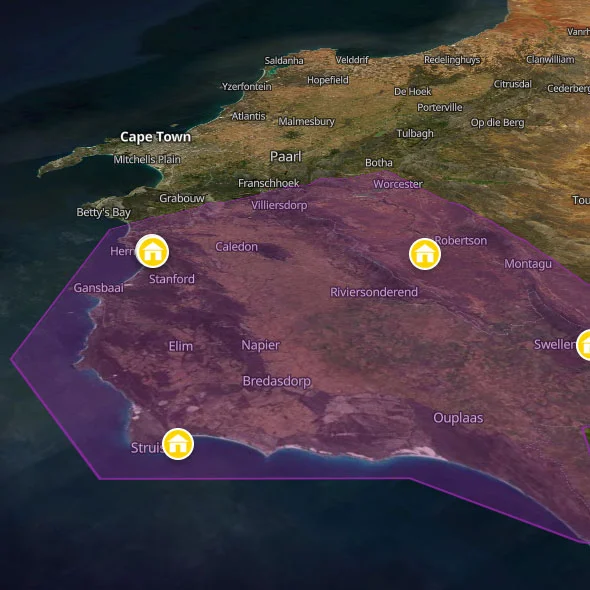
Search Overberg Backpacker Hostels
Filter backpackers hostels by digital nomad suitability, solo female traveller friendliness, safety, surfing, camping, value for money, party atmosphere, african culture experiences, adventure activities and nature experiences.
in the Overberg!
Click the icons for info.
Where To Go, What To See and How Much It'll Cost
Use our wizard to plan your trip, based on what you want to see and do, and your budget. Costs calculated according to 2026 prices.
Welcome to our backpacking guide of the Overberg!
Discover moreBackpacking The Overberg
The name means "Over the Mountain" — the country on the far side of the Hottentots Holland range from Cape Town, the territory that early Dutch settlers reached only after crossing the mountain passes that separated the Cape Peninsula from the interior. Cross those passes today and you come down into a world of wheat fields and wine farms and apple orchards and, beyond them, the long curve of the southern African coast where two oceans meet and whales as big as buses come in from Antarctica every winter to calve in the warm shallows. The Overberg is not dramatic in the way that Table Mountain is dramatic, or wild in the way that the Drakensberg is wild. What it is, in the afternoon light of a clear October day with a southern right whale rolling in the blue water below the cliff path, is quietly, persistently magnificent.
For backpackers, the Overberg sits in an unusual position: it is close enough to Cape Town to be visited as a day trip or a weekend escape, yet contains enough — the whale watching alone would justify a week — to reward a slower, more deliberate visit. It is not on the Baz Bus route. It is not on the main tourist trail between Cape Town and the Garden Route. These are not deficiencies. They are the reasons it still feels, in places, like somewhere you have found rather than somewhere you have been sent.
Read More
The Lay of the Land
The Overberg occupies the southwestern corner of the Western Cape, bounded by the Hottentots Holland mountains to the north-west, the Langeberg to the north, and the Southern Ocean along the entire southern edge. It is a region of enormous ecological and geographic diversity compressed into a relatively compact area: the northern foothills are apple-orchard country (the Elgin valley produces some of South Africa's best apples, pears, and wines from a cool climate that is almost anomalous for the Western Cape); the central Overberg is wheat and canola farming on a vast, undulating plain that is luminously yellow in spring; the coast is a sequence of very different environments — the sheltered bay of Walker Bay at Hermanus, the exposed and dangerous headland of Cape Agulhas, the pristine wilderness of the De Hoop coast, and the whitewashed fishing villages of Arniston and Struisbaai.
The fynbos of the Overberg is among the most biodiverse on earth. The Cape Floristic Region — of which the Overberg is a core part — is one of the world's six floral kingdoms, the smallest of the six, and the one with the highest density of plant species per unit area. De Hoop Nature Reserve alone contains over 1,500 plant species. In spring, the Overberg roadsides and fields erupt in wildflowers — restios, ericas, proteas, pelargoniums, and dozens of geophyte species that complete their entire above-ground life in the window of eight to ten weeks between the end of winter rain and the beginning of summer heat. The blue cranes — South Africa's national bird, globally endangered, and present in the Overberg in numbers found nowhere else — are visible from the road in the farming areas throughout the year.
The ocean along the Overberg coast is shaped by the meeting of two great current systems: the warm Agulhas Current running southwestward down the east coast of Africa, and the cold Benguela Current running northward up the west coast. Cape Agulhas is the official meridian where these two bodies of water are defined as meeting — the 20th meridian east longitude, marked by a plaque at the southernmost tip of the African continent. The collision of these current systems produces exceptionally productive fishing grounds (the Agulhas Bank is among the richest in South Africa), a complex and often violent sea state around the cape headland, and water temperatures that vary dramatically within short distances along the coast. It also produces, in the warm shallows of Walker Bay and the De Hoop coast, ideal conditions for southern right whales.
The Southern Right Whale: What You're Actually Looking At
Southern right whales — Eubalaena australis — were hunted almost to extinction in the 19th and early 20th centuries. They were the "right" whales to hunt: slow-moving, buoyant after death, and rich in oil and baleen. They came close to shore, making them easy targets. By the early 20th century, perhaps 300 individuals remained in the southern hemisphere. Under international protection from 1935 onwards — and under South African coastal protection from the mid-20th century — the population has recovered substantially and now numbers an estimated 10,000–15,000 animals, making the Overberg coast of South Africa one of the primary population strongholds. Between June and December every year, the whales arrive in Walker Bay and along the De Hoop coast to mate, calve, and nurse their young. At peak season (September–October), 50 or more individuals may be visible simultaneously from the Hermanus cliff path. The world's only dedicated whale crier — a man with a kelp-horn who blows coded signals to indicate where whales have been spotted and how many — patrols the cliff path daily during season, which is one of those South African institutions that sounds invented and is entirely real.
The whales come within metres of the shore. They breach — a 50-tonne animal launching itself completely clear of the water — often close enough that the impact of landing shakes the ground under your feet on the cliff path. They lobtail (slapping the water surface with the tail flukes, presumably for reasons of communication that researchers are still arguing about). They spy-hop (rising vertically out of the water, apparently to look around). Calves, born at 4–6 metres long and 1,500 kilograms, are visible learning to swim alongside their mothers in the shallows. Watching all of this from a cliff path above the sea, for free, in the middle of the day, is one of those experiences that sits outside the normal calibration of "things I can say I've done."
Overberg FAQs for Backpackers
When is the best time to go?
The answer depends almost entirely on whether you are prioritising the whales.
For whale watching: July to November, with September and October the peak months. Southern right whales are typically first sighted in Walker Bay in June; numbers build through July and August; September is when the most individuals are present and the most spectacular behaviour (breaching, lobtailing, mating activity) is observed; October and November see the calves growing and becoming more active as the season winds down. The annual Hermanus Whale Festival takes place in late September — a week of music, food, markets, and whale-related events that transforms an already busy town into something quite festive and considerably more crowded than usual.
For the coast without the whale crowds: December to February. The beaches are warm, the sea swimmable (sea temperatures reach 18–20°C in the shallower bays), and the Overberg has a different, more summery character. The whale crowds are gone; domestic South African holidaymakers fill the beach towns in January; outside that December–January peak it is quieter than the Garden Route coast.
For wildflowers and fynbos: August to October. The Overberg spring wildflower season coincides partly with whale season, which makes September and October a particularly compelling time to visit — whales in the bay, flowers on the hillsides, blue cranes in the pastures. This is the best single period for the Overberg if you can only choose one.
For the De Hoop Whale Trail specifically: book a year ahead for August–October. The trail fills eighteen months ahead for peak season. Off-season (April–July) it is considerably easier to book, still beautiful, and the reserve is quieter.
Do I need a car?
Yes. The Overberg is not served by the Baz Bus and has no meaningful intercity public transport connecting the main visitor destinations. From Cape Town, some tour operators run day trips to Hermanus (particularly during whale season), and the Baz Bus stops at Swellendam on the N2, but getting between Hermanus, Gansbaai, Arniston, De Hoop, and Swellendam independently requires your own vehicle. A hire car is the only practical way to do the region properly.
The good news is that Clarence Drive — the 21-kilometre coastal road between Gordon's Bay and Rooi-Els, with 77 bends, mountains on one side and the sea on the other, rated by many drivers as the most beautiful short coastal drive in South Africa — is the first thing you encounter on leaving the Cape Peninsula for the Overberg by road, and it sets the tone for everything that follows immediately.
What does it cost?
The Overberg is affordable by Western European standards and moderately priced by South African ones. Hermanus has the widest range of accommodation but fewer dedicated backpacker hostels than the Garden Route towns — it caters more to couples, families, and guesthouses than to dorm-bed travellers. Dorm beds where available run €10–€18. A good restaurant meal in Hermanus runs €10–€18 for a main course — slightly more than smaller Overberg towns, reflecting the whale-season tourist economy.
Key activity costs: whale watching from the Hermanus cliff path is free; a boat-based whale watching trip from Hermanus costs approximately €35–€50; shark cage diving at Gansbaai runs approximately €120–€140 including transport from Cape Town, or €80–€100 from Gansbaai/Hermanus directly; De Hoop Nature Reserve entry is approximately €5 per person per day; the Whale Trail costs approximately €350–€500 per person for the five-day guided trail (all accommodation and luggage porterage included). A comfortable daily budget of €40–€65 covers accommodation, food, and the cliff path whale watching; factor in activity costs separately.
Quick Facts
Things To Do In The Overberg
1. Whale Watching in Hermanus (Non-Negotiable in Season)
Hermanus has been called the best land-based whale watching destination in the world, and the claim is not marketing hyperbole. The geography of Walker Bay — a wide, shallow, sheltered bay open to the south, flanked by the Hermanus cliff path — concentrates the southern right whales in an arc of water within consistent, often very close viewing distance of the shore. At the height of the season in September, fifty or more individual whales may be visible simultaneously from the cliff path: breaching, lobtailing, spy-hopping, nursing calves, and doing the general whale business of being enormous and alive in the sea 30 metres below where you are standing. There is no admission fee for the cliff path. There is no queue. You walk along the path and the whales are there.
Read More
The 12-kilometre cliff path runs the full length of Hermanus from one end of town to the other, with multiple lookout points, benches, telescopes, and the whale crier — a town official in a kelp vest who blows different signals on a dried kelp horn to indicate the location and number of whales currently visible. The whale crier is a South African institution of considerable charm and is, according to the Guinness World Records, the world's only official whale crier. He takes his work entirely seriously and is the fastest source of current sighting information when the whales are active.
For those who want closer access or who are visiting outside the cliff path's optimal conditions, several operators offer boat-based whale watching from the New Harbour at Hermanus: smaller rigid inflatable boats that go out into the bay and approach whales under strict regulations (no engine within 50 metres of a whale, no pursuit). The boat trips cost approximately €35–€50 per person and provide a perspective — looking up at a whale from sea level rather than down at it from a cliff — that is entirely different from the cliff path experience and equally extraordinary. Ivanhoe Sea Safaris is the longest-established operator; book in advance for September, which fills weeks ahead.
One practical note: September is peak whale season and peak Hermanus season simultaneously. The town fills, accommodation prices rise, and the Whale Festival in late September adds further crowd pressure. If your dates are flexible, the first three weeks of August give outstanding whale watching with considerably fewer people, lower prices, and the additional pleasure of having the cliff path largely to yourself on weekday mornings.
2. Shark Cage Diving at Gansbaai
Thirty kilometres east of Hermanus, the small fishing town of Gansbaai sits above one of the world's most productive great white shark aggregation sites. Shark Alley — the narrow channel between Dyer Island and Geyser Rock, about eight kilometres offshore — concentrates great white sharks feeding on the Cape fur seal colony at Geyser Rock (estimated at 60,000 animals). The combination of abundant prey and the right oceanographic conditions makes Gansbaai the most reliable location in the world for observing great white sharks, and the cage diving industry that developed around this fact has been running since the early 1990s.
The experience: you take a boat from the Klein Baaihaven harbour at Kleinbaai, cross to the area around Dyer Island, and enter a steel cage suspended at water level while sharks are attracted to the boat with fish scraps and tuna oil. The cage hangs in the water with its top above the surface; you stand inside it and submerge your face and torso when a shark approaches. The sharks investigate the cage from a distance of one to three metres. They are large — adult females around Gansbaai regularly reach four to five metres in length. They are entirely calm, which is somehow more alarming than aggression would be. The briefing beforehand makes it sound much more dramatic than the reality, which is controlled, well-managed, and produces approximately twenty minutes of the most concentrated sensory experience you are likely to have in the ocean. Cost approximately €80–€100 per person booked directly from Gansbaai; approximately €120–€140 with transport from Cape Town or Hermanus included.
A note of honesty that responsible operators will tell you themselves: great white shark numbers around Gansbaai have fluctuated significantly in recent years. From around 2017–2018, a pair of orcas began working the area and killing great whites specifically to eat their livers — a behaviour documented in several remarkable underwater filming sequences and the subject of ongoing research. The orcas' presence caused many great whites to leave the immediate area. Numbers have partially recovered since, but sightings are no longer as reliably frequent as they were in the peak years of the early 2010s. Responsible operators check current shark activity before booking you and will reschedule if conditions are genuinely unsuitable. Ask any operator you book with about recent sighting rates before committing; a good operator will give you an honest answer.
A Note on the Ethics of Boat-Based Wildlife Tourism
Both boat-based whale watching and shark cage diving prompt a question that responsible travellers raise, and which deserves a direct answer here rather than being sidestepped. Is it right to motor a boat towards a whale that has come into a bay to give birth, or to attract a large predator towards humans using fish oil and blood? These are not unreasonable things to wonder.
The honest answer is: it depends enormously on how it's done, and the evidence — while not conclusive — tilts towards well-regulated operations being broadly acceptable. For boat-based whale watching in South Africa, operators are bound by the Marine Living Resources Act: engines must be cut or idled at 300 metres from a whale, and no vessel may approach within 50 metres under power. Whales are not pursued. If a whale chooses to approach the boat — which southern rights, being curious and unhurried animals, sometimes do — the engine stays off. Research studies have found that well-managed whale watching causes measurable but temporary changes in whale surfacing and movement behaviour; none has demonstrated long-term harm to animals in properly regulated programmes. The case for the activity is also made by conservation economics: the industry creates powerful local economic incentives to protect whales, and there is reasonable evidence that people who have watched a whale from 20 metres tend to become its advocates. Neither argument is absolute, but taken together, they support a cautious endorsement of well-run operators.
Shark cage diving is more contested. The core concern is that using chum (fish oil, tuna heads) to attract wild sharks conditions them to associate boats and humans with food — a behavioural change with potential consequences for both sharks and swimmers. This concern is real. However, research on the Gansbaai population — one of the most studied great white shark populations in the world — has found little detectable impact of the cage diving operations on the sharks' long-term diet, body condition, or migratory patterns. Great whites are highly mobile animals that cover enormous distances; their individual interactions with any given boat represent a very small fraction of their behaviour. The conservation argument also applies here: the cage diving industry has been a significant driver of public sympathy for great white sharks, a species that had virtually no public advocates before the 1990s and urgently needs them. Operators are required to hold permits; feeding sharks directly is prohibited; cage diving in South Africa is among the better regulated in the world. That said, the practice sits in a different ethical category to watching whales from a cliff. If you are uncertain about it, the cliff path at Hermanus delivers an experience that puts the boat trip to shame anyway, and costs nothing.
The principle worth taking away is: choose operators with transparent track records and a genuine conservation orientation, not just those promising the most dramatic encounter. Regulation is the floor; operator ethics is what sits above it.
3. Cape Agulhas: The End of Africa
Everyone knows about the Cape of Good Hope. Far fewer people know that it is not the southernmost point of Africa, and that the actual southernmost tip — the place where the Atlantic and Indian Oceans officially meet, marked by a meridian stone and a modest plaque in a windswept coastal park — is at Cape Agulhas, 170 kilometres south-east of Cape Town and 55 kilometres further south than Cape Point.
The Portuguese named it Cabo das Agulhas — Cape of Needles — in around 1500, most likely because their compass needles showed no magnetic deviation here: true north and magnetic north coincide at this meridian, which is the 20° east longitude line, and which is also the International Hydrographic Organization's official boundary between the Atlantic and Indian Oceans. The alternate explanation for the name — the jagged rocks and reefs below the surface — is equally credible, given that over 130 ships have been wrecked on this stretch of coast since those early Portuguese navigators first mapped it.
The cape itself is contained within the Agulhas National Park, a compact coastal reserve of fynbos, rocky headland, and extraordinary birdlife. The walk from the car park to the southern tip takes about ten minutes on a boardwalk through low coastal fynbos, ending at the meridian marker where you can stand at the bottom of the continent and look south into the Southern Ocean with nothing between you and Antarctica. The lighthouse — built in 1848 in an Egyptian Revival style that is quite extraordinary for a remote South African headland, modelled on the ancient Pharos of Alexandria — is the second oldest working lighthouse in South Africa. You can climb it for a small fee. The views from the top are unsentimental and magnificent: the whole of the Agulhas Plain behind you, the sea stretching away south, and the coast littered with the evidence of what the water here is capable of on a bad day.
Entry to the Agulhas National Park costs approximately €5 per person. The lighthouse museum entry is approximately €3. The drive from Hermanus takes about 75 minutes. The town of L'Agulhas has a handful of restaurants and the Agulhas Country Lodge for accommodation; Struisbaai, five kilometres east, has better beaches and a more spacious feel. The entire southern tip area is worth an overnight stay rather than a rushed day trip, particularly if you are there at dusk when the lighthouse begins its rotation and the light sweeps the sea in the dark.
4. The De Hoop Nature Reserve and the Whale Trail
If Hermanus is the best-known whale watching destination in the Overberg, De Hoop is the finest. Located 50 kilometres east of Bredasdorp between the towns of Arniston and Witsand, the De Hoop Nature Reserve covers 34,000 hectares of pristine coastal fynbos, limestone cliffs, white sand dunes, and the 16-kilometre De Hoop Vlei — a freshwater lake of international Ramsar wetland significance. The adjacent marine reserve extends five kilometres out to sea and is one of the largest marine protected areas in Africa. The entire site is a UNESCO World Heritage Site. It is, in practical terms, one of the most beautiful and ecologically significant pieces of land on the southern African coastline.
The reserve contains over 1,500 plant species, 260 bird species (including the only remaining Western Cape breeding colony of the endangered Cape vulture at Potberg), bontebok, Cape mountain zebra, eland, baboon, caracal, and a small resident leopard population. The De Hoop vlei is visited by flamingos, pelicans, fish eagles, and 13 species of migratory waders. In whale season, St Sebastian Bay — the stretch of protected water below the De Hoop coast — is known as one of the greatest whale nurseries in the world; peak counts of over 50 southern right whales in the bay simultaneously have been recorded from the dunes above Koppie Alleen.
The Whale Trail is De Hoop's signature multi-day hike and, depending on the time of year you do it, one of the finest walking experiences in South Africa. The trail covers 55 kilometres over five days, running from Potberg in the east to Koppie Alleen on the coast, through mountain fynbos, limestone cliffs, coastal dunes, and deserted beaches, with five overnight stops in well-equipped cottages (luggage is transported between stops by vehicle — this is genuine slackpacking). The coastal sections include a chain ladder descent to a sheltered cove for swimming (different from, and considerably less hazardous than, the Drakensberg chain ladders), and rock pool walks at low tide. At Koppie Alleen on the final day, if you are there in whale season, the scene below the dunes can be astonishing: the whole arc of St Sebastian Bay dotted with whale spouts and flukes, sometimes within a hundred metres of the beach.
The Whale Trail books up a year ahead for August–October. Book through CapeNature at capenature.co.za; the number is 087 087 8250. Cost approximately €350–€500 per person for the five-day trail, inclusive of accommodation and luggage porterage. Minimum group size is two; maximum is twelve. Children under eight are not permitted. There is also a note in the trail information — worth including here without editorialising — that the Denel Overberg Testing Range occasionally uses the eastern sector of the reserve for missile testing, that CapeNature receives limited notice of these tests, and that groups may need to be evacuated from the trail when they occur. This is genuinely in the trail documentation. South Africa does not always do things in the way you would expect.
For those who cannot get a Whale Trail booking or are short on time, the day hikes in De Hoop are excellent and require no advance booking beyond the entry fee: the Klipspringer Trail (5 km), the Coastal Trail from Koppie Alleen, and the vlei walking tracks all provide access to the reserve's key landscapes without the five-day commitment.
5. Witsand: The Whale Nursery
At the mouth of the Breede River — the aptly named Broad River, which is South Africa's largest river estuary and pushes a wide, blue-brown tongue of fresh water far out into St Sebastian Bay before surrendering to the Indian Ocean — the tiny village of Witsand sits on a four-kilometre stretch of bleached white sand that gives it its name. With a permanent population of no more than three or four hundred people, Witsand has the particular atmosphere of a very small settlement that knows exactly what it is: unhurried, sundrenched, faintly surreal in its quietness, and possessed of a beauty that feels semi-arid and oceanic at once. The fynbos comes down almost to the beach in places. Flamingos turn up on the estuary. Blue cranes stand in the pastures on the approach road. It has the quality of a place that has been largely left alone.
The title Witsand carries — South Africa's Whale Nursery — is earned. St Sebastian Bay and the De Hoop waters are, by some margin, the most important calving ground for southern right whales on the African coast. A 2011 aerial survey counted 85 whales and 40 calves in the bay during a single season — at least sixty percent of all the calves recorded between Muizenberg and Nature's Valley that year. Up to 70 whales have been reported in the bay at one time. These figures probably make the St Sebastian Bay–De Hoop area the largest gathering of right whale mother-and-calf pairs in the world outside the Peninsula Valdés in Argentina. The implications for a visitor standing on the beach in September are considerable.
There is an important caveat: the whale watching here is not like Hermanus. At Hermanus, the cliff path is elevated above Walker Bay, the whales routinely come within a few tens of metres of the shore, and the landscape architecture conspires to put observer and animal almost uncomfortably close. At Witsand, the whales are in the bay — visible, frequently spectacular, sometimes close — but the town lacks the dramatic elevated viewpoint of Hermanus, and the sightings are more variable. The Witsand Nature Reserve, a few minutes from town, has elevated walking trails and a whale watching platform on the deck of the Anchorage restaurant (with a telescope offering 10x magnification) that provide the best land-based vantage points. It is a different experience to Hermanus, more open and less concentrated, but in its own way more evocative: a vast, quiet bay with whales moving through it and almost no one else watching.
Boat-based whale watching is notably not available here: no licence has been issued for the bay, because the authorities have designated it a sanctuary. You watch from the shore. This is the right decision.
The other major draw at Witsand — of a very different character — is the lagoon. The Breede estuary at the river mouth is one of the world's finest flat-water kitesurfing venues, with a large, shallow, protected body of water, consistent south-easterly winds from October to April, and plenty of space. Witsand is widely regarded as the best place in South Africa to learn to kitesurf, precisely because the flat water is so forgiving and the winds so reliable. Several schools operate lessons and equipment hire; a beginner course of three to four days is entirely feasible here. Experienced kitersurfers come from as far away as Europe specifically for the conditions. Windsurfing, stand-up paddleboarding, and kayaking on the river are good alternatives for those less committed to the learning curve.
The Breede River itself is worth a note: historically one of South Africa's most important commercial waterways (a 19th-century trading enterprise ran steamships between Port Beaufort — the settlement on the opposite bank from Witsand — and Cape Town, until the railways made it obsolete), it is now famous among anglers as possibly the best kob fishing river in the country. The wreck of the SS Kadie, the Barry family's trading vessel that sank on the sandbank at the river mouth in 1864 after nearly 250 voyages, is still visible at low tide. Thirty-nine kilometres upstream, at Malgas, the last hand-operated pontoon ferry in South Africa still crosses the river for vehicles and cattle — an experience worth making the detour for, if only to confirm that some things in rural South Africa operate on a timeline unconnected to the 21st century.
Witsand has a Blue Flag beach, which is worth taking at face value as a meaningful environmental standard rather than a marketing label. Accommodation is limited and tends to book out in school holidays; self-catering houses are the dominant option, and the town fills up in January with domestic holidaymakers who treat it as a family secret. Outside December–January, it is very quiet. A good time to visit, if you want whales and atmosphere without the crowds, is September on a weekday.
6. Arniston
Forty kilometres east of Bredasdorp, on a bay flanked on either side by nature reserves, Arniston is the Overberg's most beautifully preserved fishing village and one of the most quietly exceptional small settlements anywhere in the Western Cape. It takes its official name from the British troopship HMS Arniston, which ran aground on the rocks below in 1815 with the loss of all but six of its 378 passengers and crew. From the cliffs above the wreck site, on a calm day, you can see the rusted remains below the surface at low water.
The village's older Afrikaans name is Waenhuiskrans — Wagon House Cliff — named for the enormous sea cave carved into the limestone headland south of the settlement, large enough that a fully rigged ox wagon could, by the traditional account, turn around inside it. The cave is accessible at low tide by scrambling down a rock path below the headland; bring a torch and check the tide tables before committing to the scramble, because the cave floods at high tide and the rocks are slippery. It is one of those places that is completely free to visit and completely remarkable.
The Kassiesbaai quarter of Arniston — a cluster of thatched, white-washed sandstone fishermen's cottages that have changed almost nothing in 200 years, collectively declared a National Monument — is among the most photogenic settlements in South Africa. The community that lives there is still primarily a fishing community whose families have occupied these cottages for generations. Walk through it in the morning when the boats are coming in. Buy fish directly from the boats at the slipway if you have a kitchen and an appreciation for the freshest possible seafood. Do not treat it as a theme park; it is a working community. Be a respectful visitor.
The beach at Arniston is excellent and the water — warmer here than at Hermanus by virtue of being further east and facing a more sheltered bay — is one of the most swimmable stretches on the Overberg coast. The Arniston Hotel, built in 1922 and facing directly onto the sea, has rooms and a restaurant. The town is very small; accommodation options are limited and should be booked ahead in school holidays.
7. Swellendam: The Third Oldest Town in South Africa
On the N2 highway at the eastern edge of the Overberg, with the Langeberg Mountains rising directly behind and the Bontebok National Park on its southern edge, Swellendam is the third oldest town in South Africa after Cape Town and Stellenbosch, founded by the Dutch East India Company in 1743 as the last administrative outpost of the colonial frontier. It was named after the Cape Governor Hendrik Swellengrebel and his wife Helena ten Damme — a naming convention that covered both parties economically in a single gesture. In 1795, the town's residents, fed up with VOC rule, proclaimed themselves an independent republic. The Republic of Swellendam lasted approximately six months before the British arrived and ended the experiment. The residents were presumably gracious about it.
Today, Swellendam is a well-preserved, entirely pleasant small town with more than 50 provincial heritage buildings, most of them in Cape Dutch style: whitewashed, thatched, gabled, and aligned along oak-lined streets with the mountain behind them. The centrepiece is the Drostdy Museum complex on Swellengrebel Street — the 1747 Drostdy building (the original magistrate's residence and administrative headquarters, built by the VOC and one of the finest surviving Cape Dutch buildings in South Africa), the adjacent Old Gaol, the Ambagswerf (a reconstructed artisan's yard with a working watermill), and Mayville House. The complex takes about two hours to explore and provides a more grounded, less tourist-processed version of early Cape colonial history than anything in Stellenbosch. Entry approximately €3.
The Drostdy's history is specific and worth knowing: built in 1747, expanded between 1812 and 1825, sold out of government ownership in 1846, purchased by the Steyn family in 1855, and owned by the Steyn family until 1939 when it was bought by the Union of South Africa government for use as a museum. Among the prize exhibits is a bell salvaged from the company steamer Kadie, which plied the coast between Cape Town and Port Beaufort and was wrecked in 1865. The Old Gaol contains the "black hole" — a windowless cell used for the most serious offenders — which communicates, with some immediacy, the experience of colonial-era incarceration.
Swellendam is also the gateway to Bontebok National Park, a small but significant reserve on the southern edge of town where the bontebok — a striking, chestnut-and-white antelope that was driven almost to extinction by the early 20th century — was saved from oblivion when a small group of farmers collected the remaining 17 individuals in 1931 and placed them under formal protection. The park now supports a self-sustaining population of several hundred bontebok, along with Cape mountain zebra, red hartebeest, and significant fynbos and renosterveld vegetation. Day entry to the park is approximately €5 per person; it is accessible on a morning or afternoon self-drive from town.
8. Stanford and the Hemel-en-Aarde Wine Valley
Ten kilometres east of Hermanus on the road towards Gansbaai, Stanford is a small Victorian village on the banks of the Klein River that has developed a quiet reputation for quality of life, craft production, and wine. The Hemel-en-Aarde Valley — Heaven and Earth Valley — runs inland from Hermanus and produces wines of genuine international standing from a cool maritime climate that suits Pinot Noir and Chardonnay in particular. Hamilton Russell Vineyards, which pioneered serious Burgundy-style wine production in the valley in the 1970s, has been rated among the finest Pinot Noir producers in the southern hemisphere. The tasting room is open on weekdays; a tasting flight costs approximately €5–€8 and is a serious experience rather than a tourist one. Several other estates in the valley — Bouchard Finlayson, Storm Wines, Crystallum — have their own distinct characters and are equally worth a visit.
Stanford itself has an excellent Saturday morning market, a micro-brewery (the Stanford Hills Brewery, doing good things with local ingredients), and an award-winning cheese maker (Stanford Hills again, different building). The Klein River flows through the village in a reed bed that supports a reliable population of African fish eagles, which call from the reeds at intervals throughout the day with the sound that, once you have heard it described as the voice of Africa, you cannot unhear.
9. Route 62 and the Inland Overberg
The Overberg is not only coast. The northern arc of the region — climbing through the passes of the Hottentots Holland and Langeberg ranges and descending into the wide farming valleys behind them — contains some of the most rewarding and least-visited inland driving in the Western Cape. The key thread is Route 62, the inland alternative to the N2 that runs from Robertson in the west through Montagu and Barrydale to Oudtshoorn in the Klein Karoo, and which is sometimes billed, with some justification, as the longest wine route in the world. It is, more importantly, a genuinely beautiful road through mountain terrain that sees a fraction of the tourist traffic of the coastal route.
Robertson is the valley's commercial centre, and its surrounding wine estates — Bon Courage, Rooiberg, Viljoensdrift, Robertson Winery — produce good, affordable wines from a warmer, more fertile valley floor than the Hemel-en-Aarde. Robertson is also the home of the Wacky Wine Festival each June, one of the most consistently enjoyable regional wine events in the Western Cape. The valley is also excellent for fruit: apricots, peaches, and grapes grow in volumes that make roadside stalls a feature of summer and early autumn driving.
Montagu is one of the most attractive small towns in the Western Cape — a historic settlement in a narrow valley below the Langeberg, surrounded by hot springs (the Avalon Springs resort, popular with South African families, is the main draw), apricot orchards, and some of the best rock climbing in the country. The kloof above the town offers a rock face of sufficient quality that climbers travel from Cape Town specifically to use it. Even if you are not a climber, the walk into the kloof is worth it for the mountain scenery.
Barrydale, further east on Route 62, is the kind of small Karoo-edge town that takes travellers by surprise. It has an art scene disproportionate to its size — the MUD gallery, built entirely from locally sourced natural materials, is genuinely unusual — an excellent cellar, and the Karoo-Mossie Pass nearby that rewards the fifteen-minute detour. The Tradouw Pass, built by Thomas Bain (the same engineer responsible for many of the Garden Route passes), drops south from Barrydale through a dramatic gorge to Swellendam: one of the finest short passes in the Western Cape, and a route that connects the Route 62 interior directly back to the coastal Overberg. A short detour east of Barrydale, on the R62 toward Ladismith, brings you to what might be South Africa's most famously mislabelled establishment: Ronnie's Sex Shop, which is neither Ronnie's, nor a sex shop, but a pub — the legend being that Ronnie painted his name on an outbuilding planning to sell farm produce, and some friends added the rest of the sign as a prank. It has been trading on the name for four decades. Stop, have a beer, read the notes on the ceiling. Some institutions deserve their status.
McGregor, reached from Robertson by a side road to the south, is perhaps the most serene small town in the entire Western Cape: a single tar street, whitewashed cottages under oaks, no through traffic, and an atmosphere of such willed peacefulness that it draws artists, retirees, and people in various states of recovery from the city in roughly equal measure. The Eseltjiesrus Donkey Sanctuary on the edge of town is an oddly moving place — a working refuge for donkeys, operated with the kind of quiet dedication that makes cynicism difficult. McGregor is not a grand destination; it is the kind of place you end up staying longer than you planned.
The practical point for travellers: Route 62 is the obvious inland route if you are driving between Cape Town and the Garden Route and want to avoid the N2 entirely. It adds roughly 40 minutes to the journey but travels through dramatically better landscape, passes through towns with actual character, and connects naturally to the Outeniqua Pass into George at the eastern end. If you have the time, there is no reason to use the N2 at all.
10. Clarence Drive: The Best Coastal Drive You've Never Heard Of
Between Gordon's Bay at the northern end of False Bay and Rooi-Els at the start of the Overberg coast proper, Clarence Drive — also known as the R44 — runs for 21 kilometres along the edge of the Hottentots Holland mountains where they plunge almost directly into False Bay. The road has 77 corners, some of them tight enough to require genuine attention, with the mountain face above and the sea below. On a clear day, the views across False Bay to the Cape Peninsula on the far side are extraordinary. The drive takes about 35 minutes without stopping; with stops at the viewpoints and the Betty's Bay penguin colony (a small penguin colony on the rocks, free to view from the public path), allow 90 minutes.
This is genuinely one of the finest short coastal drives in South Africa and is consistently underrated relative to Chapman's Peak, which is more famous but similar in character. The difference is that Clarence Drive has almost no tourists on it. It is the road that takes you from Cape Town to the Overberg and rewards you, immediately, for choosing to go this way rather than the N2.
11. Free Things in the Overberg
The Hermanus cliff path: 12 kilometres of cliff-top walking above Walker Bay, in whale season, with southern right whales visible below you at no charge whatsoever. This is the most reliably extraordinary free experience in the Overberg and among the finest free experiences in South Africa. Free.
Witsand beach and estuary: Four kilometres of Blue Flag beach at the Breede River mouth, and the wide flat-water lagoon. Watching the whales from the shore in season costs nothing. The Witsand Nature Reserve trails are open access. Free.
Kassiesbaai, Arniston: Walking through the National Monument fishing community in the morning. Completely free; do it with respect. Free.
Waenhuiskrans cave: The sea cave at Arniston at low tide, accessible by scrambling down the headland path. Take a torch. Check the tide table before going. Free.
The southernmost tip of Africa: The boardwalk walk through the Agulhas National Park to the meridian marker at the tip of the continent. The park entry fee is approximately €5, which is a nominal charge to stand at the bottom of Africa and look south. A reasonable argument can be made that this is not free, and an equally reasonable argument can be made that €5 is effectively free when the alternative is flying to Antarctica.
Clarence Drive: The 21-kilometre coastal drive between Gordon's Bay and Rooi-Els. Costs only the petrol, which is well spent. Free to drive.
The Tradouw Pass, Barrydale: One of Thomas Bain's finest mountain passes, connecting Barrydale to Swellendam through a steep-sided gorge. Costs only the petrol. Exceptional. Free.
Blue cranes in the Overberg farmland: South Africa's national bird, globally endangered, is present in the Overberg in greater concentrations than almost anywhere else in the country. They are visible from the roadside throughout the grain farming areas between Caledon and Swellendam — tall, grey, elegant, and unmistakable. Slow down when you see them. They stand in the fields with a quality of unhurried dignity that makes them look as if they have been here considerably longer than anyone else, which they have. Free.
De Hoop vlei shore walk: The trail around the De Hoop vlei is accessible to day visitors to the reserve (entry approximately €5). The vlei in morning light, with pelicans and fish eagles and the possibility of flamingos, is one of the finest birding walks in the Western Cape. Not entirely free, but the entry fee barely counts.
The Malgas pontoon: Thirty-nine kilometres up the Breede River from Witsand, the last hand-operated pontoon ferry in South Africa crosses the river for vehicles and livestock, pulled by hand on a wire cable. It has been doing this for generations and shows no sign of stopping. It costs a nominal fee and is one of those things that, if you happen to be near Witsand or on the De Hoop route, you should go slightly out of your way to see.
Further Reading
Ready to map out the rest of your adventure? For more general info on backpacking South Africa, see our comprehensive home page. We also highly recommend checking out our expert backpacking advice section to make sure you stay safe and save money on the road. If you need help structuring your travel routes, take a look at our suggested itineraries for tours of South Africa. For more info on backpacking, including access to our offline app and interactive PDF guide, head over to our resources page.
Top-Rated Overberg Tours on GetYourGuide.com
Overberg Backpackers Hostels
Hostels listed on Booking.com and Hostelworld
All Hostels
Full contact details are included in case you want to book direct, plus useful info such as Safety Ratings and Value For Money, Solo Female Friendliness, and Digital Nomad scorecards.
SEE OUR
Where Do You Want To Go Next?
This guide uses cookies to keep it going. Read our Cookie Policy.
Preparation
Preflight Checklists Safety Money Medical Embassies Cannabis & The Law Useful AppsIn-Country
Emergencies Transport Food & Drink Language African Etiquette Fun & Games Onward TravelSpecific Interests
Festivals & Clubs Surfing Digital Nomads Overlanding Cycle Touring Volunteering Language SchoolsSelf-Drive Itineraries
1 Week: The Cape Loop 2 Weeks: The Whistlestop Tour 2 Weeks: The Northeast Triangle 2 Weeks: The Grand Cape Loop 2 Weeks: The Wild North 2 Weeks: The Road Less Travelled 3 Weeks: The Backpacker's Bible 3 Weeks: Coast & Karoo 3 Weeks: Off The Beaten Track 1 Month: The Rainbow Nation 3 Months: The Full MontyTours & Day Trips
Cape Town Winelands West Coast Garden Route Karoo Route 62 The Overberg Sunshine Coast Durban Drakensberg Zululand Kruger Johannesburg Eswatini LesothoPDF Hostel Guide
A compact interactive PDF with a clickable map and every hostel's contact details. No wifi needed — just save it to your phone.
Download PDF (opens in a new tab)(Interactive PDF — 800kb)
Full Backpackers Bible App
The complete guide installed as an app icon on your home screen. Maps, regions, advice, tours, and hostel reviews — fully offline.
Get the App →(Progressive Web App — free)