
Welcome to our guide to backpacking Spain!

Discover more

Backpacking Spain

Most people picture Spain before they've ever set foot in it — sangria, siestas, a beach towel reserved with a paperback at 7am. Some of that is real. Most of it is the tourist-brochure version of a country that's actually stranger, older, and considerably more fun than the postcards let on. This is a country where an entire city runs from live bulls once a year for sport, where a flamenco dancer can silence a packed bar with a single stamp of a heel, and where you can be hiking a snow-capped mountain range in the morning and swimming in the Mediterranean by evening. Forget the sun lounger — this is Spain built for people who want a genuinely big adventure, not just a week off.

If you're coming from the UK or anywhere else in Western Europe, Spain will feel closer than it is — close enough that the flight barely counts as travel, different enough that within a day you'll wonder how somewhere this near ever felt this foreign. Life runs on a different clock here: lunch stretches past 2pm, dinner doesn't start until 10, and the streets are still full of families and pensioners at midnight. Head to Galicia in the rain-soaked northwest and it barely resembles the Spain of the brochures — all green hills, seafood, and Celtic folk music. Head south to Andalusia and you're somewhere that feels half Spanish, half Moroccan, whitewashed hill towns and horseshoe arches wherever you look.

And then there's what it costs, which is the part most first-timers can't quite believe. A proper three-course lunch with wine — the menú del día, a genuine Spanish institution — will often set you back less than a meal deal at a UK service station. Dorm beds, intercity buses, and a round of beers are all priced like it's still a decade ago. Whatever adventure you had in mind, Spain will let you have a bigger one for less than you budgeted.

An illustration in a heraldic style, showing a male and female backpacker, a globe map of spain, and images of Spain's tourist attractions.

Quick Facts

Sunniest Month: July
Best Value: May
Best Hiking: September
Best For Festivals: July (San Fermín and peak fiesta season)
Best Beach Weather: August
Best Surf: October
Most Popular: Barcelona
The Classic Backpacking Route: Barcelona → Valencia → Granada → Seville → Madrid → San Sebastián, with side trips to the Camino, the Balearics, or Morocco via Tarifa.
Most Underrated: Galicia, Asturias, and the Basque Country — Green Spain gets a fraction of the tourists the south does, for no good reason.
Read More

Spain rewards visiting in the shoulder seasons far more than most Western European countries. April brings Semana Santa (Holy Week) processions across the south — spectacular, but book accommodation months ahead if you want to be in Seville or Málaga for it. May and June give you long, warm days without July and August's genuinely oppressive interior heat.

July and August are peak season everywhere — hot, crowded, and expensive on the coast, but also when Spain's festival calendar is at its most intense: San Fermín (the Running of the Bulls) in Pamplona in July, and countless smaller local ferias throughout summer.

September is arguably the best all-round month: the crowds thin, the sea is still warm from summer, and the interior heat has broken. Winter (November–March) is mild on the coasts and in Andalusia, genuinely cold in Madrid and the north, and is ski season in the Pyrenees and Sierra Nevada.

The Backpackers Bible guru, a dreadlocked backpacker in a Hawaiian shirt, leaping over a charging black bull on a cobbled street in Spain

About Spain

Spain sits on the Iberian Peninsula in southwestern Europe, sharing its landmass with Portugal and separated from North Africa by just 14km of water at the Strait of Gibraltar. It is the fourth-largest country in Europe by area, and one of the most geographically varied: snow-capped mountains in the Pyrenees and the Sierra Nevada, a green and rainy Atlantic coast in the north, a bone-dry central plateau (the Meseta), and Mediterranean and Atlantic coastlines fringed with some of Europe's best beaches. The population is around 48 million, concentrated heavily in Madrid, Barcelona, Valencia, and Seville, with vast, sparsely populated interior regions in between — Spain is, on average, one of the emptiest countries in Western Europe outside its cities.

Read More

Castilian Spanish is the official language nationwide, but Spain has several other official regional languages that carry real cultural and political weight: Catalan in Catalonia and the Balearic Islands, Galician in Galicia, and Basque (Euskara) in the Basque Country and Navarre — a language with no known relation to any other on Earth. As a backpacker, Castilian Spanish (simply called "español" or "castellano" locally) will get you everywhere. English is widely spoken in tourist areas and by younger people, less so in small towns and rural areas, where a few basic Spanish phrases go a long way. Learning "por favor" and "gracias" is the bare minimum; learning a full sentence or two will regularly get you better service, bigger portions, and warmer conversations.

Spain uses the euro, which makes budgeting refreshingly simple if you're coming from the UK, US, or anywhere outside the eurozone — no confusing exchange rate mental maths required. Climate varies enormously by region and is one of the most important things to plan around. The interior (Madrid, Castile) has a continental climate: brutally hot summers (July highs regularly exceed 35°C) and genuinely cold winters. The Mediterranean coast and the south (Valencia, Andalusia) are warm nearly year-round. The north coast (Galicia, Asturias, Cantabria, the Basque Country) is cooler, greener, and considerably wetter — bring a rain jacket whatever the season. May, June, and September are widely considered the sweet spot for backpackers: warm enough for the coast, cool enough for hiking and city walking, and without the crushing heat or the peak-season crowds of July and August.

Frequently Asked Questions

How Much Do Things Cost In Spain

How expensive is Spain? That depends enormously on where you are and how touristy the place is, but for a backpacker, Spain can still be good value. The easiest way to get a feel for it is to look at the price of ordinary things you are likely to buy every day.

These are useful 2026 guide prices in euros, rather than fixed national prices. Madrid, Barcelona, San Sebastián, the Balearic Islands and major beach resorts can be considerably more expensive than a small inland town. Buying from a supermarket or local bar is also usually much cheaper than buying in a tourist-area café or restaurant.

Everyday item Typical price
250g baguette / barra de pan €0.45–€0.70
1 litre of milk €1.00–€1.30
1kg bananas €1.00–€2.50
12 eggs about €3–€4
1.5 litre bottle of water from a supermarket about €0.40–€1.00
Can of beer from a supermarket about €0.30–€1.00
Coffee (café con leche) at a local café about €1.20–€2.50
Beer at a bar about €2–€5
Bocadillo (filled Spanish bread roll) about €3–€6
Takeaway / fast-food meal about €8–€14
Menú del día about €12–€18
Cheap restaurant meal about €12–€20
Three-course meal for two at a mid-range restaurant about €45–€80

The menú del día is the backpacker's friend. This is Spain's traditional fixed-price lunch: normally several choices of starter and main course, plus dessert or coffee, bread and a drink. In 2026, a typical price is around €12–€18. Away from tourist centres you can still find cheaper menus, while prices in popular tourist areas can be considerably higher.

Eating cheaply is surprisingly easy. A supermarket breakfast can cost only a couple of euros, a bocadillo makes an inexpensive lunch, and a menú del día can give you a substantial cooked meal without spending much more than you would on fast food.

But don't assume all of Spain costs the same. A beer in a neighbourhood bar and a beer on a beachfront terrace can be two very different purchases. The same applies to accommodation and restaurants: the big cities, islands and major resort areas can be substantially more expensive than smaller towns and less-visited parts of the country.

As a rough backpacker's rule of thumb, if you shop for some of your food, use hostels, travel by bus or advance-purchase train and make the menú del día your main restaurant meal, you can keep your day-to-day spending surprisingly low. If you eat every meal in tourist restaurants, drink on expensive terraces and stay in private rooms, your budget will disappear much faster.

How much does a dorm bed cost?

A dorm bed at a good Spanish hostel runs roughly €15–€30 a night in 2026, depending heavily on city and season. Madrid and Barcelona sit at the top of that range, especially in summer — book ahead in July and August. Seville, Valencia, and smaller cities are usually €15–€22. Galicia and the smaller Camino towns can be cheaper still, sometimes €10–€15 outside peak Camino season (April–October).

What does a private room cost?

A private double room at a hostel, usually with a shared bathroom, typically costs €40–€75 a night, with Barcelona and Madrid at the higher end and smaller cities considerably less. Split between two people, this is often cheaper than two dorm beds and gets you a door that locks — worth it after a few nights of communal snoring.

How do I get around?

Spain has one of the best public transport networks in Europe, which is good news for backpackers — you genuinely don't need to hire a car here unless you want the freedom of remote villages and the Camino's quieter back roads.

Trains (Renfe): The AVE high-speed network connects major cities — Madrid to Barcelona in under 3 hours, Madrid to Seville in under 2.5 — at speeds that make the UK's rail network look faintly embarrassing. AVE tickets are pricier than buses but drop significantly if booked a few weeks ahead. Regional (Media Distancia) and local (Cercanías) trains are slower and considerably cheaper, and are how most budget backpackers move between smaller towns.

Buses (ALSA and others): The budget workhorse of Spanish backpacking. ALSA covers virtually the entire country, including places the trains don't reach, and a Madrid–Seville route can cost under €20 if booked in advance. Comfortable, reliable, and generally on time.

BlaBlaCar: Spain's long-distance ride-share app is enormous here and is how a large proportion of young Spaniards and backpackers get between cities cheaply and socially. Often the cheapest option on a given route, and a good way to meet locals.

Car hire: Only worth it for specific regions — rural Andalusia's white villages, the Camino's back roads, Galicia's coastline, or a Pyrenees road trip — where public transport thins out. Spain drives on the right. Fuel and tolls (many Spanish motorways are toll roads) add up, so factor that in versus a train ticket.

Walking and cycling: If you're doing any part of the Camino de Santiago, this is your transport for that stretch — see our dedicated advice on the Camino for planning a route.

Is Spain safe?

Yes, overwhelmingly. Violent crime against tourists is rare. The one genuine, well-documented risk is petty theft and scams in dense tourist areas — pickpocketing on Las Ramblas and the Barcelona metro, phone snatching around Sol in Madrid, and a handful of well-known street scams (fake "free" bracelets, rigged shell games, aggressive "signature for charity" approaches). Keep bags zipped and worn to the front on crowded metros, don't leave your phone on café tables, and treat overly friendly strangers near major landmarks with polite scepticism. See our full Staying Safe & Travelling Well guide for the details.

La Tomatina, the world's largest annual food fight, held in the town of Buñol in Valencia | By Graham McLellan from London, UK - 00690016, CC BY 2.0, Link

Things To Do In Spain

Spain rewards a slower kind of travel than a checklist of monuments — but there is, undeniably, a checklist of monuments, and it is a very good one. Here's the shortlist to build your trip around, plus what to do when the budget runs low and how to catch a live match while you're here.

The Big Hits

Sagrada Família, Barcelona: Antoni Gaudí's still-unfinished basilica, under construction since 1882 and now (finally) nearing completion. Nothing prepares you for the interior — coloured light pouring through stained glass onto a forest of stone columns that don't look like they were designed by anyone sane. Book timed-entry tickets online well ahead; queues without a booking can run hours. Entry from roughly €26.

Read More

The Alhambra, Granada: A Moorish palace-fortress complex on a hill above Granada, and one of the most beautiful buildings in the world — intricate Nasrid stucco, reflecting pools, and gardens that make the whole thing feel like it was built for a fairy tale rather than a sultan. Tickets are timed, limited in number, and sell out days or weeks ahead in summer. Book the moment your dates are fixed. Entry from roughly €19.

The Alcázar & Cathedral, Seville: A working royal palace with over a thousand years of Moorish, Gothic, and Renaissance layers, next to the largest Gothic cathedral in the world (climb the Giralda tower for the best view in Seville — no stairs, just a ramp originally built so the muezzin could ride a horse to the top). Combined entry from roughly €20.

The Camino de Santiago: Not a single site but an entire pilgrimage network converging on Santiago de Compostela in Galicia. You don't need to walk all 780km of the Camino Francés — plenty of backpackers do the last 100km from Sarria (the minimum distance for an official Compostela certificate), staying in cheap pilgrim albergues along the way for a fraction of hostel prices elsewhere. See our dedicated Camino advice for planning a route.

Adrenaline & Adventure

Surfing the Basque and Cantabrian coast: San Sebastián's Zurriola beach and the string of breaks along the Cantabrian coast make northern Spain one of Europe's best surf regions, with a proper beginner scene and board hire and lessons widely available. Two-hour beginner lessons run roughly €35–€45.

Canyoning in the Pyrenees: Sierra de Guara in Aragón is one of the best canyoning destinations in Europe — abseiling down waterfalls, jumping into pools, and swimming through narrow limestone gorges. Full-day guided trips run roughly €55–€75.

Skiing and hiking the Sierra Nevada and the Pyrenees: The Sierra Nevada near Granada is mainland Europe's southernmost ski resort — you can genuinely ski in the morning and be on a Mediterranean beach by afternoon in the right season. The Pyrenees offer serious multi-day hiking, with hut-to-hut routes rivalling the Alps at a fraction of the cost.

Free Things To Do

Park Güell (the free part), Barcelona: The monumental zone requires a ticket, but the majority of Gaudí's park — the wooded paths and viewpoints over the city — is free to wander.

Tapas crawls, everywhere: In much of Andalusia (Granada especially), ordering a drink still gets you a free tapa. It's not a tourist gimmick — it's simply how bars work, and stringing three or four bars together for an evening can be close to a free dinner.

Plaza Mayor and the free walking tours, Madrid: Every major Spanish city has a "free" walking tour (tip-based) that's an excellent, sociable first orientation to a new place and a good way to meet other backpackers on day one.

Watching the sunset from a rooftop, Seville or Granada: Several rooftop bars charge nothing beyond the price of a drink for views across a skyline of domes, towers, and — in Granada's case — the Alhambra lit up against the Sierra Nevada.

Any beach in Spain: Every beach in the country is public. The Mediterranean coast, the wild Atlantic beaches of Cádiz, and the north coast's surf beaches cost nothing to enjoy.

Live Sport

Football (La Liga, year-round, peak September–May): Watching a match at Camp Nou (Barcelona) or the Santiago Bernabéu (Real Madrid) is a genuine bucket-list experience for a huge number of backpackers, and tickets for non-Clásico fixtures are far more attainable than most people assume — general admission from roughly €40–€60 for a standard league match, considerably more for the biggest fixtures.

Running of the Bulls, Pamplona (July): The encierro during the San Fermín festival is one of the most famous — and most reckless — spectacles in Europe. Watching from a balcony or barrier is safe and spectacular; actually running with the bulls is a genuinely dangerous activity that sends people to hospital most years, and this site does not recommend it lightly.

Basque pelota and rowing regattas, Basque Country: Regional sports with serious local followings — a pelota match in a fronton court or a trainera (traditional rowing boat) regatta along the Basque coast is a genuine slice of local life most tourists never see.

SUGGESTED ITINERARIES, INCLUDING COST BREAKDOWNS AND DAILY DISTANCES:

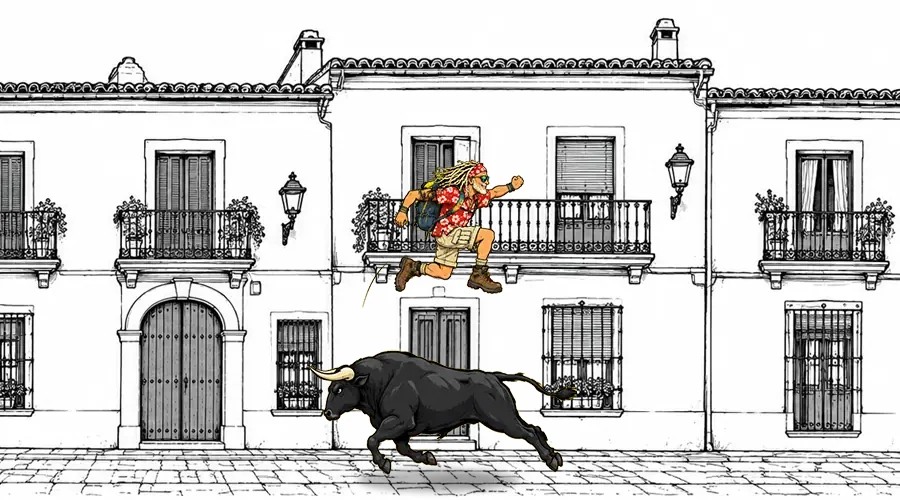
Backpacking Spain cartoon - our travel guru giving the shaka sign. He does not notice that a bull, enraged by his red shirt, is charging him from behind.

Top-Rated Spain Tours on GetYourGuide.com

MONUMENT TO CAMINO DE SANTIAGO PILGRIMS, BURGOS | By Bjørn Christian Tørrissen - Own work by uploader, http://bjornfree.com/galleries.html, CC BY-SA 3.0, Link

Budget Accommodation In Spain

Hostels listed on Booking.com and Hostelworld

Understanding Budget Accommodation In Spain

There is one important linguistic trap for backpackers in Spain: a hostel and a hostal are not the same thing.

Hostels — the backpacker option
If you're coming from the UK or elsewhere in Europe, this is probably what you mean when you say "hostel". Dormitory beds, shared facilities, common areas and a social atmosphere are the usual features. You will also see albergue used for dormitory-style accommodation, but don't assume that every place calling itself an albergue will have the same facilities or rules.

Read More

Hostales and pensiones — private budget rooms
A hostal is traditionally a small, simple hotel or guesthouse, usually offering private rooms rather than dormitory beds. A pensión is another traditional form of simple accommodation, generally with fewer services than a conventional hotel. Neither is the Spanish equivalent of a British backpacker hostel. They can nevertheless be excellent value if you're travelling as a couple or simply want a quiet night away from a dorm.

REAJ youth hostels
Spain has a nationwide network of more than 320 youth hostels belonging to REAJ (Red Española de Albergues Juveniles). These range from city hostels to accommodation in coastal and mountain areas, with shared, private, family and group rooms.

REAJ — Red Española de Albergues Juveniles

The REAJ Hosteller Card is available to travellers of all ages and gives access to REAJ hostels and the wider Hostelling International network. Conditions vary between individual hostels, so check whether a card is required or whether non-members can stay for a small supplement.

Hostelling International
REAJ is part of Hostelling International (HI), the international network of youth hostels. If you already have a valid HI or hostelling card from another country, it can be useful in Spain too.

Hostelling International

Xanascat — Catalonia's public hostel network
Travelling in Catalonia? Look out for Xanascat, the Catalan Youth Hostel Network. It has hostels in Barcelona, Girona, the Pyrenees, on the coast and in smaller towns. Xanascat is part of Hostelling International and has both dormitories and private rooms.

Xanascat — Youth Hostels in Catalonia

Camino de Santiago pilgrim hostels
The albergues de peregrinos on the Camino are a special case. They are intended for pilgrims rather than ordinary tourists. Public albergues can be extremely cheap, but may not accept advance bookings and may give priority to pilgrims travelling on foot. A Credencial del Peregrino (pilgrim's credential) is normally used to collect stamps along the route and is important if you want to obtain the Compostela. Rules vary, but one-night stays are common and some albergues have restricted opening hours or other conditions.

Official Spain.info guide to the Camino de Santiago

Municipal and public albergues
Albergue can also mean accommodation operated by a town hall, municipality, province or regional government. These can be among the cheapest places to sleep in Spain, particularly in rural and mountain areas. Some are open to anyone; others are intended for pilgrims, hikers, young people or other specific groups. Always check the individual rules before turning up.

Regional names can be confusing
Spain's regional languages produce some useful variations. In Catalonia and the Balearic Islands, alberg is the Catalan equivalent of albergue. In the Basque Country, you may encounter aterpetxe for hostel. In Galicia, albergue is the standard term, particularly along the Camino. In mountain areas anywhere in Spain, refugio usually means a mountain refuge rather than a conventional backpacker hostel.

Student residences
Some university residences open to visitors outside the academic year, particularly during summer. These can offer private or twin rooms with shared facilities and can be surprisingly good value.

Multi hostels
A newer type of budget accommodation, sometimes described as a multi hostel, is appearing in busy cities such as Madrid and Barcelona. These are often apartment-style premises fitted with rows of bunk beds, with digital check-in and little or no permanent reception. They can be useful when conventional hostels are full, but check reviews, security, facilities and late-arrival arrangements carefully.

Tourist apartments
Apartments can make sense for two or more backpackers travelling together, particularly for several nights. A kitchen can also cut food costs. Rules governing tourist apartments vary between regions.

Rural accommodation and campsites
Away from the cities, Spain has a huge range of rural accommodation, from farmhouses and country cottages to small rural hotels and guesthouses. Campsites are also widely available, particularly along the coast and in the mountains.

Wild camping — is it allowed?
You'll hear about cycle tourists and other adventurous travellers pitching a tent beside a quiet road or finding a secluded spot in the forest, but don't assume you're allowed to do the same. Wild camping (acampada libre) is generally prohibited or restricted in Spain, with rules varying between regions and municipalities. Forest fires are a major concern, particularly during hot, dry weather, so campfires and open flames can be dangerous as well as illegal. If you're travelling on a shoestring, look for authorised campsites or designated low-cost camping areas, and always check local regulations before pitching your tent.

The important distinction: if you want the classic backpacker experience — dorm beds, other independent travellers, a common room and the possibility of meeting people — look for a hostel or suitable albergue. If you search for a hostal, you're normally looking for a cheap private guesthouse instead. And remember that albergue can mean anything from a conventional youth hostel to a basic municipal hostel or a pilgrim-only accommodation. The easiest way to choose is to use the filter buttons on our interactive map at the top of the page.

ZARAGOZA AND THE EBRO RIVER | By Paulo Brandao - originally posted to Flickr as Basilica del Pilar, sunset, CC BY 2.0, Link