

Welcome to my backpacking guide to the Basque Country!

Discover more

Backpacking the Basque Country (Euskadi)

[eh-ooS-kah-dee]

San Sebastián has more Michelin stars per square metre than almost anywhere else on the planet. Bilbao went from decaying steel city to global architecture icon because of a single museum. And the whole region speaks a language, Euskara, that linguists still can't confidently link to any other tongue on Earth — not Indo-European, not anything. The Basque Country doesn't feel like an extension of Spain so much as its own small, fiercely proud, genuinely mysterious country that happens to sit inside Spain's borders, with a slice spilling over into France.

For backpackers used to the sun-and-sangria version of backpacking Spain, the Basque Country is a proper reset. It's green where the south is dry, rainy where Andalusia is scorched, food-obsessed rather than beach-obsessed (though the beaches here, especially San Sebastián's La Concha, hold their own against anywhere in the country), and built around pintxos bar-hopping rather than club-hopping — a grazing, sociable style of eating out that's genuinely one of the best ways to meet people on the road. World-class surf breaks up the coast at Zarautz and Mundaka add a completely different energy to the region than anything further south.

One honest heads-up before you book those hostels: this is not the cheapest corner of backpacking Spain. San Sebastián in particular carries its foodie reputation into its prices, and the Basque Country is generally pricier than Andalusia or Valencia. It's still entirely doable on a backpacker budget — pintxos crawling is naturally cheaper than sit-down dining, and hostels here are excellent — but budget a little more generously than you would further south.

Read More

What Kind of Place Is This, Exactly?

The Basque Country (Euskadi in Basque) is one of Spain's smallest autonomous communities by area, split into three provinces — Gipuzkoa (San Sebastián), Biscay/Bizkaia (Bilbao), and Álava (Vitoria-Gasteiz, the quieter inland capital) — hugging the Bay of Biscay coast with the Pyrenees rising to the east toward France. Small in size, but consistently one of Spain's wealthiest and most developed regions.

A Short History: An Ancient People, A Modern Story

The Basques are among the oldest documented peoples in Europe, and their language predates the arrival of Indo-European languages on the continent entirely — where Euskara actually comes from remains a genuine, unsolved mystery in linguistics. For centuries the Basque provinces held onto distinct local rights (fueros) even under the Spanish crown, and the region became an industrial powerhouse in the 19th and 20th centuries, built on Bilbao's steel and shipbuilding.

The 20th century brought real hardship. The 1937 bombing of Guernica by Nazi Germany's Condor Legion, in support of Franco's forces, remains one of the most infamous atrocities of the Spanish Civil War — immortalised in Picasso's painting of the same name — and Franco's subsequent dictatorship suppressed Basque language and identity harshly for decades. Out of that repression grew ETA, an armed Basque separatist group that carried out attacks over several decades before formally disbanding in 2018. That chapter is genuinely over — the Basque Country today is calm, safe, and among the more relaxed parts of Spain a backpacker can visit — but it's part of the region's story, and worth understanding rather than skipping past. The modern turnaround is best symbolised by Bilbao's Guggenheim Museum, whose 1997 opening triggered such a dramatic wave of tourism and reinvestment that urban planners now call the phenomenon "the Bilbao effect."

The Language You'll Hear

Euskara (Basque) and Castilian Spanish are both official here. Unlike Catalan, Euskara isn't a Romance language at all and has no confirmed relatives anywhere in the world — a genuine linguistic isolate. In practice, Spanish dominates daily conversation in San Sebastián and Bilbao, but Basque is a source of enormous local pride, taught in schools and visible on every sign, and revival efforts have grown its use significantly in recent decades.

Understanding the Basque Country: The Zones

San Sebastián (Donostia)

The region's culinary capital and one of Europe's most beautiful urban beaches, La Concha, sits right against the Old Town's dense cluster of pintxos bars. Small, walkable, and genuinely stunning — the classic first stop for backpackers touring the Basque Country.

Bilbao

The region's largest city and its economic engine, transformed from industrial decline into a global architecture and culture destination almost entirely off the back of the Guggenheim Museum. Grittier and more authentically local-feeling than San Sebastián, with an excellent, less touristy pintxos scene of its own.

Rioja Alavesa

The Basque Country's own slice of Spain's most famous wine region, in the province of Álava — rolling vineyards dotted with striking modern architecture, including Frank Gehry's titanium-clad "City of Wine" winery at Marqués de Riscal.

The Coast: Surf Towns & Fishing Villages

Zarautz and Mundaka are genuine world-class surf destinations, the latter home to one of the best left-hand waves on Earth. Getaria and Lekeitio are working fishing villages worth a wander, and San Juan de Gaztelugatxe — a tiny chapel on an islet reached by a dramatic zigzagging bridge — has become a minor pilgrimage site for fans of a certain fantasy TV series that filmed there.

The Green Interior & The Basque Pyrenees

Rolling green hills, working cider houses (sagardotegiak) that open their barrels to visitors every spring, and genuine hiking terrain rising toward the Pyrenees and the French border.

Basque Country FAQs for Backpackers

When is the best time to go?

June to September gives you the best odds of good weather, though be warned: the Basque Country is genuinely one of the rainiest parts of Spain, even in summer. Pack a proper layer regardless of when you visit — this is not the bone-dry south.

Where should I start — San Sebastián or Bilbao?

San Sebastián for beaches and the single best pintxos scene in the country; Bilbao for the Guggenheim, a bigger city feel, and noticeably lower prices. Both are easily combined — they're about an hour apart by bus or train.

How does a pintxos crawl actually work?

Walk into a bar, point at whatever pintxo (small snack, usually on a slice of bread, held with a toothpick) looks good, order a drink, eat standing at the bar or on the street outside, then move to the next place after one or two rounds. Some bars tally your toothpicks to work out the bill at the end; others expect you to pay per pintxo as you go — watch what locals do if you're unsure. Doing three or four bars is a completely normal dinner here, not a bar crawl.

What does it cost to go out?

Pricier than the rest of Spain — a pintxo and a drink runs roughly €4–€7 per stop, and San Sebastián's Michelin-starred dining is genuinely expensive if you choose to splurge. Bilbao is noticeably cheaper for the same quality of food.

Do I need to speak Spanish or Basque?

Spanish gets you everywhere; Basque is a bonus, not a requirement. English is spoken reasonably well in San Sebastián and Bilbao's tourist areas.

How do I get around?

Buses and trains connect San Sebastián and Bilbao in about an hour. The coastal surf towns (Zarautz, Mundaka) and fishing villages are reachable by regional bus, though a rental car opens up the coast considerably.

Is the tap water safe?

Yes, throughout the Basque Country. Perfectly safe to drink.

Is the Basque Country safe?

Yes, genuinely one of the safer, calmer regions in Spain to backpack — the era of ETA-related violence ended years ago and has no bearing on visiting today. See our full safety section below.

Staying Safe & Travelling Well in the Basque Country

The Basque Country is one of the safest, lowest-key regions in Spain for backpackers — lower crime rates than Barcelona or Madrid, and none of the pickpocketing reputation that follows the bigger cities further south. The historical political violence associated with ETA ended with the group's 2018 disbandment and has no relevance to visiting today.

Surf and Beach Safety

Mundaka's famous left-hand wave and the Atlantic swell along this coast are genuinely powerful — not a beginner break. Respect local surf etiquette, check conditions before paddling out, and start with a lesson at a gentler beach like Zarautz if you're new to it.

Weather and Layering

The Basque Country's famously changeable, rainy weather isn't dangerous, but it catches out visitors who packed for stereotypical sunny Spain. Bring a proper rain layer whatever the season.

Petty Theft

A low-profile issue here compared to Barcelona, but standard precautions still apply in San Sebastián's crowded Old Town pintxos bars during peak season.

Further Reading

Ready to map out the rest of your trip? For more general info on backpacking Spain, see our comprehensive home page. We also highly recommend checking out our backpacking advice section to make sure you stay safe and save money on the road. If you need help structuring your travel routes, take a look at our suggested itineraries for Spain. For more info on backpacking, including access to our offline app and interactive PDF guide, head over to our resources page.

Backpacking Basque Country heraldic cartouche, showing backpackers enjoying the area's tourist attractions

Quick Facts

Best Time To Visit:
June to September for the best odds of good weather — this is a rainy region year-round, so pack layers regardless.

Best For:
Pintxos, world-class surfing, striking architecture, green landscapes, and a genuinely sociable hostel scene.
Most Popular Experience:
A pintxos bar crawl through San Sebastián's Old Town.

Most Under-rated Experience:
San Juan de Gaztelugatxe — most visitors never make the trip up the coast to see this dramatic islet chapel.

Best Free Experiences:
La Concha beach, the Guggenheim's exterior and riverside, wandering both Old Towns, and the free viewpoints over San Sebastián.

Ideal Stay:
4–5 days to properly cover San Sebastián and Bilbao without rushing.

Budget Level:
Pricier than the rest of Spain, especially San Sebastián. Expect roughly €45–€90 per day.
Getting Around:
Buses and trains link San Sebastián and Bilbao in about an hour; a rental car opens up the coast and interior considerably.

Best Photo Spots:
La Concha beach from Monte Igueldo, the Guggenheim's titanium curves, San Juan de Gaztelugatxe's stairway, and Bilbao's Casco Viejo at dusk.
MONDRAGÓN | By Marisol Murua, CC BY-SA 3.0, Link
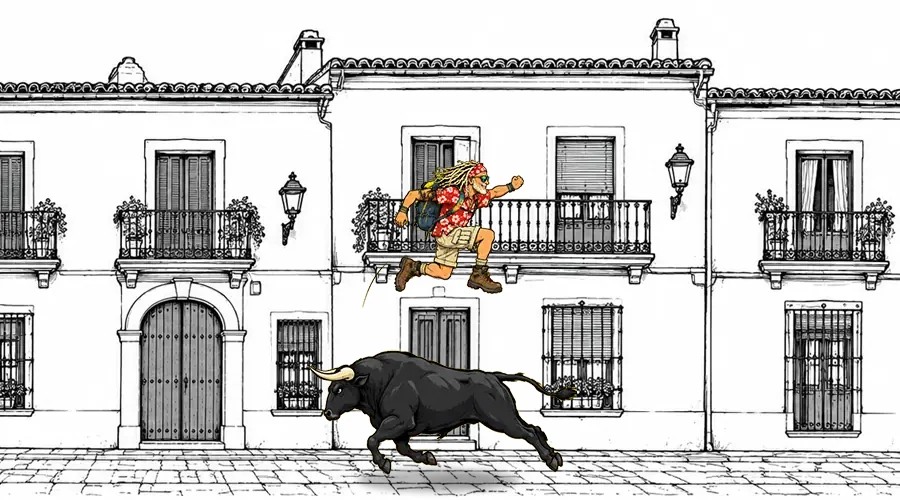
The Backpackers Bible guru, a dreadlocked backpacker in a Hawaiian shirt, leaping over a charging black bull on a cobbled street in Spain

Things To Do In The Basque Country

Search Basque Country Attractions and Tours

Interactive tourist attraction and tour map for Basque Country showing things to do for backpackers.
Tours in Basque Countryon GetYourGuide ↗
Discover the best things to do, attractions, and backpacker tours in the Basque Country. Use two fingers to move the map, pinch to zoom.

1. Pintxos & The Michelin Trail (Non-Negotiable)

Forget sit-down tapas — pintxos are the Basque Country's real culinary export, and San Sebastián's Old Town has one of the highest concentrations of good bars anywhere in the world.

A San Sebastián Old Town pintxos crawl

Start anywhere along Calle 31 de Agosto or Fermín Calbetón and just keep moving — a pintxo and a small glass of txakoli (the region's slightly fizzy local white wine) at each stop. Three or four bars is a completely normal dinner here. Roughly €4–€7 per stop.

A Michelin-starred splurge

San Sebastián has one of the highest densities of Michelin stars per capita on Earth. You don't need to book the very top tier to get a genuine taste of it — several one-star spots run tasting menus that, while not cheap, are considerably more attainable than their reputation suggests.

Read More

Bilbao's pintxos scene

Less famous than San Sebastián's, and arguably better value — the Casco Viejo's "Seven Streets" area has an excellent, noticeably less touristy pintxos crawl of its own.

2. Adrenaline

Surfing Zarautz and Mundaka: Zarautz is a long, forgiving beach break good for beginners and lessons; Mundaka, further along the coast, holds one of the best left-hand waves on the planet — for experienced surfers only.

Hiking the Basque Pyrenees: Genuine mountain trails rising toward the French border, with green, rolling scenery that looks nothing like the rest of Spain.

Coasteering near San Juan de Gaztelugatxe: Cliff-jumping and scrambling along the dramatic coastline that made this stretch famous on screen, with guided operators running trips from nearby Bermeo.

3. The Coast: Beaches & Fishing Villages

Most backpackers stick to San Sebastián and Bilbao and never see the coast between them — a genuine shame, since this stretch is one of the most dramatic in Spain.

San Juan de Gaztelugatxe

A tiny hermitage perched on an islet, reached by a steep zigzagging stone bridge — genuinely spectacular even before you factor in its brief moment of fantasy-TV fame. Access is now ticketed and limited in peak season, so check ahead.

Getaria & Lekeitio

Working fishing villages with none of the polish of the bigger towns — Getaria for its harbour and grilled-fish restaurants, Lekeitio for its beach and dramatic tidal islet.

4. Free Basque Country (Zero Euros)

La Concha beach: One of Europe's best urban beaches, free and public, right in the middle of San Sebastián.

Monte Urgull and Monte Igueldo: Free walking paths up both hills flanking San Sebastián's bay, with the best panoramic views of the city and coastline waiting at the top (skip the paid funicular and walk instead).

The Guggenheim's exterior and riverside: You don't need to pay to admire Frank Gehry's titanium curves from outside, and the surrounding Nervión riverside walk is free and genuinely pleasant.

Both Old Towns: Wandering San Sebastián's Parte Vieja and Bilbao's Casco Viejo costs nothing and is arguably the best way to experience either city.

5. Nightlife: How It Actually Works

Basque nightlife runs through pintxos bars first, proper bars second — a night out here is less about a single destination club and more about a slow crawl that naturally gets louder and later.

For a first drink

San Sebastián's Old Town is built for exactly this — bar after bar, most with standing room only, spilling out onto the streets by 11pm.

For something more local

Bilbao's Casco Viejo has a livelier, younger, less tourist-heavy bar scene than San Sebastián's, especially around Plaza Nueva.

For clubbing

Both cities have a modest but decent late-night scene, though the Basque Country's nightlife identity leans firmly toward long, sociable bar-hopping rather than big superclubs — lean into it rather than searching for a Madrid- or Barcelona-style night.

6. The Big Hits (Things You Must Not Skip)

The Guggenheim Museum, Bilbao

Frank Gehry's titanium-clad building single-handedly revived Bilbao's global reputation — worth going inside for the contemporary art collection, but the building itself is the real star.

La Concha Beach, San Sebastián

Already covered above under Free Basque Country, but it bears repeating — this is one of the most beautiful city beaches anywhere in Europe.

San Juan de Gaztelugatxe

Covered in full above — one of the most photographed spots on this entire coastline.

Rioja Alavesa Wineries

A day trip into the Basque Country's own wine region, anchored by Frank Gehry's spectacular "City of Wine" winery at Marqués de Riscal — easily combined with a tasting or two.

7. Live Sport

Athletic Bilbao at San Mamés: One of the most unusual clubs in world football — Athletic Bilbao has fielded only Basque-born or Basque-raised players since its founding, a genuinely unique policy in top-flight European football, and matchday atmosphere at San Mamés reflects that fierce local identity.

Real Sociedad at Reale Arena, San Sebastián: The city's own top-flight club, with a passionate, comparatively affordable matchday experience.

Basque pelota and rowing regattas: Pelota (a fast, wall-based ball sport played in a fronton court) is the genuine national sport here, and traditional rowing regattas (traineras) along the coast draw serious local crowds in summer — both are a real slice of Basque life most tourists never see.

Backpacking Basque Country cartoon of a travel guru at a

Top-Rated Basque Country Tours on GetYourGuide.com

PINTXOS | By No machine-readable author provided. Ardo Beltz assumed (based on copyright claims). - No machine-readable source provided. Own work assumed (based on copyright claims)., CC BY-SA 3.0, Link

Budget Accommodation in Basque Country

Hostels listed on Booking.com and Hostelworld

For a full list of hostels, see our

Where Do You Want To Go Next?