

Backpacking Spain Itineraries

Spain is one of the easiest countries in Europe to backpack: the trains are fast, the coaches are cheap and the hostels are good. The hard part is choosing a route. Here are fifteen, from a five-day city stay to a three-month grand tour, with interactive maps, daily distances, suggested places to sleep and a cost breakdown for each.

All costs are in euros per person for 2026, checked in October 2026, and based on dorm beds and a solo traveller unless stated. Flights to and from Spain are not included. Train fares move with demand, so the prices here are what to expect if you book a few weeks ahead; last-minute tickets can cost two or three times as much. If you have two weeks and want the cheapest way to see the country, start with the Shoestring Tour; for private rooms and a few treats, try the Flashpacker's Spain.

A heads-up on Granada: a series of earthquakes in August 2026 closed parts of the Alhambra. The Alcazaba reopened on 23 September 2026 on an adapted route, but visitor routes can change, and the cathedral and some churches were closed for checks. Confirm opening on the official sites before you book.
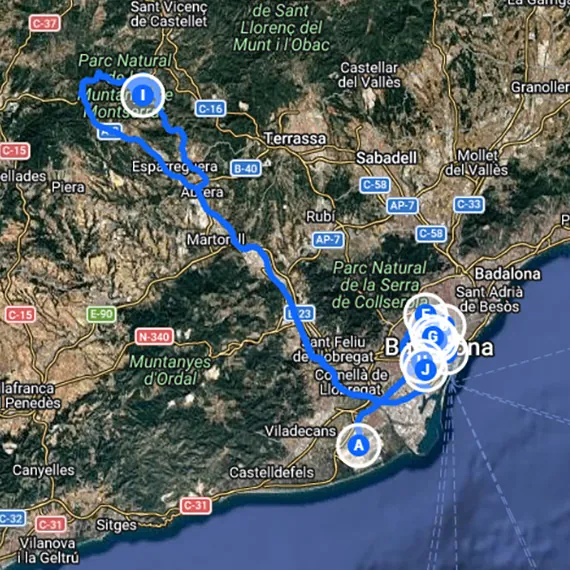
Map of the 5 Days: Barcelona City Stay itinerary 5 days · rail & metro

5 Days: Barcelona City Stay

Gaudí, the Gothic Quarter, beaches and day trips to Montserrat and Girona from one base hostel.
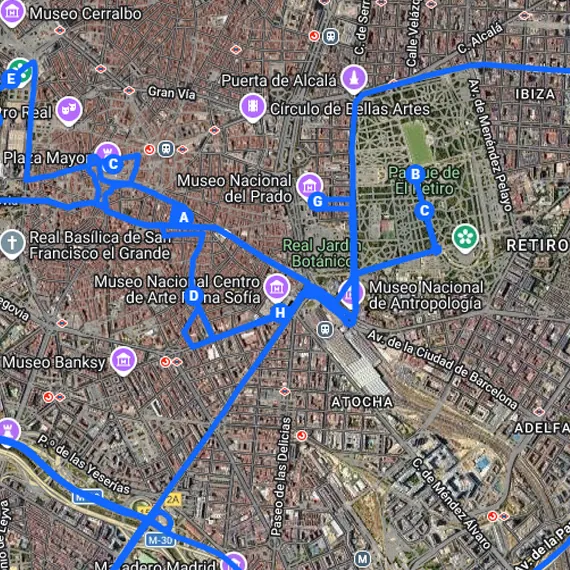
Map of the 5 Days: Madrid Without the Tourist Tax itinerary 5 days · rail & bus

5 Days: Madrid Without the Tourist Tax

The Prado, Retiro and the best tapas bars, plus Toledo and Segovia as easy day trips.
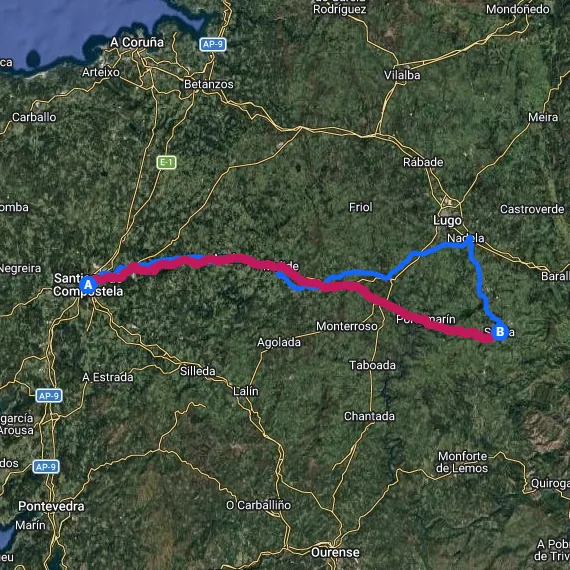
Map of the 7 Days: Camino Francés, Sarria to Santiago itinerary 7 days · on foot or by bike

7 Days: Camino Francés, Sarria to Santiago

The sociable Camino: the last 115km, with how to find your Camino family.
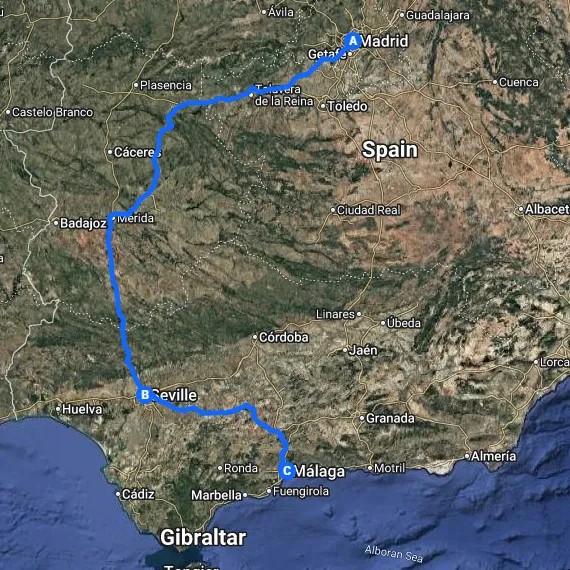
Map of the 8 Days: Accessible Spain itinerary 8 days · accessible rail

8 Days: Accessible Spain

Madrid, Seville and Málaga, designed first for wheelchair users.
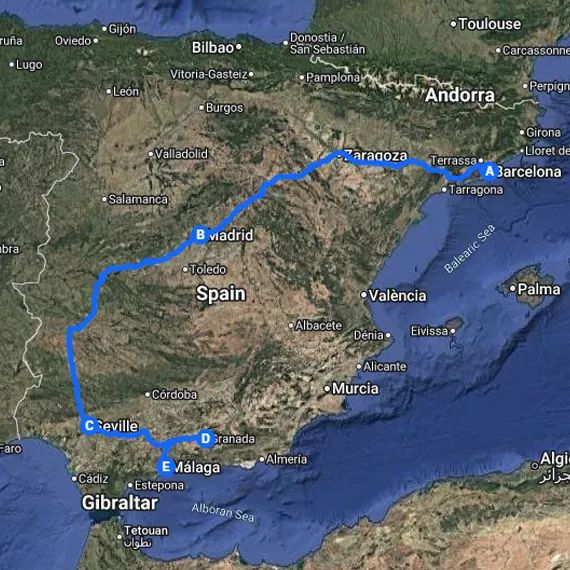
Map of the 10 Days: The Big Four itinerary 10 days · high-speed rail

10 Days: The Big Four

Madrid, Seville, Granada and Barcelona by high-speed train: the classic first trip.
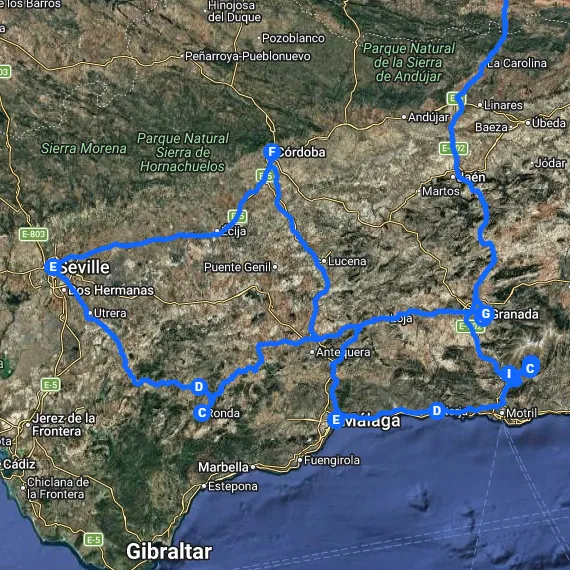
Map of the 10 Days: Four Friends and a Fiat itinerary 10 days · hire car

10 Days: Four Friends and a Fiat

A hire car split four ways round Andalusia's white villages, the Caminito del Rey and the Alpujarras.
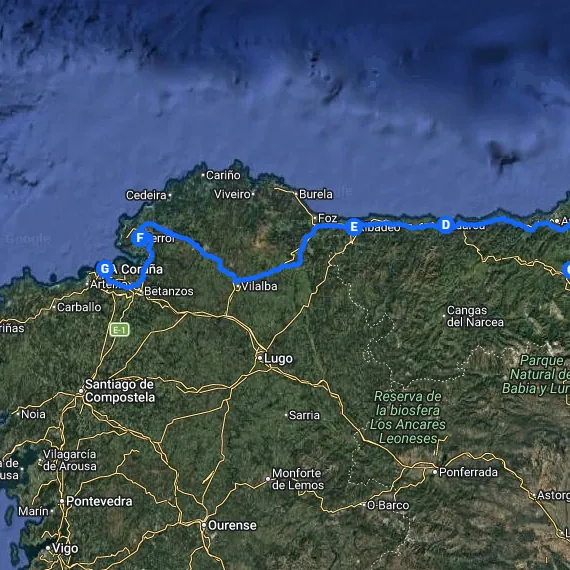
Map of the 10 Days: The Slow Train Along the Green Coast itinerary 10 days · narrow-gauge rail

10 Days: The Slow Train Along the Green Coast

Santander to Ferrol on the slow coastal railway almost nobody rides.
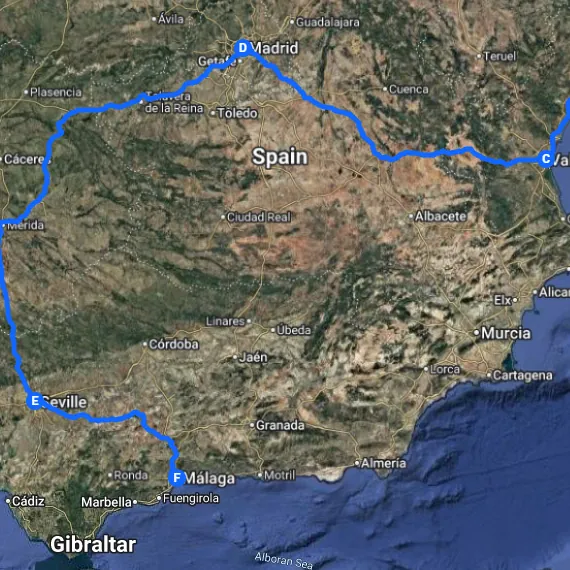
Map of the 2 Weeks: The Party Hostel Tour itinerary 2 weeks · rail & bus

2 Weeks: The Party Hostel Tour

Five party cities in fourteen days, every bed in a hostel with a bar.
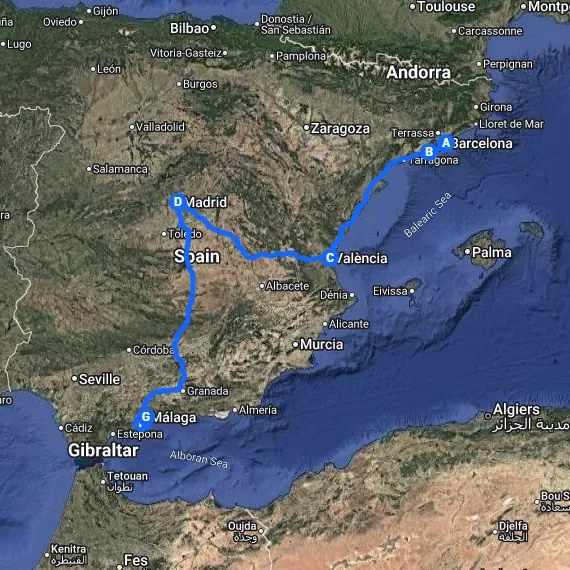
Map of the 2 Weeks: Pride and Beaches (LGBTQ+) itinerary 2 weeks · rail & coach

2 Weeks: Pride and Beaches (LGBTQ+)

Barcelona, Sitges, Valencia, Madrid and Torremolinos, staying in Travel Proud places.
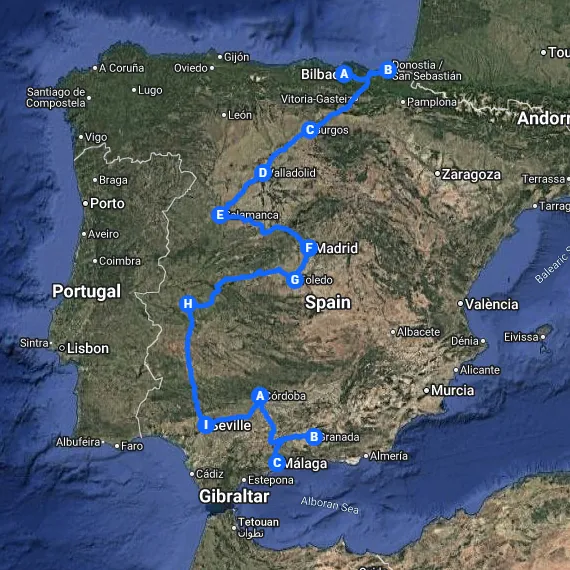
Map of the 3 Weeks: North to South itinerary 3 weeks · bus & rail

3 Weeks: North to South

Bilbao to Málaga via twelve cities, from pintxos to the Alhambra.
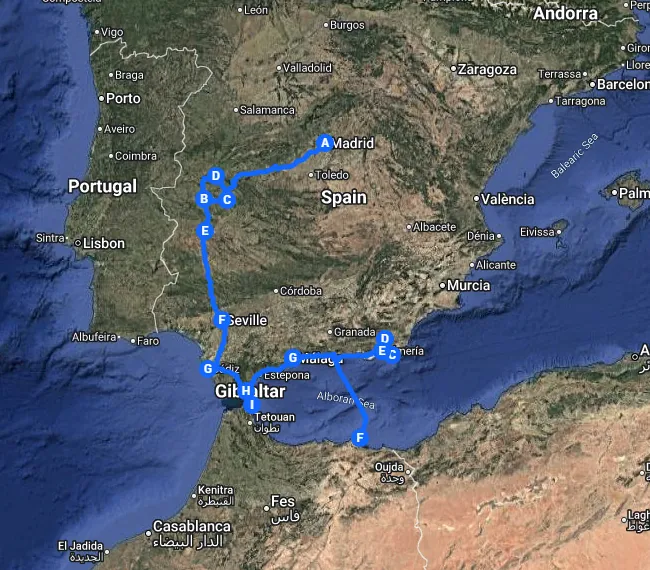
Map of the 3 Weeks: Spain Beyond the Guidebook itinerary 3 weeks · bus, rail & ferry

3 Weeks: Spain Beyond the Guidebook

Extremadura, Cádiz, Ceuta, Melilla and the Almería desert: the Spain visitors never see.
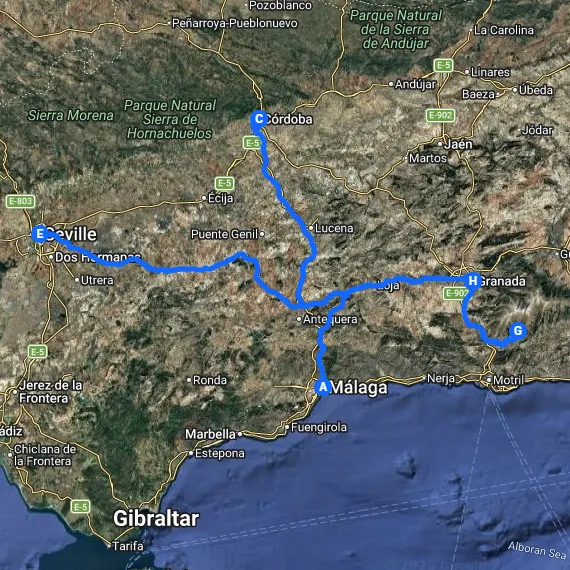
Map of the 1 Month: Spanish Immersion itinerary 1 month · local transport

1 Month: Spanish Immersion

A month of Spanish classes in Granada, with flamenco lessons and weekend trips.
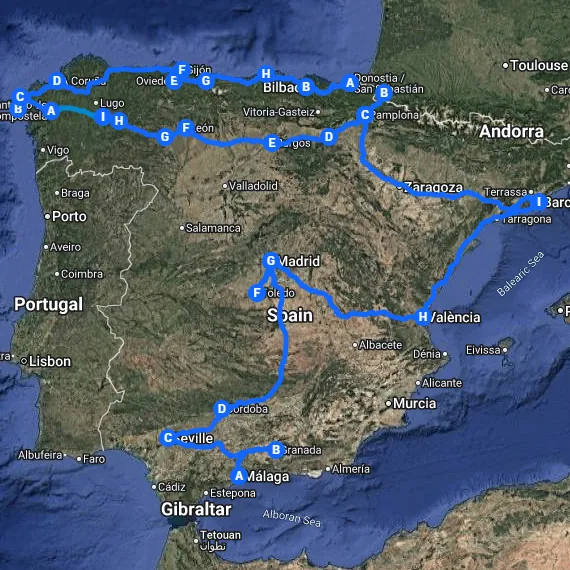
Map of the 3 Months: La Vuelta, the Grand Tour itinerary 3 months · all modes

3 Months: La Vuelta, the Grand Tour

Ninety days including the entire 780km Camino Francés, with the south, the east and the green north.
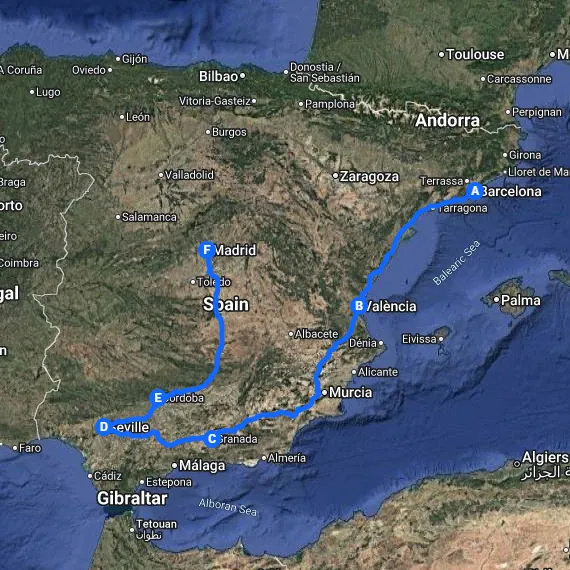
Map of the 2 Weeks: The Shoestring Tour itinerary 2 weeks · bus & rail

2 Weeks: The Shoestring Tour

The cheapest itinerary on the page: six cities by bus and train at about €52 a day.
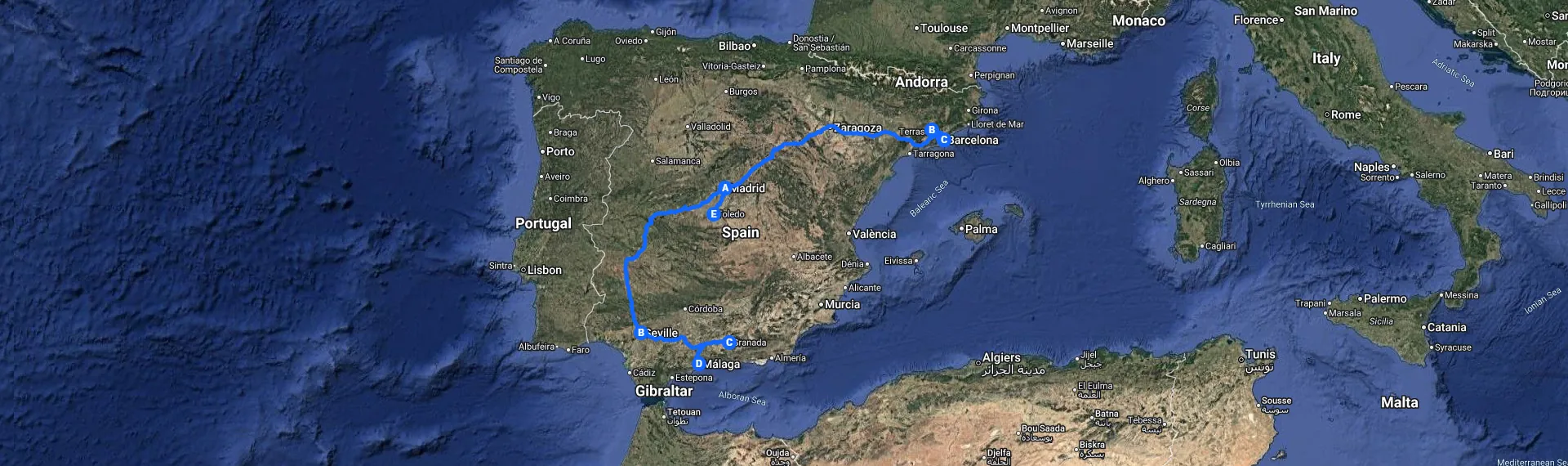
Map of the 2 Weeks: The Flashpacker's Spain itinerary 2 weeks · high-speed rail

2 Weeks: The Flashpacker's Spain

High-speed trains, private rooms and paid experiences from Barcelona to Málaga, about €114 a day.

Offline fallback map for the 5-day Barcelona City Stay itinerary

5 DAYS: Barcelona City Stay

One base, no luggage-dragging, and the best city beach in Europe. Barcelona rewards a five-day stay: Gaudí, the medieval Gothic Quarter, Picasso, a mountain monastery and long evenings in Gràcia's squares, all within a metro ride of one hostel. This is a city itinerary, so the daily distances are walking and metro, and it works out at about €68 a day. 2026 is the centenary of Gaudí's death and the city is busier than ever, so book the big tickets and your bed early.

Read More

Day 1: Arrive in Barcelona
Take the metro from the airport (line L9 Sud). The airport needs its own ticket, €5.90 one way in 2026, because the T-casual 10-trip card is not valid to the airport. Check in, walk down through the Gràcia squares and eat early; the cheapest menus stop at about 9pm.
Suggested accommodation: Sant Jordi Hostel Gràcia, Barcelona
Daily distance: about 15km from the airport.

Day 2: The Gothic Quarter, El Born and the beach
Join a tip-based walking tour of the Gothic Quarter, then cross into El Born for Santa Maria del Mar and the Picasso Museum (book ahead; prices and free slots change, so check the museum's site). Walk on to Barceloneta for a swim, and finish at the Bunkers del Carmel, a free hilltop viewpoint with the best sunset in the city.
Suggested accommodation: Sant Jordi Hostel Gràcia, Barcelona
Daily distance: about 12km on foot.

Day 3: Gaudí
Book timed tickets online well in advance. The Sagrada Família costs €26 for basic entry including the audio guide (€24 for under-30s and students, €36 with a tower), and sells out weeks ahead in the centenary year. Park Güell's monumental zone costs €18 after a steep rise in 2026, and the rest of the park is free. Casa Batlló (from €29) and La Pedrera (from €25) set their prices by demand; on a budget, admire their facades on Passeig de Gràcia for nothing.
Suggested accommodation: Sant Jordi Hostel Gràcia, Barcelona
Daily distance: about 10km on foot, plus metro.

Day 4: Montserrat (or Girona)
Take the R5 train from Plaça Espanya and then the Cremallera rack railway or the cable car up to the monastery, about €30 return from Barcelona (check the current fares). Walk the trails above the basilica for the views of the serrated rock. For a swap, take the fast train to Girona (from about 40 minutes) for its medieval walls and Jewish Quarter.
Suggested accommodation: Sant Jordi Hostel Gràcia, Barcelona
Daily distance: about 120km return by rail.

Day 5: Montjuïc and home
Walk up Montjuïc for the views over the port, then stroll down past the National Art Museum of Catalonia (MNAC). The Magic Fountain puts on free shows in the evening on a seasonal schedule, so check the current dates. If you have time, browse the Mercat de Sant Antoni before heading to the airport.
Daily distance: about 15km to the airport.

Estimated Cost Breakdown (Per Person, 2026)

Based on dorm beds and a solo traveller, with prices checked in October 2026. Flights to and from Spain are not included.

Accommodation (4 nights in a dorm, about €32 a night; Barcelona is the most expensive city in Spain for beds):
€128

Local transport (airport tickets €5.90 each way, plus a 10-trip T-casual at €13):
€25

Montserrat day trip (train, rack railway and cable car):
€30

Food and drink (about €20/day, with a menú del día lunch at roughly €13–17):
€100

Activities (Sagrada Família €26, Park Güell €18, one museum about €12):
€56

Total estimated trip cost: ~€339 per person (approximately €68/day.)

Metro tickets: The T-casual (10 trips, €13) can be shared between people, but it does not cover the airport. If you will use the metro all day, the Hola Barcelona travel card (from about €19 for 48 hours) includes the airport and unlimited travel.

Pickpockets: The metro, Las Ramblas and the beach are the hotspots. Keep your phone in a front pocket or zipped bag and never leave it on a café table.

Book early: With Gaudí's centenary in 2026, the Sagrada Família has been selling out up to two months ahead and hostels fill early. Avoid unofficial ticket resellers, who add a lot to the price.

Offline fallback map for the 5-day Madrid city stay itinerary

5 DAYS: Madrid Without the Tourist Tax

Madrid is the cheapest of Spain's big cities to stay in and the easiest to love: three of the world's great art museums, a huge park, late nights that start at 11pm and a bocadillo de calamares for the price of a coffee. It also sits in the middle of the rail network, which makes Toledo and Segovia easy day trips. At about €52 a day, this is a five-day stay with one hostel and no lines to stand in if you book the free museum slots.

Read More

Day 1: Arrive in Madrid
Take the 24-hour Exprés Aeropuerto bus (about €5) or Cercanías into the city. Check in and eat at a local bar in La Latina; the Calle Cava Baja has the best cluster of tapas bars.
Suggested accommodation: Cat's Hostel, Madrid
Daily distance: about 15km from the airport.

Day 2: The old city
Start at the Plaza Mayor, with a bocadillo de calamares (squid sandwich) on the street behind it. Walk through the Royal Palace's free gardens (Sabatini and Campo del Moro), then end the day at the Templo de Debod, an Egyptian temple that has a free sunset view over the city. Hot chocolate and churros at San Ginés are a late-night Madrid ritual.
Suggested accommodation: Cat's Hostel, Madrid
Daily distance: about 8km on foot.

Day 3: The Golden Triangle of art
Pick two of the three museums. The Prado costs €15 and is free from 6pm to 8pm Monday to Saturday (5pm to 7pm on Sundays); book a free ticket online to skip the queue. The Reina Sofía, home of Picasso's Guernica, costs €12, is free from 7pm to 9pm Monday and Wednesday to Saturday, and is closed on Tuesdays. The Thyssen-Bornemisza (about €14) is free on Mondays from 12pm to 4pm for the permanent collection, with door tickets only. A Paseo del Arte card for all three costs about €33–35.
Suggested accommodation: Cat's Hostel, Madrid
Daily distance: about 6km on foot.

Day 4: Toledo
Take an Alsa coach from Plaza Elíptica (about an hour) or the Avant train from Atocha (about 35 minutes) to the walled hill city. Wander the old Jewish Quarter, see the cathedral and watch sunset from the Mirador del Valle across the river. For a swap, go to Segovia (about 30 minutes by Avant) for the Roman aqueduct and roast suckling pig.
Suggested accommodation: Cat's Hostel, Madrid
Daily distance: about 140km return.

Day 5: Retiro, Lavapiés and home
Spend the morning in Retiro Park, hire a rowing boat on the lake and see the Crystal Palace. If it's a Sunday or holiday, El Rastro flea market runs in La Latina until mid-afternoon. Then wander Lavapiés, the city's most multicultural neighbourhood, before heading to the airport.
Daily distance: about 15km to the airport.

Estimated Cost Breakdown (Per Person, 2026)

Based on dorm beds and a solo traveller, with prices checked in October 2026. Flights to and from Spain are not included.

Accommodation (4 nights in a dorm, about €27 a night):
€108

Local transport and airport (Exprés Aeropuerto each way, metro and bus):
€25

Toledo day trip (coach or train, return):
€12

Food and drink (about €18/day: bocadillos, menú del día lunches and tapas):
€90

Activities (the museums on free evening slots, plus Toledo sights and one paid museum):
€25

Total estimated trip cost: ~€260 per person (approximately €52/day.)

Free museum hours: Free entry is the busiest time. Book the free tickets online where possible, and note that free slots, opening days and prices change, so confirm on each museum's site before you go.

Siesta and dinner times: Many kitchens close between about 4pm and 8pm and dinner rarely starts before 9pm. If you are hungry at 6pm, a bar with tapas or a bakery is your friend.

Offline fallback map for the Camino Francés itinerary from Sarria

7 DAYS: Camino Francés, Sarria to Santiago

The last 115km of the Camino Francés is the most popular pilgrimage walk in the world, and the most sociable. You walk about 20–29km a day through Galician farmland, stop at village bars for coffee and tortilla, sleep in €10 hostels and eat the pilgrim menu with a table of strangers who, by the third night, are friends. It works out at about €40 a day. This page also covers cycling the Camino. For the whole 780km route see 3 Months: La Vuelta below, and for background see our Camino de Santiago page.

Read More

Day 1: Santiago to Sarria
Take a bus from Santiago to Sarria, usually via Lugo (about €15 in total; check the timetable, as a direct bus may run). Buy your pilgrim credential (the credencial) from the albergue or a church, and get your first stamp. You need two stamps a day on the last 100km to qualify for the Compostela certificate.
Suggested accommodation: The public Xunta albergue in Sarria (about €10), or a private albergue (about €15–30)
Daily distance: about 115km by bus.

Day 2: Sarria to Portomarín
The first stage, a gentle day through oak woods and stone hamlets, and the 100km marker at Ferreiros. You arrive in Portomarín over a bridge above the reservoir.
Suggested accommodation: The public Xunta albergue in Portomarín (about €10), or a private albergue
Daily distance: about 22km on foot.

Day 3: Portomarín to Palas de Rei
A longer climb in the morning, then rolling country. Many pilgrims stop for a snack at a village bar; do the same.
Suggested accommodation: The public Xunta albergue in Palas de Rei (about €10), or a private albergue
Daily distance: about 25km on foot.

Day 4: Palas de Rei to Arzúa
The longest day, with a famous detour: the octopus restaurants (pulperías) in Melide are the traditional lunch. It is the day with the most sore feet, so start early.
Suggested accommodation: The public Xunta albergue in Arzúa (about €10), or a private albergue
Daily distance: about 29km on foot.

Day 5: Arzúa to O Pedrouzo
A shorter day through eucalyptus forest. At O Pedrouzo, everyone is excited and nervous about tomorrow.
Suggested accommodation: The public Xunta albergue in O Pedrouzo (about €10), or a private albergue
Daily distance: about 19km on foot.

Day 6: O Pedrouzo to Santiago
Climb Monte do Gozo for the first view of the cathedral spires, then walk into the old town and the Praza do Obradoiro. Collect your Compostela certificate at the Pilgrim's Office (queues can be long), and attend the pilgrims' mass if you can.
Suggested accommodation: In Santiago, a budget albergue (for example the Seminario Menor, Fin del Camino or Santo Santiago; check current prices and opening)
Daily distance: about 20km on foot.

Day 7: Santiago, Finisterre or home
Spend the morning in the old town and the market. For a swap, take a bus to Finisterre, the headland the Romans thought was the end of the world, and watch the sunset there.
Daily distance: about 90km by bus to Finisterre.

Cycling the Camino

Pilgrims who cycle need to cover the last 200km (not 100km) to qualify for the Compostela, so the Sarria start does not count. Start in Ponferrada, about 200km from Santiago, and allow three or four days of 50–70km. Bikes are allowed on the same path, but some sections are steep or rocky and you may have to push, and walkers have priority. Hire a bike in Ponferrada or Santiago and ask about one-way returns, or bring your own.

Estimated Cost Breakdown (Per Person, 2026)

Based on a solo walker staying in public albergues and eating the pilgrim menu, with prices checked in October 2026. Flights to and from Spain are not included.

Accommodation (5 nights in Xunta or private albergues at about €12 on average, plus one night in a budget albergue in Santiago at about €20):
€80

Food and drink (about €22/day: breakfast, a pilgrim menu at about €12–15 and snacks):
€154

Transport (bus from Santiago to Sarria):
€15

Credential and extras:
€3

Backpack transfer (optional, about €5–6 a stage):
€28

Total estimated trip cost: ~€280 per person (approximately €40/day, or about €250 if you carry your own pack.)

How to make friends: Eat the pilgrim menu in the village bar rather than alone at the albergue, share a table, and ask where people started. The Camino is social by design: most people have a different start, and you will walk with some for an afternoon and others for days. Say yes to dinner invitations.

Public albergues: The Xunta's public albergues in Galicia cost about €10 a night and cannot be booked, because the beds are first come, first served. In summer, arrive by early afternoon or book a private albergue the day before.

The busiest stretch: Sarria to Santiago is the most crowded part of the Camino, especially from May to October. September and October are quieter, and the weather in Galicia can turn wet at any time, so pack a poncho.

Offline fallback map for the 8-day Accessible Spain itinerary

8 DAYS: Accessible Spain

An eight-day route through the three flattest, best-served big cities in Spain, designed first for wheelchair users and then adapted for other needs: Madrid, Seville and Málaga, linked by high-speed train. It is not a hostel route, because accessible rooms are rare in hostels, and it assumes two people sharing a room. It works out at about €89 a day each. I have not travelled this route in a wheelchair, so treat every detail as something to confirm with each venue before you go. We will expand this page with more routes and more kinds of access.

Read More

Day 1: Arrive in Madrid
An accessible taxi is the easiest way from the airport to the hotel. The metro has many step-free stations but not every one, so check Metro de Madrid's accessibility map before you choose a hotel.
Suggested accommodation: A hotel with a confirmed accessible room; book directly and ask for photos of the bathroom
Daily distance: about 15km from the airport.

Day 2: Madrid art
The Prado and Reina Sofía both have step-free entrances and lifts, and many Spanish museums give free or reduced entry to disabled visitors (carry proof of disability). The Prado's tactile programme and the ONCE Tiflológico Museum in Madrid are designed for blind and low-vision visitors, so check what is currently open.
Suggested accommodation: Same hotel
Daily distance: about 4km, mostly flat.

Day 3: Retiro and the old town
Retiro Park has flat, wide paths. The old town around the Plaza Mayor has cobbles and some slopes, so plan to use the park and the main avenues.
Suggested accommodation: Same hotel
Daily distance: about 5km, mostly flat.

Day 4: Madrid to Seville
Request assistance when you book your train. Adif and Renfe provide free help at the station for people with reduced mobility at 146 stations (70 permanently staffed), and you should ask at least 24 hours ahead via the Renfe website, app or the accessibility office (+34 91 774 40 40, oca.accesibilidad@renfe.es). The high-speed train from Madrid to Seville takes about 2.5 hours and has wheelchair spaces.
Suggested accommodation: A hotel with a confirmed accessible room in Seville
Daily distance: 530km by rail.

Day 5: Seville
Seville's centre is flat, though the old streets have uneven cobbles. The Plaza de España, the María Luisa Park and the river path are flat and wide. Contact the Real Alcázar and the cathedral before you go to confirm which routes are accessible.
Suggested accommodation: Same hotel
Daily distance: about 5km, mostly flat.

Day 6: Seville
Take it easy: the riverside, Triana's market and an evening flamenco show at a venue that confirms access. Allow time for rest.
Suggested accommodation: Same hotel
Daily distance: about 4km.

Day 7: Seville to Málaga
A train to Málaga takes about 2 to 2.5 hours (check the timetable). Request assistance in advance again. Málaga's seafront promenade is flat and some city beaches offer adapted bathing services in summer; confirm with the city council.
Suggested accommodation: A hotel with a confirmed accessible room in Málaga
Daily distance: about 210km by rail.

Day 8: Málaga and home
A morning on the promenade and the port, then the Cercanías train or an accessible taxi to the airport.
Daily distance: about 10km to the airport.

Estimated Cost Breakdown (Per Person, 2026)

Based on two people sharing an accessible hotel room, with prices checked in October 2026. Flights to and from Spain are not included. Accessible rooms vary widely in price.

Accommodation (7 nights in an accessible double, about €45 per person per night):
€315

Transport (Madrid–Seville and Seville–Málaga by train, plus accessible taxis):
€140

Food and drink (about €25/day):
€200

Activities (museums and sights):
€60

Total estimated trip cost: ~€715 per person (approximately €89/day.)

Always confirm: Accessibility information changes, and a lift may be out of order on the day. Contact every hotel, venue and transport operator directly, and ask for details in writing.

Assistance dogs: Assistance dogs are legally allowed on public transport and in hotels in Spain, but check airline and ferry rules for your own dog before you travel.

Granada: Granada's Albaicín is steep and cobbled and is very difficult for wheelchair users, which is why this route leaves it out. If you want the Alhambra, check the official site for the accessible route first.

Offline fallback map for the 10-day Big Four itinerary

10 DAYS: The Big Four

The classic first trip to Spain: Barcelona, Madrid, Seville and Granada, linked by high-speed rail and one short coach, with a flight out of Málaga. It is the Spain most visitors want to see, done at a pace that gives each city enough time, for about €66 a day. Fly into Barcelona and out of Málaga.

Read More

Day 1: Arrive in Barcelona
Take the metro from the airport (the airport ticket is €5.90 one way). Walk through Gràcia and eat early.
Suggested accommodation: Sant Jordi Hostel Gràcia, Barcelona
Daily distance: about 15km from the airport.

Day 2: Barcelona
Walking tour of the Gothic Quarter and El Born, then Barceloneta beach, then the Bunkers del Carmel at sunset (free).
Suggested accommodation: Sant Jordi Hostel Gràcia, Barcelona
Daily distance: about 12km on foot.

Day 3: Gaudí
The Sagrada Família (€26 basic, €24 for under-30s and students; timed, online-only and sells out weeks ahead) and Park Güell's monumental zone (€18). The rest of Park Güell is free.
Suggested accommodation: Sant Jordi Hostel Gràcia, Barcelona
Daily distance: about 10km on foot, plus metro.

Day 4: Barcelona to Madrid
A high-speed train to the capital in 2.5 to 3 hours. Ouigo and Iryo are cheaper than Renfe's AVE on average; advance fares start around €19, but a typical advance fare is nearer €45–60. Evening tapas in La Latina.
Suggested accommodation: Cat's Hostel, Madrid
Daily distance: 620km by rail.

Day 5: Madrid
The Prado is free from 6pm to 8pm Monday to Saturday (book the free ticket online), and the Reina Sofía is free from 7pm to 9pm Monday and Wednesday to Saturday (closed Tuesdays). Spend the day in Retiro, the Plaza Mayor and the Templo de Debod at sunset.
Suggested accommodation: Cat's Hostel, Madrid
Daily distance: about 8km on foot.

Day 6: Madrid to Seville
A high-speed train south in about 2.5 hours, €35–60 if booked ahead. Walk through Santa Cruz at dusk.
Suggested accommodation: Oasis Backpackers' Hostel Sevilla, Seville
Daily distance: 530km by rail.

Day 7: Seville
The Real Alcázar (€15.50, book ahead; free for the last hour on Mondays with a reservation), the Plaza de España and the María Luisa Park, then flamenco at La Carbonería in the evening.
Suggested accommodation: Oasis Backpackers' Hostel Sevilla, Seville
Daily distance: about 10km on foot.

Day 8: Seville to Granada
A morning Alsa coach, about 3 hours and €18–25. Spend the evening on free tapas in the Realejo.
Suggested accommodation: Granada Inn Backpackers, Granada
Daily distance: 250km by coach.

Day 9: The Alhambra
Book the General ticket with Nasrid Palaces slot (about €22 online) weeks ahead. The Alcazaba reopened on 23 September 2026 on an adapted route after August's earthquakes, but visitor routes can change, and the cathedral and some churches were closed for checks, so confirm before you go.
Suggested accommodation: Granada Inn Backpackers, Granada
Daily distance: about 8km on foot.

Day 10: Granada to Málaga and home
A morning coach to Málaga, about 1.5 hours, then the Cercanías train to the airport.
Daily distance: 130km by coach, then 10km to the airport.

Estimated Cost Breakdown (Per Person, 2026)

Based on dorm beds and a solo traveller, with prices checked in October 2026. Flights to and from Spain are not included.

Accommodation (9 nights in dorms: Barcelona about €30, Madrid €27, Seville €23, Granada €20):
€230

Intercity transport (Barcelona–Madrid €45, Madrid–Seville €40, Seville–Granada €20, Granada–Málaga €12):
€117

Local transport and airport transfers:
€35

Food and drink (about €18/day):
€180

Activities (Sagrada Família €26, Park Güell €18, Alcázar €15.50, Alhambra €22, plus extras):
€100

Total estimated trip cost: ~€662 per person (approximately €66/day.)

Rail fares: On Madrid–Barcelona, average fares in late 2025 were about €61 on Ouigo, €77 on Iryo and €96 on Renfe's AVE. Renfe's cheap Avlo brand no longer runs on that route. Book early, and note that most Ouigo fares cannot be changed or refunded.

Flying instead: If you would rather skip a city to save time, you can fly between Barcelona and Seville or Málaga in about 1.5 hours. Check Ryanair and Vueling fares, and remember to add the cost of baggage and airport transfers.

Offline fallback map for the 10-day Four Friends and a Fiat itinerary

10 DAYS: Four Friends and a Fiat

Rail and coach are the cheapest way to travel Spain alone, but four people sharing one hire car changes the sums. This Andalusia loop starts and ends in Málaga and uses the car where it earns its keep — the Caminito del Rey, the white villages of Ronda and Setenil, and the Alpujarras valleys in the Sierra Nevada, none of which a bus timetable serves well — then leaves it in a garage in the big cities. It works out at about €64 a day each, and you can sleep four to a room to keep the accommodation low.

Read More

Day 1: Arrive in Málaga
Spend the afternoon on the beach and the evening in the old town, eating espetos at the beach bars. You do not need the car yet, and Málaga's centre is not a place to drive.
Suggested accommodation: Oasis Backpackers' Palace, Málaga
Daily distance: no driving.

Day 2: Málaga to Ronda via the Caminito del Rey
Collect the car in the morning. Drive to El Chorro for the Caminito del Rey, a walkway pinned to a gorge wall 100 metres above the river. It costs about €10–12, is timed and must be booked weeks ahead; arrive 30 minutes early and bring ID. Continue to Ronda in the late afternoon and watch the sun set over the Puente Nuevo.
Suggested accommodation: A four-bed room in a hostal in Ronda's old town (about €80–100 a night, split four ways)
Daily distance: about 150km.

Day 3: Ronda, Setenil and Seville
Walk the gorge viewpoints in the morning, then drive 15 minutes to Setenil de las Bodegas, where whole streets run beneath overhanging rock. Then continue to Seville, and leave the car in a garage on the edge of the old town.
Suggested accommodation: Oasis Backpackers' Hostel Sevilla, Seville (four-bed room)
Daily distance: about 150km.

Day 4: Seville
Leave the car parked. Do Plaza de España and the María Luisa Park in the morning, the Real Alcázar (€15.50; the last hour on Mondays is free with an online reservation) in the afternoon, and flamenco at La Carbonería in the evening.
Suggested accommodation: Oasis Backpackers' Hostel Sevilla, Seville (four-bed room)
Daily distance: no driving.

Day 5: Seville to Córdoba
An easy drive up the Guadalquivir valley. Spend the afternoon in the Mezquita-Catedral (about €15), the Roman Bridge and the Judería, and leave the car in a car park outside the old town.
Suggested accommodation: Córdoba hostels (four-bed room or apartment)
Daily distance: about 140km.

Day 6: Córdoba to Granada
Take the A-92 east through olive country; the hills are covered in trees for much of the way. Granada has a camera-enforced low-emission zone in the centre, so ask your accommodation to register the car's plate and park outside the zone.
Suggested accommodation: Granada Inn Backpackers, Granada (four-bed room)
Daily distance: about 165km.

Day 7: The Alhambra
Book the General ticket with Nasrid Palaces slot (about €22 online) weeks ahead. The Alcazaba reopened on 23 September 2026 on an adapted route after August's earthquakes. Evening free tapas in the Realejo.
Suggested accommodation: Granada Inn Backpackers, Granada (four-bed room)
Daily distance: no driving.

Day 8: Granada to the Alpujarras
Drive up through Lanjarón (spring water) to the white villages of the Poqueira gorge — Capileira, Bubión and Pampaneira — and walk between them. The roads are narrow and steep; take your time.
Suggested accommodation: A four-bed room or village apartment in Capileira or Pampaneira (about €70–90 a night, split four ways)
Daily distance: about 95km.

Day 9: The Alpujarras to Nerja
Drive down to the coast via Órgiva and Motril, then along the coast road to Frigiliana, a whitewashed hill village above Nerja, for lunch. Swim in one of the coves below the Nerja cliffs in the afternoon.
Suggested accommodation: A four-bed room or apartment in Nerja (about €80–100 a night, split four ways)
Daily distance: about 150km.

Day 10: Nerja to Málaga
A short, easy drive back along the coast. Return the car at the airport, then fly out.
Daily distance: about 55km.

Estimated Cost Breakdown (Per Person, 2026)

Based on four people sharing the car, rooms and fuel, with prices checked in October 2026. Flights to and from Spain are not included.

Car hire (9 days, compact car, full insurance, Málaga return; about €360 for the car, split four ways):
€90

Fuel (about 950km including detours, at roughly €1.50–1.60 a litre; about €90 for the car):
€22

Parking (city garages in Seville, Córdoba and Granada; about €85 for the car):
€21

Accommodation (9 nights in four-bed rooms or apartments, about €22.50 per person per night):
€203

Food and drink (about €20/day, self-catering for breakfast and one cooked dinner):
€200

Activities (Caminito del Rey €11, Alhambra €22, Alcázar €15.50, Mezquita-Catedral €15, miscellaneous €21):
€85

Airport transfers and miscellaneous:
€20

Total estimated trip cost: ~€641 per person (approximately €64/day, which is higher than the Shoestring Tour per day but buys you villages and valleys the buses do not reach.)

Under-25 drivers: Many hire companies add a young-driver surcharge, typically in the region of €10–25 a day, and a few will not rent to under-21s at all. Put a driver aged 25 or over on the contract, and check the excess and fuel policy before you pay.

Drinking and driving: Spain's blood-alcohol limit is 0.5g/l (0.3g/l for drivers with less than two years' licence), and roadside testing is common. Nominate a driver each day.

Tolls: This loop uses toll-free autovías throughout. If you are tempted to add Cádiz or the Costa del Sol by motorway, check whether the road is a toll road first.

Offline fallback map for the 10-day Slow Train Along the Green Coast itinerary

10 DAYS: The Slow Train Along the Green Coast

Spain's northern coast has a narrow-gauge railway that almost nobody rides: the former FEVE line, now run by Renfe as Cercanías AM. It creeps along the Cantabrian and Galician coast from Santander through Llanes, Oviedo, Luarca and Ribadeo to Ferrol, past cliffs, fishing villages and green hills, at the pace of a bus. The trains are slow and infrequent (some long sections have only two services a day each way, and the line has had cancellations), so this is a trip for people who like the journey. It works out at about €57 a day. Ferrol is also the start of the Camino Inglés, so you can carry on to Santiago on foot. Fly into Santander and out of Santiago or A Coruña.

Read More

Days 1–2: Santander
Take the airport bus into the city. Walk the Magdalena peninsula, swim at El Sardinero beach and eat rabas (fried squid) in the old town. The narrow-gauge station is next to the main one.
Suggested accommodation: A hostel in Santander (about €28)
Daily distance: about 7km from the airport, then on foot.

Days 3–4: Santander to Llanes
The first slow leg east along the coast, with two services a day to Oviedo that stop at Llanes; check the timetable the day before. Llanes is a fishing town with hidden beaches, and the Picos de Europa mountains rise behind it. Take a day to walk the coast to Gulpiyuri, a beach inside a sinkhole.
Suggested accommodation: A hostel or pension in Llanes (about €30)
Daily distance: about 100km by rail.

Days 5–6: Llanes to Oviedo
The train inland to Asturias' capital, a green and elegant city known for cider. See the pre-Romanesque churches on Monte Naranco (a UNESCO World Heritage Site) and drink cider at a sidrería on Calle Gascona.
Suggested accommodation: A hostel in Oviedo (about €25)
Daily distance: about 110km by rail.

Day 7: Oviedo to Luarca
The line to Navia has only two services a day and takes about three hours (check the timetable). Luarca is a white-and-slate fishing town on a river mouth, and a good place to stay a night.
Suggested accommodation: A pension or hostel in Luarca (about €30)
Daily distance: about 95km by rail.

Day 8: Luarca to Ribadeo
On west into Galicia. Ribadeo sits on the estuary border between Asturias and Galicia, a few kilometres from the As Catedrais beach, with sea arches that are best at low tide.
Suggested accommodation: A hostel or pilgrim albergue in Ribadeo (about €28)
Daily distance: about 85km by rail.

Day 9: Ribadeo to Ferrol
The Ferrol–Ribadeo service runs four times a day and takes about three hours, winding through Viveiro and Ortigueira. Ferrol is a naval city and the starting point of the Camino Inglés.
Suggested accommodation: A pilgrim albergue or pension in Ferrol (about €28)
Daily distance: about 150km by rail.

Day 10: Ferrol and home
Take a coach from Ferrol to Santiago or A Coruña for the airport, or begin the five-day walk to Santiago on the Camino Inglés. See our Camino de Santiago page.
Daily distance: about 70km by coach.

Estimated Cost Breakdown (Per Person, 2026)

Based on dorms or budget rooms, with prices checked in October 2026. Flights to and from Spain are not included. Narrow-gauge fares are low but the fare figures here are estimates, so check the Renfe Cercanías AM site for each leg.

Accommodation (9 nights: about €28 on average):
€252

Rail (five slow legs, about €50 in total) and local transport:
€80

Food and drink (about €20/day; the north is a little more expensive than the south):
€200

Activities:
€40

Total estimated trip cost: ~€570 per person (approximately €57/day.)

The trains are slow and sparse: On the long sections of the line, such as Oviedo to Ferrol (about seven hours) and Oviedo to Santander (about five), only two trains run each way a day, and cancellations have been common in recent years. Check the timetable at renfe.com the day before, and keep an Alsa coach as a back-up.

The luxury version: The same route is run as the Transcantábrico, a luxury tourist train that costs far more than the ordinary service.

Offline fallback map for the 2-week Party Hostel Tour itinerary

2 WEEKS: The Party Hostel Tour

Five party cities in fourteen days, every bed in a hostel with a bar, a pub crawl and a roomful of people who want to go out. It weaves its way through Barcelona, Valencia, Madrid, Seville and Málaga by rail and coach, and works out at about €92 a day, most of which is drinks. Spanish nights start late: dinner at 10pm, bars at midnight, clubs at 2am. Sleep in the afternoon, and fly into Barcelona and out of Málaga.

Read More

Day 1: Arrive in Barcelona
Take the metro from the airport (the airport ticket is €5.90 one way). Check in to a hostel with a bar, join the welcome drinks and go out with the dorm.
Suggested accommodation: Kabul Party Hostel, Barcelona
Daily distance: about 15km from the airport.

Day 2: Barcelona beach day and pub crawl
Spend the day on Barceloneta beach, then take the hostel pub crawl through the Gothic Quarter (usually €12–20 with a few drinks included). Big clubs such as Razzmatazz start late and often cost €15–30 to get in, so ask your hostel for a guest-list deal.
Suggested accommodation: Yeah Barcelona Hostel, Barcelona
Daily distance: about 10km on foot.

Day 3: Recover, then the rooftops
A slow morning, a late menú del día lunch and a walk up to the Bunkers del Carmel for a free sunset. Rooftop and beach bars in the evening.
Suggested accommodation: Kabul Party Hostel, Barcelona
Daily distance: about 8km on foot.

Day 4: Barcelona to Valencia
A coach or train down the coast, 3 to 4.5 hours, from about €15–25. Valencia is cheaper than Barcelona and just as late: the Carmen and Ruzafa neighbourhoods fill with bars from about 11pm.
Suggested accommodation: Purple Nest Hostel, Valencia
Daily distance: 350km by rail or coach.

Day 5: Valencia
Rent a bike or walk the Turia Gardens, eat paella at the beach, then spend the night in Ruzafa's bars. Check the calendar, because Valencia's big events (Las Fallas in March) change everything.
Suggested accommodation: Purple Nest Hostel, Valencia
Daily distance: about 15km.

Day 6: Valencia, beach and bars
Take the tram to Malvarrosa beach, then a hostel pub crawl or live music in the Carmen quarter in the evening.
Suggested accommodation: Purple Nest Hostel, Valencia
Daily distance: about 10km.

Day 7: Valencia to Madrid
A high-speed train in 1 hour 45 minutes, about €20–35 if booked ahead. Madrid is the only city that really does not close: Malasaña and Chueca fill up around midnight, and clubs such as Kapital and Joy Eslava run until morning.
Suggested accommodation: Cat's Hostel, Madrid
Daily distance: 355km by rail.

Day 8: Madrid
Retiro in the morning, a bocadillo de calamares for lunch and the Templo de Debod at sunset. In the evening, do the hostel tapas crawl in La Latina, then dance until you drop.
Suggested accommodation: Cat's Hostel, Madrid
Daily distance: about 8km on foot.

Day 9: Madrid, the day after
Chocolate and churros at San Ginés (the traditional end to a Madrid night), the Prado on its free evening slot and an early night, because tomorrow is a travel day.
Suggested accommodation: Cat's Hostel, Madrid
Daily distance: about 5km on foot.

Day 10: Madrid to Seville
A high-speed train, 2.5 hours, about €35–60 if booked ahead. Check in and take a rooftop pool break before the Alfalfa district's bars.
Suggested accommodation: Oasis Backpackers' Hostel Sevilla, Seville
Daily distance: 530km by rail.

Day 11: Seville
Plaza de España in the morning, the free flamenco at La Carbonería in the evening and the late bars of Calle Betis in Triana along the river.
Suggested accommodation: Oasis Backpackers' Hostel Sevilla, Seville
Daily distance: about 10km on foot.

Day 12: Seville to Málaga
A train or coach to the coast, about 2 to 3 hours and €15–25. Beach bars (chiringuitos) and espetos at sunset, then the bars around Calle Larios.
Suggested accommodation: Oasis Backpackers' Palace, Málaga
Daily distance: 210km by rail or coach.

Day 13: Málaga
Beach, the Alcazaba and a final big night with your new friends.
Suggested accommodation: Oasis Backpackers' Palace, Málaga
Daily distance: about 8km on foot.

Day 14: Málaga and home
The short Cercanías train to the airport. Drink water.
Daily distance: about 10km to the airport.

Estimated Cost Breakdown (Per Person, 2026)

Based on dorm beds in party hostels and a solo traveller, with prices checked in October 2026. Flights to and from Spain are not included.

Accommodation (13 nights in party-hostel dorms, about €27 a night):
€351

Intercity transport (Barcelona–Valencia €20, Valencia–Madrid €28, Madrid–Seville €40, Seville–Málaga €22) and airport transfers:
€150

Drinks and clubs (about €35/day: pub-crawl tickets, club entry and drinks):
€490

Food (about €18/day):
€252

Activities (pub crawls and small extras):
€50

Total estimated trip cost: ~€1,290 per person (approximately €92/day. The drinks bill is where these trips go over budget.)

Spiking and safety: Never leave a drink unattended, do not accept drinks from strangers, and stay with your group. If a friend seems far more drunk than their drinks suggest, take them somewhere safe and get help. The European emergency number is 112.

Street drinking and drugs: Many Spanish cities fine drinking in public (botellón), and possessing drugs in public is also fined. Hostel bars and clubs are the safe, legal place to drink.

Choosing hostels: Party hostels are loud by design. If you need sleep, ask for a room on a quiet floor, bring earplugs and avoid the dorms above the bar.

Offline fallback map for the 2-week LGBTQ+ Pride and Beaches itinerary

2 WEEKS: Pride and Beaches (LGBTQ+)

Spain legalised same-sex marriage in 2005 and has one of the most open gay scenes in Europe. This two-week route links the best of it: Barcelona's Gaixample, the beach town of Sitges, Valencia, Madrid's Chueca and the Costa del Sol resort of Torremolinos, all by rail and coach. It works out at about €87 a day. Look for accommodation with Booking.com's rainbow Travel Proud badge, which means the property has completed an inclusive-hospitality training course; it is a useful signal, not a guarantee, and a missing badge does not mean a place is unwelcoming. Fly into Barcelona and out of Málaga.

Read More

Day 1: Arrive in Barcelona
Take the metro from the airport (the airport ticket is €5.90 one way). Settle into the Eixample, the grid of avenues where the Gaixample scene is concentrated, and have a drink on a terrace.
Suggested accommodation: Travel Proud hostels and guesthouses in the Eixample (use the Travel Proud filter on Booking.com)
Daily distance: about 15km from the airport.

Day 2: Barcelona
Gaudí by day (book the Sagrada Família ahead: €26 for basic entry, €24 for under-30s and students), then the bars of the Gaixample in the evening.
Suggested accommodation: Travel Proud hostels and guesthouses in the Eixample
Daily distance: about 10km on foot, plus metro.

Day 3: Barcelona beaches
Spend the day on the city beaches, including Mar Bella, which has a long-standing gay section, and finish with sunset at the Bunkers del Carmel (free).
Suggested accommodation: Travel Proud hostels and guesthouses in the Eixample
Daily distance: about 10km on foot.

Day 4: Barcelona to Sitges
The R2 Sud train takes about 40 minutes (a few euros). Sitges is the beach town 35km south, with a famous Carnival in February and a Pride in June. Take the afternoon on the beach and the evening in the old-town bars.
Suggested accommodation: A Travel Proud guesthouse or hotel in Sitges (check the filter; there are few hostels)
Daily distance: about 40km by rail.

Day 5: Sitges
A full beach day, a walk along the seafront promenade and a long dinner. Sitges is small, so you will probably see the same faces in every bar by the second night.
Suggested accommodation: A Travel Proud guesthouse or hotel in Sitges
Daily distance: about 5km on foot.

Day 6: Sitges to Valencia
Go back through Barcelona and take a train or coach down the coast, about 4 to 5 hours and €25–35. Valencia's old Carmen and Ruzafa neighbourhoods have a relaxed, inclusive nightlife.
Suggested accommodation: Travel Proud hostels and guesthouses in Valencia (check the filter)
Daily distance: about 380km by rail or coach.

Day 7: Valencia
The Turia Gardens, the City of Arts and Sciences from outside, paella at the Albufera and Malvarrosa beach. Drinks in Ruzafa in the evening.
Suggested accommodation: Travel Proud hostels and guesthouses in Valencia
Daily distance: about 15km.

Day 8: Valencia to Madrid
A high-speed train in 1 hour 45 minutes, about €20–35 if booked ahead. Check in near Chueca, Madrid's famous gay neighbourhood, and walk it at dusk.
Suggested accommodation: Hostal Chueca, Madrid (reported as Travel Proud-certified; confirm the badge when you book)
Daily distance: 355km by rail.

Day 9: Madrid
The Prado and Reina Sofía on their free evening slots, Retiro Park, and a night in Chueca's bars and clubs.
Suggested accommodation: Hostal Chueca, Madrid
Daily distance: about 8km on foot.

Day 10: Madrid
Sleep late, eat a long lunch, and take the afternoon in Retiro or the Templo de Debod at sunset. Madrid Pride (Orgullo) takes over the city in early July, with a huge parade; book accommodation months ahead if you are going then.
Suggested accommodation: Hostal Chueca, Madrid
Daily distance: about 6km on foot.

Day 11: Madrid to Málaga
A high-speed train, 2.5 hours, about €35–60 if booked ahead, then the Cercanías train to Torremolinos (about 15 minutes), the Costa del Sol's long-standing gay-friendly resort.
Suggested accommodation: A Travel Proud hotel or hostel in Torremolinos (check the filter)
Daily distance: 530km by rail.

Day 12: Torremolinos
Beach all day, then La Nogalera, the pedestrian square of bars and clubs that is the centre of the gay scene.
Suggested accommodation: A Travel Proud hotel or hostel in Torremolinos
Daily distance: about 6km on foot.

Day 13: Málaga
Take the train back into Málaga for the Picasso Museum, the Alcazaba and a last espeto supper on the beach.
Suggested accommodation: A Travel Proud hostel or hotel in Málaga (check the filter)
Daily distance: about 12km by rail, then on foot.

Day 14: Málaga and home
The short Cercanías train to the airport.
Daily distance: about 10km to the airport.

Estimated Cost Breakdown (Per Person, 2026)

Based on shared or private rooms in LGBTQ+-friendly accommodation at about €38 a night, with prices checked in October 2026. Flights to and from Spain are not included.

Accommodation (13 nights, about €38 a night):
€494

Intercity transport (Barcelona–Sitges €5, Sitges–Valencia €28, Valencia–Madrid €28, Madrid–Málaga €45) and local transport:
€151

Food and drink (about €22/day):
€308

Nightlife (about €20 a night on ten nights):
€200

Activities (Sagrada Família €26 and extras):
€60

Total estimated trip cost: ~€1,210 per person (approximately €87/day.)

The Travel Proud badge: The rainbow suitcase badge on Booking.com means a property has completed an inclusive-hospitality training course, and you can filter for it. Badges change, and there are few hostels in places like Sitges, so check the filter for your dates. In Madrid, Hostal Chueca and the Room Mate Óscar hotel were reported in 2026 as Travel Proud-certified; confirm when you book.

Pride dates: Pride events cluster in June and early July: Madrid Pride is normally in early July, and Barcelona and Sitges hold theirs in June or early July. Confirm the current dates, because prices and availability change a lot around them.

Staying safe: Spain is generally welcoming, but harassment can happen, especially late at night and in smaller towns. Stay with friends after dark, avoid unlicensed street sellers and report hate crimes to the police; the European emergency number is 112.

Offline fallback map for the 3-week North to South itinerary

3 WEEKS: North to South

Spain from the Basque coast to the Costa del Sol, via twelve cities: Bilbao, San Sebastián, Burgos, Valladolid, Salamanca, Madrid, Toledo, Cáceres, Seville, Córdoba, Granada and Málaga. It starts with the best food in the country, crosses the Castilian plateau with its cathedrals and university towns, and ends in Andalusia. It works out at about €59 a day. One change to the order: Cáceres to Córdoba has almost no useful public transport, so the route goes Cáceres to Seville, then Córdoba and Granada. Fly into Bilbao and out of Málaga.

Read More

Days 1–2: Bilbao
The Guggenheim, the Casco Viejo's pintxo bars and a funicular up Artxanda for the view. Bilbao is cheaper than San Sebastián and just as good to eat in.
Suggested accommodation: A hostel in Bilbao's old town (about €25)
Daily distance: about 15km from the airport, then on foot.

Days 3–4: San Sebastián
A coach along the coast, about 1.5 hours and €8–12. Pintxos in the Parte Vieja, the beach at La Concha, and the hill of Monte Igueldo at sunset. It is the most expensive city on the route, so book the beds early.
Suggested accommodation: A hostel in San Sebastián (about €35)
Daily distance: about 120km by coach.

Day 5: Burgos
A coach or train south into Castile, about 3 to 4 hours (check the timetable). Burgos has a Gothic cathedral and the starting point of many Camino walkers' journeys through the Meseta.
Suggested accommodation: A hostel or albergue in Burgos (about €20–25)
Daily distance: about 250km by coach or rail.

Day 6: Valladolid
A train or coach, about 1 to 1.5 hours and €10–20. Valladolid is a working city that most tourists skip, with a fine sculpture museum and good tapas bars.
Suggested accommodation: A hostel in Valladolid (about €22)
Daily distance: about 125km by rail.

Days 7–8: Salamanca
A train or coach, about 1.5 hours and €10. Salamanca's golden sandstone old town, its university and the Plaza Mayor are best in the evening, when students fill the bars.
Suggested accommodation: A hostel in Salamanca (about €22)
Daily distance: about 115km by rail or coach.

Days 9–11: Madrid (with Toledo)
An Alsa coach to the capital, about 2.5 hours and €15–20. Spend one day on the Prado and Reina Sofía (free evening slots), one in Retiro and the old town, and one on a day trip to Toledo (35 minutes by Avant train or about an hour by coach, about €12 return).
Suggested accommodation: Cat's Hostel, Madrid
Daily distance: about 210km by coach, plus about 140km return to Toledo.

Days 12–13: Cáceres
A coach from Madrid's Estación Sur, about 4 hours and €25–35 if booked ahead (check for a direct train, which has run in the past). Cáceres' walled old town is a UNESCO World Heritage Site and one of the best-preserved medieval centres in Europe; it stood in for Braavos in Game of Thrones.
Suggested accommodation: A budget pension or hostel in Cáceres (about €28)
Daily distance: about 300km by coach.

Days 14–16: Seville
A coach to Seville, about 4 hours (check the timetable). The Real Alcázar (€15.50; the last hour on Mondays is free with an online reservation), the Plaza de España and free flamenco at La Carbonería.
Suggested accommodation: Oasis Backpackers' Hostel Sevilla, Seville
Daily distance: about 270km by coach.

Day 17: Córdoba
A short high-speed Avant train, about 45 minutes and €10–25. The Mezquita-Catedral (€15, or €12 for students aged 15–26), the Roman Bridge and the Judería.
Suggested accommodation: Córdoba hostels
Daily distance: 140km by rail.

Days 18–19: Granada
A coach, about 3 hours. The Alhambra (about €22 online; book weeks ahead). The Alcazaba reopened on 23 September 2026 on an adapted route after August's earthquakes, but visitor routes can change, and the cathedral and some churches were closed for checks, so confirm before you go.
Suggested accommodation: Granada Inn Backpackers, Granada
Daily distance: 165km by coach.

Day 20: Málaga
A coach to the coast, about 1.5 hours and €12. The Picasso Museum, the Alcazaba and espetos on the beach.
Suggested accommodation: Oasis Backpackers' Palace, Málaga
Daily distance: 130km by coach.

Day 21: Málaga and home
The Cercanías train to the airport.
Daily distance: about 10km to the airport.

Estimated Cost Breakdown (Per Person, 2026)

Based on dorm beds and a solo traveller, with prices checked in October 2026. Flights to and from Spain are not included.

Accommodation (20 nights in dorms: about €22–35, higher in San Sebastián and Madrid):
€501

Intercity transport (eleven coach and train legs, plus Toledo):
€187

Local transport and airport transfers:
€40

Food and drink (about €19/day, including San Sebastián pintxos):
€399

Activities (Alhambra €22, Alcázar €15.50, Mezquita €15, cathedrals and museums):
€120

Total estimated trip cost: ~€1,250 per person (approximately €59/day.)

Why Cáceres goes before Seville: The only direct public transport from Cáceres to Córdoba is a single daily coach that takes around ten hours with changes, so the route goes via Seville, which is linked by a direct coach of about four hours. Seville to Córdoba takes just 45 minutes by train.

Toledo: Toledo has no useful direct link to Cáceres, so it is a day trip from Madrid on this route.

Offline fallback map for the 3-week Spain Beyond the Guidebook itinerary

3 WEEKS: Spain Beyond the Guidebook

The Spain that most visitors never see: the Roman and medieval towns of Extremadura, the Spanish port of Cádiz, the two Spanish cities on the coast of North Africa (Ceuta and Melilla) and the desert of Almería, where the spaghetti westerns were filmed. It uses coaches, trains, two hire-car days and ferries, and works out at about €81 a day, because Ceuta and Melilla have few hostels. Fly into Madrid and out of Málaga. Read the safety note below before you go.

Read More

Day 1: Madrid to Cáceres
A train or coach to Extremadura, about 4 hours and about €25. Cáceres' walled old town is a UNESCO World Heritage Site and one of the best-preserved medieval centres in Europe.
Suggested accommodation: Budget pensiones and hostels in Cáceres (about €30)
Daily distance: about 300km by rail.

Day 2: Cáceres
Wander the old town at dawn, before the day trippers; it is empty and magnificent. Cáceres stood in for Braavos in Game of Thrones.
Suggested accommodation: Budget pensiones and hostels in Cáceres
Daily distance: about 5km on foot.

Day 3: Trujillo (hire a car)
Pick up a small hire car (you need one for the next two days, as public transport is thin). Trujillo's granite square and castle are half an hour away.
Suggested accommodation: Budget pensiones and hostels in Cáceres
Daily distance: about 100km return.

Day 4: Monfragüe to Mérida
Drive to Monfragüe National Park for griffon vultures and the Salto del Gitano cliff, then on to Mérida. Return the car in Mérida.
Suggested accommodation: Budget pensiones and hostels in Mérida (about €30)
Daily distance: about 200km.

Day 5: Mérida
Spain's best Roman ruins: the theatre and amphitheatre, the aqueduct and the bridge. A combined ticket covers the main sites (check current price).
Suggested accommodation: Budget pensiones and hostels in Mérida
Daily distance: about 5km on foot.

Day 6: Mérida to Seville
A coach south, about 2.5 hours and €15. You are in a big city for one night only, so eat well.
Suggested accommodation: Oasis Backpackers' Hostel Sevilla, Seville
Daily distance: about 200km by coach.

Day 7: Seville to Cádiz
A train to the white port city on its Atlantic peninsula, about 1 hour 40 minutes. Walk the seafront and eat fried fish.
Suggested accommodation: A hostel in Cádiz's old town
Daily distance: about 125km by rail.

Day 8: Cádiz to Algeciras
A coach along the coast, about 2.5 hours. Your base for tomorrow's ferry.
Suggested accommodation: A budget hostal in Algeciras
Daily distance: about 130km by coach.

Day 9: Algeciras to Ceuta
The ferry takes about 1 to 1.5 hours and costs from about €35 each way (fares on this route rose sharply in 2026). Ceuta is a Spanish city on the African coast, with a Spanish, Moroccan and Portuguese heritage. Start with the Royal Walls.
Suggested accommodation: A budget hotel or hostal in Ceuta (about €50–80); Ceuta has few hostels
Daily distance: about 20km by sea.

Day 10: Ceuta
Climb Monte Hacho for the views across the Strait to Gibraltar and the Rif mountains, and spend the afternoon on the city beaches.
Suggested accommodation: A budget hotel or hostal in Ceuta
Daily distance: about 10km.

Day 11: Ceuta to Málaga
Take the ferry back to Algeciras and a coach to Málaga (about 2 hours).
Suggested accommodation: Oasis Backpackers' Palace, Málaga
Daily distance: about 150km by sea and coach.

Day 12: Málaga to Almería
A coach east along the coast, about 3.5 to 4 hours. Almería's Alcazaba is the second-largest Moorish fortress in Spain (after the Alhambra).
Suggested accommodation: A hostel in Almería (about €25)
Daily distance: about 215km by coach.

Day 13: Cabo de Gata
A day in the Cabo de Gata natural park, one of the driest corners of Europe: empty beaches, volcanic cliffs and fishing villages. Public transport is limited, so take a seasonal bus or a tour.
Suggested accommodation: A hostel in Almería
Daily distance: about 35km each way.

Day 14: The Tabernas Desert
A bus to Tabernas, one of the driest places in Europe and often called its only desert, where the spaghetti westerns were filmed, about 45 minutes away. Explore the film-set theme parks and the badlands.
Suggested accommodation: A hostel in Almería
Daily distance: about 30km each way.

Day 15: Almería to Melilla
The ferry takes about 5.5 hours and costs from about €50 (check the sailing times, which vary by day). Melilla is Spain's other city on the African coast.
Suggested accommodation: A budget hotel or hostal in Melilla (about €50–70)
Daily distance: about 180km by sea.

Day 16: Melilla
Walk Melilla la Vieja, the old fortress city on the sea cliffs, then the Modernist buildings of the centre, often described as the finest outside Barcelona.
Suggested accommodation: A budget hotel or hostal in Melilla
Daily distance: about 8km on foot.

Day 17: Melilla
A day on the beaches and in the cafés. Keep this day free in case your ferry is delayed or cancelled by weather.
Suggested accommodation: A budget hotel or hostal in Melilla
Daily distance: about 5km on foot.

Day 18: Melilla to Málaga
The ferry back to the mainland, about 6 to 7 hours (check the schedule).
Suggested accommodation: Oasis Backpackers' Palace, Málaga
Daily distance: about 210km by sea.

Day 19: Málaga
Beach, the Picasso Museum and a last espeto supper.
Suggested accommodation: Oasis Backpackers' Palace, Málaga
Daily distance: about 8km on foot.

Day 20: Málaga and home
The Cercanías train to the airport.
Daily distance: about 10km to the airport.

Estimated Cost Breakdown (Per Person, 2026)

Based on dorms or budget rooms, with two days of car hire, and prices checked in October 2026. Flights to and from Spain are not included. Ceuta and Melilla have very few hostels, so budget hotels cost more.

Accommodation (19 nights: about €25–30 on the mainland and €60–65 in Ceuta and Melilla):
€693

Transport (coaches, trains and local transport €162, two days of car hire and fuel €105, ferries to Ceuta and Melilla €173):
€440

Food and drink (about €20/day):
€400

Activities (Mérida, Tabernas and extras):
€80

Total estimated trip cost: ~€1,610 per person (approximately €81/day.)

Border and safety: The Morocco land border has been unstable this year: in late July 2026, thousands of people crossed from Morocco into Ceuta and at least 18 died, according to news reports, and Morocco has since tightened security. This itinerary does not cross into Morocco. Check your government's travel advice before you go, and check the ferry schedules a few days before.

Ferries: There is no ferry between Ceuta and Melilla, so you go back through the mainland. Weather can cancel sailings, which is why Day 17 is a spare day.

Entry rules: Customs and tax rules differ in Ceuta and Melilla from the rest of Spain, and passport checks apply when you leave. Carry your passport at all times.

Offline fallback map for the 1-month Spanish Immersion itinerary

1 MONTH: Spanish Immersion

Four weeks in Granada, in a shared flat with Spaniards, with morning classes and afternoons on the streets: tapas, intercambios (language-exchange meetups), flamenco lessons, and weekend trips to Córdoba, Seville and the Alpujarras. After a month you will not be fluent, but you will be able to order, argue and joke. Granada is cheap, student-heavy and small enough to walk. Salamanca and Valencia are good alternatives.

Read More

Week 1: Arrive and settle in
Fly into Málaga or Granada, take the airport bus to the city and move into your shared flat. Your course starts on the Monday: most schools offer 20 lessons a week from about 9am to 1pm. Spend your afternoons walking the Albaicín, and go to a free-tapa bar every evening.
Suggested accommodation: A single room in a shared flat, arranged through your school
Daily distance: about 125km from Málaga by coach.

Week 2: Routine and language exchange
Classes in the morning, homework over coffee, and a weekly intercambio evening, where Spanish speakers and learners swap languages over drinks. Join a flamenco class (group lessons are common and you do not need any experience). On Saturday, take the Alhambra tour you booked in advance.
Suggested accommodation: Your shared flat
Daily distance: about 8km on foot a day.

Week 3: Weekend trips
Take a weekend to Córdoba (about 165km) or Seville (about 250km) by coach. Use the trips to practise: order in Spanish, ask for directions and chat to the hostel staff.
Suggested accommodation: Oasis Backpackers' Hostel Sevilla, Seville or Córdoba hostels
Daily distance: about 165–250km by coach.

Week 4: The Alpujarras and last classes
Spend the weekend walking in the Alpujarras, the white villages of the Sierra Nevada (about 95km from Granada by bus to Capileira), then your last week of classes. Say your goodbyes at a tapas bar.
Suggested accommodation: A hostal or rural guesthouse in Capileira
Daily distance: about 95km by bus.

Estimated Cost Breakdown (Per Person, 2026)

Based on a four-week intensive course (20 lessons a week) with a single room in a shared flat, with prices checked in October 2026. Flights to and from Spain are not included.

Course and accommodation (about €340 a week for a school package with a single room in a shared flat; shorter and longer courses vary):
€1,370

Food and drink (cooking at home, about €100 a week):
€400

Three weekend trips (coach, two nights in a hostel and extra meals):
€270

Flamenco lessons (about four, at roughly €20 each):
€80

Alhambra ticket, local transport and a SIM card:
€72

Total estimated trip cost: ~€2,190 per person (approximately €78/day.)

Choosing a school: Compare group size (small classes are better), accreditation and whether the school arranges intercambios and activities. Book accommodation through the school for the first week, and consider a Spanish family if you want the most immersion.

Visas: A course of under 90 days is fine without a student visa for many nationalities, but South African and some other passports need a Schengen visa even for short stays. Check the rules before you book.

Offline fallback map for the 3-month La Vuelta Grand Tour itinerary

3 MONTHS: La Vuelta, the Grand Tour

Ninety days: the south, the capital, the Mediterranean, the entire 780km Camino Francés from the French border to Santiago, and the green north to finish. It is Spain in a single sweep, with the Camino as the long middle chapter that gives the trip its shape. It works out at about €48 a day because five weeks of it are spent walking, sleeping in €10 albergues. Fly into Málaga and out of Bilbao. Because this is a long trip, the days are grouped into chapters.

Read More

Days 1–10: Andalusia
Málaga (2 nights), Granada (3 nights, including the Alhambra), Seville (3 nights) and Córdoba (2 nights), by coach and train. The Alcazaba reopened on 23 September 2026 on an adapted route after August's earthquakes, but visitor routes can change, and the cathedral and some churches were closed for checks, so confirm before you go.
Suggested accommodation: Granada Inn Backpackers, Granada and Oasis Backpackers' Hostel Sevilla, Seville
Daily distance: about 520km by coach and train.

Days 11–14: Madrid and Toledo
A high-speed train from Córdoba to Madrid, then three nights of art museums (the Prado and Reina Sofía on their free evening slots), Retiro and tapas, plus a day trip to Toledo.
Suggested accommodation: Cat's Hostel, Madrid
Daily distance: about 540km including Toledo.

Days 15–18: Valencia
A high-speed train in under two hours. Beach, paella at the Albufera, the Turia Gardens and the Carmen quarter.
Suggested accommodation: Red Nest Hostel, Valencia
Daily distance: 355km by rail.

Days 19–23: Barcelona
Gaudí (book the Sagrada Família ahead), the Gothic Quarter, the beaches, and a day trip to Montserrat.
Suggested accommodation: Sant Jordi Hostel Gràcia, Barcelona
Daily distance: about 470km including Montserrat.

Days 24–26: Pamplona and the Pyrenees
Train or coach to Pamplona (the home of San Fermín), then a bus to Saint-Jean-Pied-de-Port, the traditional start of the Camino Francés on the French side of the Pyrenees. Collect your credential and rest before the first, steepest day over the mountains.
Suggested accommodation: Pamplona and Saint-Jean-Pied-de-Port hostels and pilgrim albergues
Daily distance: about 450km to Pamplona by coach or train, then about 70km by bus.

Days 27–59: The Camino Francés
The long middle of the trip: about 33 days and 780km on foot from Saint-Jean-Pied-de-Port to Santiago, via Pamplona, Logroño, Burgos, León, Astorga, O Cebreiro and Sarria. Plan one rest day a week and a few extra to recover; the Meseta, the flat plains between Burgos and León, is the long, hot stretch. Municipal albergues cost about €6–12 and the Xunta albergues in Galicia about €10; eat the pilgrim menu.
Suggested accommodation: Municipal and parish albergues along the route
Daily distance: about 780km on foot.

Days 60–64: Santiago, Finisterre and Muxía
Collect your Compostela certificate and take three days to rest, before a bus (or four days on foot) to Finisterre and Muxía on the Atlantic coast.
Suggested accommodation: A budget albergue in Santiago (check prices) and a hostel in Finisterre
Daily distance: about 90km to Finisterre.

Days 65–89: The Green North
A coach to A Coruña, then the north coast by bus and rail: Asturias (Oviedo, Gijón), the Picos de Europa (hiking from Cangas de Onís or Potes), Santander, Bilbao and San Sebastián. The Atlantic coast is green, cool and cheap, and the food is the best in Spain.
Suggested accommodation: Hostels in A Coruña, Oviedo, Santander, Bilbao and San Sebastián
Daily distance: about 900km by coach and rail.

Day 90: Bilbao and home
A last pintxo at Bilbao's Casco Viejo, then the airport bus. Bilbao's airport has direct flights across Europe.
Daily distance: about 12km to the airport.

Estimated Cost Breakdown (Per Person, 2026)

Based on dorms in cities and albergues on the Camino, with prices checked in October 2026. Flights, gear and travel insurance are not included.

Accommodation (89 nights: about 53 in city dorms at €26, 33 on the Camino at €13 and 3 in Santiago and Finisterre at €22):
€1,875

Food and drink (about €18/day in cities, €22/day on the Camino):
€1,760

Intercity and local transport:
€385

Activities (Alhambra, Alcázar, Sagrada Família, Park Güell, Montserrat and extras):
€300

Total estimated trip cost: ~€4,320 per person (approximately €48/day.)

Visas: Non-EU travellers may be limited to 90 days in any 180 in the Schengen area, which is exactly this itinerary. Check the rules for your passport before you book, and note that South African citizens need a Schengen visa.

Gear: Budget for good walking shoes, a lightweight pack (6–8kg) and a poncho before the Camino, and consider sending bulky items home from Pamplona.

Offline fallback map for the 2-week Shoestring Tour itinerary

2 WEEKS: The Shoestring Tour

The cheapest itinerary on the site, and a proper one: six cities in fourteen days, from Barcelona to Madrid via Valencia, Granada, Seville and Córdoba, with no flights inside Spain and no hire car. Everything moves by bus and train, you sleep in dorms with kitchens, breakfast comes from a supermarket and lunch is a menú del día. It works out at about €52 a day all in, and it still includes the Alhambra. The route is one-way, so fly into Barcelona and out of Madrid (or the reverse) — an open-jaw ticket usually costs little more than a return.

Read More

Day 1: Arrive in Barcelona
Take the metro from the airport (line L9 Sud, with the airport supplement) or the Aerobús if your hostel is near Plaça de Catalunya. Drop your bags, walk down to the sea at Barceloneta and eat early; Spanish dinners start late and the cheapest menus finish by 9pm.
Suggested accommodation: Sant Jordi Hostel Gràcia, Barcelona
Daily distance: about 15km from the airport.

Day 2: Barcelona on foot
Join a tip-based walking tour of the Gothic Quarter, then wander El Born, Santa Maria del Mar and the Ciutadella park. Finish at the Bunkers del Carmel, a free hilltop viewpoint with the best sunset in the city — bring supermarket beers and ignore the street sellers.
Suggested accommodation: Sant Jordi Hostel Gràcia, Barcelona
Daily distance: about 10km on foot.

Day 3: Gràcia, Montjuïc and the Gaudí exteriors
Spend the morning in Gràcia's squares, then see the Sagrada Família from outside (free) and the open surroundings of Park Güell. In the afternoon take the escalators up Montjuïc for the views and, in the evening, the free Magic Fountain show (check the current season's schedule). If you want to go inside the Sagrada Família it costs €26 for basic entry (€24 for under-30s and students) and is timed and online-only, but this itinerary skips it to protect the budget.
Suggested accommodation: Sant Jordi Hostel Gràcia, Barcelona
Daily distance: about 10km on foot, plus metro.

Day 4: Barcelona to Valencia
A morning train or bus down the coast, 3 to 4.5 hours depending on service. Train fares from around €25 if booked early; coach fares from around €15–25 on FlixBus or Alsa. Arrive in time for a walk through the Turia Gardens, the old river bed turned into a 9km park that runs through the city.
Suggested accommodation: Red Nest Hostel, Valencia
Daily distance: 350km by rail or coach.

Day 5: Valencia
Breakfast at the Mercado Central, then the street art of the Carmen quarter and the outside of the City of Arts and Sciences (free to look at). Take a city bus out to the Albufera lagoon for sunset and eat paella in its home territory; the proper version uses rabbit and chicken, not seafood.
Suggested accommodation: Red Nest Hostel, Valencia
Daily distance: about 25km including the Albufera.

Day 6: Valencia to Granada
The long day of the trip: Alsa runs a direct coach of roughly 7.5 to 8 hours, about €35–40 if booked ahead. Take food and a charged phone. Granada rewards you on arrival — in many of its bars a free tapa still arrives with every drink, so dinner can cost the price of two beers.
Suggested accommodation: Granada Inn Backpackers, Granada
Daily distance: about 500km by coach.

Day 7: The Alhambra
Book the General ticket with Nasrid Palaces slot on the official site as soon as your dates are fixed; it costs about €22 online and the palace slots sell out weeks ahead in season. Arrive for your slot, then explore the Generalife gardens and the Alcazaba, which reopened on 23 September 2026 after August's earthquakes on an adapted route. Watch the sun go down from the Mirador de San Nicolás in the Albaicín.
Suggested accommodation: Granada Inn Backpackers, Granada
Daily distance: about 8km on foot.

Day 8: Granada for free
Walk the Darro river path from Paseo de los Tristes, climb through the Sacromonte neighbourhood and eat free tapas in the Realejo. Several Granada monuments, including the cathedral, were closed for structural checks after the August earthquakes, so confirm opening before you plan to go in.
Suggested accommodation: Granada Inn Backpackers, Granada
Daily distance: about 8km on foot.

Day 9: Granada to Seville
A morning Alsa coach across Andalusia, about 3 hours and €18–25. Arrive in time for the Santa Cruz quarter at dusk, when the orange-scented alleys are at their best.
Suggested accommodation: Oasis Backpackers' Hostel Sevilla, Seville
Daily distance: 250km by coach.

Day 10: Seville
Plaza de España and the María Luisa Park in the morning, then cross the river to Triana for the market and a long lunch. In the evening, La Carbonería in Santa Cruz hosts informal flamenco in a free-entry bar; arrive early for a seat.
Suggested accommodation: Oasis Backpackers' Hostel Sevilla, Seville
Daily distance: about 10km on foot.

Day 11: Seville to Córdoba
A short hop on the train or coach, from 45 minutes to 2 hours and €10–25 depending on service. Spend the afternoon at the Mezquita-Catedral (€15, or €12 for students aged 15–26 and Youth Card holders, with a free early-morning slot — check the official site for current days and hours), the Roman Bridge and the white lanes of the Judería.
Suggested accommodation: Córdoba hostels
Daily distance: 140km by rail.

Day 12: Córdoba to Madrid
A morning high-speed train to the capital in about two hours. Book Ouigo or Iryo in advance for €15–35; the same ticket turned up on the day can cost three times as much. Settle in and walk down to the Plaza Mayor for a bocadillo de calamares, the city's cheap signature sandwich.
Suggested accommodation: Cat's Hostel, Madrid
Daily distance: 400km by rail.

Day 13: Madrid
Retiro Park in the morning, then the Prado (free 6–8pm Monday to Saturday) and the Reina Sofía (free 7–9pm Monday and Wednesday to Saturday, closed on Tuesdays) on their free evening slots; book the free tickets online to skip the queue. Watch sunset at the Templo de Debod and eat in Lavapiés. If it's a Sunday, spend the morning at El Rastro flea market.
Suggested accommodation: Cat's Hostel, Madrid
Daily distance: about 10km on foot.

Day 14: Madrid and home
Spend the morning in the Malasaña and La Latina neighbourhoods, then take the metro or Cercanías to the airport. Aim to be there at least two hours before an international flight.
Daily distance: about 15km to the airport.

Estimated Cost Breakdown (Per Person, 2026)

Based on dorm beds throughout and a solo traveller, with prices checked in October 2026. Flights to and from Spain are not included.

Accommodation (13 nights in dorms, about €25 a night on average, higher in Barcelona and Madrid, lower in Granada):
€325

Intercity transport (Barcelona–Valencia €20, Valencia–Granada €38, Granada–Seville €20, Seville–Córdoba €13, Córdoba–Madrid €25):
€116

Local transport and airport transfers:
€25

Food and drink (about €16/day: supermarket breakfast, menú del día lunch, free tapas in Granada):
€224

Activities (Alhambra €22, Mezquita-Catedral €15, one paid museum €8; everything else is free):
€45

Total estimated trip cost: ~€735 per person (approximately €52/day, which makes this the cheapest itinerary on the site and still includes the Alhambra.)

Cheaper still: Hostel work exchange can cut the accommodation bill to almost nothing (typically a few hours’ work a day for a bed, with a minimum stay). Dropping Barcelona and starting in Madrid saves about €150. And in Granada, a drink with a free tapa is a legitimate dinner.

Rail fares: Spanish rail pricing follows demand. On Madrid–Barcelona, average fares in late 2025 were about €61 on Ouigo, €77 on Iryo and €96 on Renfe's AVE, with advance fares from around €19. Book as early as you can, and note that most Ouigo fares cannot be changed or refunded.

Pickpockets: Barcelona's metro, the Ramblas and the beach are the hotspots. Keep your phone in a front pocket or zipped bag, and never leave it on a café table.

Offline fallback map for the 2-week Flashpacker itinerary

2 WEEKS: The Flashpacker's Spain

The same country with the friction removed. You take high-speed trains rather than coaches, sleep in design hostels and boutique guesthouses in private rooms, eat dinner sitting down and book the experiences that are worth it: the Sagrada Família, a flamenco show, a cooking class, the Arab baths in Granada. It runs from Barcelona to Málaga via Madrid, Seville and Granada, and works out at roughly €114 a day. Fly into Barcelona and out of Málaga.

Read More

Day 1: Arrive in Barcelona
Take a taxi or the Aerobús to your hostel, drop your bags and walk through Gràcia, the neighbourhood where locals actually live. Book an early dinner and go to bed; tomorrow is a big day.
Suggested accommodation: Generator Barcelona (private room)
Daily distance: about 15km from the airport.

Day 2: Gaudí day
Book timed tickets online well ahead. The Sagrada Família costs €26 for basic entry including the audio guide (€24 for under-30s and students, €36 with a tower), and sells out weeks ahead in this centenary year. Park Güell's monumental zone now costs €18 (it rose sharply in 2026) and also needs a timed ticket; the rest of the park is free. Have a menú del día in Gràcia in between.
Suggested accommodation: Generator Barcelona (private room)
Daily distance: about 8km on foot, plus metro.

Day 3: Gothic Quarter and the Picasso Museum
Walk the Gothic Quarter in the morning, then the Picasso Museum in El Born (book ahead). In the evening take a tapas and vermouth tour, about €55, which is usually the best money you'll spend in the city.
Suggested accommodation: Generator Barcelona (private room)
Daily distance: about 10km on foot.

Day 4: Montserrat
A day trip to the serrated mountain monastery. The R5 train plus the Cremallera rack railway costs about €30 return from Barcelona, and the monastery and its walking trails reward the early start. Back in Barcelona for dinner.
Suggested accommodation: Generator Barcelona (private room)
Daily distance: about 120km return by rail.

Day 5: Barcelona to Madrid
A high-speed train to the capital in 2.5 to 3 hours. Choose a flexible fare (€55–80 on Iryo or AVE) if your plans might move; Ouigo is cheaper but non-changeable. Evening drinks and tapas in La Latina.
Suggested accommodation: The Hat Madrid (private room)
Daily distance: 620km by rail.

Day 6: Madrid's art triangle
The Prado (€15) and the Reina Sofía (€12, home of Picasso's Guernica) are close enough to do on the same day. Finish with a drink on the Círculo de Bellas Artes rooftop terrace (about €5 to go up) for the best free-ish skyline in the city.
Suggested accommodation: The Hat Madrid (private room)
Daily distance: about 9km on foot.

Day 7: Toledo day trip
Toledo's walled old town is 35 to 60 minutes from Madrid by Alsa coach or Avant train, around €12 return. Cathedral, synagogues, swords and marzipan. Back in Madrid for the evening.
Suggested accommodation: The Hat Madrid (private room)
Daily distance: about 140km return.

Day 8: Madrid to Seville
A high-speed train south in about 2.5 hours, €35–75 depending on how early you book. Check in, then walk through Santa Cruz at dusk.
Suggested accommodation: Samay Hostel Sevilla (private room)
Daily distance: 530km by rail.

Day 9: Seville's Alcázar and a flamenco night
Book the Real Alcázar ahead (€15.50) and arrive first thing, before the tour groups. Visit the cathedral (about €13) in the afternoon, and check whether the Giralda tower climb is open, as restoration work was announced for 2026. Finish with an evening flamenco show in a Triana tablao (about €30–40).
Suggested accommodation: Samay Hostel Sevilla (private room)
Daily distance: about 8km on foot.

Day 10: Cooking class and Triana
A half-day Andalusian cooking class (about €55–65) that starts with a market tour and ends with lunch. Spend the afternoon in Triana's ceramic workshops, then take it easy at the hostel's rooftop.
Suggested accommodation: Samay Hostel Sevilla (private room)
Daily distance: about 6km on foot.

Day 11: Seville to Granada
A morning coach across the Andalusian plain, about 3 hours and €20–25. Eat tapas in the Realejo as soon as you've dropped your bags.
Suggested accommodation: Makuto Guesthouse (private room)
Daily distance: 250km by coach.

Day 12: The Alhambra and the Arab baths
Book the Alhambra's General ticket with Nasrid Palaces slot (about €22 online) as early as you can. The Alcazaba reopened on 23 September 2026 on an adapted route after August's earthquakes. In the evening, soak in the candlelit Arab baths (about €35–50), a Granada institution.
Suggested accommodation: Makuto Guesthouse (private room)
Daily distance: about 8km on foot.

Day 13: Granada to Málaga
A short coach to the coast, about 1.5 hours and €12. Visit the Picasso Museum (about €12) and the Alcazaba, then swim and eat fish at the beach — espetos (sardines grilled on skewers over a fire on the sand) are the local speciality.
Suggested accommodation: Oasis Backpackers' Palace (private room)
Daily distance: 130km by coach.

Day 14: Málaga and home
Breakfast at the Atarazanas market, then the short Cercanías train to the airport.
Daily distance: about 10km to the airport.

Estimated Cost Breakdown (Per Person, 2026)

Based on two people sharing private rooms (priced per person), with prices checked in October 2026. Flights to and from Spain are not included.

Accommodation (13 nights in private rooms, about €45 per person on average):
€590

Intercity transport (Barcelona–Madrid €55, Madrid–Seville €50, Seville–Granada €22, Granada–Málaga €13):
€140

Day trips (Montserrat €30, Toledo €12) and local transport:
€75

Food and drink (about €38/day, with sit-down dinners and a tapas tour):
€532

Activities (Sagrada Família €26, Park Güell €18, Prado €15, Reina Sofía €12, Alhambra €22, Alcázar €15.50, flamenco €35, cooking class €60, Arab baths €40, Picasso Museum €12):
€255

Total estimated trip cost: ~€1,590 per person (approximately €114/day. Solo travellers should add roughly 40–50% to the room costs.)

Sagrada Família: Tickets are online-only and timed, and in 2026 they have been selling out as much as two months ahead because of Gaudí's centenary. Book as soon as your dates are fixed, and avoid unofficial resellers who add up to €15.

Alhambra: The Nasrid Palaces slot is the one that sells out. If the General ticket is gone, the Gardens ticket (about €13) is usually still available, but it does not include the palaces.