


Welcome to my backpacking guide to Seville!

Discover more

Backpacking Seville

[seh-BEE-yah]

Seville doesn't do subtle. This is a city that built a giant wooden structure nicknamed "the mushrooms" right in the middle of its old town, throws two of the biggest festivals in Spain back to back every spring, and still smells faintly of orange blossom in the kind of summer heat that would flatten most other cities. If Barcelona is Spain's international face and Madrid is its brain, Seville is unmistakably its heart — flamenco was born here, tapas culture arguably reached its purest form here, and nobody on Earth does a plaza at golden hour better.

For backpackers coming from the UK or elsewhere in Western Europe, Seville usually means flying into Madrid or Málaga first, then covering the rest by train or bus — a small extra step that's well worth it. The historic centre is one of the largest in Europe, entirely walkable, and dense enough with atmosphere that you don't need to rush between sights the way you might in a bigger city. Just know what you're walking into climate-wise: Seville is routinely one of the hottest major cities in mainland Europe, and that heat shapes the whole rhythm of daily life here, from the siesta to when dinner actually starts.

On cost, backpacking Seville is properly good value — dorm beds, tapas, and drinks all sit comfortably below Barcelona and Madrid prices, and while the citywide free-tapa tradition has faded more here than in Granada, it hasn't disappeared, especially away from the main tourist streets. Add in some of the best-preserved historic architecture in the country and you've got one of the strongest value-for-money stops on any backpacking Spain route.

Read More

What Kind of Place Is This, Exactly?

Seville is the capital of Andalusia, with around 700,000 people in the city and over 1.5 million across the metro area, sitting on the Guadalquivir River roughly 80km inland from the Atlantic coast. It's Spain's fourth-largest city, and for a long stretch of history, one of its most important — Seville was once the only port in Spain legally allowed to trade with the Americas, which made it, briefly, one of the richest cities in the world.

A Short History: Gateway to the New World

Seville has Roman roots as Hispalis, but its defining era arrived under Moorish rule, when it served as the Almohad Caliphate's capital before that role passed to Granada — the Giralda, now the cathedral's bell tower, started life as their mosque's minaret. After the 1248 Reconquista, Seville's real transformation came in 1503, when the Spanish crown granted it an exclusive monopoly on trade with the Americas through the Casa de Contratación. Gold and silver from the New World poured through the city for the next two centuries, funding a golden age of art, architecture, and wealth — until the Guadalquivir began silting up and the trade eventually shifted to Cádiz.

Seville found fame again in the 19th century as the Romantic-era symbol of exotic Spain — the setting for Bizet's opera Carmen and countless Don Juan retellings — before two 20th-century world's fairs (1929 and 1992) reshaped the city again, gifting it Plaza de España and, for the 1992 Expo, Spain's first-ever high-speed AVE railway line, built specifically to connect Seville to Madrid.

The Language You'll Hear

Castilian Spanish in a strong Andalusian accent — dropped consonants, softened endings, and a speed that can catch out even fluent Spanish speakers from elsewhere. English is spoken less widely here than in Madrid or Barcelona, particularly once you're away from the main hotels and sights, so a few basic phrases genuinely help.

Understanding Seville: The Neighbourhoods

Santa Cruz

The former Jewish quarter and the most atmospheric part of the old town — a maze of narrow whitewashed lanes right beside the cathedral and Alcázar. Beautiful, genuinely magical after dark, and also the most tourist-dense and priciest part of the city.

Triana

Across the river and a world apart in feel — Triana is the traditional birthplace of flamenco and Seville's historic ceramics quarter, working-class in character and home to some of the most authentic (and least touristy) flamenco peñas in the city.

Alameda de Hércules

The main nightlife hub — a long, plaza-lined boulevard that's Seville's bohemian, LGBTQ+-friendly answer to Madrid's Malasaña, packed with bars and a young crowd well into the night.

La Macarena

A quieter, more local neighbourhood north of the centre, home to the revered Basílica de la Macarena and its famous Virgin statue — the emotional epicentre of the city's Semana Santa processions.

El Arenal

The riverside district near the bullring and the Torre del Oro, a former Moorish watchtower — good for a sunset walk along the water and a starting point for river cruises.

Semana Santa & The Feria de Abril: Seville's Defining Weeks

Nowhere in Spain does Holy Week like Seville. For a full week before Easter, silent hooded brotherhoods carry elaborate religious floats through the streets around the clock, trailed by huge, hushed crowds — genuinely one of the most intense atmospheres you'll find anywhere in Europe, religious or not. Two weeks later, the mood flips entirely for the Feria de Abril: a full week of flamenco dresses, horse-drawn carriages, and all-night dancing inside a temporary tent city of over a thousand marquees. Both are unmissable if your dates line up, and both mean booking accommodation months ahead.

Seville FAQs for Backpackers

When is the best time to go?

March to May and October to November are by far the best windows. Seville's summer heat is genuinely extreme even by Andalusian standards — July and August regularly bring 40–46°C, and the city noticeably empties out in response. If your dates only work for summer, plan your days around the mornings and evenings.

Where should I stay?

Santa Cruz puts you in the middle of the postcard views but at a premium. Alameda de Hércules is the classic backpacker pick — central, nightlife-heavy, and full of hostels. Triana offers a quieter, more local stay just a short walk across the river.

What does it cost to go out?

Genuinely good value — a beer runs roughly €2.50–€4, and while the free-tapa-with-every-drink tradition isn't as universal here as in Granada, plenty of traditional bars away from the tourist strip still keep it alive.

Do I need to speak Spanish?

Useful to have some — English is spoken less widely here than in Madrid or Barcelona, especially outside the main sights and hostels.

How do I get around?

Seville's old town is compact and entirely walkable. Sevici, the city's public bike-share scheme, is a good cheap option for covering more ground, and a single tram line and bus network fill in the rest.

Is the tap water safe?

Yes, throughout Seville. Perfectly safe to drink.

Is Seville safe?

Yes — violent crime against tourists is rare, and pickpocketing is a smaller issue here than in Barcelona, though not absent. The city's biggest safety consideration by far is the heat. See our full safety section below.

Should I plan my trip around Semana Santa or the Feria?

If the dates line up, absolutely — but book accommodation months in advance, as prices spike hard and hostels fill up fast for both events.

Staying Safe & Travelling Well in Seville

Seville is a safe city for backpackers by most measures, with lower pickpocketing rates than Barcelona and no significant overtourism backlash to speak of. As with the rest of Andalusia, the single biggest safety consideration isn't crime — it's the heat.

The Heat Is the Real Risk

Seville is consistently ranked among the hottest major cities in Europe, and summer heat here is genuinely dangerous if you're not prepared. Drink far more water than feels necessary, avoid strenuous sightseeing between roughly 2pm and 6pm in July and August, and take the local siesta habit seriously.

Pickpocketing Around the Big Sights

Lower-profile than Barcelona, but still worth a normal level of caution around the cathedral, Alcázar, and crowded Santa Cruz lanes in peak season — keep bags zipped and phones out of back pockets.

Unofficial Guides and Ticket Sellers

Around the cathedral and Alcázar, buy tickets only from the official booth or website — unofficial "skip the queue" sellers are a known scam, and both sights sell out in peak season regardless, so book ahead.

Feria de Abril Crowd Safety

If you're visiting during the Feria, be aware it's a huge, alcohol-heavy, all-night event — keep valuables secure, look out for your group in the crowds, and pace your drinking across a very long night.

Walking at Night

Santa Cruz, Alameda, and the central old town are well-lit and busy late into the night. As anywhere, stick to busier streets if you're heading back alone in the smaller hours.

Further Reading

Ready to map out the rest of your trip? For more general info on backpacking Spain, see our comprehensive home page. We also highly recommend checking out our backpacking advice section to make sure you stay safe and save money on the road. If you need help structuring your travel routes, take a look at our suggested itineraries for Spain. For more info on backpacking, including access to our offline app and interactive PDF guide, head over to our resources page.

Backpacking Seville heraldic cartouche, with 2 backpackers and a globe map surrounded by the city's tourist attractions

Quick Facts

Best Time To Visit:
March to May and October to November — July and August bring genuinely dangerous heat here.

Best For:
Moorish architecture, flamenco, festivals, tapas, and a genuinely sociable hostel scene.
Most Popular Experience:
Climbing the Giralda for the best rooftop view in the city.

Most Under-rated Experience:
Triana — Seville's flamenco birthplace across the river, quieter and far less touristy than Santa Cruz.

Best Free Experiences:
Plaza de España, Metropol Parasol's ground-level walkways, wandering Santa Cruz and Triana, and the riverside at sunset.

Ideal Stay:
3–4 days for the city itself, longer if your dates land on Semana Santa or the Feria de Abril.

Budget Level:
One of the better-value big cities in Spain for backpackers. Expect roughly €35–€75 per day.

Getting Around:
The old town is entirely walkable; Sevici bike-share and a small tram/bus network cover the rest.
Best Photo Spots:
Plaza de España's tiled alcoves, the Giralda at sunset, Metropol Parasol from below, and the Torre del Oro from across the river.
LA CARTUJA STADIUM | By Anual - Own work, CC BY-SA 4.0, Link
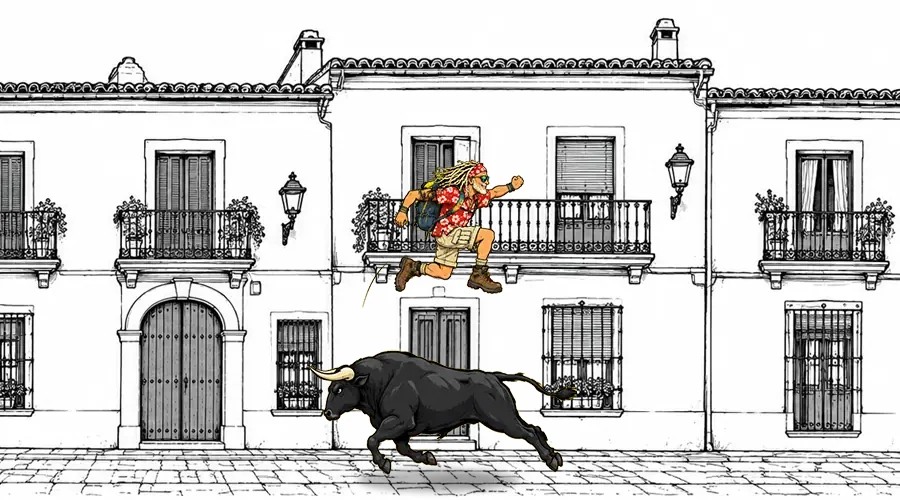
The Backpackers Bible guru, a dreadlocked backpacker in a Hawaiian shirt, leaping over a charging black bull on a cobbled street in Spain

Things To Do In Seville

Search Seville Attractions and Tours

Interactive tourist attraction and tour map for Seville showing things to do for backpackers.
Tours in Sevilleon GetYourGuide ↗
Discover the best things to do, attractions, and backpacker tours in Seville. Use two fingers to move the map, pinch to zoom.

1. The Cathedral, Alcázar & Giralda (Non-Negotiable)

Seville's three biggest sights sit within a five-minute walk of each other, and together they're as essential as anything else in Spain.

Seville Cathedral & The Giralda

The largest Gothic cathedral in the world, built directly over a former mosque, and home to Christopher Columbus's tomb. Climb the Giralda tower via a ramp rather than stairs — originally built so the muezzin could ride a horse to the top — for the single best rooftop view in the city. Entry from roughly €12.

The Real Alcázar

A still-functioning royal palace layered with over a thousand years of Moorish, Gothic, and Renaissance architecture — and, for anyone who's seen a certain fantasy TV series, instantly recognisable as the Water Gardens of Dorne. Book timed tickets online ahead; it sells out fast in peak season. Entry from roughly €14.

Read More

Metropol Parasol (Las Setas)

A vast wooden lattice structure — nicknamed "the mushrooms" — rising above the old town, with a rooftop walkway offering sweeping views over Seville's rooftops for a small fee, and a free public plaza and Roman-ruin museum underneath.

2. Adrenaline

Kayaking the Guadalquivir: Paddle the same river that once carried gold and silver galleons from the Americas, with the Torre del Oro and the city skyline as your backdrop.

Cycling the city on Sevici: Seville is one of the most bike-friendly cities in Spain, with dedicated lanes throughout — a fast, cheap way to cover more ground than on foot.

Horseback riding and carriage tours: A more old-fashioned way to see the city, with routes running through Parque de María Luisa and past Plaza de España.

3. Triana & The River

Most visitors stick to Santa Cruz and never properly cross the river — a genuine mistake, since Triana is where a lot of Seville's real character lives.

Triana Market & The Ceramics Quarter

A working food market built over the foundations of a Moorish castle, surrounded by workshops still producing Triana's famous hand-painted azulejo tiles — a genuine slice of daily life away from the tourist trail.

Sunset on the Puente de Triana

The bridge connecting Triana to the old town is free, always busy at golden hour, and gives you the classic postcard view back across the river to the Torre del Oro and the cathedral.

4. Free Seville (Zero Euros)

Plaza de España: A vast, ornate semicircular plaza built for the 1929 Ibero-American Exposition — free to wander and one of the most photogenic public spaces in Spain.

Metropol Parasol's ground level and Roman ruins: The plaza underneath "the mushrooms," along with the small archaeological site beneath it, costs nothing to explore.

Wandering Santa Cruz and Triana: Both neighbourhoods reward aimless wandering more than any single paid attraction.

Parque de María Luisa: Seville's main green space, shaded and genuinely pleasant even in summer heat, and completely free to enter.

5. Nightlife: How It Actually Works

Seville nights run late even by Spanish standards, especially in summer when the heat pushes everything back — dinner from 10pm, bars from 11:30pm, and the streets still busy at 3am.

For flamenco

Triana's peñas offer something rawer and more authentic than a tourist-oriented tablao show — smaller rooms, less choreography, and a genuinely intense atmosphere if you catch a good night.

For a first drink

Alameda de Hércules is the obvious starting point — a long plaza lined with bars and a young, mixed crowd well into the night.

For something more local

Triana's bars are quieter, cheaper, and considerably more local than anything near the cathedral — a good pick if you want a night out that doesn't feel built entirely for visitors.

6. The Big Hits (Things You Must Not Skip)

Plaza de España

Already covered above under Free Seville, but it bears repeating — this is the single most photographed spot in the city, and deservedly so.

Casa de Pilatos

A 16th-century noble palace blending Renaissance and Mudéjar styles, with some of the best-preserved tiled courtyards in the city and a fraction of the Alcázar's crowds.

The Torre del Oro

A 13th-century Moorish watchtower on the riverbank, once used to control access to the port during Seville's gold-and-silver trading heyday — now a small maritime museum and a great sunset spot.

The Plaza de Toros (Real Maestranza)

One of Spain's oldest and most important bullrings, and a genuine architectural landmark whether or not you choose to attend an actual bullfight — a deeply divisive tradition even within Spain, and entirely your own call.

7. Live Sport

Sevilla FC vs Real Betis — El Gran Derbi: One of the fiercest local derbies in Spanish football, and if your dates line up with a match, this is Seville at its loudest and most passionate. Even a non-derby league game is a genuinely good, comparatively affordable way to catch live La Liga football.

Semana Santa & The Feria de Abril: Not sport, but the two defining live events of the Seville calendar — see the section above for the full detail. If either lines up with your trip, build your whole visit around it.

Cartoon of a backpacking guru in Seville

Top-Rated Seville Tours on GetYourGuide.com

ALCÁZAR GARDENS | By Mihael Grmek - Own work, CC BY-SA 3.0, Link

Budget Accommodation In Seville

Hostels listed on Booking.com and Hostelworld

For our pick of Seville's top hostels, see

For a full list of hostels, see our

Where Do You Want To Go Next?