

Welcome to my backpacking guide to Galicia!

Discover more

Backpacking Galicia

[gah-LEE-thyah]

Show someone a photo of rural Galicia without telling them where it is, and most people will guess Ireland. Green hills roll down to a rugged, inlet-carved coastline, it rains more here than almost anywhere else in the country, and the local Celtic festival calendar treats bagpipes as a serious instrument, not a novelty act. This is the Spain that never got the memo about flamenco and relentless sunshine — and for backpackers willing to trade a tan for something genuinely different, it might be the most rewarding corner of the whole country.

Most people who've heard of Galicia know it as the endpoint of the Camino de Santiago, and if a long walk to a cathedral is your plan, we've got a dedicated guide coming for exactly that. But Galicia is a full region in its own right, worth visiting on its own merits — a rugged Atlantic coastline of hidden beaches and dramatic cliffs, some of the best seafood anywhere in Spain (this is where pulpo a la gallega, octopus with paprika and olive oil, actually comes from), and a Celtic heritage that shows up in the music, the place names, and a culture that feels genuinely distinct from the rest of the country.

On cost, Galicia is one of the best-value regions left for backpacking Spain — noticeably cheaper than the Basque Country or Barcelona, with far fewer tourists competing for hostel beds outside the Camino's final stretch into Santiago. It's an easy region to explore slowly and cheaply, which suits its unhurried, food-and-nature-first character perfectly.

Read More

What Kind of Place Is This, Exactly?

Galicia occupies the northwestern corner of Spain, bordered by Portugal to the south and the Atlantic Ocean to the north and west, split into four provinces — A Coruña, Lugo, Ourense, and Pontevedra. Its defining geographic feature is the rías: deep, drowned river valleys that carve the coastline into fjord-like inlets, splitting into the Rías Altas in the north and the more sheltered, beach-lined Rías Baixas in the south. It's also, reliably, the rainiest region in Spain — a fact that explains why everything here is so relentlessly green.

A Short History: Celts, Saints, and a Very Famous Tomb

Galicia's pre-Roman inhabitants, the Gallaeci, were a Celtic people, and that heritage still shapes the region's identity more than almost anywhere else in Spain — in the music, the place names, even a lingering sense of separateness from the rest of the country. The single event that shaped Galicia's next thousand years came in the early 9th century, with the claimed discovery of the tomb of the Apostle James in what became Santiago de Compostela — instantly making it one of Christendom's three great pilgrimage destinations, alongside Jerusalem and Rome, and building an economy and identity around pilgrimage that persists to this day.

Galicia also has one of the highest historic emigration rates of any Spanish region — poverty and limited opportunity drove huge waves of Galicians abroad, particularly to Latin America, and the diaspora (and its remittances) shaped the region's culture and economy for generations. Worth knowing, too: Francisco Franco was born in the Galician city of Ferrol in 1892, a fact the region itself has a complicated relationship with.

The Language You'll Hear

Galician (Galego) is co-official alongside Spanish, and it's genuinely closer to Portuguese than to Castilian — the two languages share a common medieval ancestor, Galician-Portuguese. It's widely spoken, especially in rural areas and by older generations, and carries real cultural pride. Spanish will get you everywhere as a visitor.

Understanding Galicia: The Zones

Santiago de Compostela

The region's spiritual and administrative capital, built around its enormous cathedral and a genuinely lively university-town atmosphere that has nothing to do with pilgrimage. Worth visiting whether or not a single step of the Camino is part of your trip.

A Coruña

Galicia's largest city, with a proper city beach right in the centre and the Tower of Hercules — a still-functioning Roman lighthouse and the oldest of its kind in the world. A modern, coastal, distinctly un-touristy feel.

The Rías Baixas

A string of stunning estuary coastlines south of Santiago, home to Albariño — Spain's best-known white wine — and the Cíes Islands, a protected archipelago with turquoise water and white sand so striking it's regularly ranked among the best beaches in the world.

The Costa da Morte ("Coast of Death")

A wild, dramatic stretch of Atlantic coastline north of Santiago, named for the centuries of shipwrecks its rocks and currents have claimed. Genuinely spectacular, genuinely rugged, and a world away from Spain's more manicured southern coasts.

Lugo & The Green Interior

Lugo's fully intact Roman wall — the only one of its kind still standing complete around an entire old town — is a genuine, underrated wonder. Beyond it, rolling green countryside, cider culture, and a slower pace than the coast.

Galicia FAQs for Backpackers

When is the best time to go?

June to September gives you the best odds of dry weather, though be honest with yourself: it can, and does, rain here even in high summer. Pack for it regardless of your dates.

Do I need to be walking the Camino to visit Galicia?

Not at all — Galicia is a complete destination on its own, and plenty of backpackers visit without walking a single stage. If a Camino trek is part of your plan, keep an eye out for our dedicated Camino de Santiago guide for full route, stage, and albergue detail.

What's the seafood scene actually about?

Genuinely the best in Spain, and worth planning meals around. Pulpo a la gallega (boiled octopus with paprika and olive oil) is the signature dish; percebes (goose barnacles, a genuine local delicacy) and a proper mariscada (mixed seafood platter) are both worth seeking out, especially around the Rías Baixas.

Do I need to speak Spanish or Galician?

Spanish covers you everywhere. English is spoken less widely here than in Barcelona or Madrid, particularly outside Santiago, so a little Spanish helps.

How do I get around?

Trains and buses connect Santiago, A Coruña, Vigo, and Lugo reliably. The coast, especially the Rías Baixas and Costa da Morte, is best explored by bus or rental car, since public transport thins out fast once you leave the main cities.

Is the tap water safe?

Yes, throughout Galicia. Perfectly safe to drink.

Is Galicia safe?

Yes — genuinely one of the safest, lowest-crime regions in Spain. See our full safety section below.

Staying Safe & Travelling Well in Galicia

Galicia is a low-crime, low-hassle region for backpackers — noticeably calmer than Barcelona or Madrid, with no pickpocketing reputation to speak of. The main things worth planning around here are weather and the coastline itself, not crime.

The Coast Can Be Genuinely Dangerous

The Costa da Morte earned its name honestly — strong currents, sudden swells, and rocky shorelines have claimed ships and swimmers alike for centuries. Respect any flag warnings, don't swim at unpatrolled beaches in rough conditions, and take local advice seriously on this stretch of coast in particular.

Weather and Layering

Galicia's rain isn't dangerous, but it catches out visitors who packed for stereotypical sunny Spain. Bring a proper waterproof layer whatever the season, and expect it to actually get used.

Camino Safety (In Brief)

If you're arriving via the Camino de Santiago, general hiking safety applies — proper footwear, sun and rain protection, and pacing yourself on the final stretches into the city. Full trail-specific safety advice will live on our dedicated Camino guide.

Petty Theft

A minimal issue here compared to Spain's bigger cities, though standard precautions are still sensible in Santiago's crowded cathedral square during peak pilgrim season.

Further Reading

Ready to map out the rest of your trip? For more general info on backpacking Spain, see our comprehensive home page. We also highly recommend checking out our backpacking advice section to make sure you stay safe and save money on the road. If you need help structuring your travel routes, take a look at our suggested itineraries for Spain. For more info on backpacking, including access to our offline app and interactive PDF guide, head over to our resources page.

Backpacking Galicia heraldic cartouche, showing the area's tourist attractions and 2 backpackers

Quick Facts

Best Time To Visit:
June to September for the best odds of dry weather — this is Spain's rainiest region year-round, so pack layers regardless.

Best For:
Seafood, wild Atlantic coastline, green landscapes, Celtic culture, and a genuinely sociable hostel scene.

Most Popular Experience:
A proper mariscada seafood platter overlooking one of the Rías Baixas.

Most Under-rated Experience:
The Costa da Morte — most visitors never leave Santiago long enough to see this wild, dramatic stretch of coast.

Best Free Experiences:
Santiago's cathedral square, A Coruña's city beach, Lugo's Roman wall walk, and wandering any Rías Baixas fishing village.

Ideal Stay:
5–7 days to cover Santiago, the coast, and at least one of the Rías without rushing.

Budget Level:
One of the best-value regions left in Spain. Expect roughly €35–€75 per day.

Getting Around:
Trains and buses connect the main cities reliably; a rental car is the best way to properly explore the coast.

Best Photo Spots:
Praza do Obradoiro at dawn, the Cíes Islands' turquoise water, the Tower of Hercules at sunset, and Lugo's intact Roman wall.
PAZO DE RAXOI, SANTIAGO DE COMPOSTELA | By sporras - Ayuntamiento de Santiago de Compostela.jpg, CC BY-SA 2.0, Link
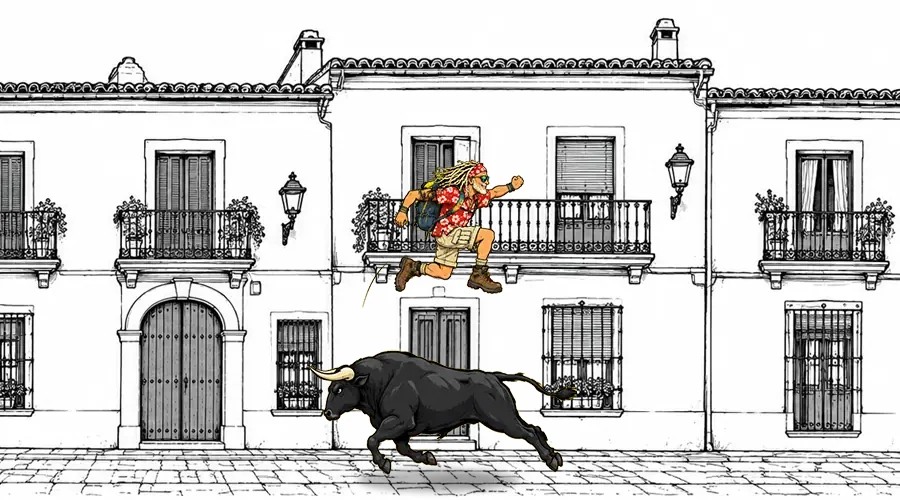
The Backpackers Bible guru, a dreadlocked backpacker in a Hawaiian shirt, leaping over a charging black bull on a cobbled street in Spain

Things To Do In Galicia

Search Madrid Attractions and Tours

Interactive tourist attraction and tour map for Madrid showing things to do for backpackers.
Tours in Galiciaon GetYourGuide ↗
Discover the best things to do, attractions, and backpacker tours in Galicia. Use two fingers to move the map, pinch to zoom.

1. Santiago's Cathedral & Old Town (Non-Negotiable)

Whether or not a single step of your trip involved walking, Santiago de Compostela's old town is worth building time around.

Santiago de Compostela Cathedral

A genuinely moving building regardless of your beliefs — Romanesque, Gothic, and Baroque layered on top of each other over centuries, and the reputed resting place of the Apostle James. Time your visit for a pilgrim's mass if you can, when the enormous botafumeiro incense burner sometimes swings the full length of the transept. Entry to the cathedral is free; the museum and rooftop tours cost extra.

Praza do Obradoiro & The Old Town

The grand square in front of the cathedral is where every pilgrim's journey ends, and it's worth simply sitting in it for a while to watch that happen. The surrounding old town — narrow granite streets, market halls, university buildings — rewards aimless wandering as much as any specific sight.

Read More

Walking any single stage of the Camino

You don't need to commit to the full trek to get a taste of it — walking even a short stretch into Santiago, alongside pilgrims who've come hundreds of kilometres, is a genuinely moving thing to do with a spare afternoon. For the full route, stages, and planning detail, look out for our dedicated Camino de Santiago guide.

2. Adrenaline

Surfing the Costa da Morte: Beaches like Pantín and Razo have a genuine, growing surf scene, with beginner lessons and board hire widely available.

Coasteering and cliff walks, Costa da Morte: Guided operators run cliff-scrambling and coasteering trips along this dramatic coastline — spectacular scenery with a real edge to it.

Kayaking the Rías: Paddle the calm, sheltered waters of the Rías Baixas past mussel rafts and fishing villages, with the option to land on a beach only reachable by boat.

3. The Rías Baixas & Cíes Islands

South of Santiago, the coastline softens into a string of estuaries and beaches that most backpackers touring Spain never make it far enough north to see.

The Cíes Islands

A protected Atlantic archipelago reachable by ferry from Vigo, with Rodas Beach — once named the best beach in the world by a major UK newspaper — as the headline attraction. Visitor numbers are capped, so book the ferry and any required access permit ahead in peak season.

Albariño Wine Country

The Rías Baixas produce Spain's best-known white wine, and several small bodegas around Cambados offer tastings — a relaxed, scenic way to spend an afternoon between beach stops.

4. Free Galicia (Zero Euros)

Praza do Obradoiro and Santiago's Old Town: Free to wander, and one of the most atmospheric squares in Spain, especially at dawn or dusk.

The Tower of Hercules, A Coruña: The exterior and surrounding coastal park cost nothing — climbing the still-functioning Roman lighthouse itself carries a small fee.

A Coruña's city beach: A proper sandy beach right in the centre of a major city, free and genuinely good.

Lugo's Roman wall: You can walk the entire 2km circuit of the still-intact wall around the old town for free — a genuinely unique way to see a city from above.

5. Nightlife: How It Actually Works

Santiago's nightlife runs on a university-town rhythm — busy, cheap, and studenty, especially during term time, with a completely different energy to the pilgrim crowds that fill the cathedral square by day.

For a first drink

The streets around Praza de Mazarelos and Rúa do Franco are packed with bars and tapas spots, popular with both students and pilgrims celebrating the end of their walk.

For something more local

A Coruña and Vigo both have solid, considerably less touristy bar scenes than Santiago, worth a night if your route takes you through either city.

For live Celtic music

Galicia's Celtic heritage is very much alive in its music — keep an eye out for live gaita (bagpipe) performances in bars and plazas, especially around festival season.

6. The Big Hits (Things You Must Not Skip)

Santiago de Compostela Cathedral

Already covered above, but it bears repeating — the single essential sight in the entire region.

The Tower of Hercules

The oldest working Roman lighthouse in the world, still guiding ships into A Coruña after nearly two thousand years.

The Cíes Islands

Covered in full above — one of the best beaches in Europe, and arguably the single best day trip in the whole region.

Lugo's Roman Wall

A genuinely unique, still-complete circuit of Roman fortification — one of the most underrated sights in Spain.

7. Live Sport & Culture

Celta Vigo and Deportivo La Coruña: Galicia's two biggest football clubs, both with passionate local followings — a genuinely good, comparatively affordable way to catch live La Liga or second-division football depending on the season.

The Ortigueira Celtic Music Festival: A major international Celtic music gathering held every July in the small coastal town of Ortigueira — bagpipes, folk music, and a genuinely surprising reminder of just how seriously Galicia takes its Celtic roots.

Backpacking Galicia cartoon - the travel guru plays bagpipes while a traditional Celtic musician puts his fingers in his ears

Top-Rated Galicia Tours on GetYourGuide.com

COUNTRYSIDE NEAR LUGO | By José Antonio Gil Martínez - originally posted to Flickr as Serra do Courel, CC BY 2.0, Link

Budget Accommodation In Galicia

Hostels listed on Booking.com and Hostelworld

For a full list of hostels, see our

Where Do You Want To Go Next?