

Welcome to my backpacking guide to Aragón!

Discover more

Backpacking Aragón

[ah-rah-GOHN]

Zaragoza sits almost exactly halfway between Madrid and Barcelona on Spain's high-speed rail line — which means most backpackers touring Spain fly straight over Aragón, or at best watch it slide past the train window at 300km/h without ever stopping. Meanwhile, one of the region's own provinces became so famous for being overlooked that its unofficial slogan, "Teruel Existe" ("Teruel Exists"), turned into an actual national political movement, protesting rural depopulation and winning real seats in Spanish parliament. Welcome to the most skippable-on-paper, most rewarding-in-person region in the entire country.

Zaragoza itself is a genuinely underrated big city — Spain's fifth-largest, built around one of the country's most important pilgrimage sites, with a tapas scene (centred on the aptly named "El Tubo" district) that holds up against Madrid or Seville at a fraction of the price. North of the city, the Aragonese Pyrenees hold some of the best, least crowded hiking in Spain at Ordesa y Monte Perdido National Park. South, in Teruel, you'll find UNESCO-listed Mudéjar towers, a genuinely huge dinosaur fossil scene, and a medieval love story so famous it's basically Spain's answer to Romeo and Juliet.

Cost-wise, Aragón is easy, affordable backpacking Spain territory — few international crowds outside Zaragoza itself, cheap hostels, and some of the best-value tapas anywhere in the country. A genuinely smart stopover if you're travelling between Madrid and Barcelona rather than just watching it go by.

Read More

What Kind of Place Is This, Exactly?

Aragón is made up of three provinces — Zaragoza, Huesca, and Teruel — stretching from the high Pyrenees in the north down through the fertile Ebro river valley to arid steppe in the south. That north-south range gives the region genuinely different landscapes and climates within a single afternoon's drive: snow-capped mountains, a green river valley, and near-desert plains.

A Short History: A Mediterranean Empire, Muslim Craftsmen, and a Ghost of the Civil War

The Kingdom of Aragón, founded around 1035, became genuinely significant history in 1137 when it united with the County of Barcelona to form the Crown of Aragón — a Mediterranean trading and military power that, at its peak, controlled Sicily, Naples, Sardinia, and briefly even Athens. Zaragoza itself dates back to Roman Caesaraugusta, named for Emperor Augustus, from which the modern city name eventually derives.

After the Reconquista, Aragón's Christian rulers kept employing Muslim craftsmen, producing the distinctive Mudéjar architectural style — intricate decorative brickwork found across the region and recognised as UNESCO World Heritage. Centuries later, Aragón became a major front line of the Spanish Civil War; George Orwell fought here with anti-fascist militias, an experience that shaped much of his book Homage to Catalonia, despite its title.

The Language You'll Hear

Mostly Castilian Spanish, though the region has genuine linguistic diversity that gets far less attention than Catalonia or the Basque Country: Aragonese (Aragonés) survives as a minority language in Pyrenean valleys, and Catalan is spoken in a narrow eastern strip near the Catalonia border known as La Franja. Neither has anywhere near the institutional support of their more famous neighbours.

Understanding Aragón: The Zones

Zaragoza

The regional capital and a genuinely underrated big city — home to the Basílica del Pilar (one of Spain's most important pilgrimage sites), the Aljafería (a rare surviving Moorish palace), and El Tubo, a dense tapas district that rivals anywhere in the country.

The Aragonese Pyrenees

Ordesa y Monte Perdido National Park delivers some of the best hiking in Spain, with dramatic canyons, waterfalls, and peaks over 3,000m — genuinely on par with the French Pyrenees, but with noticeably fewer crowds. Jaca is the classic mountain-town base.

Teruel

Home to UNESCO-listed Mudéjar towers, a genuinely major dinosaur fossil scene (complete with a dedicated theme park, Dinópolis), and the medieval legend of the Lovers of Teruel — a tragic real-history romance often compared to Romeo and Juliet, whose mummified remains are still displayed in a mausoleum in the city.

The Ebro Valley & Monasterio de Piedra

Wine country stretching along the Ebro river, home to the Monasterio de Piedra — a medieval monastery whose grounds hide a genuinely spectacular hidden park of waterfalls, caves, and lush greenery, a world away from the surrounding dry plains.

Aragón FAQs for Backpackers

When is the best time to go?

May, June, and September for Zaragoza and the Ebro valley — summers here get genuinely hot. For the Pyrenees, June to September gives the best hiking window, while winter (December–March) is ski season around Jaca.

Is Zaragoza worth stopping for, or should I just pass through?

Worth stopping for — even one night is enough to see the Basílica del Pilar, wander El Tubo, and get a genuine feel for a big Spanish city that most backpackers never bother with.

Is Teruel worth the detour?

Yes, if you have the time — the Mudéjar architecture is genuinely unique, and the mix of dinosaur fossils and medieval romance legend makes for a memorable, low-key stop that very few international backpackers ever add to their route.

Do I need to speak Spanish?

Spanish covers you everywhere. English is spoken reasonably well in Zaragoza's tourist areas, less so in Teruel and the smaller Pyrenean towns.

How do I get around?

Zaragoza sits directly on the Madrid–Barcelona AVE line, making it an easy add-on to that route. Buses connect Zaragoza to Teruel and the Pyrenean towns; a rental car opens up Ordesa and the smaller mountain villages considerably.

Is the tap water safe?

Yes, throughout Aragón. Perfectly safe to drink.

Is Aragón safe?

Yes — genuinely one of the safest, lowest-crime regions in Spain. See our full safety section below.

Staying Safe & Travelling Well in Aragón

Aragón is a low-crime, low-hassle region for backpackers, with no pickpocketing reputation to speak of. The genuine safety considerations here are about terrain and heat, split cleanly between the mountains and the plains.

Mountain Weather in the Pyrenees

Conditions in Ordesa and the wider Aragonese Pyrenees can shift fast, even in summer. Check forecasts before any serious hike, carry proper layers, and don't push on into deteriorating weather on exposed ridgelines.

Summer Heat in the Ebro Valley & Teruel

Zaragoza and the southern plains around Teruel get genuinely hot and dry in summer — drink more water than feels necessary and pace strenuous sightseeing around the cooler parts of the day.

Petty Theft

A minimal issue here compared to Spain's bigger cities, though standard precautions are still sensible around Zaragoza's busiest tourist streets and during the Fiestas del Pilar in October.

Further Reading

Ready to map out the rest of your trip? For more general info on backpacking Spain, see our comprehensive home page. We also highly recommend checking out our backpacking advice section to make sure you stay safe and save money on the road. If you need help structuring your travel routes, take a look at our suggested itineraries for Spain. For more info on backpacking, including access to our offline app and interactive PDF guide, head over to our resources page.

Backpacking Aragon illustration, with 2 backpackers and a globe map surrounded by the region's backpacking attractions.

Quick Facts

Best Time To Visit:
May, June, and September for Zaragoza and the valley; June to September for Pyrenees hiking; December to March for skiing.

Best For:
Underrated pilgrimage sites, Pyrenees hiking, Mudéjar architecture, and dinosaur fossils, all in one region.

Most Popular Experience:
Visiting the Basílica del Pilar and tapas-crawling El Tubo in Zaragoza.

Most Under-rated Experience:
Ordesa y Monte Perdido National Park — genuinely on par with the French Pyrenees, with far fewer people.

Best Free Experiences:
The Basílica del Pilar's plaza, the Aljafería's exterior, and wandering Zaragoza's El Tubo tapas district.

Ideal Stay:
3–5 days to cover Zaragoza and at least one day in the Pyrenees or Teruel.

Budget Level:
One of the cheapest regions in Spain. Expect roughly €30–€65 per day.

Getting Around:
Zaragoza sits directly on the Madrid–Barcelona AVE line; buses or a rental car are best for the Pyrenees and Teruel.

Best Photo Spots:
The Basílica del Pilar lit up at night, Ordesa's canyon views, Teruel's Mudéjar towers, and the Monasterio de Piedra's hidden waterfalls.
ZARAGOZA AND THE EBRO RIVER | By Paulo Brandao - originally posted to Flickr as Basilica del Pilar, sunset, CC BY 2.0, Link
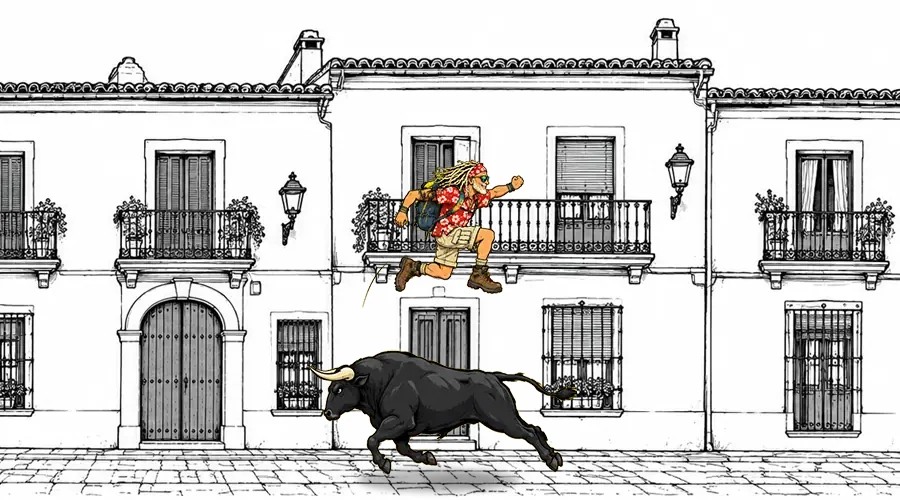
The Backpackers Bible guru, a dreadlocked backpacker in a Hawaiian shirt, leaping over a charging black bull on a cobbled street in Spain

Things To Do In Aragón

Search Aragon Attractions and Tours

Interactive tourist attraction and tour map for Aragon showing things to do for backpackers.
Tours in Aragonon GetYourGuide ↗
Discover the best things to do, attractions, and backpacker tours in Aragon. Use two fingers to move the map, pinch to zoom.

1. The Basílica del Pilar & Zaragoza's Old City (Non-Negotiable)

Zaragoza's old city is compact enough to see properly in a day, and unusual enough to justify staying longer.

The Basílica del Pilar

One of Spain's most important pilgrimage sites and a genuinely enormous Baroque basilica dominating the Ebro riverfront — climb the tower for sweeping views over the city, and don't miss the small chapel said to hold the original pillar the Virgin Mary appeared beside.

The Aljafería Palace

A rare surviving 11th-century Moorish palace, later repurposed by Christian and Aragonese royalty — the northernmost Islamic-era palace in Europe, and a genuinely stunning example of the intricate stucco work that would later influence Mudéjar architecture across the region.

Read More

The Roman Walls & La Seo Cathedral

Fragments of Zaragoza's original Roman walls survive near the river, and La Seo Cathedral just off Plaza del Pilar blends Mudéjar, Gothic, and Baroque styles into one genuinely striking building.

2. Adrenaline

Hiking and via ferrata in Ordesa: Ordesa y Monte Perdido National Park delivers some of the best hiking in Spain, with routes for everyone from casual day-walkers to serious mountaineers, plus several protected via ferrata routes for a cable-assisted scramble.

White-water rafting the Gállego River: The Pyrenean foothills near Huesca offer genuinely excellent rafting, with routes suited to both complete beginners and more experienced paddlers.

Skiing Formigal and Candanchú: Two of Spain's best ski resorts sit in the Aragonese Pyrenees, generally quieter and cheaper than their French counterparts just over the border.

3. Teruel's Mudéjar Towers & Dinópolis

Most backpackers never make it this far south, which is exactly why Teruel is worth the detour.

The Mudéjar Towers

Four UNESCO-listed Mudéjar bell towers rise above Teruel's old town, intricate brick-and-tile masterpieces built by Muslim craftsmen for Christian churches after the Reconquista — a genuinely unique architectural fusion found almost nowhere else in the world.

Dinópolis

Teruel province is a genuinely major dinosaur fossil site, and Dinópolis — part museum, part theme park — makes the most of it, a fun, slightly unexpected stop if you want a break from churches and city walls.

4. Free Aragón (Zero Euros)

Plaza del Pilar: Zaragoza's vast central square, and the basilica's exterior, cost nothing to admire, day or night.

The Aljafería's exterior and gardens: The surrounding grounds are free to walk, even if you skip the paid interior tour.

Teruel's Mudéjar towers: All four are free to view and photograph from the street.

El Tubo: Wandering Zaragoza's dense tapas district costs nothing beyond whatever you choose to eat and drink along the way.

5. Nightlife: How It Actually Works

Zaragoza's nightlife runs through tapas first — El Tubo is a genuine bar-hopping institution, and locals treat a proper night out as a slow crawl between small plates and glasses of wine rather than a single destination bar.

For a first drink

El Tubo's narrow lanes are packed with tapas bars built for exactly this kind of evening — order small, move often, repeat.

For clubbing

Zaragoza has a genuinely decent late-night scene for a city its size, concentrated around the areas just off the old town.

During the Fiestas del Pilar

If your dates land in early-to-mid October, Zaragoza transforms entirely — one of Spain's biggest city festivals, with parades, concerts, and an atmosphere that spills into every bar in town.

6. The Big Hits (Things You Must Not Skip)

The Basílica del Pilar

Already covered above, but it bears repeating — the single essential sight in the entire region.

Ordesa y Monte Perdido National Park

Covered in full above — some of the best, least crowded hiking anywhere in Spain.

Teruel's Mudéjar Towers

Covered in full above — a genuinely unique architectural style found almost nowhere else on Earth.

The Monasterio de Piedra

A medieval monastery whose grounds hide a spectacular hidden park of waterfalls and caves — one of the most surprising day trips in the whole region.

7. Live Sport & Culture

Real Zaragoza: The region's biggest football club, with a loyal local following — a genuinely good, comparatively affordable way to catch live Spanish football depending on the division that season.

The Fiestas del Pilar: Zaragoza's biggest annual festival, held every October in honour of the city's patron saint — parades, giant papier-mâché figures, concerts, and a citywide party atmosphere genuinely worth timing a visit around.

Backpacking Aragon cartoon - our travel guru looking at a portrait of Catherine of Aragon

Top-Rated Aragón Tours on GetYourGuide.com

LOARRE CASTLE | By Joachim Quandt - originally posted to Flickr as PA010057, CC BY-SA 2.0, Link

Budget Accommodation In Aragón

Hostels listed on Booking.com and Hostelworld

For a full list of hostels, see our

Where Do You Want To Go Next?