

Welcome to my backpacking guide to Toledo!

Discover more

Backpacking Toledo

[toh-LEH-doh]

Toledo has a marketing problem: it's so close to Madrid (thirty minutes by train) that almost everyone treats it as a day trip, does the cathedral, buys an overpriced souvenir sword, and leaves by 4pm — completely missing the city that actually exists once the tour buses go. And the swords are real, by the way: Toledo steel has armed soldiers for two thousand years, and if you've ever admired a blade on Game of Thrones, there's a genuine chance it was forged right here.

Toledo was Spain's capital until 1561, and it looks like it — a dense, dramatic medieval city built on a granite hill almost completely encircled by a gorge of the Tagus River, Spain's longest waterway. For backpackers coming off a Madrid stay, it's the single easiest overnight add-on in the country: cheap, walkable, and genuinely atmospheric after dark, once the day-trip crowds have thinned out and the old city belongs to whoever's actually staying the night.

Cost-wise, this is easy backpacking Spain territory — hostels, food, and drinks all priced well below Madrid, with none of the compromise on history or atmosphere. Stay one night, and you'll understand instantly why every backpacker who does gets slightly annoyed at everyone who treats it as a rushed afternoon out.

Read More

What Kind of Place Is This, Exactly?

Toledo sits roughly 70km south of Madrid, in the province it gives its name to, within the autonomous community of Castilla-La Mancha. The old city occupies a granite outcrop wrapped on three sides by a deep gorge cut by the Tagus River — a natural fortress that made it one of the most strategically important cities in Iberian history, and today makes for some of the most dramatic skyline views of any city in Spain.

A Short History: Roman Fortress, Visigothic Capital, City of Three Cultures

Toledo's defensive setting made it valuable from the start — the Romans knew it as Toletum, and it later became the capital of the Visigothic Kingdom that ruled Spain before the Moorish conquest of 711. Reconquered relatively early, in 1085, Toledo entered its most remarkable era: for the next few centuries, Christian, Muslim, and Jewish communities lived, worked, and collaborated here in a way genuinely rare for medieval Europe, with the city's School of Translators rendering classical Greek and Arabic texts into Latin at a scale that helped fuel the later European Renaissance.

Toledo remained Spain's capital until 1561, when Philip II moved the royal court to Madrid — partly because Toledo's hilltop site left little room to expand a growing imperial bureaucracy, and partly because Madrid's flatter, more central location suited the crown better. Toledo never fully recovered its political status, which is precisely why so much of its medieval and Renaissance character survives intact today.

The Swords You Came Here to See

Toledo's reputation for blade-making genuinely dates to Roman times, when Toledo steel armed Roman legions, and continued through the medieval period as Toledo blades became prized across Europe. A handful of workshops still forge swords by hand using traditional methods, and Toledo-made blades have supplied film and television productions, including work for HBO's Game of Thrones — a fact the local sword shops are, understandably, very happy to remind you of.

The Language You'll Hear

Just Castilian Spanish. English is spoken reasonably well around the main tourist sights, less so once you're away from them.

Understanding Toledo: The Zones

The Cathedral Quarter

The dense knot of streets around the Primatial Cathedral — Toledo's archbishop holds the title of Primate of Spain, the country's senior Catholic clergyman, which tells you everything about how seriously this building was once taken. Plazas, tapas bars, and sword shops radiate outward from here.

The Jewish Quarter (Judería)

A maze of narrow lanes holding two surviving medieval synagogues and the El Greco Museum — the quietest, most atmospheric part of the old city, especially once evening falls.

San Juan de los Reyes & The City Walls

A Franciscan monastery built by Ferdinand and Isabella to commemorate their victory in a key Reconquista battle, near the dramatic Puerta de Bisagra and Puerta del Sol city gates.

Across the Tagus: The Miradores

The viewpoints across the gorge — particularly the Mirador del Valle — deliver the classic postcard shot of Toledo's skyline, and are dramatically better at sunset than at any tour-bus hour of the day.

The Alcázar & Zocodover

A hilltop fortress-palace, now a military museum, overlooking Zocodover — Toledo's lively main square and the natural centre of the old city's day-to-day life.

Toledo FAQs for Backpackers

Should I do Toledo as a day trip or stay overnight?

Stay overnight if you can — a day trip from Madrid covers the big sights, but Toledo after dark, once the crowds have gone home, is a genuinely different and better experience.

How do I buy a sword without getting ripped off?

Genuine handmade Toledo blades come from specific workshops (several offer factory visits) and cost considerably more than the mass-produced tourist versions sold in most souvenir shops. If authenticity matters to you, ask directly whether a piece was hand-forged in Toledo or ask staff to point you to a workshop that does its own forging.

How do I get there from Madrid?

A high-speed train from Madrid's Atocha station takes roughly 30 minutes, making Toledo one of the easiest and fastest day-trip-or-overnight add-ons from the capital.

Where's the best photo spot, and how do I get there?

The Mirador del Valle, across the gorge from the old city — it's a genuine walk or a short taxi/bus ride from the centre, not somewhere you'll stumble onto by accident, so plan the trip out deliberately, ideally for sunset.

Do I need to speak Spanish?

English covers you around the main sights; a little Spanish helps everywhere else.

Is the tap water safe?

Yes, throughout Toledo. Perfectly safe to drink.

Is Toledo safe?

Yes — genuinely one of the safest, lowest-crime cities in Spain. See our full safety section below for the one real practical consideration: the terrain.

Staying Safe & Travelling Well in Toledo

Toledo is a low-crime, low-hassle city for backpackers, with no pickpocketing reputation to speak of. The genuine practical considerations here are about terrain and heat, not people.

Steep, Uneven Medieval Streets

The old city is built on a hill with narrow, steep, unevenly cobbled streets throughout — comfortable, sturdy footwear matters more here than in almost any other Spanish city on this site.

Summer Heat

Toledo's exposed hilltop position means summer heat can be intense, with little shade in the busiest tourist areas — carry water and pace your sightseeing during the hottest hours of the day.

Petty Theft

A minimal issue here compared to Spain's bigger cities, though standard precautions are still sensible around the busiest sights during peak day-trip hours.

Further Reading

Ready to map out the rest of your trip? For more general info on backpacking Spain, see our comprehensive home page. We also highly recommend checking out our backpacking advice section to make sure you stay safe and save money on the road. If you need help structuring your travel routes, take a look at our suggested itineraries for Spain. For more info on backpacking, including access to our offline app and interactive PDF guide, head over to our resources page.

Backpacking Toledo heraldic cartouche, showing 2 backpackers and a globe map, surrounded by the city's tourist attractions.

Quick Facts

Best Time To Visit:
May, June, and September for the most comfortable weather — Toledo's exposed hilltop position makes summer genuinely intense.

Best For:
Medieval streets, a genuine sword-making tradition, cathedrals, and staying overnight once the day-trip crowds have gone.

Most Popular Experience:
Wandering the Cathedral Quarter and the Judería, buying a genuine hand-forged sword.

Most Under-rated Experience:
The Mirador del Valle at sunset — most day-trippers leave before they'd ever see it.

Best Free Experiences:
Wandering the old city streets, walking the exterior of the city walls, and viewing the Mirador del Valle skyline.

Ideal Stay:
1–2 nights — enough time to see the sights and experience the old city after the day-trippers leave.

Budget Level:
Noticeably cheaper than Madrid. Expect roughly €30–€60 per day.

Getting Around:
A 30-minute high-speed train connects Toledo directly to Madrid's Atocha station; the compact old city itself is entirely walkable.

Best Photo Spots:
The Mirador del Valle at sunset, the cathedral's spires from Zocodover, the Alcázar above the gorge, and the Judería's narrow lanes at dusk.
THE TARGUS RIVER FLOWING THROUGH TOLEDO | By Dmitry Dzhus from London - Toledo, CC BY 2.0, Link
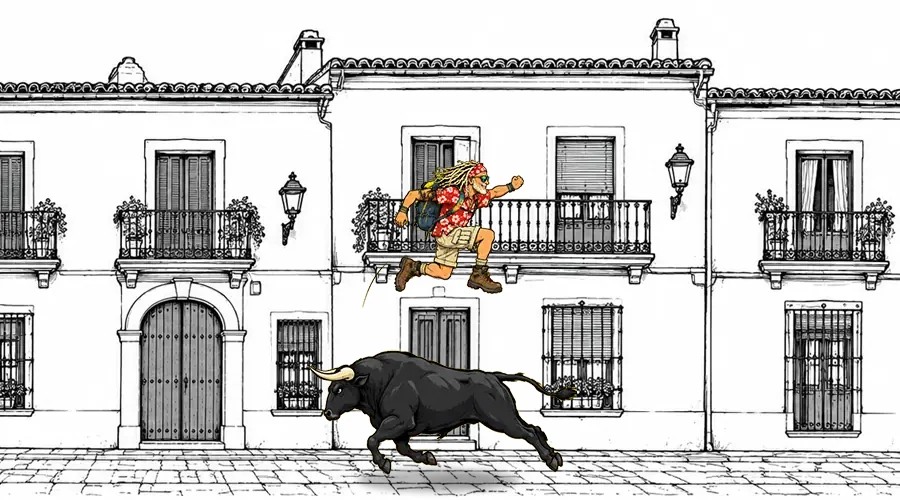
The Backpackers Bible guru, a dreadlocked backpacker in a Hawaiian shirt, leaping over a charging black bull on a cobbled street in Spain

Things To Do In Toledo

Search Toledo Attractions and Tours

Interactive tourist attraction and tour map for Toledo showing things to do for backpackers.
Tours in Toledoon GetYourGuide ↗
Discover the best things to do, attractions, and backpacker tours in Toledo. Use two fingers to move the map, pinch to zoom.

1. The Cathedral & El Greco (Non-Negotiable)

Toledo's flagship sights are all within a short walk of each other, and together they justify a full day on their own.

Toledo Cathedral

The seat of the Primate of Spain and one of the great Gothic cathedrals of the country, packed with El Greco paintings and an enormous gilded altarpiece. Entry from roughly €12.

Santo Tomé & The Burial of the Count of Orgaz

A small, unassuming church holding one enormous payoff — El Greco's masterpiece, painted specifically for this space and still hanging exactly where it was installed in 1588. Entry from roughly €4.

Read More

The El Greco Museum

A collection of the artist's work housed in a recreation of a period Toledo home, in the heart of the Judería — a good next stop after Santo Tomé if you want more of his distinctive, elongated style.

2. Adrenaline

Zip-lining across the Tagus gorge: A genuine zip-line attraction lets you fly across the gorge that wraps Toledo's old city — a fun, slightly absurd way to see the skyline from an angle almost nobody else gets.

Kayaking the Tagus: Paddle the river at the base of the gorge, looking straight up at the old city walls from a viewpoint most visitors never see.

E-bike tours of the gorge rim: Cover more ground than on foot, looping around the miradors and city walls at a manageable pace even in summer heat.

3. Sword Workshops & The Judería

Beyond the cathedral crowds, this is where Toledo's other great tradition — and its quietest, most atmospheric neighbourhood — actually live.

A Working Sword Workshop

Several traditional forges around the city still hand-make blades using centuries-old methods, and some offer short demonstrations or factory visits — genuinely worth seeking out over the mass-produced tourist versions.

The Jewish Quarter (Judería)

A maze of narrow lanes holding two surviving medieval synagogues, Santa María la Blanca and El Tránsito — the quietest, most atmospheric part of the old city, especially once evening falls and the day-trippers have gone.

4. Free Toledo (Zero Euros)

The Mirador del Valle: Free to walk or bus to, and delivers the single best skyline view of the entire city — best at sunset.

The city walls and gates: Puerta de Bisagra and Puerta del Sol cost nothing to admire from outside, and the surrounding walk along the old walls is genuinely scenic.

Wandering the Judería and the old city: No admission fee attached to simply getting lost in Toledo's medieval streets, which is arguably the best thing to do here regardless of budget.

Zocodover: Toledo's lively main square costs nothing to sit in and watch the city go by.

5. Nightlife: How It Actually Works

This is the whole point of staying overnight: once the day-trip coaches leave in the late afternoon, Toledo empties out dramatically, and the old city takes on a completely different, quieter, more atmospheric character.

For a first drink

The streets around Zocodover and the Cathedral Quarter have a good, low-key selection of tapas bars — perfect for a slow evening rather than a big night out.

For atmosphere over volume

A walk through the empty, lantern-lit Judería after dinner is genuinely one of the best "nightlife" experiences in the city — no bar required.

6. The Big Hits (Things You Must Not Skip)

Toledo Cathedral

Already covered above, but it bears repeating — the single essential sight in the city.

The Alcázar

A hilltop fortress-palace, now a military museum, with sweeping views across the city and the gorge below.

San Juan de los Reyes

A Franciscan monastery built by Ferdinand and Isabella to commemorate a key Reconquista victory — genuinely one of the finest examples of Isabelline Gothic architecture in Spain.

The Mirador del Valle

Covered in full above — the single best photo opportunity in the entire city.

7. Live Sport & Culture

Corpus Christi in Toledo: One of the most elaborate Corpus Christi celebrations anywhere in Spain — the entire old city is draped in awnings and scented herbs, and a solid-silver monstrance so heavy it takes several men to carry is processed through streets lined with crowds. Genuinely spectacular if your dates line up (moveable feast, roughly late May to June).

Local football: Toledo's regional club offers an affordable, low-key way to catch live Spanish football if the timing works out — not the big leagues, but a genuine local matchday atmosphere.

A cartoon about Toledo - our guru is holding a sword that he has bpught, while two backpackers look on in alarm.

Top-Rated Toledo Tours on GetYourGuide.com

Budget Accommodation In Toledo

Hostels listed on Booking.com and Hostelworld

For a full list of hostels, see our

Where Do You Want To Go Next?