


Welcome to my backpacking guide to Castilla-La Mancha!

Discover more

Backpacking Castilla-La Mancha

[kas-TEE-yah lah MAHN-chah]

Don Quixote spent an entire novel charging at windmills across this exact landscape, and four centuries later, the windmills are still here — lined up along ridgelines above small whitewashed towns, looking exactly as improbable and exactly as photogenic as Cervantes described them. Castilla-La Mancha is the setting of the most famous novel ever written in Spanish, the source of the cheese you've definitely already eaten (queso manchego), and, almost unbelievably, the single largest wine-growing region on Earth by planted area — bigger than Bordeaux and Rioja combined. And most backpackers touring Spain know it only as "the place with Toledo," if they know it at all.

South of Madrid, the landscape opens out into vast, flat, dramatic plains — a different kind of "big sky" scenery than anywhere else on a typical backpacking Spain route, dotted with the odd hilltop castle or row of windmills breaking the horizon. Toledo, the former capital and one of the most historically important cities in the country, is the obvious anchor point, but the windmill towns, the cliff-edge houses of Cuenca, and a wine region the size of a small country are all genuinely worth building extra days around.

On cost, this is easy, affordable territory for backpackers — few crowds outside Toledo itself, cheap hostels, and some of the best-value wine tasting in the entire country. A genuinely underrated add-on to any Madrid-based trip.

Read More

What Kind of Place Is This, Exactly?

Castilla-La Mancha stretches across the southern Meseta, directly south and east of Madrid, made up of five provinces: Albacete, Ciudad Real, Cuenca, Guadalajara, and Toledo. The name "La Mancha" likely comes from an old Arabic or Mozarabic term for a dry, parched plain — an accurate description of the region's flat, arid, wide-open landscape, a genuine contrast to the greener plateau of Castile y León to the north.

A Short History: A Former Capital, Three Cultures, and a Fictional Knight

Toledo was Spain's capital until 1561, when Philip II moved the royal court to Madrid largely because it was more geographically central and politically neutral. For centuries before that, Toledo was genuinely remarkable as the "City of Three Cultures" — Christians, Muslims, and Jews lived and worked alongside each other, and the city's famous School of Translators became one of medieval Europe's most important intellectual engines, rendering classical Greek and Arabic texts into Latin at a pace that helped fuel the later European Renaissance. That coexistence ended with the 1492 expulsion of Spain's Jewish population and later, harsher measures against Muslim communities.

A few decades later, in 1605, Miguel de Cervantes published Don Quixote, explicitly setting it in "a village in La Mancha whose name I do not care to remember" — and in doing so made this exact stretch of plains and windmills one of the most famous literary landscapes on Earth.

The Language You'll Hear

Just Castilian Spanish here — like Castile y León to the north, this is another region with no separate regional-language debate at all. English is spoken reasonably well in Toledo's tourist areas, less so elsewhere.

Understanding Castilla-La Mancha: The Zones

Toledo

The former capital, perched dramatically above a bend in the Tagus River — a maze of narrow medieval streets holding a genuinely spectacular Gothic cathedral, the Alcázar fortress, and Santo Tomé church, home to El Greco's masterpiece The Burial of the Count of Orgaz. A popular day trip from Madrid, but staying a night lets you see the old city once the day-trip crowds have gone — a completely different, much quieter atmosphere.

The Windmills of Consuegra & Campo de Criptana

Rows of whitewashed 16th-century windmills along hilltop ridges, exactly as Cervantes described them — Consuegra's row of twelve is the most famous and most photographed, with several open to walk inside.

Cuenca

A dramatic hilltop town famous for its casas colgadas — "hanging houses" built directly into the edge of a sheer gorge, seemingly defying gravity. A UNESCO World Heritage site, and one of the most striking townscapes anywhere in Spain.

La Mancha Wine Country

The single largest wine-growing region on Earth by planted area — bigger than Bordeaux and Rioja combined — centred around towns like Valdepeñas, with genuinely excellent, genuinely affordable tastings on offer.

Las Lagunas de Ruidera

A surprising chain of turquoise lakes and waterfalls strung across the otherwise flat, dry plains — a genuinely unexpected natural feature, and a popular kayaking and swimming spot in summer.

Castilla-La Mancha FAQs for Backpackers

When is the best time to go?

May, June, and September give you the best sightseeing weather. Summers on these open plains are genuinely brutal — expect regular 38–40°C days in July and August, with no coastline to cool things down.

Should I visit Toledo as a day trip or stay overnight?

A day trip from Madrid covers the highlights, but staying one night lets you experience the old city after the tour buses leave — genuinely worth it if you have the time.

Can I visit the windmills without a tour?

Yes — Consuegra and Campo de Criptana are both reachable by regional bus from Toledo or Madrid, though a guided day trip or rental car makes combining several windmill towns in one day much easier.

Do I need to speak Spanish?

Spanish covers you everywhere. English is spoken reasonably well in Toledo's tourist centre, less so in the smaller windmill towns and wine country.

How do I get around?

Toledo is a fast, frequent half-hour train from Madrid. The windmill towns, Cuenca, and the wine country are best reached by bus (limited) or rental car.

Is the tap water safe?

Yes, throughout the region. Perfectly safe to drink.

Is Castilla-La Mancha safe?

Yes — genuinely one of the safest, lowest-crime regions in Spain. See our full safety section below for the one real seasonal consideration: the heat.

Staying Safe & Travelling Well in Castilla-La Mancha

Castilla-La Mancha is a low-crime, low-hassle region for backpackers, with no pickpocketing reputation to speak of. The genuine safety consideration here is the region's exposed, arid climate.

Summer Heat on the Open Plains

With no coastline and very little shade across the open Meseta, summer heat here is genuinely intense. Drink far more water than feels necessary, avoid strenuous sightseeing between roughly 2pm and 6pm in July and August, and wear proper sun protection if you're visiting the windmills or Ruidera's lakes.

Toledo's Steep, Uneven Streets

Toledo's medieval old city is built on a steep hill with narrow, uneven cobbled streets — comfortable, sturdy footwear matters more here than in most Spanish cities.

Petty Theft

A minimal issue here compared to Spain's bigger cities, though standard precautions are still sensible around Toledo's busiest tourist streets in peak season.

Further Reading

Ready to map out the rest of your trip? For more general info on backpacking Spain, see our comprehensive home page. We also highly recommend checking out our backpacking advice section to make sure you stay safe and save money on the road. If you need help structuring your travel routes, take a look at our suggested itineraries for Spain. For more info on backpacking, including access to our offline app and interactive PDF guide, head over to our resources page.

Backpacking Castilla La Mancha heraldic cartouche, an illustration with a backpacking couple surrounded by the regions tourist attractions.

Quick Facts

Best Time To Visit:
May, June, and September for the most comfortable weather — summer heat on these open plains is genuinely brutal.

Best For:
Windmills, Toledo's old city, cheap wine, and one of the most iconic literary landscapes in the world.

Most Popular Experience:
Wandering Toledo's old city after the day-trip crowds from Madrid have gone home.

Most Under-rated Experience:
Cuenca's hanging houses — most visitors do Toledo and never make it further into the region.

Best Free Experiences:
Wandering Toledo's old city, viewing the Consuegra windmills, and admiring Cuenca's hanging houses from the gorge below.

Ideal Stay:
3–4 days to cover Toledo and at least one windmill town without rushing.

Budget Level:
One of the cheapest regions in Spain. Expect roughly €30–€65 per day.

Getting Around:
A half-hour train connects Toledo to Madrid; buses or a rental car are best for the windmill towns, Cuenca, and wine country.

Best Photo Spots:
The Consuegra windmills at golden hour, Toledo's skyline from across the Tagus, Cuenca's hanging houses, and any La Mancha vineyard at harvest time.
THE TAGUS RIVER, TOLEDO PROVINCE | By M.Peinado from Alcalá de Henares, España - 013754 - Toledo, CC BY 2.0, Link
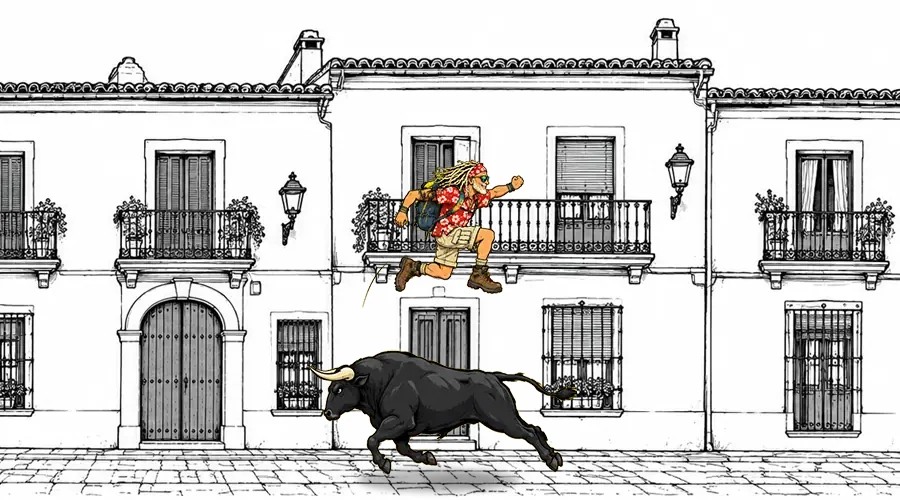
The Backpackers Bible guru, a dreadlocked backpacker in a Hawaiian shirt, leaping over a charging black bull on a cobbled street in Spain

Things To Do In Castilla-La Mancha

Search Castilla-La Mancha Attractions and Tours

Interactive tourist attraction and tour map for Castilla-La Mancha showing things to do for backpackers.
Tours in Castilla-La Manchaon GetYourGuide ↗
Discover the best things to do, attractions, and backpacker tours in Castilla-La Mancha. Use two fingers to move the map, pinch to zoom.

1. Toledo's Old City (Non-Negotiable)

Toledo's old city is dense enough with history that a single day genuinely isn't enough — but it's also compact enough to hit the essentials if that's all the time you've got.

Toledo Cathedral

One of the great Gothic cathedrals of Spain, packed with El Greco paintings, an enormous gilded altarpiece, and a treasury holding a solid-silver monstrance so heavy it takes several men to carry it through the streets during Corpus Christi. Entry from roughly €12.

Santo Tomé & The Burial of the Count of Orgaz

A small, unassuming church holding one enormous payoff: El Greco's masterpiece, painted specifically for this space and still hanging exactly where it was installed in 1588. Entry from roughly €4.

Read More

The Jewish Quarter & Synagogues

Two surviving medieval synagogues — Santa María la Blanca and El Tránsito — stand as rare, tangible evidence of Toledo's "Three Cultures" era, when Christian, Muslim, and Jewish communities lived and worked side by side.

2. Adrenaline

Hot air ballooning over windmill country: Several operators run early-morning balloon flights over the La Mancha plains near Consuegra — a genuinely spectacular way to see the windmills and castles from above.

Kayaking Las Lagunas de Ruidera: Paddle between the chain of turquoise lakes and small waterfalls strung across the plains — a surprising, refreshing break from the region's dry, flat terrain.

Climbing near Cuenca's gorges: The dramatic limestone gorges surrounding Cuenca offer genuine rock climbing and via ferrata routes, with the town's hanging houses as a backdrop.

3. The Windmills & Don Quixote Country

Most backpackers see Toledo and head straight back to Madrid — a genuine shame, since the windmill towns just beyond it are exactly the landscape that inspired one of the most famous novels ever written.

Consuegra

A row of twelve beautifully restored 16th-century windmills lining a ridge above the town, several open to walk inside and see the original grinding mechanisms — the single most photographed windmill site in the region.

Campo de Criptana

A second, less crowded windmill row, genuinely believed to be one of the specific locations that inspired Cervantes' famous "giants" scene.

4. Free Castilla-La Mancha (Zero Euros)

The Consuegra and Campo de Criptana windmills: Free to walk up to and admire from outside — only stepping inside a working mill carries a small fee.

Toledo's old city streets: Wandering the medieval lanes, viewpoints, and squares costs nothing, and is genuinely one of the best free experiences in the region.

Cuenca's hanging houses: Viewing the casas colgadas from the gorge below or the bridge above is free — only certain interior museum spaces charge admission.

The Mirador del Valle, Toledo: A free viewpoint across the river offering the single best panoramic photo of Toledo's skyline.

5. Nightlife: How It Actually Works

This is a genuinely quieter region than Madrid, Salamanca, or the coast — Castilla-La Mancha's evening scene leans toward a good tapas dinner and a glass of local wine rather than a big night out, and that's very much part of the appeal.

In Toledo

A modest but pleasant selection of bars and tapas spots around the old city, best enjoyed slowly rather than as a proper bar crawl — this is a wind-down region, not a party one.

In wine country

An evening tasting at a bodega around Valdepeñas or the wider La Mancha wine region is the closest thing to a headline night out here, and genuinely worth building an evening around.

6. The Big Hits (Things You Must Not Skip)

Toledo Cathedral

Already covered above, but it bears repeating — the single essential sight in the entire region.

The Consuegra Windmills

Covered in full above — the most iconic image associated with the whole of Castilla-La Mancha.

Cuenca's Hanging Houses

A UNESCO-listed townscape unlike anywhere else in Spain — houses seemingly defying gravity along a sheer gorge edge.

The Alcázar of Toledo

A hilltop fortress dominating Toledo's skyline, with a long, dramatic military history and sweeping views across the city and surrounding plains.

7. Live Sport & Culture

Local football: Regional clubs based in Toledo and Albacete offer an affordable, low-key way to catch live Spanish football if the timing lines up — not the big leagues, but a genuine local matchday atmosphere.

La Mancha's grape harvest festivals: Wine towns across the region hold lively harvest (vendimia) festivals every autumn — genuinely good, low-cost local celebrations if your dates happen to line up.

Backpacking Castilla La Mancha cartoon - the guru is helping Don Quixote and Pancho Sanchez with directions on his mobile phone

Top-Rated Castilla-La Mancha Tours on GetYourGuide.com

MESETA SUR PLATEAU, CONSUEGRA | By No machine-readable author provided. Chocid~commonswiki assumed (based on copyright claims). - No machine-readable source provided. Own work assumed (based on copyright claims)., CC BY-SA 2.5, Link

Budget Accommodation In Castilla La Mancha

Hostels listed on Booking.com and Hostelworld

For a full list of hostels, see our

Where Do You Want To Go Next?