Welcome to my backpacking guide to Andalusia!

Discover more

Backpacking Andalucia (Andalusia)

[ahn-dah-loo-THEE-ah]

Every cliché you've ever heard about Spain — flamenco, bullfights, whitewashed villages baking in the sun, a siesta so sacred that entire towns shut their shutters for it — didn't come from Spain in general. It came from Andalusia specifically, and got exported to the rest of the world as "Spanish culture." That's not a knock. Andalusia earned every one of those clichés the hard way, over eight centuries of Moorish rule that left behind some of the most extraordinary buildings on the continent, and it remains, hands down, the most atmospheric, most historically distinct region in the entire country.

For backpackers coming from the UK or elsewhere in Western Europe, Andalusia is where a backpacking Spain trip tends to slow right down — this is a region built for lingering, not ticking boxes. Seville, Granada, Córdoba, and Málaga are all connected by fast, cheap trains, and each one feels like a different country: Granada's hillside Alhambra glowing above a city of free tapas and flamenco caves, Córdoba's mosque-turned-cathedral with its endless forest of striped arches, Seville's orange-tree courtyards and Plaza de España. It's also the hottest region in mainland Europe, which shapes everything from the siesta to when the nightlife actually starts.

On cost, backpacking Andalusia is about as good as backpacking Spain gets — this is consistently one of the cheapest regions in the country, and the tradition of a free tapa with every drink is still genuinely alive here, especially in Granada, in a way it barely survives in Barcelona or Madrid anymore. It's a mainstay of the classic InterRail and backpackers' Spain circuit for exactly this reason: big, unmissable sights, low prices, and a hostel scene that makes it easy to string a route together as you go.

Read More

What Kind of Place Is This, Exactly?

Andalusia is Spain's southernmost and most populous autonomous community, and the second-largest by area — big enough to stretch from Atlantic beaches in the west to Mediterranean resort towns in the east, with the Sierra Nevada mountains (home to mainland Spain's highest peak, Mulhacén) rising inland. It borders Portugal to the west and looks out across the Strait of Gibraltar to Morocco in the south, close enough that a day trip to Africa is genuinely on the table from Tarifa or Algeciras.

A Short History: 800 Years of Al-Andalus

In 711 AD, Moorish forces crossed from North Africa and conquered most of the Iberian Peninsula within a few years, establishing what became known as Al-Andalus. Córdoba grew into one of the largest, wealthiest, and most intellectually advanced cities on Earth under the Caliphate, a genuine centre of science, philosophy, and religious tolerance between Muslims, Christians, and Jews. As Christian kingdoms slowly reconquered the peninsula over the following centuries, the Nasrid Kingdom of Granada held out as the last Muslim stronghold in Western Europe, finally falling to the Catholic Monarchs in 1492 — the same year Columbus set sail. That 800-year layer of history is why Andalusia looks, in its bones, unlike anywhere else in Spain: the Alhambra, the Mezquita, the Real Alcázar all stand as direct legacies of it.

The Language You'll Hear

Castilian Spanish, but spoken in a famously distinct Andalusian accent — dropped final consonants, softened or "aspirated" s sounds, and a rhythm that even other Spaniards sometimes struggle to follow at full speed. There's no separate official regional language here, unlike Catalonia or the Basque Country, but the accent alone is enough to mark Andalusia out. English is spoken less widely here than in Madrid or Barcelona, especially outside the main tourist sights, so a little Spanish goes further.

Andalusia or Andalucía?

They're the same place. Andalucía is the Spanish spelling, and the official name you'll see on road signs, train tickets and tourist offices. Andalusia is the traditional English spelling. Both come from Al-Andalus, the name of the Moorish-ruled territory, and plenty of British travellers write Andalucia with no accent at all. This guide uses Andalusia, but if you searched for Andalucia, you're in the right place.

Understanding Andalusia: The Cities & Zones

Seville

The regional capital and the birthplace of flamenco, with a full guide of its own coming soon — for now, know that Plaza de España, the cathedral, and Semana Santa (Holy Week) and the Feria de Abril festivals make it an essential stop on any Andalusia route.

Granada

Home to the Alhambra and the single strongest free-tapa culture left in Spain — order a drink in most traditional bars here and a proper plate of food arrives with it, no charge. The Sacromonte neighbourhood's cave dwellings host some of the most authentic flamenco performances in the country.

Córdoba

Smaller and more overlooked than Seville or Granada, and worth every extra hour — the Mezquita is one of the most extraordinary buildings in Europe, and the city's flower-filled inner patios (celebrated every May at the UNESCO-recognised Patios Festival) are a genuine hidden gem.

Málaga & The Costa del Sol

Picasso's birthplace and the region's main international airport, Málaga has quietly become a genuinely good city break in its own right, while the Costa del Sol beyond it is Spain's classic package-holiday resort coast — worth knowing about even if it's not really backpacker territory.

Cádiz & The Costa de la Luz

Cádiz claims to be the oldest continuously inhabited city in Western Europe, and its Atlantic coastline, the Costa de la Luz, is a completely different animal to the Mediterranean side — wilder beaches, a serious surf and kitesurf scene around Tarifa, and Spain's best Carnaval outside the Canary Islands.

The Pueblos Blancos & The Sierra Nevada

A scattering of whitewashed hill towns across the Andalusian interior, of which Ronda — perched dramatically over a 100-metre gorge — is the standout. Inland, the Sierra Nevada offers genuine hiking in summer and mainland Europe's southernmost ski resort in winter.

A Note on Flamenco and Bullfighting

Flamenco genuinely originated here, rooted in Andalusia's Roma (Gitano) communities, and it's worth seeking out a proper peña or a Sacromonte cave show over a purely tourist-oriented tablao if you want the real thing. Bullfighting also remains more prevalent and culturally embedded in Andalusia than in most of Spain — it's a deeply divisive tradition even among Spaniards themselves, with strong feelings on both sides, and entirely your own call whether it's something you want to see.

Andalusia FAQs for Backpackers

When is the best time to go?

Spring (April–June) and autumn (September–October) are strongly recommended. Andalusian summers are genuinely extreme — Córdoba and Seville are regularly among the hottest cities in mainland Europe, with July and August highs of 40–45°C. If you're backpacking Andalusia in summer, plan around the heat rather than through it.

Where should I start — Seville, Granada, or Málaga?

Málaga has the main international airport and the easiest flights, but Seville and Granada are the bigger draws for most first-time backpackers. A classic route runs Seville → Córdoba → Granada (or the reverse), all connected by fast, frequent trains.

What does it cost to go out?

Cheap by Spanish standards, and genuinely cheap by Western European ones. A beer runs roughly €2–€3.50, and in Granada especially, ordering a drink still gets you a free tapa — stack a few bars together for something close to a free dinner.

Do I need to speak Spanish?

More useful here than in Madrid or Barcelona — English is spoken less widely, particularly in smaller towns and the pueblos blancos. A basic phrasebook's worth of Spanish makes a real difference in Andalusia.

How do I get around?

High-speed AVE trains connect Seville, Córdoba, and Málaga quickly and affordably. Granada is reachable by train or a slightly longer bus journey. For the pueblos blancos and rural Sierra Nevada, buses or a rental car open things up considerably.

Is the tap water safe?

Yes, throughout Andalusia. Some locals prefer bottled water for taste, particularly inland, but tap water is safe to drink everywhere.

Is Andalusia safe?

Yes — violent crime against tourists is rare, and even petty theft is less notorious here than in Barcelona. The biggest real risk in Andalusia isn't crime, it's the heat. See our full safety section below.

Can I really day-trip to Morocco?

Yes — ferries from Tarifa and Algeciras reach Tangier in under an hour, making Morocco a genuine, popular day or overnight trip from Andalusia. Bring your passport and check current visa requirements before you go.

Staying Safe & Travelling Well in Andalusia

Andalusia is a safe region for backpackers by most measures — violent crime against tourists is rare, and even the pickpocketing that defines Barcelona's reputation is a much smaller issue here. The single biggest safety consideration in this region isn't crime at all. It's the heat.

The Heat Is the Real Risk

Seville and Córdoba are routinely among the hottest cities in mainland Europe in summer, with temperatures that make sightseeing genuinely dangerous if you're not prepared. Drink far more water than feels necessary, avoid strenuous walking between roughly 2pm and 6pm in July and August, and take the local siesta habit seriously rather than fighting it.

Petty Theft in Tourist Areas

Lower-profile than Barcelona or Madrid, but not absent — keep an eye on bags around the Alhambra queues, Seville's cathedral area, and crowded city-centre streets in peak season.

Unofficial Ticket Sellers and Scams

Around major sights like the Alhambra and the Mezquita, avoid buying tickets from anyone other than the official booth or website — unofficial "skip the queue" sellers are a known scam, and official tickets sell out fast in peak season regardless, so book ahead online.

Atlantic Beach Safety

The Costa de la Luz's Atlantic beaches around Cádiz and Tarifa have genuine rip currents and stronger surf than the calmer Mediterranean coast — pay attention to flag warnings and don't assume it behaves like the beaches further east.

A Generally Low-Key Region for Overtourism

Unlike Barcelona, Andalusia's cities haven't seen major anti-tourism backlash, though Seville in particular has seen growing local concern over short-term rentals pushing up housing costs. Being a considerate guest — supporting small local bars, keeping noise down late at night — goes a long way, as it does anywhere.

Further Reading

Ready to map out the rest of your trip? For more general info on backpacking Spain, see our comprehensive home page. We also highly recommend checking out our backpacking advice section to make sure you stay safe and save money on the road. If you need help structuring your travel routes, take a look at our suggested itineraries for Spain. For more info on backpacking, including access to our offline app and interactive PDF guide, head over to our resources page.

An illustration of Andalusia in a heraldic style, showing 2 backpackers, a globe map and the area's tourist attractions

Quick Facts

Best Time To Visit:
April to June and September to October — July and August bring genuinely dangerous heat inland.
Best For:
Moorish architecture, flamenco, whitewashed hill towns, cheap tapas, and a genuinely sociable hostel scene.
Most Popular Experience:
Watching the sun set over the Alhambra from the Mirador de San Nicolás.
Most Under-rated Experience:
Córdoba's Mezquita — often treated as a Seville/Granada afterthought, but arguably the single most extraordinary building in Andalusia.
Best Free Experiences:
Free tapas with every drink in Granada, Plaza de España in Seville, the Mirador de San Nicolás viewpoint, and wandering any pueblo blanco.
Ideal Stay:
7–10 days to properly cover Seville, Córdoba, and Granada without rushing.
Budget Level:
One of the cheapest regions in Spain for backpackers. Expect roughly €35–€80 per day.
Getting Around:
High-speed AVE trains link the big cities fast and affordably; buses or a rental car are best for the pueblos blancos and rural Sierra Nevada.
Best Photo Spots:
The Alhambra from the Mirador de San Nicolás, the Mezquita's striped arches, Plaza de España in Seville, and Ronda's gorge-spanning bridge.
Arcos_de_la_Frontera | By Malopez 21 - Own work, CC BY-SA 4.0, Link
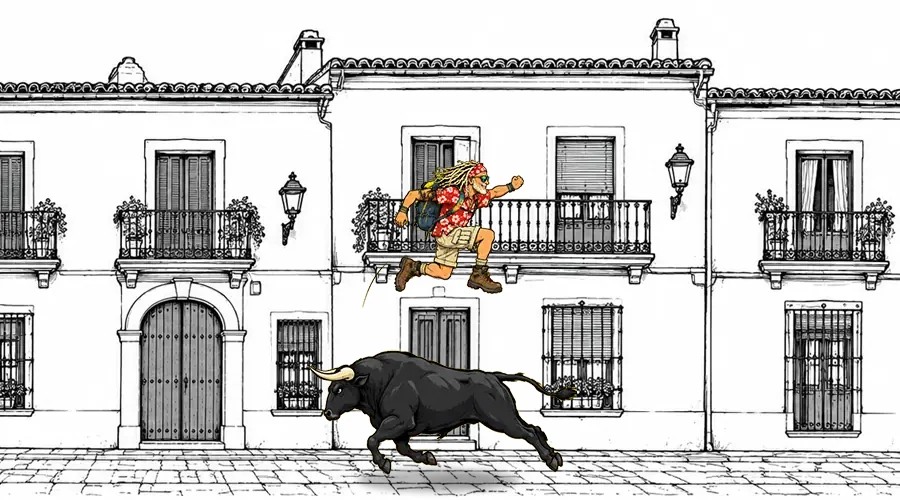
The Backpackers Bible guru, a dreadlocked backpacker in a Hawaiian shirt, leaping over a charging black bull on a cobbled street in Spain

Things To Do In Andalusia

Search Andalusia Attractions and Tours

Interactive tourist attraction and tour map for Andalusia showing things to do for backpackers.
Tours in Andalusiaon GetYourGuide ↗
Discover the best things to do, attractions, and backpacker tours in Andalusia. Use two fingers to move the map, pinch to zoom.

1. The Alhambra & Andalusia's Moorish Masterpieces
(Non-Negotiable)

Andalusia's Moorish legacy isn't background scenery, it's the main event — three buildings alone are worth building an entire trip around.

The Alhambra, Granada (book weeks ahead)

A hilltop palace-fortress complex that's less a single building than an entire miniature city — intricate Nasrid stucco, reflecting pools, and gardens that feel built for a fairy tale rather than a sultan. Tickets are timed, limited in number, and sell out days or weeks ahead in peak season — book the moment your dates are fixed. Entry from roughly €19.

The Mezquita, Córdoba

A former mosque of hundreds of red-and-white striped double arches, with a Renaissance cathedral built directly into its centre centuries later — one building physically layering two entire religious traditions on top of each other. Entry from roughly €13.

Read More

The Real Alcázar, Seville

A still-functioning royal palace with over a thousand years of Moorish, Gothic, and Renaissance layers — and, for anyone who's seen a certain fantasy TV series, instantly recognisable as the Water Gardens of Dorne. Entry from roughly €14.

2. Adrenaline

Kitesurfing in Tarifa: Genuinely one of the best kitesurf and windsurf destinations on Earth, thanks to the wind funnel created by the Strait of Gibraltar. Lessons and gear hire are widely available for complete beginners.

Hiking and skiing the Sierra Nevada: Mainland Europe's southernmost ski resort in winter, and genuinely serious hiking terrain — including Mulhacén, mainland Spain's highest peak — in summer.

Coasteering and canyoning near El Chorro: The dramatic gorge that hosts the Caminito del Rey (see below) also has canyoning and climbing operators running trips through the surrounding cliffs.

3. The Pueblos Blancos (The Day Trip That Changes Everything)

Most backpackers stick to Seville, Córdoba, and Granada and never see the villages between them — a genuine shame, since Andalusia's whitewashed hill towns are some of the most photogenic places in the entire country.

Ronda

Perched dramatically on either side of a 100-metre gorge, spanned by the 18th-century Puente Nuevo bridge — one of the single most photographed views in Spain, and worth the day trip from Seville or Málaga on its own.

The Caminito del Rey

A vertigo-inducing walkway bolted to the side of a gorge near El Chorro, once branded "the world's most dangerous path" before a major safety rebuild — now a spectacular, perfectly safe half-day hike that still delivers the thrill. Book tickets online well ahead, as daily numbers are capped.

A note on Gibraltar: It's an easy day trip from the Costa del Sol, and since July 2026 there are no routine passport checks at the land border with Spain. Gibraltar is still outside the EU, though, and for UK visitors the days you spend there count towards your 90-in-180-day Schengen allowance. Take your passport anyway, and check the latest GOV.UK travel advice for Gibraltar before you go, as the new rules are still provisional.

4. Free Andalusia (Zero Euros)

Free tapas in Granada: Order a drink at most traditional bars and a plate of food arrives with it, unasked and unbilled — genuinely free, and one of the best-value traditions left in Spain.

Plaza de España, Seville: A vast, ornate semicircular plaza built for the 1929 Ibero-American Exposition, free to wander and one of the most photogenic public spaces in the country.

The Mirador de San Nicolás, Granada: The single best view of the Alhambra, especially at sunset, with the Sierra Nevada as a backdrop — free, and often accompanied by an impromptu flamenco guitarist.

Wandering any pueblo blanco: Villages like Ronda, Zahara de la Sierra, and Setenil de las Bodegas cost nothing to walk around and are reason enough for a day trip on their own.

5. Nightlife: How It Actually Works

Andalusian nights run even later than Madrid's in summer — the heat pushes everything back, so dinner can start at 10:30pm and the streets are still busy at 3am.

For flamenco

A tourist-oriented tablao show is a fine, accessible introduction, but seek out a smaller peña or a Sacromonte cave performance in Granada if you want something closer to the real thing — rawer, less choreographed, and considerably more intense.

For a first drink

Seville's Alameda de Hércules and Granada's Albaicín and Realejo neighbourhoods are the classic starting points — a proper bar-hopping, tapas-grazing scene that barely resembles a "night out" back home.

For clubbing

Seville and Málaga both have solid late-night club scenes, though Andalusia's nightlife identity leans more toward long tapas-and-bar crawls than big superclubs — embrace the pace rather than fighting it.

6. The Big Hits (Things You Must Not Skip)

Seville Cathedral & The Giralda

The largest Gothic cathedral in the world, built directly on top of a former mosque — climb the Giralda tower via a ramp, not stairs, originally built so the muezzin could ride a horse to the top.

The Alhambra and the Mezquita

Covered in full above — but they bear repeating as two of the most essential sights not just in Andalusia, but in the whole of Spain.

Ronda's Puente Nuevo

The gorge-spanning bridge that anchors the most photographed pueblo blanco in the country — see the Pueblos Blancos section above for the full detail.

Day trip: Seville

A full Seville-specific guide is coming soon — for now, know it's an essential stop on any Andalusia route, with its own dedicated page in the works.

7. Live Sport

Sevilla FC vs Real Betis — El Gran Derbi: One of the fiercest local derbies in Spanish football, splitting the city of Seville down the middle. Even a non-derby match at either club is a genuinely good, comparatively affordable way to catch live La Liga football, with tickets often considerably cheaper than Madrid or Barcelona.

Semana Santa & The Feria de Abril, Seville: Not sport, but genuinely spectacular live culture — Holy Week's silent, hooded processions through the streets, followed weeks later by the Feria's week of flamenco dresses, horses, and all-night dancing in a temporary tent city.

Cartoon of a backpacking guru overindulging in tapas

Top-Rated Andalusia Tours on GetYourGuide.com

Budget Accommodation In Andalucia

Hostels listed on Booking.com and Hostelworld

For a full list of hostels, see our

By kallerna - Own work, CC BY-SA 4.0, Link

Where Do You Want To Go Next?