

Welcome to my backpacking guide to Extremadura!

Discover more

Backpacking Extremadura

[eks-treh-mah-DOO-rah]

A wildly disproportionate number of the men who conquered the Americas for Spain came from one of its poorest, emptiest corners: Hernán Cortés, who toppled the Aztec Empire, was born in the small Extremaduran town of Medellín; Francisco Pizarro, who did the same to the Inca, came from nearby Trujillo. They left because there was nothing here for them — and centuries later, Extremadura remains one of the emptiest, least-visited regions in Western Europe, holding some of the best-preserved Roman ruins and Renaissance townscapes in the entire country almost entirely to itself.

Cáceres' old town is so perfectly preserved that it stood in for King's Landing in Game of Thrones, and Mérida holds more intact Roman ruins than anywhere else in Spain, including an amphitheatre and theatre that still host performances two thousand years after they were built. Add storks nesting on every rooftop in Trujillo, wild vultures wheeling over Monfragüe National Park, and the free-range Iberian pigs that produce the best jamón in the country, and you've got a region that most backpackers touring Spain skip entirely — usually because they've never heard of it.

Cost-wise, this is about as cheap as backpacking Spain gets — genuinely low tourist numbers mean genuinely low prices, on hostels, food, and everything else. The trade-off is logistics: distances are real and public transport is thin, so budget a bit more travel time (and ideally a rental car) than you would in a denser, more touristed region.

Read More

What Kind of Place Is This, Exactly?

Extremadura sits in southwestern Spain along the Portuguese border, made up of two provinces — Cáceres and Badajoz — that rank among the largest in the entire country by area, yet hold some of the lowest population densities anywhere in Western Europe. Much of the landscape is dehesa: open oak savanna, a genuinely unique managed ecosystem that's supported free-range livestock, especially the black Iberian pig, for centuries.

A Short History: Roman Capital, Conquistador Factory, Empty Interior

Mérida began as Emerita Augusta, founded in 25 BC as the capital of the Roman province of Lusitania — one of the most important Roman cities anywhere in Iberia, which is exactly why its ruins are so extensive today. Centuries later, after the Reconquista pushed the frontier through this region, Extremadura's poverty and lack of opportunity pushed a striking number of its sons toward the New World: minor nobility with no inheritance to speak of, seeking in the Americas the fortune the region itself couldn't offer.

That same lack of opportunity never fully went away. Extremadura remains one of the driving regions behind Spain's modern "España Vaciada" (Emptied Spain) movement — the same rural-depopulation conversation that produced Aragón's "Teruel Existe," playing out here on an even larger scale.

The Language You'll Hear

Almost entirely Castilian Spanish, with one genuine curiosity: a small area called the Valle de Jálama, in the far north, is home to A Fala — a distinct minority language recognised in its own right, spoken by only a few thousand people and found nowhere else on Earth.

Understanding Extremadura: The Zones

Cáceres

A UNESCO World Heritage old town so completely intact that it needed almost no set-dressing to become King's Landing on screen — a dense knot of medieval and Renaissance stone palaces, towers, and storks' nests, genuinely one of the best-preserved historic centres anywhere in Spain.

Mérida

The best Roman ruins in the country, full stop — an amphitheatre, a theatre still hosting performances, and Spain's National Museum of Roman Art, built specifically to house the scale of what's been excavated here.

Trujillo

Francisco Pizarro's hometown, centred on a genuinely beautiful Plaza Mayor and a hilltop castle, with white storks nesting on practically every rooftop and church tower in town.

Monfragüe National Park

One of the best birdwatching destinations in Europe — enormous populations of griffon vultures, black storks, and Spanish imperial eagles wheel over dramatic river gorges, with several accessible viewpoints for anyone without specialist gear.

The Dehesa & Jamón Country

Open oak pastureland where free-range black Iberian pigs forage on acorns, producing the jamón ibérico de bellota widely considered the finest cured ham in Spain — several producers offer tastings and farm visits.

Extremadura FAQs for Backpackers

When is the best time to go?

April, May, and October are ideal. Extremadura's interior summer heat is genuinely intense, regularly among the hottest anywhere in mainland Spain — plan around it or avoid it if you can.

Cáceres, Mérida, or Trujillo — which comes first?

If you can only pick two, Cáceres and Mérida cover the region's two headline experiences (the old town and the Roman ruins); Trujillo is a smaller, easy add-on between them if time allows.

Do I need a rental car?

Strongly recommended. Buses connect the main towns, but Extremadura is genuinely spread out and sparsely served by public transport — a car makes Monfragüe and the smaller towns dramatically easier.

Do I need to speak Spanish?

Spanish covers you everywhere. English is spoken less widely here than almost anywhere else on this site, given how few international tourists pass through — a little Spanish genuinely helps.

Is the tap water safe?

Yes, throughout Extremadura. Perfectly safe to drink.

Is Extremadura safe?

Yes — genuinely one of the safest, lowest-crime regions in Spain. See our full safety section below for the one real seasonal consideration: the heat.

Staying Safe & Travelling Well in Extremadura

Extremadura is a low-crime, low-hassle region for backpackers, with no pickpocketing reputation to speak of. The genuine safety consideration here is the region's exposed, arid interior climate.

Summer Heat

Extremadura regularly records some of the highest temperatures in mainland Spain in July and August. Drink far more water than feels necessary, avoid strenuous sightseeing during the hottest hours, and don't underestimate how remote some of this heat exposure can be away from the main towns.

Monfragüe Hiking

Trails around the park are generally well marked, but distances between facilities can be significant — carry proper water and sun protection, and let someone know your planned route on longer walks.

Remote Driving

Some rural roads see very little traffic and limited phone signal — sensible precautions apply if you're relying on a rental car to get around, particularly after dark.

Petty Theft

A minimal issue here compared to Spain's bigger cities, given how few crowds gather anywhere in the region to begin with.

Further Reading

Ready to map out the rest of your trip? For more general info on backpacking Spain, see our comprehensive home page. We also highly recommend checking out our backpacking advice section to make sure you stay safe and save money on the road. If you need help structuring your travel routes, take a look at our suggested itineraries for Spain. For more info on backpacking, including access to our offline app and interactive PDF guide, head over to our resources page.

Backpacking Extremadura heraldic cartouche

Quick Facts

Best Time To Visit:
April, May, and October for comfortable weather — Extremadura's interior summer heat is genuinely intense.

Best For:
Roman ruins, conquistador history, storks on every rooftop, and genuine empty-Spain solitude.

Most Popular Experience:
Wandering Cáceres' UNESCO old town, a place so intact it doubled as King's Landing.

Most Under-rated Experience:
Monfragüe National Park — one of the best birdwatching destinations in Europe, and most visitors have never heard of it.

Best Free Experiences:
Cáceres' old town, Trujillo's stork-covered rooftops, and Mérida's Roman ruins from the outside.

Ideal Stay:
4–5 days to cover Cáceres, Mérida, and Trujillo without rushing.

Budget Level:
One of the cheapest regions in Spain, genuinely low tourist numbers keep prices down. Expect roughly €30–€55 per day.

Getting Around:
Buses connect the main towns, but a rental car is strongly recommended — this is a genuinely spread-out region with thin public transport.

Best Photo Spots:
Cáceres' old town at golden hour, storks nesting in Trujillo, Mérida's amphitheatre, and vultures wheeling over Monfragüe.
GARGANTA DE CUARTOS | By Manuel Vilela (Cadoalla) - Own work, CC BY-SA 3.0 es, Link
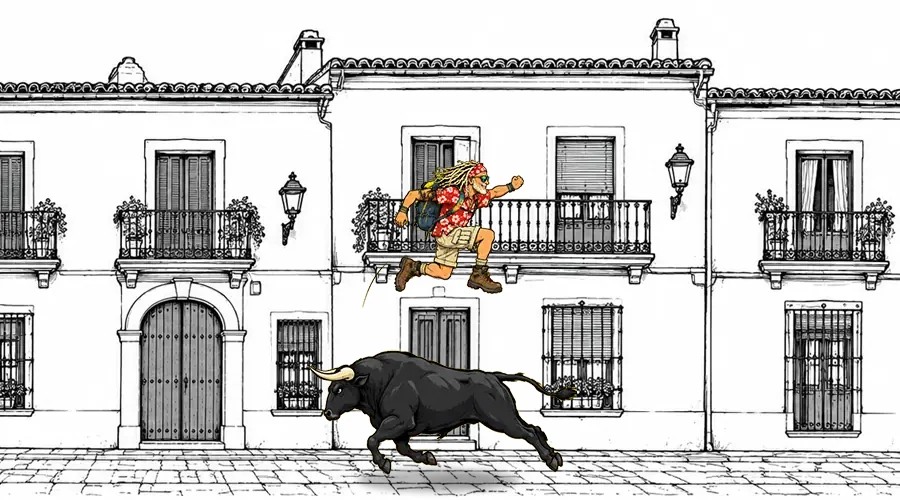
The Backpackers Bible guru, a dreadlocked backpacker in a Hawaiian shirt, leaping over a charging black bull on a cobbled street in Spain

Things To Do In Extremadura

Search Extremadura Attractions and Tours

Interactive tourist attraction and tour map for Extremadura showing things to do for backpackers.
Tours in Extremaduraon GetYourGuide ↗
Discover the best things to do, attractions, and backpacker tours in Extremadura. Use two fingers to move the map, pinch to zoom.

1. Cáceres' Old Town (Non-Negotiable)

Cáceres' old town is compact enough to see properly in half a day, and atmospheric enough that you'll want to give it a full one.

The Ciudad Monumental

A near-perfectly preserved medieval and Renaissance old town, its stone palaces and towers so intact that HBO used it almost entirely unaltered as King's Landing for Game of Thrones — wander the Plaza Mayor and the surrounding tangle of streets to see why.

The Torre de Bujaco & City Walls

Climb the old Moorish watchtower for sweeping views across the old town's rooftops, and trace what remains of the original fortified walls that once enclosed the whole city.

Read More

The Storks of Cáceres

Look up almost anywhere in the old town and you'll spot white storks nesting on towers and rooftops — a genuinely charming, year-round feature of the skyline here and across much of the region.

2. Adrenaline

Birdwatching and hiking in Monfragüe: Marked trails and viewpoints let you watch griffon vultures and Spanish imperial eagles wheeling over dramatic river gorges — one of the best wildlife-watching experiences in the country, no specialist gear required.

Kayaking the Tagus and Guadiana rivers: Both rivers cut through genuinely scenic stretches of the region, with calm sections suitable for complete beginners.

Rock climbing near Monfragüe: The park's granite outcrops offer genuine climbing routes for those wanting more than a wildlife walk.

3. Mérida's Roman Ruins

This is, without exaggeration, the best place in Spain to see what a major Roman city actually looked like.

The Roman Theatre & Amphitheatre

A genuinely extraordinary pair of structures — the theatre, with its two-tier colonnaded stage backdrop, still hosts a summer classical drama festival two thousand years after it was built, while the neighbouring amphitheatre once held gladiatorial games for 15,000 spectators. Entry from roughly €15 for a combined ticket covering both plus other Roman sites in the city.

The National Museum of Roman Art

Built specifically to house the sheer scale of what's been excavated in Mérida, this museum alone justifies the detour — mosaics, statuary, and everyday Roman objects displayed in a building designed around genuine archaeological trenches beneath the floor.

4. Free Extremadura (Zero Euros)

Cáceres' old town: Wandering the Ciudad Monumental costs nothing, and is genuinely one of the best free experiences on this entire site.

Trujillo's Plaza Mayor and storks: Free to explore, with the added bonus of spotting storks nesting on nearly every surrounding rooftop.

Mérida's Roman bridge and Temple of Diana: Several of the city's Roman remains, including its still-functioning ancient bridge, cost nothing to see from outside.

Monfragüe's main viewpoints: Several roadside miradors let you watch vultures and eagles for free, no guide required.

5. Nightlife: How It Actually Works

This is a genuinely quiet region after dark — Extremadura's evening scene leans toward a good dinner and a glass of local wine rather than a big night out, and honestly, that's very much part of the appeal.

In Cáceres

A modest but pleasant selection of tapas bars around Plaza Mayor, best enjoyed slowly rather than as a proper bar crawl.

In Mérida

A handful of bars near the Roman ruins fill up with a mixed crowd of locals and visitors on summer evenings, especially during the theatre festival.

Jamón and wine tastings

The closest thing to a headline night out here is an evening tasting at a dehesa farm or wine producer — genuinely worth building a night around.

6. The Big Hits (Things You Must Not Skip)

Cáceres' Old Town

Already covered above, but it bears repeating — the single essential sight in the entire region.

Mérida's Roman Theatre & Amphitheatre

Covered in full above — the best-preserved Roman remains anywhere in Spain.

Trujillo

Pizarro's hometown, built around a genuinely beautiful Plaza Mayor and hilltop castle — small enough to see properly in an afternoon.

Monfragüe National Park

Covered in full above — one of the best wildlife-watching destinations anywhere in Europe.

7. Live Sport & Culture

The Mérida International Classical Theatre Festival: Held every July and August in the actual 2,000-year-old Roman theatre, this is genuinely one of the most remarkable live-performance settings anywhere in the world — classical drama performed on the exact stage it was originally built for.

Local football: Regional clubs based in Cáceres and Badajoz offer an affordable, low-key way to catch live Spanish football if the timing lines up — not the big leagues, but a genuine local matchday atmosphere.

A cartoon about Backpacking Extremadura: our travel guru is amidst Roman ruins. He is wearing a Roman toga and is in a Caesar Augustus pose, taking a selfie with his smartphone in his raised hand. Backpackers are taking photos of him.

Top-Rated Extremadura Tours on GetYourGuide.com

ROMAN RUINS, MÉRIDA | By The photo was taken on the 10th October 2004 by Håkan Svensson (Xauxa). - Own work, CC BY-SA 3.0, Link

Budget Accommodation In Extremadura

Hostels listed on Booking.com and Hostelworld

For a full list of hostels, see our

Where Do You Want To Go Next?