What Kind of Place Is This, Exactly?
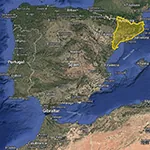
Catalonia occupies the northeastern corner of Spain, wedged between the Pyrenees and France to the north and the Mediterranean to the east, with Barcelona — a metro area of around 5 million people — as its capital and undisputed centre of gravity. It is one of Spain's seventeen autonomous communities, but one with an unusually strong sense of itself: its own parliament, its own police force (the Mossos d'Esquadra), its own public broadcaster, and a level of devolved power that goes well beyond what most of Spain's other regions have.
Geographically, it's a region of sharp contrasts packed into a small area. You can be swimming in the Mediterranean in the morning and standing in snow in the Pyrenees by early afternoon. The coastline alone splits into two entirely different characters — the rugged, cove-studded Costa Brava in the north and the flatter, quieter beaches of the Costa Daurada to the south — while the interior holds medieval market towns, vineyard country (Penedès, source of most of Spain's cava), and some of the best-preserved Romanesque architecture in Europe, tucked into Pyrenean valleys most tourists never reach.
A Short History: Counts, a Crown, and a Very Long Argument With Madrid
Catalonia's distinct identity isn't a modern invention. It traces back to the medieval County of Barcelona, which by the 12th century had merged with the Kingdom of Aragon to form the Crown of Aragon — a Mediterranean trading power in its own right, with Catalan as its administrative language, its influence stretching as far as Sicily and Sardinia. When the crowns of Aragon and Castile united in 1479 under Ferdinand and Isabella, Catalonia kept its own laws, institutions, and language for over two centuries.
That changed after the War of the Spanish Succession, when Barcelona backed the losing side and fell to Bourbon forces on 11 September 1714 — a date still marked every year as Catalonia's National Day, the Diada. The new Bourbon monarchy abolished Catalonia's historic institutions and self-government. Catalan language and culture went through further periods of suppression, most severely under Franco's dictatorship (1939–1975), when public use of Catalan was banned outright. Since Spain's return to democracy and the 1978 constitution, Catalonia has held broad autonomous powers again — though exactly how much autonomy is enough remains a live and genuinely contested question in Catalan politics, one that came to a head with the disputed 2017 independence referendum and its turbulent aftermath. It's not this guide's place to tell you what to think about that — Catalans themselves are divided on it — but it's worth understanding as background to a lot of what you'll see and hear.
The Language You'll Hear
Catalan and Castilian Spanish are both official languages here, and you'll see both on every street sign, menu, and metro announcement. Catalan is not a dialect of Spanish — it's its own Romance language, closer in some ways to Occitan and French than to Castilian. In Barcelona, most people are fully bilingual and will switch to Spanish or English without a second thought once they clock you're a visitor; in smaller towns and particularly in rural Catalonia, Catalan is the default language of daily life. Learning a handful of Catalan phrases — bon dia (good morning), si us plau (please), gràcies (thank you) — goes down well and costs you nothing.
Understanding Catalonia: Four Zones
Barcelona: Where You'll Live
Most of your Catalonia trip will happen here, and for good reason. The Gothic Quarter and El Born hold the medieval old town — narrow stone alleys, hidden squares, Roman ruins underfoot. Gràcia, a former separate village swallowed by the city's growth, keeps its own identity with leafy plazas and a strong local bar scene away from the tourist crush. Poble Sec and El Raval are the grittier, more nightlife-heavy neighbourhoods where a lot of backpacker hostels cluster. And then there's the Eixample, Ildefons Cerdà's 19th-century grid of octagonal blocks, home to most of Gaudí's major works and some genuinely excellent, unpretentious tapas bars once you get a street or two off the main avenues.
The Costa Brava: Where You'll Go for the Coast
North of Barcelona, the Costa Brava ("Rugged Coast") lives up to its name — pine-covered cliffs dropping into impossibly clear coves, connected by the Camí de Ronda, a network of old fishermen's coastal paths you can walk for free. Tossa de Mar and Cadaqués (the latter a longtime favourite of Salvador Dalí, who kept a house nearby) are the standout bases, both easily reached by bus or organised day trip from Barcelona.
The Pyrenees & Catalan Interior: Where You'll Go for Mountains
The Catalan Pyrenees hold genuinely serious hiking and, in winter, some of Spain's best skiing (La Molina, Baqueira-Beret). Girona, an hour north of Barcelona by train, is a compact medieval city with one of Europe's best-preserved Jewish Quarters, a Gothic cathedral with the widest nave in the world, and — since a certain HBO series filmed scenes on its city walls — a small but noticeable fantasy-tourism trail. Further inland, the Penedès wine region and small Romanesque churches scattered through the Pyrenean valleys reward anyone willing to rent a car and get properly off the coastal route.
The Costa Daurada: Where It Gets Quieter
South of Barcelona, the Costa Daurada ("Golden Coast") is flatter, sandier, and considerably less visited by international backpackers, who tend to head north instead. Tarragona, with some of the best-preserved Roman ruins in Spain (a UNESCO World Heritage amphitheatre right above the beach), and Sitges, a laid-back and famously LGBTQ+-friendly beach town with a lively summer festival calendar, are the two towns worth the detour.
Catalan Identity and Independence: What You'll Notice
You will see the estelada — the Catalan independence flag, a star on a striped yellow-and-red background — hanging from balconies across the region, sometimes on entire streets at once. This isn't decoration; it's a genuine, live political statement, and not every Catalan flies one or agrees with what it stands for. Support for independence is a real and ongoing debate within Catalan society itself, not a settled consensus, and it's not this site's place to take a side on it. What's useful for you to know as a visitor is simply this: it's a serious topic to a lot of people here, it comes up in conversation more than in most parts of Spain, and the respectful approach is to listen if it's raised rather than assume you already know the "right" answer or that everyone in the room agrees.
Catalonia FAQs for Backpackers
When is the best time to go?
May, June, and September give you warm weather without August's punishing heat and even more punishing crowds — August is when much of Barcelona itself goes on holiday, ironically enough, while tourists pour in. Ski season in the Pyrenees runs roughly December to March.
Where should I stay in Barcelona?
The Gothic Quarter and El Born put you in the middle of the old town's atmosphere but come with a premium and some noise. Poble Sec and El Raval offer a livelier, more budget-friendly hostel scene with easy nightlife access. Gràcia is quieter and more residential, a good pick if you want a break from the tourist centre without straying far from the metro.
What does it cost to go out?
A beer at a neighbourhood bar costs roughly €3–€4; the same beer on Las Ramblas or right by the Sagrada Família can be double that. Vermouth hour (roughly midday to early afternoon) at a local vermuteria is one of the best-value social rituals in the city — a glass and a plate of olives or anchovies for a few euros.
Do I need to speak Catalan or Spanish?
No — English gets you through Barcelona easily, and Castilian Spanish will work almost everywhere in the region. But a few words of Catalan, especially outside the capital, are genuinely appreciated and often get you a warmer welcome.
Getting around: metro, train, or bus?
Barcelona's metro is fast, cheap, and covers the whole city — a T-Casual card (10 rides) is the standard budget move. Rodalies regional trains reach Girona, the Costa Brava towns, Montserrat, and Sitges directly from the city centre for a few euros. For the Pyrenees or smaller Costa Brava villages off the train line, a regional bus or a rental car opens things up considerably.
Is the tap water safe?
Yes, throughout Catalonia. Some locals prefer bottled water for taste rather than safety, but tap water is perfectly fine to drink.
Is Barcelona safe?
Yes, in terms of violent crime — but it has one of the worst pickpocketing reputations in Western Europe, and it's worth taking seriously. See our full safety section below.
Why do I keep seeing "tourists go home" graffiti?
Barcelona has had a genuine and well-documented overtourism backlash in recent years, including public protests. It isn't aimed at any individual traveller — it's a response to housing pressure and crowding that residents feel keenly. Being a considerate guest (see below) goes a long way.
Staying Safe & Travelling Well in Catalonia
Catalonia doesn't carry the kind of violent-crime risk that some backpacking destinations do. The overwhelming majority of visitors — including huge numbers of solo travellers in their twenties — have a completely trouble-free trip. What you do need to take seriously is petty theft, a handful of well-known scams, and being a decent guest in a city that's grown genuinely tired of badly-behaved tourists.
The Number One Risk: Pickpocketing
Barcelona consistently ranks among Europe's worst cities for pickpocketing, and it is concentrated hard around Las Ramblas, the Sagrada Família queue, Park Güell's entrance, and the L3 metro line. The technique is usually opportunistic and crowd-based — a bump, a distraction, a bag left unzipped. Wear bags cross-body and to the front on the metro, keep your phone in a zipped inner pocket rather than a back pocket, and be extra alert in exactly the places you're most excited to be, since that's precisely where your guard drops.
Nightlife Scams and Drink Safety
Watch for street sellers pushing "free" roses or bracelets that suddenly aren't free, rigged shell-and-pea games near major sights, and unofficial "promoters" outside clubs offering deals that turn into inflated bar tabs. As with any big nightlife city, never leave a drink unattended, and stick with people you trust when moving between venues late at night.
Overtourism and Travelling Respectfully
Barcelona's frustration with mass tourism is real, well-covered locally, and worth understanding rather than dismissing. Keep noise down late at night in residential neighbourhoods like Barceloneta and Gràcia, don't treat the whole city like a stag-do venue, tip and spend at small local businesses rather than only the chains built for tourists, and if you see a protest or demonstration, it's sensible to simply give it space rather than film it up close — they're almost always peaceful, but crowds can shift fast.
Hiking the Pyrenees Safely
Mountain weather in the Catalan Pyrenees can change quickly even in summer. Check forecasts before any serious hike, carry proper layers, tell someone your route and expected return time, and don't rely on phone signal once you're off the main trails.
Further Reading
Ready to map out the rest of your trip? For more general info on backpacking Spain, see our comprehensive home page. We also highly recommend checking out our backpacking advice section to make sure you stay safe and save money on the road. If you need help structuring your travel routes, take a look at our suggested itineraries for Spain. For more info on backpacking, including access to our offline app and interactive PDF guide, head over to our resources page.














 SHARE