

Welcome to my backpacking guide to Castile y León!

Discover more

Backpacking Castile y León

[kas-TEE-leh ee leh-OHN]

Castile y León is bigger than Portugal. It holds more UNESCO World Heritage sites than any other region in the country. The Spanish language is named after it — castellano literally means "the language of Castile." And most backpackers touring Spain will pass straight through it on a fast train, headphones in, without ever getting off. That's the opportunity: a region genuinely central to what "Spain" even means, sitting almost entirely ignored between the country's two biggest tourist magnets.

This is a different kind of Spain than the coastal regions — no beach, no Camino coastline, just a vast interior plateau (the Meseta) dotted with walled medieval cities, Roman engineering, and one genuinely unmissable stop for anyone backpacking Spain on a budget: Salamanca, a golden sandstone university town with one of the biggest, cheapest, most sociable student nightlife scenes in the entire country. Add in the fairy-tale castle at Segovia, the completely intact medieval walls of Ávila, and two genuinely stunning Gothic cathedrals in Burgos and León, and you've got a region that rewards anyone willing to actually stop the train.

Cost-wise, Castile y León is one of the best-value regions in the country — cheap hostels, cheap food, and a student-city energy in Salamanca that keeps prices low even by Spanish standards. Genuinely one of the best-kept budget secrets on any backpacking Spain itinerary.

Read More

What Kind of Place Is This, Exactly?

Castile y León is Spain's largest autonomous community by area — over 94,000 km², genuinely bigger than Portugal — made up of nine provinces (Ávila, Burgos, León, Palencia, Salamanca, Segovia, Soria, Valladolid, and Zamora), more than any other Spanish region. It sits entirely landlocked on the northern Meseta, the high central plateau, with an extreme continental climate: brutally hot summers and genuinely cold winters, a world away from the coastal regions to the north.

A Short History: Where "Castile" — and Spanish — Come From

The name Castile comes from the many castles (castillos) built along the medieval frontier zone between Christian and Muslim territory. The Kingdom of Castile emerged around 1065 and, through repeated unions and separations with the neighbouring Kingdom of León, gradually became the dominant power in the Reconquista. When Isabella of Castile married Ferdinand of Aragon in 1469, their union created the foundation of modern Spain — and because Castile was the dominant partner, Castilian became the country's national language, the one you're using in every other conversation on this trip.

The region's intellectual weight runs just as deep: the University of Salamanca, founded in 1218, is one of the oldest universities in the world, and it was here that scholars debated Christopher Columbus's proposed route to the Indies before his voyages, and where the first grammar of any modern European language was written.

The Language You'll Hear

Just Castilian Spanish — genuinely the one region in Spain where there's no debate at all about what to call the local language, since it's literally named after the place. English is spoken reasonably well around Salamanca's large international student population, less so elsewhere.

Understanding Castile y León: The Zones

Salamanca

A golden sandstone university city built around one of Spain's most beautiful squares, the Baroque Plaza Mayor, with a student population large enough to power a genuinely huge, genuinely cheap nightlife scene — one of the best backpacker bases in the entire region.

Segovia

Home to a nearly 2,000-year-old Roman aqueduct, still standing without a drop of mortar holding it together, and the fairy-tale Alcázar castle, widely credited as an inspiration for Disney's Cinderella castle. An easy day trip from Madrid, but genuinely worth a night of its own.

Ávila

Ringed by a completely intact medieval wall you can walk the full circuit of — one of the best-preserved city walls anywhere in Europe — and the birthplace of St. Teresa of Ávila.

Burgos & León

Both hold spectacular Gothic cathedrals (León's stained glass is genuinely extraordinary), and both sit directly on the Camino Francés — if you've read our Camino guide, these are the big cities pilgrims pass through on the longer route toward Galicia.

Ribera del Duero Wine Country

A world-class red wine region that genuinely rivals Rioja, centred around the town of Peñafiel and its hilltop castle — an easy, relaxed day out if you want a break from cathedrals and city walls.

Castile y León FAQs for Backpackers

When is the best time to go?

May, June, and September are ideal. The Meseta's continental climate means summer can be brutally hot and winter genuinely cold — spring and autumn give you the most comfortable sightseeing weather by far.

Should I base myself in Salamanca?

For most backpackers, yes — it's the region's most sociable, most affordable base, with easy onward connections to Segovia, Ávila, and Madrid.

What's the student nightlife scene actually like?

Genuinely one of the best and cheapest in Spain — Salamanca's huge student population (including a large international contingent) keeps bars, tapas, and drinks priced for people with a student budget, and the old town is dense enough with venues that a bar crawl barely requires planning.

What does it cost to go out?

Cheap — a beer in Salamanca often runs under €2, and free-tapa traditions survive in several of the region's cities, including a version locally called "el tapeo," where a round of drinks comes with a plate of food included.

How do I get around?

Excellent train connections, since much of the region sits on fast AVE lines radiating out from Madrid — Segovia and Ávila are both under an hour away, and Salamanca isn't much further. Buses cover the smaller towns and Ribera del Duero.

Is the tap water safe?

Yes, throughout the region. Perfectly safe to drink.

Is Castile y León safe?

Yes — genuinely one of the safest, lowest-crime regions in Spain. See our full safety section below for the one real seasonal consideration: the climate.

Staying Safe & Travelling Well in Castile y León

Castile y León is a low-crime, low-hassle region for backpackers, with no pickpocketing reputation to speak of. The genuine safety consideration here is the region's extreme continental climate, in both directions.

Summer Heat

The Meseta's summer heat is dry but genuinely intense — drink more water than feels necessary, and avoid the most strenuous sightseeing during the early afternoon in July and August.

Winter Cold

Less of a backpacker-season concern, but worth knowing: winters here are genuinely cold, with regular sub-zero nights, a real contrast to the mild winters on Spain's coasts.

Petty Theft

A minimal issue here compared to Spain's bigger cities, though standard precautions are still sensible in Salamanca's busiest student bars and around the main tourist sights in Segovia and Ávila during peak season.

Further Reading

Ready to map out the rest of your trip? For more general info on backpacking Spain, see our comprehensive home page. We also highly recommend checking out our backpacking advice section to make sure you stay safe and save money on the road. If you need help structuring your travel routes, take a look at our suggested itineraries for Spain. For more info on backpacking, including access to our offline app and interactive PDF guide, head over to our resources page.

Backpacking Castilla And Leon heraldic cartouche - illustration of a female and male backpacker surrounded by the area's tourist attractions.

Quick Facts

Best Time To Visit:
May, June, and September for the most comfortable sightseeing weather — summers get brutally hot, winters genuinely cold.

Best For:
Walled medieval cities, cathedrals, cheap student nightlife, and a genuinely underrated slice of interior Spain.

Most Popular Experience:
A bar crawl through Salamanca's old town, powered by one of Spain's biggest student populations.

Most Under-rated Experience:
Ávila's complete medieval walls — most visitors do Segovia and skip the full circuit here.

Best Free Experiences:
Segovia's aqueduct, Ávila's city walls exterior, and wandering the old towns of Salamanca and Burgos.

Ideal Stay:
4–6 days to cover Salamanca, Segovia, and Ávila without rushing.

Budget Level:
One of the cheapest regions in Spain, especially in student-city Salamanca. Expect roughly €30–€65 per day.

Getting Around:
Fast AVE trains connect Madrid, Segovia, and Ávila in under an hour; buses cover Salamanca, Burgos, León, and Ribera del Duero.

Best Photo Spots:
Segovia's aqueduct at sunrise, Salamanca's Plaza Mayor lit up at night, Ávila's full city walls, and León Cathedral's stained glass.
SIERRA DE GREDOS | By Beatriz (con permiso del autor) - Own work, CC BY-SA 4.0, Link
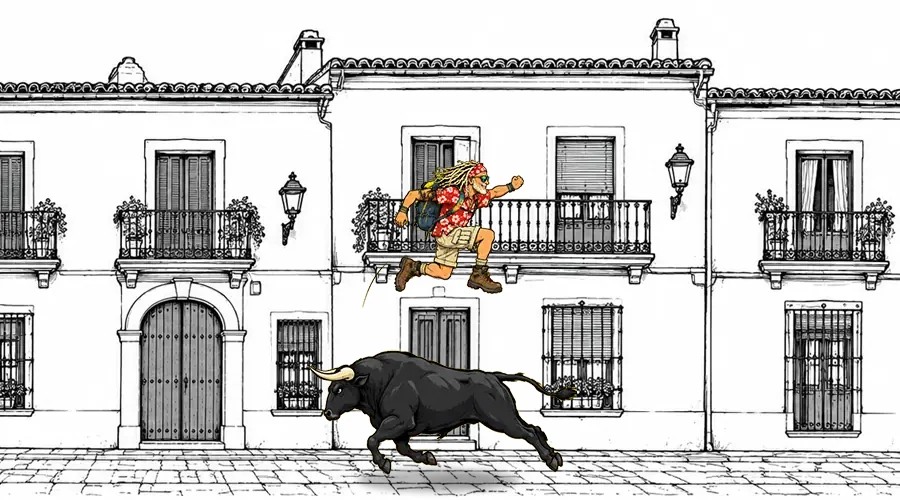
The Backpackers Bible guru, a dreadlocked backpacker in a Hawaiian shirt, leaping over a charging black bull on a cobbled street in Spain

Things To Do In Castile y León

Search Castile and Leon Attractions and Tours

Interactive tourist attraction and tour map for Castile and Leon showing things to do for backpackers.
Tours in Castile and Leonon GetYourGuide ↗
Discover the best things to do, attractions, and backpacker tours in Castile and Leon. Use two fingers to move the map, pinch to zoom.

1. Salamanca's Old Town & Plaza Mayor (Non-Negotiable)

Salamanca's old town is compact enough to see properly in a day, and golden enough at sunset that you'll want to give it two.

Plaza Mayor

Widely considered one of the most beautiful squares in Spain — an 18th-century Baroque masterpiece, ringed by cafes, and the natural centre of gravity for the whole city, day and night. Free to sit in for as long as you like.

The Old and New Cathedrals

Two connected cathedrals, one Romanesque and one Gothic, built centuries apart and joined into a single UNESCO-listed complex — climb the Ieronimus towers for one of the best rooftop views in the region.

Read More

The University & Casa de las Conchas

Founded in 1218, the University of Salamanca is one of the oldest in the world — look for the famous hidden frog carved into the façade, said to bring good luck (and exam success) to anyone who spots it unaided. Nearby, the shell-covered Casa de las Conchas is one of the city's most distinctive buildings.

2. Adrenaline

Hot air ballooning over the Meseta: Several operators run early-morning balloon flights over Segovia and the surrounding plains — a genuinely spectacular way to see the region's castles and countryside from above.

Hiking the Sierra de Gredos: A genuine mountain range in the region's south, with proper hiking trails, glacial lakes, and a noticeably cooler climate than the plains below in summer.

Cycling Ribera del Duero wine country: Rent a bike and cover the vineyards around Peñafiel at your own pace, stopping at bodegas along the way.

3. Segovia's Aqueduct & Alcázar

An easy day trip from Salamanca or Madrid, and worth every minute of the journey.

The Roman Aqueduct

Nearly 2,000 years old, still standing at its original height, and built without a single drop of mortar holding the stones together — one of the best-preserved pieces of Roman engineering anywhere on Earth, and free to walk beneath.

The Alcázar

A fairy-tale castle perched on a rocky outcrop, widely credited as an inspiration for Disney's Cinderella castle — the interior and battlements are well worth the entry fee for the views alone.

4. Free Castile y León (Zero Euros)

Segovia's aqueduct: Free to walk beneath and admire, day or night.

Ávila's walls (from outside): The full exterior circuit is free to walk around; only the interior ramparts charge a small fee.

Salamanca's old town and Plaza Mayor: Free to wander for as long as you like, and genuinely one of the best free experiences in the whole region.

Burgos and León cathedral exteriors: Both are free to admire from outside, even if you skip the paid interior visits.

5. Nightlife: How It Actually Works

Salamanca has one of the biggest, cheapest, most sociable student nightlife scenes in the entire country — a huge local and international student population keeps the old town's bars busy and its drink prices low.

For a first drink

The streets around Plaza Mayor and Gran Vía are packed with bars built for exactly this kind of student budget night out.

For tapas

El tapeo — a round of drinks that comes with a plate of food included — survives in several bars around the region, a genuinely good-value tradition worth seeking out.

For clubbing

Salamanca's late-night scene is genuinely lively during term time, with a concentration of clubs around the old town that rivals cities many times its size.

6. The Big Hits (Things You Must Not Skip)

The Segovia Aqueduct

Already covered above, but it bears repeating — the single most photographed piece of Roman engineering in Spain.

Ávila's Medieval Walls

A completely intact circuit you can walk the top of — one of the best-preserved city walls anywhere in Europe.

Salamanca's Plaza Mayor

Covered in full above — reason enough on its own to add Salamanca to any Castile y León route.

Burgos & León Cathedrals

Two of the finest Gothic cathedrals in Spain, both directly on the Camino Francés — León's stained glass in particular is genuinely extraordinary.

7. Live Sport & Culture

Real Valladolid: The region's biggest football club, based in the regional capital — a genuinely good, comparatively affordable way to catch live Spanish football depending on the division that season.

The Camino Francés passing through Burgos and León: If you've read our Camino de Santiago guide, these are two of the major cities pilgrims pass through on the longer route — worth timing a visit to catch the pilgrim energy even if you're not walking yourself.

Backpacking Castile y Leon cartoon - the guru dressed in a suit of armour, flanked by two backpackers dressed as medieval men-at-arms

Top-Rated Castile y León Tours on GetYourGuide.com

Budget Accommodation In Castile y León

Hostels listed on Booking.com and Hostelworld

For a full list of hostels, see our

Where Do You Want To Go Next?