

Welcome to my backpacking guide to Navarre!

Discover more

Backpacking Navarre

[nah-BAH-rrah]

For one week every July, Pamplona becomes the most famous city in Spain that isn't Madrid or Barcelona — half a tonne of angry bull, a narrow medieval street, and several thousand people who have decided, for reasons Hemingway never fully explained either, that running directly in front of it is a good idea. San Fermín is genuinely one of the most recognisable festivals on Earth, and it's also just about the only thing most people know about a region that spent centuries as its own fiercely independent kingdom, has a literal desert inside it, and only got folded into Spain as recently as 1512.

Outside that one wild week, Navarre is one of the calmest, most pleasant regions in the country — Pamplona's Casco Viejo is a genuinely lovely pintxos city the rest of the year, the Camino de Santiago crosses into Spain here at Roncesvalles (the traditional starting point for pilgrims arriving from France), and the Bardenas Reales, a genuine semi-desert of eroded badlands, is one of the strangest landscapes anywhere in the country — bizarre enough that Star Wars and Game of Thrones both filmed here.

Cost-wise, Navarre is easy, affordable backpacking Spain territory outside San Fermín week, when prices and crowds both spike hard. Visit any other time and you'll find cheap hostels, excellent pintxos, and a region genuinely worth exploring on its own terms rather than as a one-week bucket-list stop.

Read More

What Kind of Place Is This, Exactly?

Navarre is a small, single-province autonomous community sitting between the Basque Country and Aragón, bordering France to the north. It's geographically split dramatically in two: green Pyrenean foothills and forest in the north, giving way to a dry Ebro valley and near-desert badlands in the south — genuinely more landscape diversity than a region this size has any right to hold.

A Short History: An Independent Kingdom That Held Out Longest

The Kingdom of Navarre was founded around 824 AD by Basque nobility resisting both Frankish and Moorish control, and it stayed genuinely independent for nearly seven centuries — one of the last major territories absorbed into unified Spain, only annexed by Castile in 1512 (a rump Kingdom of Navarre actually continued on the French side of the border until 1620). Even after annexation, Navarre held onto its own laws and privileges (fueros) for centuries, a distinct legal and political identity that locals remain genuinely proud of.

San Fermín itself traces back to a practical medieval tradition: driving bulls from outside pens into the city's bullring the morning of a fight, a task that gradually turned into the spectacle of young men (and eventually women) running ahead of them through the streets. Formalised as an annual festival for centuries, it exploded into global fame after Ernest Hemingway featured it in his 1926 novel The Sun Also Rises.

The Language You'll Hear

Navarre has a genuine internal language divide: Basque (Euskera) is co-official in the northern third of the region, culturally and linguistically tied to the neighbouring Basque Country, while Spanish dominates entirely in Pamplona and the south. It's one of the few Spanish regions where the language map genuinely changes as you travel through it.

Understanding Navarre: The Zones

Pamplona

The regional capital, world-famous for one week a year and genuinely charming for the other fifty-one — a compact Casco Viejo (old town) built around Plaza del Castillo, with a strong, low-key pintxos scene that rivals its Basque neighbours.

Roncesvalles & The Camino

A tiny mountain village and monastery that also happens to be the traditional starting point in Spain for the Camino Francés, where pilgrims arriving over the Pyrenees from France collect their first stamp and their first Spanish albergue bed.

The Bardenas Reales

A genuine semi-desert of wind- and water-eroded badlands in Navarre's dry south, declared a UNESCO Biosphere Reserve — an alien, almost lunar landscape that's stood in for other planets and continents on screen, including scenes from both Star Wars and Game of Thrones.

Olite & Wine Country

Olite's royal castle-palace is a genuinely spectacular piece of Gothic architecture, sometimes nicknamed "the Camelot of Spain," surrounded by the vineyards of the Navarra wine region.

Navarre FAQs for Backpackers

When is San Fermín, and should I go?

San Fermín runs from midnight on 6 July to midnight on 14 July every year. It's genuinely worth experiencing the atmosphere — but see our safety section below before deciding whether "experiencing" should include actually running with the bulls.

Is Navarre worth visiting outside San Fermín week?

Genuinely, yes — Pamplona is a lovely, low-key pintxos city the rest of the year, and the Bardenas Reales and Camino connection are worth visiting regardless of when you come.

Do I need to speak Spanish or Basque?

Spanish covers you everywhere. Basque is genuinely useful only in the region's northern third, and entirely optional as a visitor anywhere in Navarre.

How do I get around?

Pamplona is well connected by bus and train to Madrid, Zaragoza, and San Sebastián. The Bardenas Reales, Roncesvalles, and Olite are best reached by rental car or an organised day tour.

Is the tap water safe?

Yes, throughout Navarre. Perfectly safe to drink.

Is Navarre safe?

Yes, outside the specific risks of San Fermín itself — genuinely one of the safest, lowest-crime regions in Spain otherwise. See our full safety section below.

Staying Safe & Travelling Well in Navarre

Navarre is a low-crime, low-hassle region for backpackers for fifty-one weeks of the year. San Fermín week is the genuine exception, and deserves its own honest treatment.

Running With the Bulls: A Real Risk, Not a Bucket-List Stunt

People are injured, and some years people are killed, running the encierro — this is a genuinely dangerous activity involving half-tonne animals moving at speed through narrow crowded streets, not a curated tourist experience. This site does not recommend it lightly, or at all, for casual visitors. Watching from an official viewing barrier or a balcony gives you the full spectacle without the risk, and is how the vast majority of visitors sensibly experience it.

San Fermín Crowd Safety

Beyond the bull run itself, San Fermín is an enormous, alcohol-heavy, round-the-clock event — keep valuables secure, stick with your group in dense crowds, and pace your drinking across a genuinely long, multi-day event.

Bardenas Reales Heat and Exposure

The Bardenas offer very little shade and can get genuinely hot — bring more water than feels necessary and proper sun protection if you're exploring independently rather than on a guided tour.

Petty Theft

A minimal issue in Navarre generally, though pickpocketing risk rises considerably in Pamplona's dense San Fermín crowds specifically — standard precautions matter more that one week than the rest of the year combined.

Further Reading

Ready to map out the rest of your trip? For more general info on backpacking Spain, see our comprehensive home page. We also highly recommend checking out our backpacking advice section to make sure you stay safe and save money on the road. If you need help structuring your travel routes, take a look at our suggested itineraries for Spain. For more info on backpacking, including access to our offline app and interactive PDF guide, head over to our resources page.

A heraldic illustration of Navarra, showing a backpacking couple and a map of Navarra, surrounded by the region's tourist attractions

Quick Facts

Best Time To Visit:
Any time except San Fermín week (6–14 July) unless that's specifically why you're going — May, June, and September give the best all-round weather.

Best For:
A world-famous festival, a genuine desert, a lost kingdom, and pintxos culture, all in one small region.

Most Popular Experience:
The Running of the Bulls during San Fermín — genuinely one of the most famous events in the world.

Most Under-rated Experience:
The Bardenas Reales — a genuine semi-desert most visitors have never even heard of.

Best Free Experiences:
Pamplona's Casco Viejo, the Bardenas Reales viewpoints, and Roncesvalles' monastery.

Ideal Stay:
2–4 days to cover Pamplona and at least one day trip to the Bardenas Reales.

Budget Level:
Cheap outside San Fermín, expensive and hard to book during it. Expect roughly €30–€65 per day normally.

Getting Around:
Pamplona is well connected by bus and train; the Bardenas Reales and Roncesvalles are best reached by rental car or organised tour.

Best Photo Spots:
The Bardenas Reales' Castildetierra rock formation, Pamplona's Casco Viejo streets, and Olite's fairy-tale castle.
BARDENAS REALES | By Bruno Barral - Own work, CC BY-SA 3.0, Link
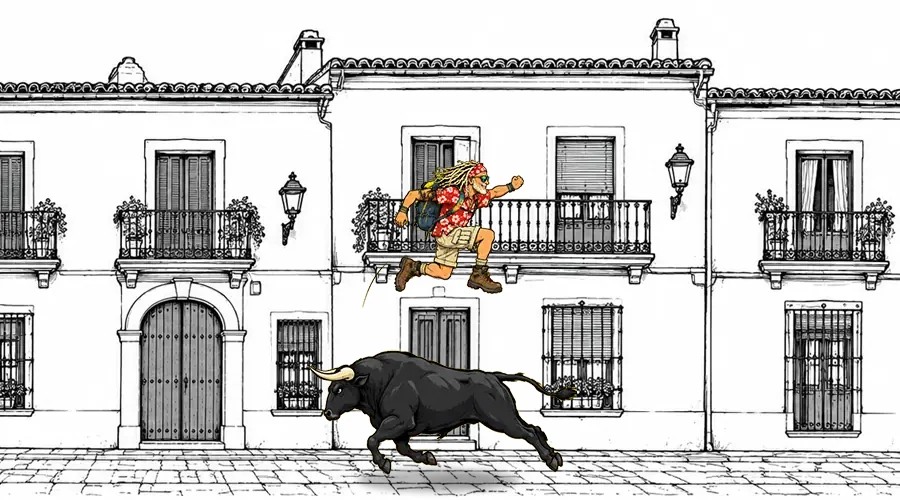
The Backpackers Bible guru, a dreadlocked backpacker in a Hawaiian shirt, leaping over a charging black bull on a cobbled street in Spain

Things To Do In Navarre

Search Navarre Attractions and Tours

Interactive tourist attraction and tour map for Navarre showing things to do for backpackers.
Tours in Navarreon GetYourGuide ↗
Discover the best things to do, attractions, and backpacker tours in Navarre. Use two fingers to move the map, pinch to zoom.

1. Pamplona's Casco Viejo (Non-Negotiable)

Pamplona's old town is compact, walkable, and genuinely lovely whether or not your visit lines up with San Fermín.

Plaza del Castillo & The Encierro Route

The city's grand central square is the natural heart of the old town, and tracing the route the bull run follows through the surrounding streets — even outside festival week — gives a genuine sense of just how narrow and steep those famous corners actually are.

Pamplona Cathedral & The City Walls

A Gothic cathedral with a striking cloister, alongside a well-preserved circuit of Renaissance-era fortified walls that ring the old town — worth a walk for the views alone.

Read More

The Hemingway Trail

Several bars and cafes around the old town proudly claim a connection to Ernest Hemingway, who made San Fermín globally famous — Café Iruña on Plaza del Castillo is the most celebrated stop.

2. Adrenaline

4x4 or buggy tours of the Bardenas Reales: The most popular way to properly explore the badlands' restricted and hard-to-reach areas, with an accredited guide explaining the geology and history along the way.

Hiking and mountain biking the Bardenas: Independent exploration on foot or by bike is also possible on marked routes — just bring serious sun protection and water.

White-water rafting near the Pyrenees: The rivers running down from Navarre's northern mountains offer genuinely good rafting for both beginners and more experienced paddlers.

3. The Bardenas Reales

Most backpackers touring Spain have never heard of this place, which is exactly why it's worth the detour.

Castildetierra

The Bardenas' most photographed rock formation — a lone eroded pillar rising from the flat badlands, and one of the most surreal single images you'll come away with from this entire trip.

The Bardena Blanca

The park's most dramatic, most heavily eroded zone, all pale rock and sculpted ridgelines — genuinely alien enough that it's stood in for other worlds on screen more than once.

4. Free Navarre (Zero Euros)

Pamplona's Casco Viejo and city walls: Free to wander, and genuinely one of the best free experiences in the region.

The Ciudadela: A star-shaped former fortress turned public park, right in the middle of Pamplona — free, green, and a good break from the old town's stone streets.

Roncesvalles' monastery exterior: Free to view, even if you don't linger long at this tiny Camino waypoint.

The Bardenas Reales' main viewpoints: Independent access to the park itself is free — only guided vehicle tours into restricted zones carry a fee.

5. Nightlife: How It Actually Works

Outside San Fermín, Pamplona's nightlife runs through pintxos bars, much like its Basque neighbours — a slow crawl between small plates rather than a single destination venue.

For a first drink

The streets around Plaza del Castillo and Calle San Nicolás are the classic pintxos-crawl starting point.

During San Fermín

An entirely different animal — the whole city runs on a nonstop, multi-day party rhythm, bars stay open around the clock, and the crowds are unlike anything else on this site's calendar.

For something quieter

Outside festival season, Pamplona is a genuinely relaxed, low-key city for an evening — good tapas, good wine, nothing forced.

6. The Big Hits (Things You Must Not Skip)

The Bardenas Reales

Already covered above, but it bears repeating — the single most surprising landscape in the entire region.

Pamplona's Casco Viejo

Covered in full above — worth visiting on its own merits, San Fermín or not.

Olite Castle

A genuinely spectacular Gothic royal castle-palace, sometimes nicknamed "the Camelot of Spain" — an easy day trip from Pamplona through wine country.

Roncesvalles

The Camino de Santiago's traditional Spanish starting point, a tiny mountain village worth a stop even if you're not walking a single step of the trail yourself.

7. Live Sport & Culture

San Fermín and the Running of the Bulls: Already covered above and in the safety section — the single most famous live event in the region, and one of the most recognisable in the world.

CA Osasuna: Pamplona's football club has a genuinely passionate, tightly bonded fanbase — a good, comparatively affordable way to catch live Spanish football if your dates line up outside San Fermín.

Backpacking Navarre cartoon - the guru is in Pamplona, walking down the street and not noticing that there are bulls charging behind him.

Top-Rated Navarre Tours on GetYourGuide.com

trong>BAZTAN VALLEY | By Aitzol Berasategi - Own work, CC BY-SA 4.0, Link

Budget Accommodation In Navarre

Hostels listed on Booking.com and Hostelworld

For a full list of hostels, see our

Where Do You Want To Go Next?