This is not a scenery-of-the-month destination in the way that Cape Town or the Drakensberg are. There are no iconic landmarks. What it has instead is a cumulative, slow-building quality — the kind of place where you plan to stay three days and find yourself still there two weeks later, because the surf was good, the hostel was good, and the Sardine Run started and you forgot about everything else.
The Indian Ocean here is a completely different proposition to the Atlantic on the Cape. It is warm — 22–27°C in summer, rarely below 19°C in winter — and the colour of a swimming pool in good light. You can swim comfortably every month of the year. The water is also, periodically, full of the most extraordinary marine life on the planet: whale sharks at Aliwal Shoal, migrating whales, dolphins in their thousands riding the sardine run inshore, and what is consistently rated as one of the top ten dive sites in the world sitting a few kilometres offshore from Umkomaas. For a coastline this rich in marine experience, it is remarkably unbothered by crowds.
The Sardine Run: Africa's Greatest Show
Between June and July each year, hundreds of millions of sardines migrate northward along the KZN coast in a shoal that can be 15 kilometres long, 3 kilometres wide, and 40 metres deep. This is the Sardine Run — the largest animal migration on earth by biomass — and it triggers a feeding frenzy of a scale that has to be seen to be understood. Dolphins, estimated at 18,000 or more, herd the sardines into bait balls near the surface. Cape gannets dive-bomb the bait balls at 100km/h from height, hitting the water in white explosions. Sharks slice through from below. Whales arrive to scoop up what the dolphins leave. And humans wade into the water with their hands to grab fistfuls of fish, which washes ashore in quantities large enough that local communities fill buckets and bring home enough protein for weeks.
If you are anywhere on the South Coast in June or July, you need to be in the water for this. Snorkellers and freedivers can enter the water alongside the bait balls and experience the full feeding event from inside it — dolphins passing within touching distance, gannets hitting the water around you, the churning silver mass of sardines visible in every direction. It is one of the most extraordinary natural spectacles available to an ordinary traveller anywhere on earth, and it is happening on a stretch of coast where you can stay for R150 a night in a surf hostel. Book ahead for June and July — this is the one time the South Coast fills up.
A word of warning though: the Sardine Run is hit and miss. At the best of times, sometimes it doesn't happen at all. The problem has been exacerbated in recent years by overfishing and climate change, so our recommendation is that you don't pin all your holiday hopes on it: if it happens, great, but don't spend your money flying here from the other side of the world just to see it. Chances are, you'll be disappointed.
Getting Here and Getting Around
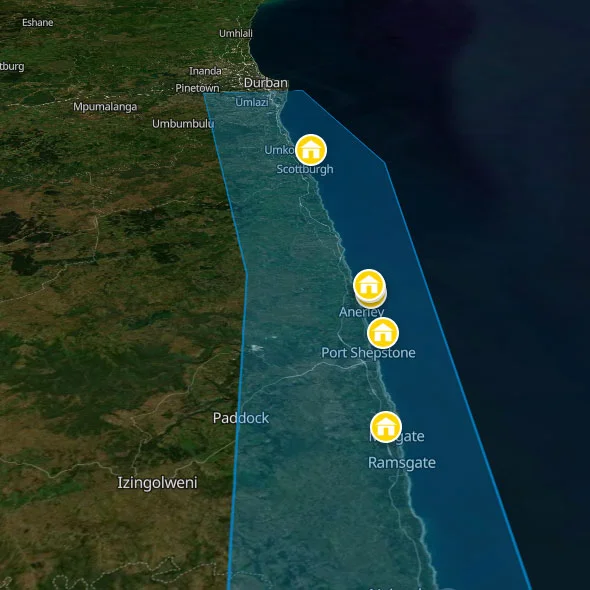
From Durban: The South Coast is accessed via the N2 south from Durban. The road is good and the drive to the northern end of the coast (Amanzimtoti, Scottburgh) takes 45 minutes to an hour. Margate, roughly in the middle of the coast, is about 1.5 hours from Durban. Port Edward, at the southern end, is 2 hours.
Baz Bus: The Baz Bus (South Africa's backpacker-focused hop-on, hop-off bus service) runs along the N2 and drops at several South Coast hostels by arrangement. This is the most practical option if you're coming from Cape Town or the Garden Route without your own vehicle — tell the Baz Bus operator which hostel you're heading to and they will advise on the drop-off logistics. Check the current Baz Bus schedule before booking, as routes and frequency change seasonally.
Margate Mini Coach: A regular shuttle service operates between Durban's Berea Road station and Margate, running several times daily. Affordable and reliable, this is the budget option for getting to the middle or southern sections of the coast from Durban without your own wheels.
Getting around the coast itself: This is the honest bit. The South Coast does not have a functional public transport network that tourists can rely on. There are local taxis (minibus kombis) between towns, but the routes and timing are opaque to visitors and English-language information is limited. If you are staying at one of the surf hostels, you are largely in one spot — and that is fine, because the surf, the beach, and the hostel itself will keep you occupied. If you want to explore the length of the coast, a hire car is the proper answer. Uber operates from Margate northward but coverage becomes patchy on the southern sections.
From Port Elizabeth (Gqeberha): The Wild Coast and Port Elizabeth are to the south. The drive from Port Edward to PE via the N2 takes approximately 4.5 hours, passing through Port Shepstone and Kokstad and through the tail end of the Wild Coast region. It is a long, mostly inland, occasionally beautiful drive. Allow a full day.
When To Go
Summer (November to March): Hot, humid, occasionally stormy. Water temperature at its warmest (25–27°C). Busy with South African domestic tourists, particularly around Christmas and Easter — book accommodation weeks in advance for these periods. The surf tends to be smaller in summer, which makes it better for beginners. Excellent for swimming, snorkelling, and general beach life. The east coast of South Africa receives most of its rainfall in summer, in short, heavy afternoon thunderstorms — dramatic but rarely day-ruining.
Winter (June to August): Mild, sunny, and considerably quieter. Water temperature drops to 19–21°C — still warm by any normal standard. This is when the Sardine Run happens (June–July), when the swell is most consistent and powerful (better for experienced surfers), and when whale watching is at its peak (humpbacks and southern rights migrating north). Whale shark sightings at Aliwal Shoal are year-round but particularly good in winter. If you are coming for the marine life, winter is the season.
Shoulder seasons (April–May, September–October): The sweet spot. Warm, quiet, good surf, reasonably priced, the beaches largely to yourself. September in particular is excellent — the sardine run is recent memory, the whales are still around, and the holiday crowds have gone home.
The Sugar Cane, the History, and What You're Actually Looking At
The rolling green hills inland from the coast are almost entirely covered in sugar cane — KwaZulu-Natal produces about 80% of South Africa's sugar, and the South Coast was at the heart of that industry from the 1850s onward. Sugar cane requires large amounts of labour for planting and harvesting, and the colonial government's solution was to import indentured workers from India — a decision that would, over the following decades, make KwaZulu-Natal home to the largest Indian community outside India, and make Durban a city unlike any other in Africa. Mahatma Gandhi lived and worked in South Africa for 21 years, much of that time on the KZN coast and in Durban, where he developed the philosophy of non-violent resistance before applying it in India. The community he advocated for still constitutes roughly 8% of KZN's population, and the South Coast's food, culture, and social fabric reflect this history in ways that are visible and delicious everywhere you go. A bunny chow — a hollowed-out half loaf of white bread filled to the brim with curry, eaten with your hands — is the greatest fast food invention in the history of human civilisation, and it was invented in Durban.
South Coast FAQs For Backpackers
Is the water warm enough to swim year-round?
Yes, genuinely. The Agulhas Current — which flows southwestward along the east coast of Africa — keeps KZN coastal waters significantly warmer than the Atlantic side of South Africa. Summer water temperatures are 25–27°C; winter temperatures rarely drop below 19°C. Compare that to Cape Town's Atlantic beaches where 14°C in February is considered a warm day. You do not need a wetsuit to swim on the South Coast in any month of the year, though surfers in winter will find a shortie (2mm wetsuit) comfortable.
Are there sharks?
Yes, and this is the one piece of information that requires straight talking. KwaZulu-Natal has a genuine shark presence, and the provincial government takes it seriously enough to maintain the KZN Sharks Board — an organisation that operates shark nets and drumlines along most of the South Coast's popular swimming beaches. The nets do not create a shark-free zone; they reduce the probability of shark-human interaction to very low levels and have done so consistently since 1952. Shark attacks on netted beaches are extremely rare.
Always swim at netted beaches when one is available. If you are surfing at an unnetted break — and many of the surf spots used by the hostels are unnetted — you are in shark territory. The local surfers know this and surf there anyway, which tells you something about the actual level of risk relative to perception. But go in eyes open: the South Coast has had incidents, particularly at the unnetted river mouth breaks. The ocean here is not a swimming pool. Swim at flagged beaches, know whether your break is netted, and don't surf alone at dawn or dusk.
Is there malaria on the South Coast?
No. The KZN South Coast is below the malaria line. You do not need malaria prophylaxis for the South Coast itself, or for Durban, or the Drakensberg. Malaria risk in KwaZulu-Natal is confined to the low-lying, subtropical northern areas — the Zululand bushveld and areas bordering Mozambique. If you are planning to visit Hluhluwe-iMfolozi, the St Lucia wetlands, or anywhere north of the Thukela (Tugela) River in a low-lying area, check with a travel health clinic before departure.
Is it safe?
The South Coast is significantly less threatening than Durban or Johannesburg from a safety perspective. The towns are small, the pace is slow, and the tourist areas are embedded in residential communities rather than in urban centres with the crime pressures that come with population density. That said, South Africa's general safety rules apply here as everywhere: don't walk alone after dark on deserted roads, don't leave valuables visible in a car, be aware of who is around you. The hostels on this list are all in low-crime areas and none have significant adverse security histories. Apply common sense and you will have a completely trouble-free experience.
Safety On The South Coast
The South Coast is, by South African standards, a relaxed and relatively low-crime environment for visitors. It is not Cape Town's City Bowl; it is not Johannesburg's CBD. The risks that exist here are specific and manageable, not ambient and unavoidable. Here is what you actually need to know.
The Ocean Is The Real Risk
More tourists get into trouble in the sea on the South Coast than anywhere on land. Rip currents are the primary hazard — the coast's geography, with its mix of sandy beaches, rocky headlands, and river mouths, generates persistent rips at predictable locations. Always swim between the flags at lifeguarded beaches. If you are caught in a rip, do not swim against it (you will exhaust yourself and drown); swim parallel to the beach until you are out of the current, then swim in. Every lifeguard on this coast will tell you that the people who get into trouble are the ones who ignored the flags and swam at unmarked breaks alone.
Petty Theft
Don't leave anything on the beach while you swim. Don't leave bags visible in a parked car on a beach road. Don't leave your phone charging unattended in a hostel common room. These are South Africa basics that apply here at a lower intensity than in the cities, but still apply. The hostels on this list all have lockers or safes — use them.
Night Walking
The towns on the South Coast are small and not all of them are well-lit after dark. Margate has a functioning town centre that is reasonably populated at night; the smaller coastal villages are essentially dark by 9pm. If you are moving between spots after dark, use an Uber or get a hostel shuttle. Walking along unlit coastal roads at night is not a good idea anywhere in South Africa.
Road Safety
This one is underrated as a risk. South Africa has one of the highest road fatality rates in the world, and the R61 and coastal roads on the South Coast are not exempt. Minibus taxis drive aggressively. Livestock sometimes wanders onto rural roads at night. If you are driving, do not drive after dark if you can avoid it. Always wear a seatbelt. Be aware that other road users may not be following any of the rules you assume apply. Driving a hire car in daylight on the main coastal road is fine; taking shortcuts on unmarked farm tracks at night is not.
Further Reading
Ready to map out the rest of your adventure? For more general info on backpacking South Africa, see our comprehensive home page. We also highly recommend checking out our expert backpacking advice section to make sure you stay safe and save money on the road. If you need help structuring your travel routes, take a look at our suggested itineraries for tours of South Africa. For more info on backpacking, including access to our offline app and interactive PDF guide, head over to our resources page.











 SHARE (opens in a new tab)