The Most English City in South Africa
Durban has always been, in character and in self-image, the most English city in South Africa. Where Cape Town is a hybrid — Dutch colonial foundations overlaid with Malay, British, and indigenous influences in complex layers — and Johannesburg is a gold-rush city that grew too fast to have much character at all, Durban was built by British settlers with a specific and deliberate intention: to recreate England in Africa. The City Hall, completed in 1910, is a near-exact replica of Belfast's City Hall — a colonial government building of enormous confidence and ambition, transplanted wholesale to the KwaZulu-Natal coast as a statement of permanence. Whether you find that historically fascinating or historically uncomfortable probably depends on where you're from and what you know about how that settlement happened. Both responses are reasonable.
That English character expressed itself politically, too. Durban was, through most of the apartheid era, more liberally minded than the rest of white South Africa. The city's English-speaking population tended to regard the National Party government — an Afrikaner political project — with a mixture of contempt and alarm. The feeling, not always expressed politely, was that the Nationalists were running the country into the ground while Durban quietly got on with the business of being a functional, cosmopolitan port city. This was the city that produced Albert Luthuli, first African Nobel Peace Prize laureate and ANC president. This was the city where Mahatma Gandhi developed his philosophy of non-violent resistance during the twenty-one years he spent in South Africa, most of them in Natal. History ran through Durban in ways that were not always comfortable, but were always significant.
The Beach Decision That Changed Everything
Durban was once South Africa's playground, eclipsing Cape Town as the country's premier tourist destination. It's proximity to Johannesburg, its sunny weather, beaches and the Golden Mile made it white South Africa's favourite before and during apartheid. In the mid-1980s, the city made a decision that was, by the standards of the time, genuinely courageous: it desegregated its beaches. Under apartheid, South Africa's beaches had been divided by race — white beaches, Indian beaches, and beaches designated for Black South Africans, which were invariably the ones with less infrastructure, less maintenance, and less access. Durban, led by its English-character municipal government and its liberal white population's discomfort with the status quo, opened all its beaches to all races ahead of the national legal change.
The result was catastrophic for the city's tourism industry.
The tourists from the Transvaal — the "Vaalies," as KZN locals called them, the Johannesburg and Pretoria families who had been driving to Durban's beaches every summer for generations — simply stopped coming. Rather than share a beach, they chose to drive more than double the distance to faraway Cape Town instead. The decision was explicit and collective and it happened quickly. Within a few seasons, Durban's beachfront had lost the domestic tourist base that had sustained it for decades. The hotels emptied. The investment dried up. Cape Town boomed.
The consequences are visible today. There has been virtually no private hotel development along Durban's famous Golden Mile beachfront since the 1980s. The government has pumped billions of rands into the beachfront — uShaka Marine World, the promenade upgrades, the stadium — on the theory that infrastructure would attract visitors. But infrastructure without word-of-mouth marketing, without a domestic audience recommending it, without the organic social networks that drive tourism decisions, does not fill hotel rooms. The beachfront retains a slightly melancholy quality: enormous potential in an extraordinary location, the warm Indian Ocean stretching to the horizon, and the crowds of holiday-makers that should be there simply not arriving.
The irony, for an international backpacker, is that this makes Durban genuinely cheap and genuinely uncrowded by the standards of what it should be. A city with this coastline, this food, this culture, and this weather would, in a functioning international tourism market, be one of the most visited cities in Africa. Instead, it is largely unknown outside South Africa, undersold even within it, and waiting.
The Indian City
Durban has the largest Indian community outside India — a fact that most visitors, even well-travelled ones, are not prepared for. It is visible and extraordinary and it is the direct result of the sugar industry. When British colonists established sugar plantations in KwaZulu-Natal from the 1850s onward, the indigenous Zulu population declined to perform indentured agricultural labour on land that had, within living memory, been theirs. The colonial government's solution was to import workers from India — first as indentured labourers on five-year contracts, then, when many chose to stay after their contracts expired, as a permanent community that put down deep roots in KZN's soil.
Gandhi arrived in Durban in 1893 as a young lawyer, intending to stay for a year. He stayed for twenty-one, and during that time he was thrown off a first-class train at Pietermaritzburg for being non-white despite holding a valid ticket — an experience of institutionalised racism so vivid and so formative that it reoriented his entire life and, eventually, the independence movement of the most populous nation on earth. The platform at Pietermaritzburg station has a plaque. It is worth reading.
The Indian community's presence in Durban is not a historical footnote. It is the food, the culture, the music, the architecture, and the social fabric of whole neighbourhoods. The curry you will eat in Durban — specifically the bunny chow, the hollowed-out half-loaf of white bread filled with richly spiced curry, eaten with your hands — is not a tourist attraction. It is what people eat here. It was invented by Durban's Indian community, likely in the 1940s, as a practical way to serve curry to workers who had no plates. It is one of the great street food inventions in the history of the world, and you will eat at least three of them before you leave.
The Zulu City
Durban is also, and simultaneously, a Zulu city. KwaZulu-Natal is Zulu land — the land of the people of heaven, as the name translates — and the Zulu nation's history is one of the most dramatic in southern Africa: a relatively small clan that, under the military genius of King Shaka in the early 19th century, built an empire through a combination of tactical innovation, political absorption, and overwhelming force that reshaped the entire subcontinent. The consequences of Shaka's expansion — the Mfecane, or "the crushing," a period of mass displacement, warfare, and famine that rippled across southern Africa as people fled the Zulu advance — are still debated by historians in terms of scale and causation. What is not debated is that the Zulu nation's encounter with British colonial expansion, culminating in the Anglo-Zulu War of 1879, was one of the most significant military contests in the history of African resistance to European colonisation. The Battle of Isandlwana — where a Zulu force destroyed a British regiment in a defeat so catastrophic that the British public refused to believe it — is studied in military academies today.
All of this history — Zulu, Indian, British colonial, anti-apartheid — runs through Durban simultaneously, and you feel it in the city's energy in a way that is different from any other South African city. Durban is not trying to be Cape Town. It is not trying to be Johannesburg. It is entirely itself, which is a complicated, layered, subtropical, extraordinary thing.
Getting To and Around Durban
By air: King Shaka International Airport is located approximately 35 kilometres north of the city centre, near the town of La Mercy. It is a modern, functional airport served by domestic flights from Johannesburg (approximately 1 hour), Cape Town (approximately 2 hours), and other South African cities on multiple daily services. Transfers to the city centre by Uber take approximately 40–50 minutes and are the most practical option for backpackers with luggage.
By bus: Greyhound, Intercape, and Translux all operate intercity coach services to Durban from the main South African cities, arriving at the Durban Station bus terminal.
Getting around the city: Uber operates reliably throughout Durban's good areas — the Berea, Morningside, the beachfront, and the northern suburbs. It is the most practical option for getting between points safely. The city also has a reasonably functional bus network (the People Mover/Mynah bus system covers tourist routes) and an extensive minibus taxi network that locals use daily. Minibus taxis are affordable but the routing system is opaque to visitors without local knowledge. Ask at your hostel for guidance on specific routes before attempting to use them independently.
A note on road names: Durban has undergone significant street renaming since the end of apartheid, and many maps — including some GPS systems — have not fully caught up. What appears on an old map as one name may now be something entirely different on a street sign. Verify current road names on Google Maps before navigating. The broad principle is that roads named after colonial figures or apartheid-era politicians have been renamed after liberation movement leaders, local historical figures, or in some cases international revolutionary figures — Che Guevara Road in the Glenwood area being one example. This is part of an ongoing national process of renaming public spaces to reflect a post-apartheid identity, and it is worth approaching with awareness rather than frustration.
Understanding Durban: The Neighbourhoods
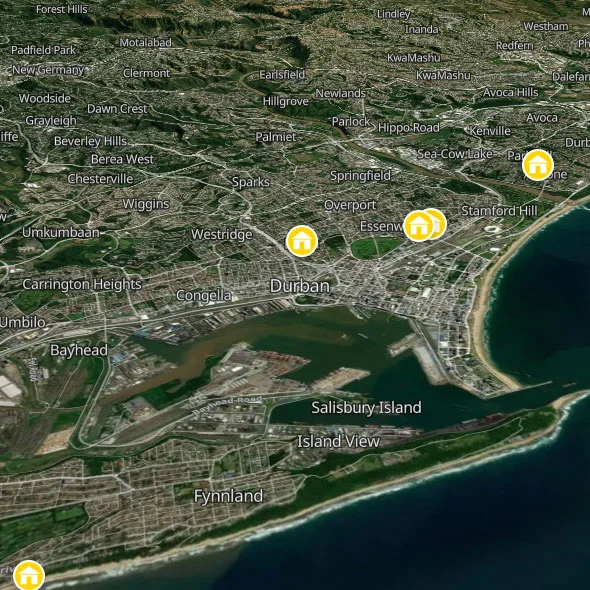
The Berea and Morningside — where you want to be: The best neighbourhoods in Durban for backpackers are the Berea and, particularly, Morningside. These are leafy, hilly suburbs set back from the coast on the ridge above the city — genuinely beautiful areas of wide tree-lined streets, old colonial houses with wraparound verandas, independent restaurants, coffee shops, and the kind of unhurried, liveable quality that good subtropical cities produce when things have been allowed to grow properly. Florida Road — which runs off Peter Mokaba Ridge Road down toward the Greyville racecourse area — is Durban's equivalent of Cape Town's Kloof Street: the best concentration of restaurants, bars, and general evening life in the city. The Monkey Bar and Butcher Boys have been landmarks on Florida Road for years; the strip as a whole is walkable, sociable, and safe by day and by reasonable evening hours. This is where you eat, where you drink, and where you get your bearings on the city.
The Glenwood area — particularly around the Davenport Road area — has its own concentration of restaurants and casual bars that is less polished than Florida Road but genuinely local and good value. Be aware that the streets immediately adjacent to the restaurant strip in this area have a visible sex-work presence — not dangerous in itself, but worth knowing so you're not surprised. The restaurant strip itself is fine.
The beachfront / Golden Mile: The beachfront promenade is at its best early in the morning — from sunrise to about 9am — when it fills with joggers, cyclists, rollerbladers, and early-morning swimmers, and when the police presence is strong and the energy is genuinely good. The Indian Ocean here is warm and the beach is long and the sunrise from the promenade, looking south with the city behind you, is one of the better free things in Durban. Later in the day and into the evening, the dynamic changes. Stay on the promenade itself; don't wander into the surrounding streets or the flatland areas immediately behind the beachfront. The Addington and South Beach areas — the flat, high-rise-dense areas around The Wheel shopping mall — are not recommended for independent exploration. This is not prejudice; it is a practical assessment of an area where crime affecting tourists is documented and where the infrastructure of responsible tourism (active street life, restaurants, visible foot traffic) is absent.
The northern beaches — Durban's best-kept secret: The genuinely best beaches in Durban are not the Golden Mile. They are the undeveloped northern beaches between Blue Lagoon and Snake Park — a stretch of coast that is, by the standards of what it is, practically deserted. The water is warm, the sand is good, the crowds are negligible. The reason these beaches remain empty has its roots in apartheid: this stretch of coast was designated as non-white beach space during the apartheid era, and the association — irrational, but persistent — has kept South African domestic visitors away even decades after desegregation. The result is that an international backpacker can have some of the finest beach in the city almost entirely to themselves. Go early, go in a group, and take only what you need for the day.
⚠ Safety Warning: Water Quality
Water quality is a critical factor to consider before swimming in Durban. The city has faced ongoing challenges with its sewage infrastructure, which can lead to high E. coli levels, particularly near the mouth of the Umgeni River (affecting areas like Blue Lagoon and Laguna Beach). While the majority of Durban’s 23 bathing beaches are regularly tested and currently safe for swimming, conditions can deteriorate rapidly after heavy rains as runoff enters the ocean. It is essential to check the official eThekwini Municipality water quality results or look for the color-coded safety flags at beach entrances before diving in. If the water appears murky or there has been a recent storm, consider using the city’s public swimming pools instead.
The city centre: Durban's CBD has a significant crime problem that makes independent tourist exploration inadvisable without a local guide. The Victoria Street Market area — historically the heart of the Indian trading district and a genuine cultural landmark — is best approached with a guide arranged through your hostel, or avoided altogether if you prefer not to manage that complexity. The City Hall is worth seeing from the outside as you pass; the immediate CBD blocks surrounding it are not recommended for wandering. This is a consistent pattern in South African city centres and Durban is not exceptional in it — it is simply honest.
Durban FAQs For Backpackers
What is a bunny chow and where do I get one?
A bunny chow is a hollowed-out quarter, half, or full loaf of white bread — the bread itself acting as the bowl — filled to the brim with curry. Mutton is the classic. Bean is excellent for vegetarians. Chicken is widely available. You eat it with your hands, tearing pieces of the bread from the inside of the loaf to scoop the curry. There is no elegant way to eat a bunny chow. Wear something you don't mind staining.
The canonical bunny chow experience in Durban is at one of the Indian-owned curry shops in the Greyville and Berea areas — functional, counter-service establishments where the curry has been cooking since early morning and the queue at lunchtime is made up entirely of locals who know exactly what they want. Ask at your hostel for their current recommendation. The bunny chow you get from a place that has been making them for forty years, from a recipe passed through three generations, costs about R60–R80 and is one of the best things you will eat in South Africa.
What is the weather like?
Hot and humid in summer (November to March), with afternoon thunderstorms that are spectacular and usually short. Warm and dry in winter (June to August) — genuinely pleasant, with daytime temperatures of 20–25°C and almost no rain. Durban's winters are markedly more pleasant than Johannesburg's (cold, dry highveld winter) or Cape Town's (wet, windy, grey). If you are planning a long South African trip and have flexibility on timing, the KZN coast in July is one of the most reliably enjoyable climates in the country. The sardine run on the south coast happens in June and July. The whales are in the water. The days are sunny and mild. It is excellent.
Is there malaria in Durban?
No. Durban is well below the malaria line. Malaria risk in KwaZulu-Natal is confined to the low-lying subtropical areas in the far north of the province — the Zululand bushveld bordering Mozambique. You do not need prophylaxis for Durban, for the KZN coast, or for the Drakensberg.
Is uShaka Marine World worth visiting?
uShaka Marine World is a large marine theme park on the Point area of the Durban waterfront — one of the government's major infrastructure investments in the beachfront's post-apartheid revival. The aquarium component is genuinely good, with one of the largest shark tanks in the southern hemisphere. If dolphin and seal shows are your thing, they're here. The waterpark element is family-oriented. As a destination it is fine — decent for a morning if you have a specific interest in marine life, less compelling as a general tourist attraction.
The honest caveat: uShaka sits in the Point area of the waterfront, and the route to it passes through parts of the city that are not tourist-friendly. Get there by Uber and return by Uber; don't walk to or from uShaka through the surrounding streets. The park itself is secure once you're inside. The area immediately outside it is not a place to linger.
Safety In Durban
Durban requires the same level of street intelligence as any major South African city — which is to say, considerably more than most visitors from Western Europe or Australia are used to operating with. The risks are specific and manageable. Here is what you actually need to know.
Where To Go And Where Not To Go
Safe for walking, day and reasonable evening hours: The Berea, Morningside, Florida Road and its immediate surroundings, the Glenwood restaurant strip, the beachfront promenade in the early morning.
Avoid: Mahatma Gandhi Road — entirely. The Addington and South Beach flatland areas (the high-rise blocks around The Wheel shopping mall). Any spontaneous wandering in the CBD without a local guide. The Point/Esplanade area around uShaka — transit only, by Uber.
The beachfront rule: The promenade is fine in the early morning when it is populated and the police presence is high. Stay on the promenade itself. If you step off the promenade into the surrounding streets, the risk profile changes immediately. Aggressive begging is the most likely unpleasant experience in the beachfront-adjacent areas; more serious crime is possible in the blocks behind the Golden Mile. The promenade itself, in daylight with other people around, is manageable. The surrounding streets are not worth exploring independently.
Phone Snatching
As in every South African city, phone snatching is the number-one crime affecting tourists. Keep your phone in your pocket when walking. Check your navigation before leaving, not while walking. A crossbody bag with a zip is better than a backpack with an external pocket.
Driving
If you are driving in Durban, follow the same rules as the rest of South Africa: windows up in slow traffic, nothing visible on seats, avoid GPS shortcuts through unfamiliar areas, do not drive after dark in areas you don't know. Durban's road system is not difficult to navigate in the tourist areas; the complexity comes from the renamed streets, which can confuse GPS systems. Verify your route before you set off.
The Ocean
Durban's main beaches are netted by the KZN Sharks Board and lifeguarded through the main season. Swim at flagged beaches. Rip currents exist along this coast — if caught in one, swim parallel to the beach, not against the current. The northern beaches between Blue Lagoon and Snake Park are unnetted — swim with awareness, not panic, but do not swim alone there. Shark nets are not present but the northern beaches are calmer and less exposed than the open Golden Mile.
⚠ Safety Warning: Water Quality
Water quality is a critical factor to consider before swimming in Durban. The city has faced ongoing challenges with its sewage infrastructure, which can lead to high E. coli levels, particularly near the mouth of the Umgeni River (affecting areas like Blue Lagoon and Laguna Beach). While the majority of Durban’s 23 bathing beaches are regularly tested and currently safe for swimming, conditions can deteriorate rapidly after heavy rains as runoff enters the ocean. It is essential to check the official eThekwini Municipality water quality results (Beach Water Quality and E.Coli results are displayed on public notice boards of all bathing beaches every day) or look for the color-coded safety flags at beach entrances before diving in. If the water appears murky or there has been a recent storm, consider using the city’s public swimming pools instead.
Further Reading
Ready to map out the rest of your adventure? For more general info on backpacking South Africa, see our comprehensive home page. We also highly recommend checking out our expert backpacking advice section to make sure you stay safe and save money on the road. If you need help structuring your travel routes, take a look at our suggested itineraries for tours of South Africa. For more info on backpacking, including access to our offline app and interactive PDF guide, head over to our resources page.













 SHARE (opens in a new tab)