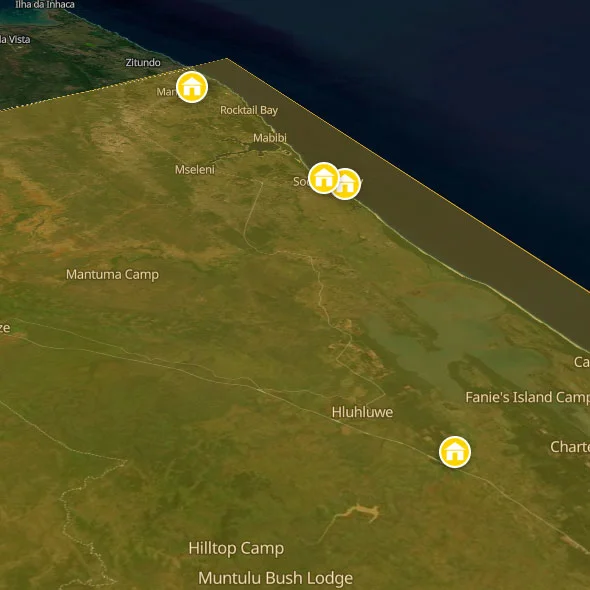
Geographically, Zululand covers the northern two-thirds of KwaZulu-Natal province, from roughly Stanger in the south to the Mozambique border in the north. It takes in the rolling green hills around Eshowe — the oldest town in Zululand, home to four Zulu kings — the sugar cane flats of the coastal strip, the iSimangaliso Wetland Park stretching 220km up the coast, the Hluhluwe-iMfolozi Game Reserve (the oldest proclaimed reserve in Africa), Sodwana Bay's coral reefs, Kosi Bay's lake system on the Mozambique border, and the vast interior wilderness of the Mkuze Game Reserve and Phongola Flood Plains. The KwaZulu-Natal names alone should tell you something about where you are: Mtubatuba, Dukuduku, Kwambonombi (known to locals simply as "Kwambo"), Hluhluwe — say it out loud: shloo-shloo-wee, a sound like water moving over rocks — and iSimangaliso itself, rolling off the tongue in five syllables of Zulu poetry. These are not place names that translate comfortably into English. They belong to a language built for a different relationship with this landscape, and getting comfortable with them is part of arriving here properly.
Two things define Zululand in equal measure: the wildlife and the history. They are not separable. The land where the white rhino was brought back from the edge of extinction is the same land where Shaka built his empire, where the Zulu impis defeated the British army at Isandlwana, and where the blood-red Buffalo River ran with the bodies of the fallen at the Battle of Blood River. The animals and the history happened in the same places. The hills are the same hills. The rivers are the same rivers. Understanding this — that Zululand is a place where human and natural history are woven together tightly rather than occupying different lanes — is the key to understanding why it affects visitors so deeply and stays with them so long after they leave.
The Zulu People And Their History
The Zulu are the largest ethnic group in South Africa and one of the most culturally distinctive peoples on the African continent. Their history as a unified nation is relatively recent by African standards — the Zulu kingdom as it is understood today was forged in the early 19th century — but the culture, language, and traditions that underpin that nation are ancient, and they are very much alive in the Zululand of the present day.
King Shaka: The Central Figure
It is not possible to understand Zululand without understanding Shaka kaSenzangakhona — King Shaka — the man who transformed a small and unremarkable clan on the Mfolozi River into the most feared military force in southern Africa within a decade. Shaka became chief of the Zulu clan around 1816 and immediately set about revolutionising warfare. He abandoned the traditional throwing spear in favour of the iklwa — a short-handled, broad-bladed stabbing spear designed for close combat — and the large cowhide shield, and he drilled his regiments, the amabutho, into the famous impondo zankomo or "bull horn" formation: a central chest that engaged the enemy while two flanking "horns" encircled them, pinning them for the kill. He also imposed a ferocious discipline: his warriors ran barefoot at extraordinary speed across country, lived in military kraals for years without marrying, and fought with an organised ferocity that overwhelmed neighbours who had nothing comparable.
The result was the Mfecane — "the crushing" — a period of catastrophic, widespread warfare and displacement that reshaped the demography of southern Africa. Entire nations were destroyed, displaced, or absorbed. New nations were forged from the refugees. The Sotho kingdom in the mountains that would become Lesotho existed partly because Moshoeshoe gathered the survivors. The Ndebele kingdom in what is now Zimbabwe was founded by a general who fled Shaka's reach. The effects were felt thousands of kilometres away. Shaka himself was murdered by his half-brothers Dingane and Mhlangana in 1828, and the Zulu kingdom passed to Dingane — a less gifted but equally ruthless ruler who would face a new and more technologically formidable enemy: the Voortrekkers.
Blood River: 16 December 1838
On 16 December 1838, a Voortrekker force of approximately 470 men under Andries Pretorius formed a laager with their ox-wagons on the bank of the Ncome River in what is now northern KwaZulu-Natal, and fought off an estimated 10,000–15,000 Zulu warriors in a battle that lasted less than two hours. Dingane's impis — responding to the murder of Retief's party at Mgungundlovu — attacked the laager in waves. The Voortrekkers' superior firepower turned the river red with Zulu blood: the Ncome became known from that day as Blood River. The Voortrekkers suffered not a single fatality. For Afrikaner nationalists, the Battle of Blood River became a foundational myth — a covenant with God, kept. For Zulu people, it is remembered differently: as a day of devastating loss. 16 December remains a public holiday in South Africa, now called the Day of Reconciliation — an attempt, of debatable success, to hold both memories simultaneously.
Isandlwana and Rorke's Drift: 22 January 1879
On 22 January 1879, in one of the most shocking military reversals in the history of the British Empire, a Zulu army of approximately 20,000 men under the command of King Cetshwayo overwhelmed a British camp at the foot of the sphinx-shaped hill called Isandlwana and killed over 1,300 soldiers — the majority of a British column — in a single afternoon. The Zulu warriors, armed primarily with spears, went around the formidable British firepower using the bull-horn formation Shaka had perfected six decades earlier. The defeat at Isandlwana remains the largest single loss ever suffered by the British army against an indigenous African force.
That same evening and into the following morning, a force of around 150 British soldiers and auxiliaries at the small mission station of Rorke's Drift — 15km from Isandlwana — fought off approximately 3,000 to 4,000 Zulu warriors who had crossed the Buffalo River after the Isandlwana victory. The defence of Rorke's Drift lasted through the night, with the British soldiers fighting from barricades of mealie bags and biscuit boxes, and produced eleven Victoria Crosses — the highest number ever awarded for a single engagement. The British Empire needed the story of Rorke's Drift. Isandlwana was too catastrophic to end the narrative on. Both sites are visitable today — they are among the most significant battlefield sites in the world, and touring them with a local guide rather than independently is the only way to understand what actually happened there.
Zulu Culture Today
Zulu culture is not a museum exhibit. It is a living, evolving set of practices, beliefs, and social structures that continues to shape the daily life of millions of people in KwaZulu-Natal. The umkhosi woMhlanga — the Reed Dance, held annually in late August or early September — brings tens of thousands of young Zulu women to the royal palace at Nongoma to present reeds to the King, in a ceremony that celebrates chastity, womanhood, and the continuity of the nation. King Shaka Day on 24 September is a national public holiday and a major cultural event, celebrated with warrior dances, traditional dress, and ceremonies at sites of significance across the province. The Shembe Church — officially the Ibandla lamaNazaretha — is a Zulu-inflected syncretic Christian movement that draws enormous gatherings, particularly in October at its pilgrimage to the Nhlangakazi mountain, where the founder Isaiah Shembe is said to have received his divine calling.
The sangoma — the traditional healer, diviner, and communicator with ancestral spirits — remains a figure of real authority and significance in Zulu society, not a folkloric curiosity. The beadwork of Zulu women communicates social information — age, marital status, clan affiliation — in a visual language that is still read and understood. The ilobolo system of bride price, negotiated between families in cattle or cash, is still practised. The cattle themselves — the long-horned Nguni breed, their hides a living catalogue of colour variations — remain symbols of wealth, status, and spiritual continuity in a way that no other domesticated animal is for any other South African people.
For the backpacker, the most authentic access to this living culture comes through places like Eshowe — where Graham Chennells of Zululand Eco-Adventures has been running real Zulu cultural immersion tours since 1995, taking small groups to village ceremonies, traditional homesteads, sangoma consultations, and the working life of rural Zululand that exists completely outside the tourist circuit. This is not performance. It is invitation. The difference matters enormously.
The Wildlife Of Zululand
Zululand is where the white rhino was saved. By the early 20th century, the southern white rhino — Ceratotherium simum simum — had been hunted to the edge of extinction. The last viable population on earth, numbering fewer than 50 individuals, was clinging on in the Hluhluwe-iMfolozi Game Reserve in northern KwaZulu-Natal. This reserve — established in 1895, making it the oldest proclaimed game reserve in Africa — became the cradle of one of conservation's few genuine success stories. Under the protection of the reserve and through the pioneering work of KwaZulu-Natal Wildlife, the white rhino was brought back. Today the global population numbers over 17,000, of which the vast majority trace their ancestry to this one small patch of KwaZulu-Natal bush. Every white rhino anywhere in the world — in parks, in zoos, in reserves from Kenya to California — is descended from the survivors at Hluhluwe-iMfolozi. The next time you see a white rhino anywhere on earth, you are looking at an animal whose existence depends on the conservation work that happened in this specific valley.
Beyond the rhino, Zululand contains a remarkable concentration of wildlife across multiple ecosystems. Hluhluwe-iMfolozi is Big Five: lion, leopard, elephant, buffalo, and both black and white rhino. The iSimangaliso Wetland Park — stretching 220km from St Lucia to Kosi Bay — holds hippos, crocodiles, elephants, leopards, and a birdlist of over 530 species, including the endangered African pygmy kingfisher, the Pel's fishing owl, and the palm-nut vulture. The Indian Ocean within iSimangaliso's marine protected area is home to humpback whales (June–November), loggerhead and leatherback turtles (nesting November–February), whale sharks, manta rays, and the coral reef system at Sodwana Bay — the most southerly tropical coral reef in the world, and South Africa's finest diving destination. The Tembe Elephant Park near the Mozambique border protects the largest free-ranging elephants in Africa — the Tembe bulls are bigger than their equivalents in Kruger, a consequence of the relative remoteness of this coastal forest and the absence of culling pressure. The Mkuze Game Reserve, inland from the coast on the Mkuze River floodplain, is one of the finest birding destinations in southern Africa, with species that are found nowhere else in the country. We'll say more about Mkuze below — it is a hidden gem that almost no backpacker guide mentions.
The Ghost Mountain: A Zululand Secret
Halfway between Mkuze and the Swaziland border, rising above the flat thornveld on the edge of the Lebombo range, is a hill unlike any other in Zululand. Shokwe — the Ghost Mountain — sits above the town of Mkuze like an enormous muffin, its rounded dome of ancient granite so symmetrical, so improbably placed, that it seems designed rather than eroded. From a distance it looks almost implausible: a perfect bun-shaped mass of grey rock rising alone from the flat surrounding plain, its summit wreathed in mist on wet mornings, its flanks darkened by the dense fig trees and euphorbia that grow in its crevices. Most backpacker guides don't mention it. It is not on the standard tourist trail. That is precisely why you should go.
The Zulu name iNtaba yaMapunga — "mountain of spirits" — tells you what the Zulu people have always known about this place. It is considered deeply sacred in Zulu spiritual tradition. The mountain is associated with the ancestral spirits of the Nyawo clan who have lived in its shadow for generations, and it has an atmospheric quality that is difficult to explain rationally but very easy to feel. The stories of unusual occurrences around the mountain — sounds, lights, unexplained phenomena — have attached themselves to it for so long that the English name "Ghost Mountain" predates the colonial era in local consciousness. Whether you approach this sceptically or with an open mind, the physical presence of the mountain produces an effect. It is one of those places that has a gravity to it — you feel it drawing your attention from kilometres away, and once you have stopped to look at it, it is difficult to look away.
The mountain was also the site of the Battle of Tshaneni in 1884 — the decisive engagement of the Zulu Succession War, in which the forces of Zibhebhu kaMaphitha crushed the Usuthu faction loyal to the deposed King Cetshwayo near the base of the mountain. It was one of the most violent intra-Zulu conflicts of the 19th century, fought in the shadow of this sacred place, and the bodies of the fallen lay on these slopes for months. The mountain remembers all of it: the spiritual, the political, the violent, the ancient — layered in the same rock, the same mist, the same silence.
If you are passing through Mkuze, stop for lunch or a drink at the Ghost Mountain Inn, a classic Zululand bush hotel on the edge of town. It is not a backpacker operation — it is a proper hotel with a pool, a restaurant, and the slightly faded colonial-era atmosphere that Zululand's older establishments carry so well — but it is exactly the kind of place where you sit on the verandah with a cold Castle, look out at the mountain across the thornveld, and feel the specific quality of Zululand settling around you. The staff know the mountain's stories. The birding in the hotel grounds is outstanding. And the lunch menu is the best meal you will find between Hluhluwe and the Swaziland border. Go for the pie and stay for the mountain.
Mkuze Game Reserve: The Hidden Gem
Almost nobody in the backpacker world talks about Mkuze Game Reserve, which is baffling when you understand what it contains. Established in 1912 on the Mkuze River floodplain, it is one of the oldest reserves in KwaZulu-Natal. It is not Big Five — there are no lions, and elephants are occasional visitors — but what it offers is, for a specific kind of traveller, more rewarding than a lion sighting. Mkuze is the finest birding reserve in southern Africa. Over 400 species have been recorded, including the Pel's fishing owl, the African finfoot, the Narina trogon, the palm-nut vulture, the Rudd's apalis, and the broadbilled roller. The fig forest hides along the Mkuze River — purpose-built blinds that allow you to sit at water level while forest birds and raptors move through the canopy above you — are some of the best bird photography opportunities in southern Africa. Non-birders who visit for the atmosphere of the reserve — the fig forests, the pans teeming with hippos and crocodiles, the rhinos moving through yellow thornveld in the late afternoon — rarely leave disappointed either. Day fees are moderate. Accommodation inside the reserve (KZN Wildlife chalets) is affordable. Mkuze is what Kruger was like before Kruger became what it is now: uncrowded, unhurried, and quietly remarkable.
Zululand FAQs For Backpackers
Do I need a car?
Yes, with one partial exception. Without a car, Zululand is extremely difficult to travel independently. The Baz Bus serves St Lucia — the hub town — as a stop on the North Coast Runner shuttle between Durban and Mozambique, which makes St Lucia accessible by public transport. From St Lucia, you can join organised day tours to Hluhluwe-iMfolozi, take boat cruises on the estuary, and arrange shuttles to some surrounding attractions. But beyond St Lucia, independent exploration without a car is very limited. Hluhluwe-iMfolozi requires your own vehicle or an organised tour. Eshowe, Sodwana Bay, Kosi Bay, Mkuze, and the Thembe Elephant Park all require a car — or a very well-planned series of shuttles and pre-arranged transfers from your hostel. If you are doing Zululand without a car, base yourself in St Lucia for the iSimangaliso experience and supplement with organised tours. If you have a car, the whole region opens up.
When is the best time to visit?
Winter (June–September) is the best time for game viewing in Hluhluwe-iMfolozi — the bush thins out as the dry season progresses, water concentrates at the pans, and animals are easier to see. It is also the prime season for whale watching (humpbacks migrate north along the coast from June to November) and for birding in Mkuze (winter migrants swell the resident bird population). Temperatures are warm and pleasant — nothing like the cold of the Drakensberg or the Karoo at the same time of year.
November–February is turtle season — loggerhead and leatherback turtles nest on the beaches north of Cape Vidal and at Kosi Bay Mouth, and guided turtle tours at night are one of the most extraordinary natural experiences available in South Africa. The summer months are also when the coral reef at Sodwana Bay is at its clearest and warmest, and when the humpback whales that calved off Mozambique begin making their return south. The downside: heat and humidity are significant in summer, and malaria risk increases in the wet months (see below).
Spring (September–November) is arguably the best compromise: reasonable game viewing, the start of turtle season, good diving conditions, and more comfortable temperatures than midsummer.
Is malaria a risk in Zululand?
Yes — Zululand is a malaria zone, and you need to take this seriously. The risk is highest in the warm, wet summer months (October–April) and lower in winter, but it is never zero. Malaria-risk areas include iSimangaliso Wetland Park, Hluhluwe-iMfolozi, Mkuze Game Reserve, and everything north of the Mkuze River. If you are spending more than a night or two in northern Zululand, you should take prophylactics — consult a travel health clinic or doctor before you arrive for the appropriate medication (doxycycline, Malarone, or mefloquine depending on your health profile and budget). Anti-mosquito measures also matter: long sleeves and trousers after dark, DEET on exposed skin, sleeping under a mosquito net. Your hostel will usually have nets in accommodation. If you develop flu-like symptoms within three months of returning from a malaria zone, tell your doctor where you have been. Malaria treated promptly is manageable; malaria treated late is potentially fatal.
Is the water safe to swim in?
The Indian Ocean at Sodwana Bay and on the iSimangaliso coast is warm, clear, and exceptional for swimming and snorkelling. There are no great white sharks in this water — the water is too warm for them. There are occasionally bull sharks and tiger sharks, but shark incidents at these beaches are genuinely rare. The practical risks to be aware of are the Indian Ocean's strong currents at some beach access points, and the waves at the Sodwana Bay beach launch — where dive boats launch through breaking surf — which are not safe for casual swimming. Swim at designated swimming spots and follow local advice.
The rivers, estuaries, and lakes are a different matter entirely. Lake St Lucia and all its connecting waterways, the Kosi Bay lake system, and the rivers of iSimangaliso are home to Nile crocodiles and hippos. Do not swim in, or wade into, any inland water body in Zululand without checking with a local first. This applies to rivers that look calm and safe. Crocodiles and hippos are responsible for more human deaths in Africa than any other large animal. The hippos that walk through the streets of St Lucia town at night are genuine wild animals on genuine business and should be given a wide berth. They are not tame. They are not friendly. They are enormous, unpredictable, and very fast.
Is Zululand safe for travellers?
Zululand's tourist zones — St Lucia, Hluhluwe town, Sodwana Bay, Kosi Bay, Eshowe — are low-risk tourist environments. The major risks are environmental (malaria, wildlife encounters, Indian Ocean currents) rather than criminal. The rural areas require the standard South African awareness on the roads, and visitors should not stop for strangers on isolated roads at night. The hostels covered on this page are all well-established operations with good security records. St Lucia village, with its permanent tourist economy and estuary-walk culture, is extremely safe for solo walkers and solo women. Sodwana Bay and Kosi Bay are remote enough that the tourist population is self-selecting and crime against visitors is rare. Eshowe is a small town where Graham Chennells knows the area comprehensively and will give you a frank assessment of where to go and where not to go. Use your hosts as your primary safety resource — their local knowledge is worth more than any general guide.
⚠ Safety Warning: 9 Mile Beach, Sodwana
Recent security reports have highlighted an increase in crime at more isolated spots like 9 Mile Beach near Sodwana Bay. There have been reports of tourists being targeted by armed assailants, sometimes wielding machetes, particularly in the quieter stretches away from the main resort area. To stay safe, never visit 9 Mile Beach or other remote coastal stretches alone. Always travel in a group of at least four people, avoid carrying high-value items, and stick to daylight hours. If you are confronted, prioritise your personal safety and do not resist.
Further Reading
Ready to map out the rest of your adventure? For more general info on backpacking South Africa, see our comprehensive home page. We also highly recommend checking out our expert backpacking advice section to make sure you stay safe and save money on the road. If you need help structuring your travel routes, take a look at our suggested itineraries for tours of South Africa. For more info on backpacking, including access to our offline app and interactive PDF guide, head over to our resources page.













 SHARE (opens in a new tab)