The easiest way to choose your Eswatini hostel. Use our unique 3D map to filter cultural stays, nature reserves, and adventure bases.

Search Eswatini Backpacker Hostels

Filter backpackers hostels by digital nomad suitability, solo female traveller friendliness, safety, surfing, camping, value for money, party atmosphere, african culture experiences, adventure activities and nature experiences.

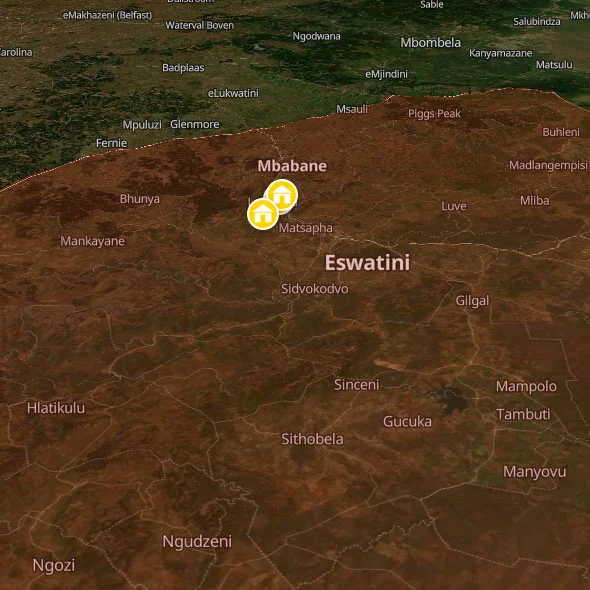
Interactive backpacker hostel map of Eswatini showing hostels that can be filtered by travel style, safety, digital nomad suitability, surfing, camping and budget travel preferences.

Where To Go, What To See and How Much It'll Cost

Use our wizard to plan your trip, based on what you want to see and do, and your budget. Costs calculated according to 2026 prices.

Welcome to our backpacking guide of Eswatini!

Discover more

Backpacking Eswatini

Eswatini is landlocked entirely within South Africa's and Mozambique's borders — a small, hilly, subtropical kingdom covering roughly 17,000 square kilometres, enclosed by the country you have just come from. But step across the border and the atmosphere changes immediately. The roads are quieter. The landscape shifts — misty green mountains rise in the west, rolling sugar cane fields spread across the midveld, the flat Lubombo plateau catches the eastern light. The people are Swazi. The culture is entirely their own.

Read More

You can drive around the perimeter of Eswatini in roughly six hours. In those six hours you will pass through mountain highlands with long views into South Africa, down through subtropical midveld where the sugar estates run to the horizon, across the lowveld game country of Hlane Royal National Park, and back up through the Lubombo Mountains toward the Mozambique border. In a single day's drive you will see more geographical and cultural variety than many countries offer in a week. Most backpackers who come here for one day stay for three. Plan accordingly.

Mbabane, the capital, sits at 1,243 metres in the Mdimba Mountains — cool, distinctly green, and considerably more attractive than most African capitals of comparable size. It is a walking city: small enough to navigate on foot, with a functioning commercial centre, good craft stalls, coffee, and none of the overwhelming urban pressure of Johannesburg or central Durban. It is one of those capitals that works first as a place where people live, and only secondarily as a destination — which for a backpacker with an afternoon to spare makes it genuinely pleasant to wander.

The Monarchy: Africa's Last Absolute King

Eswatini is the last absolute monarchy in sub-Saharan Africa. King Mswati III has ruled since 1986 — the current holder of a throne whose lineage traces directly back to the founding of the Swazi nation in the early 19th century. In 2018 he renamed the country from Swaziland to Eswatini — "the land of the Swazis" in siSwati — dropping the English colonial suffix that had been attached to the kingdom since British protectorate days.

The monarchy attracts criticism, principally from international human rights organisations and neighbouring democratic governments. Eswatini has no multi-party political system — political parties are banned, candidates for the parliament stand as individuals rather than as party representatives, and the king appoints both the prime minister and the cabinet. Press freedom is constrained. There have been pro-democracy protests, suppressed by force, and there are political prisoners. None of that is simple, and a tourist guide is not the place to adjudicate it.

What is also true — and what most of the international coverage misses entirely — is that the Swazi nation's relationship with its monarchy is considerably more complex than the straightforward oppressor-victim framing that advocacy journalism tends to produce. The king is not merely a head of state in the Western sense. He is the living symbol and central pivot of Swazi culture — its ceremonies, its identity, its continuity across generations. The two great annual ceremonies that define Swazi cultural life — the Umhlanga Reed Dance, in which thousands of unmarried women cut reeds and present them to the Queen Mother, and the Incwala first-fruits ceremony, the sacred ritual marking the Swazi new year — are not political performances. They are the genuine expression of a culture that predates colonisation and survived it, and the king is their embodiment.

Swazis are, by and large, intensely proud of their culture and their royal house. Many may have political frustrations with specific policies or decisions; that does not mean they want to dismantle the institution that holds their cultural identity together. Both things coexist, as they do in many places where tradition and modernity are in dialogue rather than at war. A visitor who arrives with only the international headlines will miss most of what makes Eswatini genuinely interesting. Come with curiosity rather than conclusions and you will leave with something more valuable than a confirmed opinion.

The Ezulwini Valley

The Ezulwini Valley — "valley of heaven" in siSwati — runs south from Mbabane for about 20 kilometres toward Manzini, the country's commercial capital. This is the cultural heart of Eswatini: the location of the royal palace at Lobamba, the national parliament, Mlilwane Wildlife Sanctuary, the Mantenga Cultural Village (a living reconstruction of a traditional 19th-century Swazi homestead with daily cultural performances), and the highest concentration of craft markets, restaurants, and tourist infrastructure in the country. Most of the backpacker accommodation is here. If you have one day in Eswatini, you will spend most of it in this valley, and it will not feel like enough.

Getting In and Getting Around

From Johannesburg: The main crossing is Oshoek (South Africa) / Ngwenya (Eswatini) — open 24 hours, on the N17, approximately 3.5 hours from Johannesburg. From the border, Mbabane is 12 kilometres east. This is the fastest and most straightforward entry point from the highveld.

From Durban: The most convenient crossing is Golela (South Africa) / Lavumisa (Eswatini) — open 07:00–22:00, on the N2/R69 northeast of Durban, approximately 3 hours from central Durban. From Lavumisa you enter the southern Swazi lowveld and drive north through Big Bend and Manzini to the Ezulwini Valley — a drive of approximately 2 hours.

Onward to Mozambique: From the Ezulwini Valley, the route to Maputo continues northeast through Manzini to the Lomahasha (Eswatini) / Namaacha (Mozambique) border crossing — open 07:00–22:00. From Namaacha it is 82 kilometres to Maputo. Full logistics in our Onward Travel section.

Getting around: Eswatini is a self-drive country. The roads are good, well-signed, and distances are short. Hire cars from South Africa are generally permitted to cross into Eswatini — confirm with your hire company before departure as policies vary. Minibus taxis (combis) run between Mbabane and Manzini and stop at the Gables shopping centre in the Ezulwini Valley, which is the most useful public transport access point for the valley hostels. Road conditions are generally excellent by regional standards.

Navigation note: Google Maps directions to Mlilwane Wildlife Sanctuary and Sondzela are known to be unreliable and can send drivers to the wrong gate. Use the GPS coordinates for the Sangweni Gate entry point: -26.46972 S, 31.20076 E. Follow signs for Mlilwane from the main Ezulwini Valley road rather than trusting turn-by-turn navigation alone.

Money: The Swazi lilangeni (plural emalangeni) is pegged 1:1 to the South African rand. Rand is accepted everywhere throughout Eswatini — no currency exchange is required if you are arriving from South Africa. Cards accepted at hotels, larger supermarkets, and tourist centres; carry some cash for markets, smaller operators, and rural areas.

Malaria: The highlands (Mbabane, Ezulwini Valley, Malkerns) are low risk. The lowveld — Big Bend, the Lubombo area, the Mozambique border zone — carries a higher malaria risk particularly in summer months. If you are spending time in the lowveld or crossing to Mozambique, take prophylaxis. See our Advice page before departure.

Eswatini FAQs For Backpackers

Do I need a visa?

No visa is required for most Western and Commonwealth nationalities and EU citizens for stays up to 30 days. Your passport must be valid for at least 6 months beyond your intended departure date. South African citizens enter visa-free. Verify your specific nationality's current requirements before travel.

Can I see the Big Five?

Yes, with nuance. Mlilwane Wildlife Sanctuary in the Ezulwini Valley — the backpacker heartland — does not have lion or buffalo, which means it can be safely explored on foot, horseback, and bicycle rather than from the confines of a vehicle. Walking freely among impala, zebra, warthog, wildebeest, hippo, and crocodile, in an unfenced reserve, is a more immediate wildlife experience than many fenced vehicle safaris, and one that is genuinely uncommon at this price point.

For lion, white rhino, elephant, buffalo, and leopard — the full Big Five — Hlane Royal National Park in the lowveld is the destination, approximately 1.5 hours from the Ezulwini Valley. Mkhaya Game Reserve, also in the lowveld, specialises in black and white rhino and is one of the finest rhino viewing experiences in southern Africa. Both are operated by Big Game Parks and bookable through the Sondzela or Mlilwane reservations desk.

Is it safe?

By regional standards, yes. The petty crime profile is significantly lower than South Africa's cities. Mbabane and Manzini require standard urban awareness at a much lower intensity than Johannesburg or Cape Town. The Ezulwini Valley tourist corridor is well-frequented and has no specific security issues for visitors. Political demonstrations are occasional and concentrated in urban centres — avoid any gathering with a political character and you will have no contact with civil unrest. The rural areas and game reserves are very safe.

Safety In Eswatini

Eswatini does not require the elevated vigilance of South Africa's cities. Standard travel common sense — don't walk alone after dark in unfamiliar urban areas, keep valuables secured, don't display expensive equipment openly — covers the realistic risk profile here. The tourist areas of the Ezulwini Valley are genuinely relaxed and safe. The one specific thing worth knowing:

Road safety: Eswatini has a road fatality rate that is disproportionate to its size. Minibus taxis drive aggressively. Livestock and pedestrians appear on rural roads unexpectedly. Do not drive after dark in rural areas if you can avoid it. Wear seatbelts. The main tourist roads are well-maintained; the risk comes from other drivers rather than road conditions.

The lowveld at night: The Big Bend area and the Lubombo lowveld near the Mozambique border are more isolated and less frequented by tourists than the highland areas. Plan your logistics so you are not driving unfamiliar lowveld roads after dark.

Further Reading

Ready to map out the rest of your adventure? For more general info on backpacking South Africa, see our comprehensive home page. We also highly recommend checking out our expert backpacking advice section to make sure you stay safe and save money on the road. If you need help structuring your travel routes, take a look at our suggested itineraries for tours of South Africa. For more info on backpacking, including access to our offline app and interactive PDF guide, head over to our resources page.

Backpacking Eswatini heraldic cartouche featuring a male and female backpacker framing a globe map of Eswatini, surrounded by local attractions.

Quick Facts

Best Time To Visit: May to September for cooler, dry weather and excellent wildlife viewing. October to April is lush and green, with summer rains bringing dramatic landscapes and vibrant scenery.
Best For: A compact but diverse road trip destination, traditional culture, mountain scenery, wildlife reserves, craft markets, and experiencing one of the world’s remaining African monarchies in a modern setting.
Most Popular Experience: Visiting Hlane Royal National Park for game drives and rhino sightings, often combined with a stop at cultural villages and traditional ceremonies depending on the season.
Most Under-rated Experience: Driving the entire country in a single loop, where mountains, valleys, wildlife reserves, and cultural sites can all be experienced in one day—offering one of the most condensed and varied road trips in southern Africa.
Best Free Experiences: Scenic drives through the Ezulwini Valley and highlands, stopping at viewpoints, exploring local markets, and taking in rural Swazi landscapes along the way.
Ideal Stay: 2–4 days is enough to experience the main highlights, though the country is small enough to explore at a relaxed pace in a very short trip.
Budget Level: Mid. Accommodation and activities are generally affordable compared to larger safari destinations, though prices vary between lodges, reserves, and urban stays.
Getting Around: A rental car is the best option, although you can get around fairly easily using local transport. Distances are short and roads are generally easy to navigate, making self-driving the most efficient way to experience the country in a single loop.
Best Photo Spots: Ezulwini Valley viewpoints, Hlane Royal National Park wildlife scenes, Mlilwane Wildlife Sanctuary landscapes, and sweeping highland mountain roads.
Photo: Sara Atkins Wikimedia Commons

Things To Do In Eswatini

1. House on Fire — and the MTN Bushfire Festival

House on Fire is one of those places that is almost impossible to adequately describe to someone who has not been there. It is a performance venue and living sculpture park in the Malkerns Valley, 23 kilometres from Mbabane, built and continuously expanded over decades by brothers Jiggs and Sholto Thorne into something that resists every attempt at categorisation. Vast organic architectural forms — carved stone, tiled mosaics, salvaged metalwork, wooden figures, inscribed text — grow out of each other in layers that reveal new detail the longer you look. There is no master plan visible in it; there is only a sustained creative vision applied to one site over a long time, and the result is extraordinary. It is one of the most singular spaces in southern Africa, and it should not be missed.

Read More

Every year at the end of May, House on Fire is the setting for the MTN Bushfire Festival — one of the most celebrated music and arts festivals in Africa. Drawing over 23,000 people across three days, Bushfire brings together artists from across the African continent and beyond in a programme of music, dance, visual art, and spoken word that reflects the full breadth of African cultural creativity. The festival has an international reputation built over two decades of programming, and the setting — the extraordinary architecture of House on Fire, the Swazi highlands landscape, the warm late-May evenings — gives it a character that no conventional festival venue could replicate. If your trip coincides with Bushfire weekend, this is the non-negotiable centrepiece of your Eswatini visit. Check the current year's dates at bushfire.co.sz well in advance — accommodation across the Ezulwini Valley fills up completely during festival weekend.

Adjacent to House on Fire and worth combining in the same visit: Swazi Candles — a candle-making and craft workshop where artisans work in full view, producing sculptural candles in animal and abstract forms of extraordinary quality. One of the best craft studios in Eswatini and worth an hour of your time even if you have no intention of buying anything.

2. Manzini Market

Manzini is Eswatini's largest and most commercially active city — a real, working African city rather than a curated tourist destination. Its market is one of the finest in the region for authentic Swazi crafts, and the batiks especially are exceptional: hand-painted fabric in vivid Swazi patterns, genuinely made here, at prices that reflect a market where Swazi traders sell to Swazis as much as to visitors. This is not the sanitised craft centre experience of the Ezulwini Valley tourist strip. It is a working southern African urban market, with all the energy and colour and occasional chaos that implies. Go on a weekday morning when it is at its most authentic. The batik fabric is the thing to buy — lightweight, genuinely beautiful, and culturally specific in a way that most southern African craft market goods are not.

3. Mlilwane Wildlife Sanctuary

Mlilwane is Eswatini's oldest protected area — a wildlife sanctuary in the Ezulwini Valley that has been restoring indigenous animals to the valley since the 1960s, when conservationist Ted Reilly began the work of bringing species back to land that had been stripped by hunting and overgrazing. The result is a sanctuary of remarkable intimacy: impala, zebra, wildebeest, blesbuck, warthog, crocodile, and hippo move freely through the reserve, and the defining characteristic of Mlilwane is that you can move freely among them. Walking, cycling, and horseback riding are all available without a guide, in an unfenced reserve — an experience that no conventional fenced safari park can replicate. The feeling of walking a footpath with a zebra herd 30 metres away, or watching a hippo submerge in the dam at sunset from a bench above the water, is the one that people describe when they talk about why Eswatini surprised them.

Navigation note: Google Maps directions to Mlilwane are unreliable. Use GPS coordinates for the Sangweni Gate: -26.46972 S, 31.20076 E. Follow signs from the main Ezulwini Valley road.

4. Hlane Royal National Park

Hlane — the name means "wilderness" in siSwati — is Eswatini's largest protected area, located in the lowveld approximately 1.5 hours from the Ezulwini Valley. It is a serious Big Five reserve: lion, elephant, white rhino, and a range of plains game roam a landscape of flat acacia bush and riverine forest that is completely different from the green Ezulwini highlands. Self-drive is permitted in the ungated sections; the lion and elephant areas require a guided game drive. The self-drive sections are particularly good for white rhino — some of the most relaxed, accessible rhino viewing in southern Africa, at a fraction of the cost of equivalent reserves in South Africa. Night drives reveal the full cast of nocturnal species. Hlane is bookable through Big Game Parks (biggameparks.org) and can be combined with Mkhaya on a two-day lowveld circuit.

5. The Mantenga Cultural Village

In the Mantenga Nature Reserve within the Ezulwini Valley, the Mantenga Cultural Village is a carefully reconstructed traditional Swazi homestead of the 1850s period — the era just before colonial contact radically changed the physical and social landscape of the kingdom. Daily cultural performances include traditional Swazi dance and music. The guides are Swazi, the commentary is genuine, and the setting — in the gorge below the Mantenga waterfall, surrounded by indigenous vegetation — is one of the more beautiful spots in the valley. It is a better introduction to Swazi cultural life than any museum, and the Mantenga Falls directly above the village are worth the walk up the gorge in their own right.

6. The Ezulwini Valley Craft Markets

The Ezulwini Valley road is lined with craft markets and studios of varying quality. The standouts are the Mantenga Craft Centre (Swazi-made crafts, consistently good quality, adjacent to the Mantenga Cultural Village and Legends Backpackers), Gone Rural in the Malkerns Valley (grass-woven homewares and textiles of exceptional quality, made by a cooperative of rural Swazi women — genuinely one of the best craft producers in southern Africa), and the various independent roadside stalls that appear and disappear seasonally. The rule for craft buying in Eswatini is the same as anywhere: the closer to a major tourist concentration, the higher the price and the lower the authenticity. Manzini market, gone rural, and the smaller valley studios represent better value and better quality than the hotel-adjacent market stalls.

7. Horseback Riding in Mlilwane

Mlilwane Wildlife Sanctuary offers guided horseback rides through the reserve — a 2-hour or full-day experience that takes you through the wildlife areas on horseback, approaching animals considerably more closely than is possible on foot or in a vehicle. Horses are available for all levels of rider. The experience of cantering across the valley floor with Nyonyane mountain in the background and a herd of wildebeest moving ahead of you is one of the finest things available in Eswatini at any price. Book through the Mlilwane/Sondzela reception desk — rides go out in the morning and late afternoon.

8. Mountain Biking in Mlilwane

Mlilwane has an extensive network of mountain bike trails through the sanctuary — hire bikes are available from the reception desk at Sondzela and the main Mlilwane camp. Trail difficulty ranges from easy valley routes suitable for casual cyclists to more technical climbs into the surrounding hills with views across the Ezulwini Valley. Cycling independently among the wildlife, at your own pace, with no guide and no itinerary, is one of the defining low-cost Eswatini experiences.

FREE AND LOW-COST ACTIVITIES

Walking in Mlilwane: The entrance fee to Mlilwane is modest and covers self-guided walking in the sanctuary. This is one of the best-value wildlife experiences in southern Africa — walking freely in an unfenced reserve among genuine African wildlife for the price of a day pass.

Mbabane city wander: Free. The capital is small enough to walk in an afternoon. The Swazi Plaza and nearby market areas are worth an hour. The surrounding Mdimba Mountains provide a backdrop that makes Mbabane one of the more atmospherically set African capitals.

Sunset from the Ezulwini Valley: Free. The valley catches the light in the late afternoon in a way that makes the mountains to the west glow. From the higher points of the valley — the road above Mlilwane, the ridge behind Lidwala — the view across the sanctuary toward the setting sun is one of those things you end up photographing repeatedly and still not capturing properly.

House on Fire (outside festival period): Open to visitors when no event is scheduled. Wandering the architecture costs nothing beyond the drive to Malkerns. Phone ahead to confirm it is open on the day you plan to visit.

Mantenga Falls: A short walk from the Mantenga Cultural Village entrance, a 95-metre waterfall dropping into a pool in a forested gorge. Eswatini's most visited waterfall and worth it.

Top-Rated Eswatini Tours on GetYourGuide.com

Photo: ZS Khumalo Wikimedia Commons

Eswatini Backpackers Hostels

Hostels listed on Booking.com and Hostelworld

All Hostels

Full contact details are included in case you want to book direct, plus useful info such as Safety Ratings and Value For Money, Solo Female Friendliness, and Digital Nomad scorecards.

SEE OUR

Where Do You Want To Go Next?