What Kind of Place Is This, Exactly?
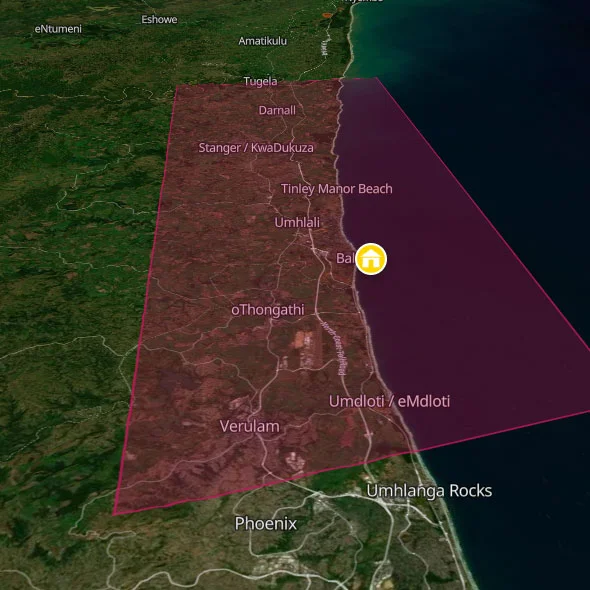
The North Coast is subtropical in climate — hot, humid summers with afternoon thunderstorms, mild winters with long stretches of sunshine and water warm enough to swim in year-round. It has none of the drama of Cape Town's mountain-and-sea geography; the landscape here is gentle, rolling, domestic. The hills are covered in cane, the valleys run down to small river mouths and tidal lagoons, the coastal towns are relaxed in a way that Durban, 40 minutes south, is emphatically not. Ballito is the commercial centre — a fast-growing beach town with good restaurants, good surf, and the slightly bewildering energy of a place that has doubled in size in ten years and is still figuring out what it wants to be. Salt Rock, Shaka's Rock, Sheffield Beach, Tinley Manor, Zinkwazi — these are quieter, smaller, each with its own tidal pool and its own stretch of the warm Indian Ocean, reached by the M4 coastal road that runs behind the dunes all the way north to the Tugela.
What gives the North Coast its specific character — the thing that makes it genuinely unlike anywhere else in South Africa — is its people. This is the heartland of South Africa's Indian community, one of the most remarkable and least-known immigrant success stories in the world. Understanding how they came here, and what they built, turns a pleasant beach holiday into something considerably more interesting.
The Sugar and the People Who Made It: A History
Sugar was first grown commercially in Natal in the 1840s. The colony's white settlers had discovered that the coastal soil and climate were ideal for the crop, and within a decade the industry was expanding rapidly along the narrow coastal belt. There was only one problem: labour.
The Zulu people — whose kingdom occupied the broader region — were not interested in working as cane cutters. This was not laziness or incapacity; it was a considered cultural position. In traditional Zulu society, agricultural field work was women's work. For a Zulu man to cut cane alongside women for wages set by a European employer was not merely underpaid — it was socially incomprehensible, a category violation that offended the entire structure of how masculine identity and honour were understood. Historians describe it more formally: Zulu men had access to land, were embedded in a pastoral economy organised around cattle, and had no economic or cultural incentive to enter wage labour "on conditions set by others," in the words of one academic account. Whatever one makes of the colonial frustration this produced, the Zulu refusal had a logic that was entirely coherent on its own terms — and the descendants of those same workers are today some of the wealthiest landowners in KwaZulu-Natal.
The colonial planters turned to the British imperial system of indentured labour — a practice of binding workers to multi-year contracts, developed after the abolition of slavery in 1833 as a way of maintaining plantation production across the Empire. The system had already been operating in Mauritius since 1834, where it had proven, from the planters' perspective at least, highly effective. Mauritius's experience was the template: an island sugar economy that had successfully transitioned from enslaved to contract labour using workers recruited from British India. When Natal's planters lobbied London for permission to do the same, the authorities pointed to Mauritius and approved it.
The first ship, the Truro, arrived in Durban harbour on 16 November 1860. It carried 342 indentured workers from Madras (now Chennai), in southern India. They had signed five-year contracts — what they called the girmit, a Hindustani pronunciation of the English word "agreement" — in exchange for free passage, food, accommodation, medical care, and ten shillings a month, with annual increments of one shilling thereafter. Over the following 51 years, 384 ships would make the same journey, carrying a total of 152,184 souls. More than two-thirds came from southern India; the rest from the north. Most were Hindu; a significant minority were Muslim; a small number were Christian. Most were from low-caste rural agricultural communities who had little to lose and very little to return to. Over time, a second wave of voluntary migrants — known as "passenger Indians" — followed, arriving under their own steam, typically to trade. It is from this passenger class that the Indian merchant and professional community of South Africa primarily descends.
The conditions of indenture were brutal by any honest assessment. Workers were bound by penal contract — absences, refusals to work, and complaints were treated as criminal offences. The basic wage of ten shillings a month did not change across the entire 51-year period of indenture. Workers who completed their contracts were offered the choice of a free return passage to India, a grant of land in Natal equivalent in value to that passage, or a third period of indenture at higher wages. Many chose the land. It was from these land grants — small plots, often marginal — that the South African Indian community began its slow and remarkable ascent.
In 1911, India banned further emigration to Natal, citing the documented mistreatment of its citizens in the colony. The indenture system was over, but the community it had created was permanent. The roughly 150,000 people and their descendants who had come through that system were here, in KwaZulu-Natal, with no realistic prospect of return and every incentive to build something in the country that had brought them.
From Cane Fields to Courtrooms: The Rise of Indian South Africa
The story of what South Africa's Indian community built from the wreckage of indenture is one of the most extraordinary stories in the country — and one of the least told in the histories that reach European readers. The descendants of people who arrived with nothing, bound by legal contracts they could not read, in a country they had never heard of, went on to become some of the most educationally accomplished, economically successful, and politically significant communities in South African history.
The obstacles were formidable. The colonial government imposed a £3 annual tax on any Indian who had completed their indenture and chose not to re-indenture or return to India — a punitive measure designed to push them out of the colony. Land ownership was restricted. From the 1890s onward, a series of discriminatory laws progressively limited Indian rights to property, business, and political participation. The apartheid system, when it came in 1948, imposed the full set of racial classifications on a community that had been in South Africa for nearly a century.
None of it worked as intended. The community educated its children, formed organisations, ran businesses in the spaces permitted to them, and produced lawyers, doctors, academics, and eventually politicians in numbers that vastly exceeded their proportion of the population. The Indian community of South Africa today — approximately 1.4 million people, concentrated in KwaZulu-Natal and the western suburbs of Johannesburg — is among the most educationally qualified and professionally represented ethnic groups in the country. The medical, legal, and business professions in KZN have Indian South Africans throughout their upper ranks. The food culture they brought and adapted — a fusion of southern Indian, northern Indian, Muslim, and specifically Natal-local culinary influences — produced what is now considered the most distinctive regional cuisine in the country. More on this in the FAQs and Things to Do sections.
Gandhi's Twenty-One Years: How South Africa Made the Mahatma
Mohandas Karamchand Gandhi arrived in Durban in May 1893, aged 24, on a year's legal assignment for an Indian trading house. He intended to stay twelve months. He stayed twenty-one years. It was on the North Coast, on a farm outside Durban in the community now known as Phoenix, that Gandhi underwent the most important transformation of his life — from a successful Westernised lawyer to the architect of a philosophy of nonviolent resistance that would change the world.
The trigger for that transformation was almost immediate. On his first train journey in South Africa, Gandhi was removed from a first-class compartment at Pietermaritzburg station and thrown off the train for refusing to move to the third-class carriage reserved for non-white passengers, despite holding a valid first-class ticket. He spent the night on the station platform in the winter cold, and spent the next twenty years deciding what to do about it.
He began by organising: founding the Natal Indian Congress in 1894, fighting the £3 poll tax, representing indentured workers in legal disputes against their employers, and launching Indian Opinion, a newspaper published in English, Tamil, Hindi, and Gujarati from 1903 onward. In 1904, reading John Ruskin's Unto This Last on a 24-hour train journey, he had what he later described as a life-changing revelation about the value of manual labour and communal living. He bought 100 acres of land near the station of Phoenix, 25 kilometres north of Durban, and founded there a community based on self-sufficiency, the dignity of physical work, and resistance to injustice through means that did not replicate the violence of the thing being resisted.
It was at the Phoenix Settlement that Gandhi developed and refined what he called satyagraha — literally "truth-force" or "soul-force" — the philosophy of active, nonviolent resistance to injustice that he later deployed in India and that Martin Luther King Jr. would study and adapt for the American civil rights movement. The Settlement was a printing press, a farm, a community, and a laboratory for ideas that would eventually help end two colonial empires. Gandhi left South Africa in 1914, never to return. His son Manilal continued to live at Phoenix Settlement for decades afterward. The Settlement was declared a National Heritage Site in 2020. It is open to visitors, free of charge, 25 minutes' drive from King Shaka Airport. It is one of the most historically significant places on the African continent, and most people driving past on the N2 have no idea it is there.
Shaka's Country: The Zulu Legacy on the North Coast
Before the sugar, before the indentured workers, before the British colony, this coast belonged to the Zulu kingdom — and its traces are everywhere, in the place names, in the landscape, and in the specific piece of history buried in the inland town of KwaDukuza (formerly called Stanger by its colonial administrators, a name the locals largely ignore).
Shaka kaSenzangakhona — known simply as Shaka — was arguably the most consequential military and political figure in sub-Saharan African history. Born around 1787, he rose from the illegitimate, bullied son of a minor chief to become the founder and absolute ruler of the Zulu Kingdom, transforming a small clan into the dominant military power of the region through tactical innovations that reshaped how war was fought on the subcontinent. His regiments, organised by age-grade rather than clan affiliation, carried short stabbing spears called iklwa (named, reportedly, for the sucking sound they made when withdrawn from a body) and large cowhide shields, and operated in a characteristic encircling formation — the "bull horn" — that delivered devastating psychological and physical shock to opponents accustomed to long-range skirmishing. He was assassinated by his half-brothers in 1828, at his royal kraal in what is now KwaDukuza, and buried on the site. You can visit his grave today.
The North Coast carries Shaka's name in its very geography. Shaka's Rock — the small village between Ballito and Salt Rock — takes its name from a rocky promontory that local tradition records as having multiple uses by the king: as a lookout post from which he scanned the coastline and the sea, and, in the darker version of the legend, as a place from which he tested his warriors' courage by daring them to jump, and from which he is said to have thrown enemies to their deaths. The promontory is still there, above the tidal pool. On a clear day it commands exactly the kind of view that a militarily-minded chief surveying his coastal territory would have valued. Whether the darker stories are literally true is historically uncertain; that Shaka's presence shaped this landscape is not.
Salt Rock, just north, gets its name from a different royal connection: this was where the maidens of the Zulu royal household came to harvest salt from the coastal rocks — a commodity of enormous value in a pre-industrial economy — for Shaka's household and his armies. The image of royal women working the coastal rocks for salt is very North Coast: the sea as supplier, the kingdom as consumer, the women doing the work that the men's culture forbade them to be seen doing in the cane fields.
And then there is Albert Luthuli, buried near KwaDukuza, whose legacy the North Coast carries alongside Shaka's with equal if less well-publicised pride. Chief Albert Luthuli — the Zulu chief and ANC president who won the Nobel Peace Prize in 1960, the first African to do so — lived at Groutville, just inland from the coast, and is buried there. His museum is 20 minutes from Ballito. The man who accepted the Nobel Peace Prize while under banning order from the apartheid government, who was prohibited from making public speeches in his own country, who described nonviolent resistance to apartheid in a Nobel lecture that was read on his behalf in Oslo — buried within sight of the Indian Ocean, in the middle of sugarcane country. The North Coast contains multitudes.
The Dolphins: Why the Name Is Earned
The "Dolphin Coast" nickname is not marketing fiction. The warm Agulhas Current that flows north along this coastline draws hundreds of bottlenose dolphins into the near-shore waters year-round, and they are frequently visible from the beach, surfing the waves just beyond the breakers, often close enough to make out individual animals. In the whale-watching season (June to November), humpback and southern right whales transit offshore, sometimes close enough to see from the clifftops above the tidal pools. The sardine run — one of the great wildlife spectacles on earth, an annual northward migration of billions of sardines from the cold Cape waters up the KZN coast, pursued by sharks, dolphins, game fish, and gannets dive-bombing from above — takes place between approximately May and July each year, and the North Coast beaches are among the better positions from which to witness it when conditions align. None of this costs a cent. The Indian Ocean is warm, the dolphins are regular, and the sardine run, when it comes, is the kind of thing you photograph and then realise no photograph will ever convey.
KwaZulu-Natal North Coast FAQs For Backpackers
When is the best time to visit?
The North Coast is an all-year destination by the standards of anywhere in the northern hemisphere — the average temperature is above 20°C in every month. That said, the seasons are meaningfully different.
Summer (November–March) is hot, very humid, and punctuated by afternoon thunderstorms that typically arrive fast, dump spectacular quantities of rain, and then clear within an hour. The ocean is at its warmest and the beaches are alive — this is peak South African domestic holiday season, and from mid-December to mid-January the North Coast is full of KwaZulu-Natal families doing exactly what families do at the beach. Prices rise accordingly. If you are coming to surf, swim, and be among a crowd, this is your season. The Mount Moreland swallow roost (see above, and the Things to Do section) is active from October through April.
Winter (June–August) is drier, less humid, and cooler — days typically 22–25°C, nights dropping to around 15°C, which requires a light layer. The sea is slightly cooler but still perfectly swimmable. Crowds are minimal, prices are low, and the coast returns to something closer to its natural character. The sardine run happens during this window (typically June–July), and the whale-watching season is well underway. For travellers who want the beach without the school-holiday crowd, winter is excellent.
The sweet spot for most backpackers is September–November or March–May: warm, increasingly dry, the ocean still swimmable at comfortable temperatures, and the domestic holiday crowd either not yet arrived or just departed.
Why is this called the Dolphin Coast rather than the North Coast?
Because someone in a tourism office in the early 1990s decided that "Dolphin Coast" was more marketable than "North Coast," and they were not entirely wrong. The bottlenose dolphins that frequent the near-shore waters here are genuinely abundant and genuinely visible from the beach. The name stuck in tourism materials and on road signs. The locals — people who live here, people who grew up here — still mostly say "the north coast." Expect both; understand they mean the same thing.
Why is Shaka's Rock called Shaka's Rock?
The village takes its name from a rocky promontory above the beach associated with the Zulu king Shaka (reigned 1816–1828). Local tradition holds that Shaka used the rock as a lookout point from which to survey the coastline and the ocean. A parallel tradition — darker, and historically unverifiable — holds that he tested his warriors' courage by challenging them to jump from it, and that enemies were thrown from it to their deaths below. Whether or not the specific legends are literally accurate, the promontory is real, the view from it is commanding, and Shaka's presence in this landscape is historical fact. His grave, his royal kraal, and the site of his assassination are all within 20 kilometres, at KwaDukuza. The rock above the tidal pool at Shaka's Rock Beach — you can stand on it — does exactly what a military lookout post should do: it shows you the ocean, both directions of coast, and everything approaching from the sea.
Where does the best Indian food come from, and what should I eat?
From everywhere, is the honest answer — the density of excellent Indian food on the North Coast is so high that even a petrol station forecourt is likely to offer a credible bunny chow. But there are things you specifically need to try, in order.
Bunny chow is the essential Durban-Indian dish: a hollowed-out quarter loaf of white bread filled with curry — originally bean curry, but now available with mutton, chicken, prawn, and various vegetarian fillings — the bread lid balanced on top. The "bunny" has nothing to do with rabbits; the name comes from "bania," the caste name of many of the early Indian traders who sold the dish from their shops. The combination of bread and curry may sound simple and is in fact extraordinary: the bread soaks up the sauce, the curry keeps the bread from becoming heavy, and the whole thing is eaten with your hands, with no utensils, with no dignity, and with complete happiness. Cost: R40–R80. Available: everywhere. Best eaten: standing at the counter of a takeaway on the R102, with the windows open and something soulful playing from the kitchen.
Durban curry is not like any other curry you have eaten. The Natal Indian community developed their own culinary tradition over 160 years — drawing on southern and northern Indian regional cooking, adapting to local spices and local ingredients, absorbing influences from the Zulu, Malay, and Cape cooking traditions that surrounded them — and the result is something that is specifically Natal: hotter than you think, complex in a way that reveals itself over the meal rather than on the first bite, finished with fresh coriander and sometimes with banana or tamarind in ways that would surprise a chef in Chennai. The prawn curry of the North Coast is an exceptional thing in its own right — the Indian Ocean provides the prawns, the Natal Indian community provides the recipe, and the result is one of the great combinations in South African food.
Roti, samoosas, koeksisters (the Afrikaner version — sweet, plaited, syrup-soaked — not the Cape Malay version), mithai (Indian sweets), and achaar (pickled mango, fiery, addictive, eaten with everything) are all part of the foodscape and should all be tried. The community markets that operate throughout the North Coast — informal, often roadside, often in the back of a car boot — are the best places to find achaar and spice mixes made to family recipes that exist nowhere else.
Can I swim in the sea here?
Yes, and this is genuinely one of the best places in South Africa to do so. The Agulhas Current keeps the Indian Ocean here at 21–26°C year-round — warm enough to swim comfortably in winter without a wetsuit, warm enough in summer to feel like a bath. The beaches are generally protected by shark nets — the Natal Sharks Board maintains nets along the KZN coast and has been doing so since 1952, giving this stretch of coastline an excellent shark-incident safety record. Swim within the flagged areas, observe the lifeguard warnings (the red-and-yellow flags), and check whether the beach you are at has lifeguards on duty — the larger beaches at Ballito, Salt Rock, and Zinkwazi do; some of the smaller ones do not.
The tidal pools at Shaka's Rock, Salt Rock, and Sheffield Beach are particularly good for snorkelling — calm, clear, protected from the waves, and full of sea life that is visible without equipment to anyone who looks.
What is the cane burning, and is it a problem?
Sugarcane is burned before harvest to remove the dry outer leaves that cannot be processed and to drive out snakes and insects from the dense cane. The burning happens year-round but is most concentrated in the winter and early spring dry season. You will see the fires from the beach — a wall of flame moving slowly through a field, followed by columns of black-grey smoke — and the ash falls for miles. The effect on air quality in the immediate vicinity is real, though rarely prolonged; the coast usually has enough onshore breeze to push the smoke inland quickly. It is not a health crisis for most visitors. It is, however, one of the most dramatic visual features of the North Coast landscape, and the sight of cane burning at night — the orange light, the shadows of the stalks, the crackle audible from the road — is one of those specifically KZN experiences that belongs nowhere else.
Do I need a hire car?
For the North Coast, yes — a car makes an enormous difference. The towns are connected by the N2 freeway and the older coastal M4, and the distances between them are not large (Ballito to KwaDukuza is 18km, KwaDukuza to Zinkwazi is another 15km), but public transport is not visitor-accessible in the way that Cape Town's MyCiTi system is. Uber is functional between the larger towns, but the smaller beaches and inland sites are effectively car-only. Pick up at King Shaka Airport (all major companies have desks in the terminal), drive on the left, and note that the N2 toll road charges apply northbound — have cash or a card for the toll plazas. The M4 coastal road is toll-free and, more importantly, slower and more scenic; take it when you are not in a hurry and stop at every tidal pool you pass.
What is the sardine run and will I see it?
The Sardine Run is an annual mass migration of billions of Cape Pilgrim Sardines from their cold-water feeding grounds in the Cape up the east coast of South Africa to KwaZulu-Natal, driven by a cold-water current that pushes inshore between May and July. The sardines migrate in "bait balls" — densely packed shoals of millions of fish — that are pursued by bronze whaler sharks in their hundreds, common dolphins in their thousands, gannets dive-bombing from above, and game fish striking from below. When a bait ball reaches the surface near a beach, the sea turns black with fish, the birds are manic overhead, the dolphins are working systematically, and the sharks are circling the perimeter. It is one of the great wildlife spectacles on earth.
The caveat: it is entirely unpredictable. The run does not happen on a schedule. It happens when the oceanographic conditions align — a cold inshore current, the right water temperature differential — and some years it is spectacular on the North Coast, some years it barely reaches KZN at all. It has also been affected by over-fishing and climate change. If you are here in June or July, watch the local social media groups (North Coast fishing and diving communities are the best early warning systems), listen to what the charter boats are saying, and if reports come of a run, get to a beach or onto a boat immediately. It will not wait. But if you see it, you will talk about it for the rest of your life.
How do I get to the Phoenix Settlement (Gandhi's farm)?
The Phoenix Settlement is approximately 25km north of central Durban, in the community of Phoenix-Inanda. It is not on the North Coast proper — it is inland, in a peri-urban area that requires a degree of navigational care. The easiest approach is by hire car from King Shaka Airport (20–25 minutes) following the R102/M25 via Inanda, following the brown heritage signs once you reach the Phoenix area. The entrance to the settlement is at the top of the road — do not stop at the information sign on the way up; drive to the top. Entry is free. Phone ahead to arrange a visit: the settlement is not always staffed, and booking in advance ensures you will have a guide. The printing press where Gandhi's Indian Opinion was set by hand is still there. So is the reconstruction of his cottage, Sarvodaya. So is a remarkable quietness, given what happened here and what it produced. Allow two hours and go with some knowledge of Gandhi's South African years; the site rewards those who know what they are looking at.
A note on the surrounding area: the Phoenix-Inanda community has experienced significant communal tensions in recent years, most notably during the 2021 KwaZulu-Natal riots following Jacob Zuma's imprisonment. The settlement itself is a national heritage site and is not a risk destination. But navigate to it and from it directly, do not wander the surrounding streets, and go during daylight hours.
What is the Natal Sharks Board?
The only organisation of its kind in the world. The Natal Sharks Board has been maintaining a system of shark exclusion nets along the KwaZulu-Natal coastline since 1952 — a network of approximately 37km of nets protecting 37 beaches, including all the major swimming beaches on the North Coast. The nets do not completely surround the beaches (they are open at the top and bottom); they work by reducing shark population density in the near-shore zone through entanglement. The Board monitors the nets daily, releases live non-target species, and maintains the infrastructure that gives KZN one of the best shark-incident records in the world for a warm-water surf coast. Their Umhlanga headquarters runs public shark dissection and educational presentations on weekday mornings — the chance to see up close what actually swims offshore, and to understand how the protection system works, is one of the stranger and more educational mornings available on this stretch of coast.
Safety On The KwaZulu-Natal North Coast
The North Coast is, by South African standards, a relatively safe tourist destination — and that relative safety is genuine, not a marketing euphemism. The resort towns of Ballito, Salt Rock, and Shaka's Rock are among the safer areas in KwaZulu-Natal for visitors, with active private security presence, good tourist infrastructure, and a crime profile that is significantly lower than Durban, Johannesburg, or the province's township areas. The comparison with the country as a whole requires the usual calibration: "safe by South African standards" is not the same as "safe by Dutch standards." The same basic habits that apply across the country apply here. Apply them and you will almost certainly have a trouble-free visit.
The Beach Towns: Where You Should Stay And What To Know
Ballito, Salt Rock, Shaka's Rock, Zinkwazi, and the other resort villages operate with a combination of municipal and private security that keeps the tourist-facing areas well-patrolled during the day. These are functioning holiday destinations where large numbers of South African families bring their children every school holiday; the ambient security reflects that. Walk the beachfronts freely during daylight. The tidal pools, the beaches, and the main commercial strips are safe to move around in standard-awareness mode during the day.
After dark: apply the same rule that applies everywhere in KwaZulu-Natal. Use Uber between venues rather than walking unfamiliar streets at night. The resort centres are quieter after dark than they appear during the day, and a quiet street in an unfamiliar place at night is a quiet street — keep that in mind.
Your Phone And Belongings: The Standard Rules Apply
Phone theft and bag snatching at beaches is an opportunistic crime that happens on every coastal tourism strip in the world. On the North Coast, as anywhere: keep valuables not in use locked in your car or in your accommodation, not lying on the sand while you swim. Do not leave bags unattended. Use your phone with awareness of who is around you and what is behind you. These are habits you should have anyway; the North Coast is not a high-risk environment for this, but complacency is its own risk.
Townships And Inland Areas: Know The Difference
The tourist towns of the North Coast are enclaves of relatively managed security within a broader region that is significantly more mixed in its safety profile. The inland areas — including parts of KwaDukuza/Stanger town and the townships to the west of the N2 — operate in a different environment from Ballito or Salt Rock. The historical and cultural sites inland (Shaka's memorial at KwaDukuza, the Luthuli Museum at Groutville, the Harold Johnson Nature Reserve) are worthwhile and are generally safe to visit during business hours with standard precautions. Do not wander off the specific sites into surrounding areas without local guidance.
The Phoenix and Inanda area, where Gandhi's Settlement is located, experienced communal violence during the July 2021 riots and has an elevated-tension history between its Indian and Zulu communities. Visit the Settlement on a planned visit, during daylight, navigate directly to and from it, and treat the surrounding areas as you would any unfamiliar peri-urban zone in KwaZulu-Natal — with awareness and directness of purpose rather than casual exploration.
Driving On The North Coast: Specific Cautions
The N2 toll road is well-maintained, well-lit, and generally safe to drive on in daylight and with standard awareness at night. The M4 coastal road is slower, prettier, and entirely fine during the day, but it is mostly single-lane and has very narrow shoulders. Avoid stopping on dark, unfamiliar roadsides. Keep your windows up and doors locked when stationary in slow-moving traffic or at traffic lights in areas you don't know — this applies to the Tongaat, Verulam, and KwaDukuza sections of the N2 more than to the beachside areas, but is a good general habit. Smash-and-grab theft from vehicles stopped at traffic lights is documented on the N2 corridor in the broader Durban metro area, less so on the resort sections of the North Coast proper.
When driving to or from King Shaka Airport: use the N2 as directed by Google Maps, ignoring any suggested shortcuts through unfamiliar township areas, particularly at night. The Tongaat-Verulam interchange area of the N2 is the section that warrants the most awareness; drive through it with windows up and proceed directly.
Sharks: The Real Risk Assessment
South Africa has sharks, and KwaZulu-Natal has warm-water sharks that include bull sharks, tiger sharks, and the occasional great white in the cooler months. The Natal Sharks Board's net system, operating since 1952, makes the protected beaches here among the safest shark-incident beaches in the world. Swim at netted beaches within the flagged zones. Observe the shark flag system: green means all clear, black-ball flag means water is closed for any reason including shark sightings. Do not swim at beaches without nets, particularly around river mouths, at dawn or dusk, or in murky water — these are the conditions in which shark encounters are most likely. The statistical risk of a shark incident on a netted North Coast beach is extremely low. The risk of complacency is higher; obey the flags.
Further Reading
Ready to map out the rest of your adventure? For more general info on backpacking South Africa, see our comprehensive home page. We also highly recommend checking out our expert backpacking advice section to make sure you stay safe and save money on the road. If you need help structuring your travel routes, take a look at our suggested itineraries for tours of South Africa. For more info on backpacking, including access to our offline app and interactive PDF guide, head over to our resources page.












 SHARE (opens in a new tab)