in the country!
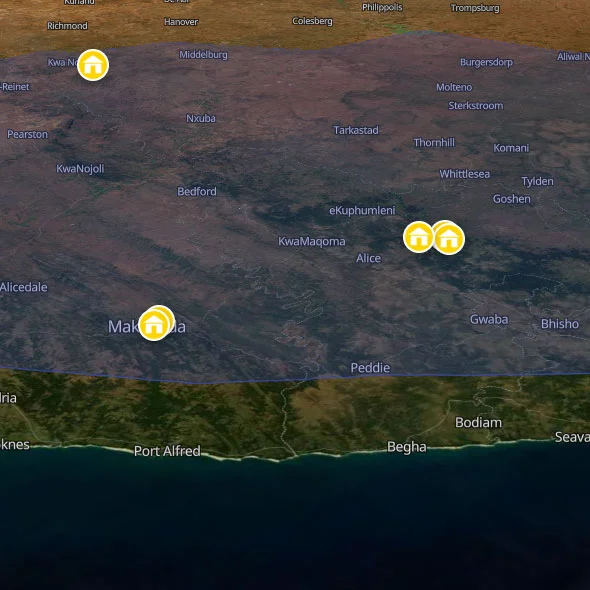
Click the icons for info.
Welcome to our backpacking guide of the Eastern Cape Interior!
Discover moreBackpacking The Eastern Cape Interior
Most backpackers who come to South Africa follow the obvious route: Cape Town, the Garden Route, maybe Kruger. That is a brilliant trip and nobody is arguing otherwise. But there is another South Africa running parallel to that one, further inland, quieter, stranger, and in some ways more powerful. The Eastern Cape Interior is that other South Africa, and the people who find it tend to talk about it differently when they get home.
Read More
This is a region of dramatic contrasts, packed into a manageable driving circuit. You can stand in a river valley in Hogsback where the indigenous forest is so thick and tangled and moss-covered that it honestly looks like Middle Earth -- and it likely did inspire Tolkien, who grew up hearing stories of these mountains. You can drive three hours south and find yourself standing at dawn on a dirt road in Addo Elephant National Park while a herd of 40 elephants crosses the track in front of your car with complete indifference to your existence. You can turn north into the Sneeuberg Mountains and drop into Nieu-Bethesda, a village so small and so remote and so strange that its most famous resident was an artist named Helen Martins who spent the last decades of her life encrusting every surface of her house with ground glass and cement sculptures, creating a vision so singular that Athol Fugard wrote a play about it and people fly from Johannesburg just to see it. And you can base yourself in Makhanda -- the university town the rest of South Africa calls Grahamstown -- and watch one of the continent's great arts festivals explode out of a quiet Eastern Cape town every July.
The Eastern Cape Interior is also, outside of a brief window in July during the National Arts Festival, almost entirely free of crowds. You will not be jostling for space at Addo in the way you would at Kruger. You will not be waiting in a queue at Hogsback's waterfalls. Nieu-Bethesda has perhaps three dozen guesthouses and one main road. The entire town is smaller than a single city block in Cape Town. This is, depending on your temperament, either a warning or the best possible news.
A word on getting around: this region rewards car travel. The distances between Addo, Makhanda, Hogsback, and Nieu-Bethesda are significant -- we are talking about a circuit of roughly 600km -- and the public transport options between them are limited or nonexistent. Hogsback in particular is 20km up a mountain road from the nearest town of Alice. If you are not driving, ask your hostel about shuttle options; most of them operate something, or can connect you with a local driver. If you are driving, the roads are generally good, the scenery is extraordinary, and fuel is cheap by European standards (roughly €0.80 per litre for petrol as of early 2026).
One more thing: the Eastern Cape is Xhosa country. More than any other province, this is the heartland of one of South Africa's most significant cultures -- the language, the traditions, the ululations that carry across hillsides at sunset, the red-ochre-painted initiates you will see on roadsides between Alice and Hogsback marking their passage into adulthood. South Africa has 11 official languages; Xhosa is one of the most melodious, with its distinctive click consonants. The people you will meet in this region are almost universally warm and unhurried in a way that the coastal tourist infrastructure is not. Take your time. Have the conversation at the petrol station. Accept the invitation to the braai. The Eastern Cape will give back exactly as much as you put in.
ABOUT THE TOWNS
Makhanda (Grahamstown): The Festival Town
Makhanda sits in a bowl of golden hills about 130km east of Port Elizabeth, surrounded by game farms and acacia scrubland. It is a town of significant contradictions: a prestigious colonial settler history coexisting with profound post-apartheid poverty; a world-class university sitting alongside township unemployment rates that would shock most European visitors; a quiet, dusty little place that somehow produces, every July, the third-largest arts festival on earth.
Rhodes University -- one of South Africa's top academic institutions -- is the engine of the town's cultural life. It brings a young, politically engaged, creative student population, and it means that Makhanda's bar and music scene punches well above its weight for a town of 140,000 people. The Rat and Parrot on New Street is an institution: a large, boisterous pub that has been the social hub of Makhanda nightlife for decades, with live music, pool tables, a beer garden and the kind of crowd that is simultaneously very local and very welcoming to outsiders. Haricot's Deli and Bistro on High Street is the place for coffee and breakfast. Major Fraser's Craft Bar and Eatery is the newer arrival, with locally brewed craft beers and a good kitchen.
The National Arts Festival -- held every July for approximately ten days -- transforms Makhanda completely. The town of 140,000 swells to nearly double its size as 200,000 visitors descend for what is genuinely one of the most extraordinary cultural events on the continent: theatre, dance, music, visual art, comedy and street performance, across dozens of venues, from the 1820 Settlers Monument (the main venue complex, perched on a hill above town) down to improvised performance spaces in pubs, gardens, and the street itself. If you are anywhere near the Eastern Cape in July, book accommodation months in advance and come for at least four days. The energy is unlike anything else on the South African calendar.
Outside of the Festival period, Makhanda is a good base for game drives. The surrounding area has several Big Five private reserves operating day-visitor safaris, and the combination of Addo Elephant Park (about 90 minutes' drive) with a Makhanda base makes logistical sense for travellers coming from the east coast without a Gqeberha (Port Elizabeth) base.
Hogsback: Middle Earth in the Amathole Mountains
Hogsback is 20km up a winding mountain road from Alice, at an altitude of around 1,300 metres in the Amathole mountain range. The drive up is already remarkable -- the road climbs through a landscape that transitions from dry Eastern Cape scrubland into dense, mist-wreathed indigenous forest within minutes. At the top, Hogsback is a small village of perhaps 1,500 people (significantly fewer in winter), scattered along forested ridges with views across the Eastern Cape that stretch as far as the eye makes sense of distance.
The indigenous forest here is the real draw. It is genuinely ancient -- some of the yellowwood trees in the Auckland Nature Reserve are estimated to be over 800 years old -- and it is unlike any forest in the Cape or the Drakensberg. The light comes through it at angles that seem arranged. The birdlife is extraordinary: Cape parrots, Knysna turacos, Narina trogons. The waterfalls -- Swallow Tail, Bridal Veil, Madonna and Child -- are reached by walking trails that leave from the village and drop through forest so thick that you emerge from them damp and slightly astonished. In summer, the mountains attract enough rain to turn everything intensely green. In winter, there is occasional snow -- one of the very few places in South Africa where snow falls reliably enough to be expected -- and the village fires up its log burners and becomes deeply cosy.
The Tolkien connection is real, or real enough: J.R.R. Tolkien was born in Bloemfontein in 1892 and spent his early childhood in the Eastern Cape before his mother brought him to England. Whether the forests of Hogsback directly inspired the landscapes of Middle Earth is debated by scholars, but walking through the Auckland Nature Reserve in early morning mist, past trees draped in old man's beard lichen, you will find the claim entirely plausible. The village leans into this enthusiastically. Several establishments have Hobbit names (Away with the Fairies' bar is called the Wizard's Sleeve). It is charming rather than cheesy.
Nieu-Bethesda: The Strangest Village in South Africa
Nieu-Bethesda is not on the way to anywhere. It sits at the end of a 27km gravel road that branches off the N9 between Graaff-Reinet and Middelburg, in a valley between the Sneeuberg mountains at an altitude of roughly 1,350 metres. The town itself has one main tarred road, a handful of guesthouses and restaurants, a craft brewery, a coffee roastery, and perhaps 2,000 residents. There is no petrol station. There is no ATM. Mobile signal is intermittent. The nearest town with full services is Graaff-Reinet, 58km away on the gravel.
What Nieu-Bethesda has, and what draws people to it from across the world, is the Owl House: the home and studio of Helen Martins (1897-1976), a reclusive artist who spent the last three decades of her life transforming every inch of her property into an obsessive personal vision. The courtyard and house are filled with hundreds of cement and wire sculptures -- camels, owls, mermaids, biblical figures, abstract forms -- and the interior walls and ceilings are coated with crushed glass in various colours so that candles and sunlight create a constantly shifting, kaleidoscopic effect. Helen Martins called this "the night room." She eventually died by suicide, having ingested caustic soda -- the substance she had been using to grind glass for 30 years had finally made her too ill to work. The house is now a National Monument and a museum. Admission is approximately €3 and includes a guided walk.
The town around the Owl House has become a quiet magnet for artists, writers, and people in search of complete silence. The Sneeuberg mountains above the valley turn pink at sunset in a way that makes you understand why someone might stay. The Compassberg, the highest peak in the Cape, is 20km away. Fossil walks in the surrounding Karoo plains reveal marine reptile remains from 250 million years ago. The local brewery does tastings. Dinners at the informal restaurants in town -- lamb from the surrounding farms, dried apricot, fresh herb salads, coffee roasted on the premises -- are some of the best simple meals available anywhere in the Eastern Cape.
One more thing about Nieu-Bethesda: it is cold. The Sneeuberg range gets hard frost from April through September, and the stone houses in the village retain the cold with impressive determination. Come prepared with layers even in autumn. Conversely, summers (December to February) are warm, clear and dry, the Milky Way is visible with the naked eye on most nights, and the town attracts a small but reliable influx of art-inclined summer visitors.
Addo Elephant National Park: The Big Seven
Addo Elephant National Park began in 1931 as a rescue mission. By the early 20th century, the elephant population of the Eastern Cape had been hunted almost to extinction -- reduced from tens of thousands to approximately 11 surviving animals hemmed into a patch of dense Addo bush near the Sunday River citrus farms. A warden named Harold Trollope was tasked with protecting those last elephants. Today, the park holds more than 700 elephants, and the herd has grown so large that it is now one of the most significant elephant populations in the world.
But Addo has something Kruger does not: it is entirely malaria-free, it is accessible year-round without the extreme heat of the Limpopo summer, it is a fraction of the size of Kruger (making game sightings more reliable), and it contains the Big Seven. Most people know the Big Five (lion, leopard, elephant, buffalo, rhino). Addo added two more: when the park expanded its borders to include offshore islands in Algoa Bay, it incorporated the breeding grounds of the great white shark and the calving grounds of the southern right whale, making it officially the world's first Big Seven reserve.
The concentration of elephants in the Addo section of the park is exceptional by any standard. It is common to encounter herds of 40, 50, or more animals at waterholes -- all ages, from enormous bulls with tusks that brush the ground to calves so small and new that they stumble under their mothers' bellies. The buffalo in Addo are equally dense. The black rhinos are elusive but present. Lions were reintroduced in 2003. The park has a fully functional self-drive circuit that can be completed in half a day; a guided sunrise or sunset game drive with a park ranger goes deeper, onto tracks not accessible to self-drive visitors, and costs approximately R600-R800 per person (about €30-€40) through the park itself, or roughly €70-€90 through the guided operators at the Orange Elephant Backpackers, who include a full day in the park, sundowners and considerable local knowledge.
Eastern Cape Interior FAQs For Backpackers
When is the best time to go?
The honest answer is that different parts of this region peak at different times, and a circuit covering all of them can work year-round.
Addo: Accessible and good year-round. The summer months (October to March) are hot (35+ degrees C in January) and the bush is thicker and greener, making sightings sometimes harder. The dry winter months (May to August) reduce the vegetation, concentrate animals at waterholes, and produce clear, cool days ideal for game viewing. Winter is the recommended season for serious wildlife watching.
Makhanda: The National Arts Festival runs in the last week of June and first week of July. This is when you come if the festival is your primary reason. Outside of the Festival, the town is quieter but perfectly functional. Summer (November to February) is warm and pleasant; winter evenings are cold.
Hogsback: Summer (October to February) is lush, warm, and green -- the waterfalls are at their strongest and the forest is at its most spectacular. The downside is afternoon thunderstorms, which are common and occasionally dramatic. Winter is cold (snow is possible November to August, genuinely likely June to August), but the mist-wrapped forests and the fireside evenings at the hostels are atmospheric in a way that summer does not replicate. Autumn (March to May) is arguably the sweet spot: less rain, still green, cold enough for a jumper but not for snow, and significantly fewer visitors.
Nieu-Bethesda: The Karoo summer (November to March) is hot by day and cool at night, with spectacular clear skies and star-gazing conditions that are extraordinary. Winter (May to August) brings hard frosts but also that particular low-winter-sun clarity that makes the Sneeuberg mountains look almost impossibly beautiful at golden hour. Come whenever you can get there -- the Owl House does not close, the mountains do not move, and the silence is consistent across seasons.
Do I need a car?
For the full circuit, yes. There is no reliable scheduled public transport between Addo, Makhanda, Hogsback, and Nieu-Bethesda. Minibus taxis run between larger towns (Makhanda to East London, Makhanda to Gqeberha/Port Elizabeth), but the specific destinations on this circuit -- the park entrance, the village of Hogsback, Nieu-Bethesda -- are off the taxi routes entirely. Car hire from Gqeberha (Port Elizabeth) International Airport is the standard approach; all major companies are represented and daily rates start from roughly €20-€30. The airport is 90 minutes from Addo, 2 hours from Makhanda.
If you are not hiring a car, the hostels in this region are unusually good at organising alternatives. Orange Elephant runs shuttle transfers from Gqeberha. Elundini has long operated a shuttle from Alice and East London. Away with the Fairies offers transfers from East London and Chintsa. Ask your hostel specifically -- none of them will leave you stranded if you communicate clearly.
What does it cost?
This is one of the cheapest regions in South Africa for a backpacker. Hostel dorm beds run €5-€10 per night. A full day guided safari at Addo through Orange Elephant costs around €70. A sit-down dinner at a restaurant in Nieu-Bethesda is €8-€15. A meal at a Makhanda pub costs €5-€8. A full day of hiking in Hogsback -- including multiple waterfalls and several hours of indigenous forest -- costs R10 (less than €0.50) in conservation fees. The region is, in this sense, an extraordinary value compared to the Garden Route or Cape Town.
Is cannabis legal?
South Africa's Constitutional Court decriminalised the private use and personal cultivation of cannabis by adults in 2018. You can legally use it in a private space such as a hostel room, provided the hostel permits it. Public use -- on the street, in the park, at the waterfall -- remains illegal. A formal retail market was still in the legislative pipeline as of early 2026. Use common sense; be discreet; do not use in public.
Is the tap water safe?
In Makhanda and Addo village, yes -- tap water is treated and safe to drink. In Hogsback, most hostels use mountain spring water or rainwater harvesting, which is generally clean but variable; bottled water is available in the village. In Nieu-Bethesda, the water is safe but has a high mineral content that some visitors notice. The Owlhouse Backpackers and other establishments use filtered water for drinking.
What about load shedding?
Eskom's rolling power cuts affect the Eastern Cape, and in 2025-2026 the situation has been variable -- periods of Stage 0 (no cuts) alternating with scheduled interruptions. Download the EskomSePush app when you land and check your schedule daily. The eco-hostels at Hogsback -- particularly Terra Khaya and Elundini -- are entirely off-grid and unaffected. Addo and Makhanda hostels generally have inverters or generators for basic power continuity.
Safety In The Eastern Cape Interior
The Eastern Cape Interior is, by the standards of South African travel, a low-risk environment for backpackers. It is not Cape Town's Long Street at 2am or a Johannesburg CBD at night. The specific destinations on this circuit -- the Addo game reserve, the village of Hogsback, Nieu-Bethesda -- are small, quiet, community-based environments where the majority of visitors complete their trips without incident. That said, South Africa is not Europe, and the general principles of smart travel apply throughout.
Makhanda: The One Town On This Circuit With Real Urban Risk
Makhanda is the only destination on this circuit with a meaningful urban crime profile. It is a South African town with high unemployment, a significant student population, and the usual dynamics of a post-apartheid city. Phone theft and opportunistic bag-snatching happen, particularly at night in the town centre. The standard rules apply: phone in your pocket when walking, don't walk alone after midnight in unfamiliar areas, take Bolt or Uber from venue to venue after dark. The area around the university is more active and generally safer at night than the town centre. The Arts Festival period brings an enormous temporary surge in population and requires heightened vigilance; keep your valuables with you at all times during festival events.
Gravel Roads And The N9
The road into Nieu-Bethesda is 27km of gravel. It is well-maintained by Karoo standards, but it is a gravel road -- potholes appear, washboard surfaces rattle your car, and stones kick up into your windscreen. Drive at 80km/h or below. Check your spare tyre before you leave Graaff-Reinet. The N9 approach road from Middelburg side passes through some remote sections where mobile signal drops out entirely; fill up with fuel before turning off the main road and tell someone your itinerary.
Addo: Wild Animal Encounters
Addo Elephant National Park is not a zoo. The animals are wild, fast, and occasionally unpredictable, particularly bull elephants in musth (a hormonal state that can make them extremely aggressive). The park rules exist for reasons: stay in your vehicle at all times on self-drive, do not get out except at designated areas, do not approach animals closer than the permitted distance, and do not feed anything. Lion are present in the park; they are not friendly. Buffalo are statistically more dangerous to humans than elephants. Stay on established roads. If you are guided, follow your guide's instructions without question.
Hiking In Hogsback
The trails around Hogsback are generally safe and well-marked, but the mountain weather can change rapidly. The Auckland Nature Reserve requires a R10 conservation fee and provides a map at the entrance -- take the map. Solo hiking is possible on the main trails; for longer routes (the Amatola Trail, multi-day hikes) go with at least one other person and let your hostel know your route and expected return time. The biggest hazard in Hogsback is not crime but weather: afternoon thunderstorms in summer arrive with very little warning, the temperature can drop 15 degrees in an hour, and the forest trails become slippery when wet. Start hikes early.
Further Reading
Ready to map out the rest of your adventure? For more general info on backpacking South Africa, see our comprehensive home page. We also highly recommend checking out our expert backpacking advice section to make sure you stay safe and save money on the road. If you need help structuring your travel routes, take a look at our suggested itineraries for tours of South Africa. For more info on backpacking, including access to our offline app and interactive PDF guide, head over to our resources page.
Things To Do In The Eastern Cape Interior
1. Addo Elephant National Park (Non-Negotiable)
You are going to Addo. There is no version of the Eastern Cape Interior trip that skips this. The only question is how you do it.
Self-Drive (the freedom option):
Addo's main Addo section is entirely navigable on your own in a standard hire car. You enter at the Main Gate (well-signposted from Addo village), pay the SANParks conservation fee (approximately R400 per person per day, roughly €20), and drive the gravel circuit roads at your own pace. The waterholes are where the action concentrates -- pull up to Domkrag Dam or Rooidam early in the morning, cut your engine, and wait. The elephants will come. In peak game-viewing season (dry winter months, May to August) it is not uncommon to see several hundred animals in a single morning without getting out of the car. You can hire a guide at the camp reception who will join you in your car if you want expert identification and interpretation; expect to pay approximately R600 for a half-day guide.
Read More
Guided Full-Day Safari through your hostel (the deep option):
Orange Elephant Backpackers operates their own guided safaris into Addo, run by guides who have been working these roads for years. The difference between a guided day and a self-drive is knowledge: the guide knows where the lions were seen at dawn, knows which waterhole the breeding herd uses in afternoon heat, knows the difference between an elephant's relaxed feeding posture and one that is about to tell your vehicle to move. A full day costs approximately R2,800 per person (about €140) which sounds expensive but covers the park entry fee, a packed lunch, expert guiding, and up to 10 hours in the park. Split two ways it is roughly €70 each. For the people who book this, it is consistently the highlight of their Eastern Cape trip.
The Two-Park Safari (Addo + Mountain Zebra):
For those with two or more days and a taste for something completely different, Orange Elephant offers a combined safari that adds the Mountain Zebra National Park near Cradock to the Addo experience. Mountain Zebra is smaller, quieter, and focused on -- as the name suggests -- the Cape mountain zebra, which was nearly extinct by the 1950s and has now recovered to a healthy population. The park also has cheetah, and the cheetah-tracking walk -- on foot with a ranger in the field -- is one of the more extraordinary experiences available anywhere in South Africa. The two-park tour is run over two days and includes accommodation near Cradock. Ask Orange Elephant for current pricing and availability.
2. Hogsback: Waterfalls, Forests and the Edge of the World
The Waterfall Circuit (free to cheap):
Pay R10 at the Auckland Nature Reserve entrance - less than €0.50 - and you have access to one of the best day-hike networks in the Eastern Cape. The three main waterfalls are Swallow Tail (the easiest, about 40 minutes from Away with the Fairies), Bridal Veil (longer, more spectacular, through the deepest section of indigenous forest), and Madonna and Child (the most dramatic drop, approximately 2-3 hours return). You can combine all three in a full day. The path goes through forest so old and dense and covered in epiphytes and lichen that it genuinely does not look like it belongs to the same Africa as the Karoo or the Bushveld. It looks like a completely different planet. Wear trail shoes (the paths are muddy in wet weather), take a rain layer, and start early.
The Big Tree:
A Giant Yellowwood - scientific name Podocarpus latifolius - estimated to be between 800 and 2,000 years old, standing at approximately 36 metres, just in front of Away with the Fairies Backpackers. It is not a hike. It is a tree. You stand in front of it and try to comprehend the number 1,000. It is free.
Abseiling the Madonna and Child Waterfall (paid adventure):
Hogsback Adventures offers abseiling down the face of the Madonna and Child waterfall -- a 30m abseil with the water running alongside you and an extraordinary view of the valley below. This is a commercial abseil run to a professional safety standard; no prior experience required. Cost approximately R350-R450 per person (roughly €18-€23). Book through your hostel or directly through Hogsback Adventures.
Horse Trails with Terra Khaya (paid, unforgettable):
Shane at Terra Khaya runs horse trails across the Hogsback plateau using natural horsemanship techniques -- no bits, bridles that depend on trust and communication rather than control, horses that respond to your weight and breath. Day rides go up onto the plateau with views across the Amathole range and the Eastern Cape valleys beyond. Overnight trails last 2-4 days, cover 120km of countryside, and include a night with a Xhosa family, a stay at Elundini Backpackers, and campfire dinners at viewpoints that are accessible by no other means. Cost varies: a half-day ride starts at approximately R600 (roughly €30); the multi-day trail is a bespoke booking. No riding experience is necessary for the day rides; Shane will assess your ability and pair you with the right horse.
The Labyrinth at The Edge (free):
On the edge of the Hogsback plateau, a restaurant called The Edge has built one of the world's larger labyrinths in its garden -- a Chartres-design, 11-circuit stone labyrinth with a diameter of 29 metres, perched above a valley with views that would make a hardened cynic pause. Walking a labyrinth is not a religious act (though it can be); it is a form of moving meditation that has been used across cultures for centuries. You walk in, you reach the centre, you walk out. The garden is open daily; have lunch or coffee at the restaurant. This is not the kind of thing you put in a travel diary. It is the kind of thing that stays in your mind for longer than you expect.
3. Makhanda: Culture, History and the Arts
The Albany Museum Complex (paid, historically fascinating):
The Albany Museum is actually several connected institutions on the edge of the Rhodes University campus: a natural history museum, a history museum, and the Observatory Museum -- an 1882 building containing a rare Victorian Camera Obscura, one of fewer than 30 operating in the world. The Camera Obscura projects a live image of the surrounding town onto a white table through a lens and mirror system in the rooftop cupola. It sounds modest. It is genuinely arresting. Entry to the full complex costs approximately R70 per person (about €3.50). The history collections covering the 1820 Settler period and the frontier wars of the Eastern Cape are excellent.
The 1820 Settlers National Monument (free to enter):
The large concrete monument on Gunfire Hill above the town was built to commemorate the British settlers who arrived in the Eastern Cape in 1820. Architecture you can argue about, but the views from the hill are spectacular and the complex houses several performance venues, galleries, and exhibition spaces that run programming year-round, including residencies, local art exhibitions, and the main festival infrastructure each July.
Township Food and Culture (free to cheap, with a guide):
Ask at your hostel about community-based township tours. Makhanda's townships -- Joza, Fingo Village, Tantyi -- contain some of the most important early ANC organising history in South Africa, as well as a living Xhosa community that is genuinely welcoming to visitors who come with respect. The food in township homes and informal restaurants is extraordinary: umngqusho (samp and beans, slow-cooked), imifino (wild greens), umxhaxha (pumpkin and corn), and braai meat from farms whose names you will never see in a supermarket. A township meal with a family who has been approached through a community guide typically costs less than €5 and is one of the most meaningful things you can do in Makhanda.
The National Arts Festival (July only -- book months ahead):
Ten days, 200,000 visitors, 60-plus venues, 700 productions. Theatre from South Africa, Zimbabwe, Nigeria, the UK, and France. Dance from companies that tour internationally but rarely play a town this small. Comedy so sharp and so politically embedded that you will laugh at things you only half understand and then spend the evening working out what you missed. Visual art in converted warehouses. Street performance at 1am in the car park of the Rat and Parrot. Jazz. Electronic music. Spoken word. Children's shows. The Fringe. The main programme. Queues for sold-out shows. Festival passes and day tickets available at the box office. Book accommodation six months ahead; within two months it is largely gone.
4. Nieu-Bethesda: Silence, Stars and the Owl House
The Owl House Museum (paid, unmissable):
Martin Street, Nieu-Bethesda. Open most days; check with your hostel for current hours. Entry approximately R70 per person (about €3.50). Guided walks in English and Afrikaans. The guide is essential -- they know Helen Martins' story, know the symbolism of the sculptures (east-facing figures represent light and enlightenment; west-facing figures represent darkness), know the history of how she and her assistant Koos Malgas built every one of the hundreds of cement figures by hand over 30 years. Go in the morning when the light through the stained-glass windows is at its best. The Camel Yard -- the outdoor sculpture garden -- is best appreciated from above; stand on the wall and look down.
Fossil Walks (paid, mind-bending):
The Nieu-Bethesda area sits on Permian geological formations that contain some of the densest concentrations of prehistoric marine fossils in South Africa. Guided walks into the surrounding Karoo plains uncover the remains of creatures that swam in the shallow seas covering this landscape 250 million years ago: Lystrosaurus, dicynodonts, ancient reptiles that predate the dinosaurs. A fossil guide costs approximately R200-R300 per person (about €10-€15) for a 2-3 hour walk. Astounding value for a morning that reshapes your sense of geological time. Book through your hostel or through the Nieu-Bethesda tourism office.
The Brewery and Two Goats Deli (free to enter, cheap to consume):
Nieu-Bethesda has a craft brewery on its main street that brews several styles on site and does tastings. The Two Goats Deli attached to it does cheese, charcuterie, bread baked on the premises, and coffee roasted in the back room. This is a remarkable thing to find in a village of 2,000 people accessible only by gravel road. A flight of four beers costs approximately R80 (about €4). Sit in the courtyard. Stay for longer than you planned.
Stargazing (free):
Nieu-Bethesda is one of the darkest settlements in South Africa, surrounded by 80km of uninhabited Karoo on all sides. On a clear night -- which is most nights from April to October -- the Milky Way is so bright and so dense overhead that it casts a faint shadow. The Large and Small Magellanic Clouds are visible to the naked eye. You do not need a telescope. You need to walk to the edge of the village, away from the few streetlights, and look up. Give your eyes 15 minutes to dark-adapt. It is genuinely one of the most extraordinary things available on this continent, and it costs nothing.
5. Elundini: The Real Africa (Off the Beaten Path Entirely)
Thirty minutes from Hogsback, down the R345 towards the Katrivier Dam, sits the small Xhosa village of Elundini -- population approximately 200 people. This is not a tourist attraction in any conventional sense. It is a living village, and Elundini Backpackers -- the community-based hostel that sits within it -- has spent over a decade building a model of sustainable village tourism that is run 100% by local community members through their own micro-businesses.
The activities at Elundini are entirely community-organised: Xhosa bread-making on an open fire (a two-hour session with a local woman who teaches you the technique and shares the bread; cost approximately R150, about €7.50); guided village walks with a local youth guide who explains the layout of a traditional Xhosa homestead, the role of the cattle kraal, the significance of the uluhanga (the decorated front door of a senior woman's house); horse riding through the surrounding hills with local riders; optional Xhosa language lessons. In the evening, dinner is communal -- shared pots of traditional food around a fire under stars that, at 1,200 metres in the Amathole foothills, are extraordinary. There is no electricity in the rooms. There is a bar stocked with cold 750ml beers. There is a fire. There are people who will make you feel welcome in a way that has nothing to do with professional hospitality and everything to do with genuine human warmth.
Elundini was voted one of the 12 best remote hostels in the world by Hostelworld in 2020. The people who stay there tend to agree.
Top-Rated Eastern Cape Tours on GetYourGuide.com
SEE OUR
Where Do You Want To Go Next?
This guide uses cookies to keep it going. Read our Cookie Policy.
Preparation
Preflight Checklists Safety Money Medical Embassies Cannabis & The Law Useful AppsIn-Country
Emergencies Transport Food & Drink Language African Etiquette Fun & Games Onward TravelSpecific Interests
Festivals & Clubs Surfing Digital Nomads Overlanding Cycle Touring Volunteering Language SchoolsSelf-Drive Itineraries
1 Week: The Cape Loop 2 Weeks: The Whistlestop Tour 2 Weeks: The Northeast Triangle 2 Weeks: The Grand Cape Loop 2 Weeks: The Wild North 2 Weeks: The Road Less Travelled 3 Weeks: The Backpacker's Bible 3 Weeks: Coast & Karoo 3 Weeks: Off The Beaten Track 1 Month: The Rainbow Nation 3 Months: The Full MontyTours & Day Trips
Cape Town Winelands West Coast Garden Route Karoo Route 62 The Overberg Sunshine Coast Durban Drakensberg Zululand Kruger Johannesburg Eswatini LesothoPDF Hostel Guide
A compact interactive PDF with a clickable map and every hostel's contact details. No wifi needed — just save it to your phone.
Download PDF (opens in a new tab)(Interactive PDF — 800kb)
Full Backpackers Bible App
The complete guide installed as an app icon on your home screen. Maps, regions, advice, tours, and hostel reviews — fully offline.
Get the App →(Progressive Web App — free)