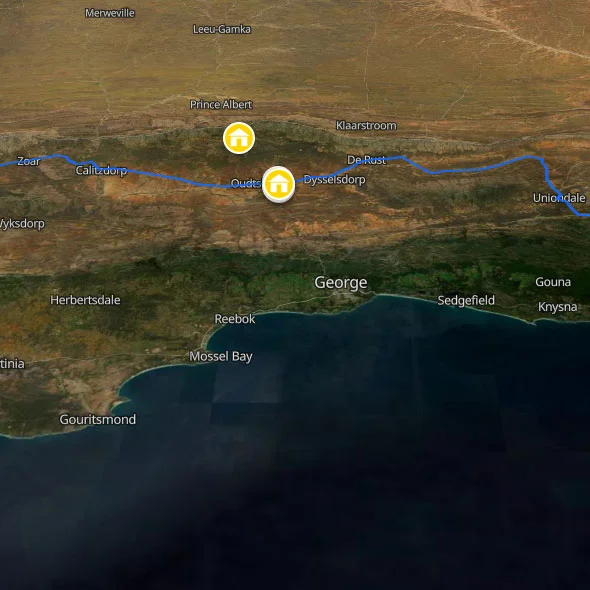
Route 62 runs roughly 850 kilometres from Worcester in the west to Humansdorp in the east, connecting the Breede River Valley wine country to the Klein Karoo to the Langkloof and finally to the Garden Route. It is marketed as the longest wine route in the world, which is true and also slightly misses the point — it is also the road that takes you through some of the most striking and varied landscapes in the Western and Eastern Cape, past the hot springs of Montagu, through the surreal landscape of the Huisrivier Pass, into Oudtshoorn and its ostriches and its extraordinary caves, and over the Swartberg Mountains on a dirt road engineered by convict labour in the 1880s that is still, 140 years later, regarded as one of the finest mountain passes in Africa. The wine is excellent. But the wine is almost a bonus.
The Landscape: What You're Driving Through
The Klein Karoo — the Little Karoo — is a different ecosystem from the vast, flat Great Karoo of the interior. It is an elongated valley, about 270 kilometres long and 40–60 kilometres wide, sandwiched between two mountain ranges: the Langeberg and Outeniqua to the south, which catch the coastal rain and keep the little Karoo semi-arid, and the Swartberg to the north, a wall of folded sandstone and quartzite that separates the Klein Karoo from the Great Karoo plateau above. The result is a landscape of compressed contrasts: you drive from a green valley of vineyards and orchards into a dry, succulent scrubland within a few kilometres, and then into a river gorge with clear mountain water and ancient rock formations, and then back into cultivation again. It is never the same view twice, and it never gets boring.
The geology here is the same ancient Cape Fold Mountains that produce Table Mountain: rocks compressed and folded and then tilted upright 330 million years ago when the continents were still sutured together as Gondwana. The contorted rock strata visible in the passes — layers of red and cream and grey sandstone bent at improbable angles — are the exposed cores of those ancient fold events, worn down to their present state by 300 million years of erosion. Thomas Bain, the Victorian road engineer who built the Swartberg Pass and several other passes in this region using convict labour and fire-and-water boulder-splitting techniques, was building roads through geology that would have been instructive to any university Earth sciences department. The wonder is that the roads, built without a gram of cement in the retaining walls and without any machine heavier than a wheelbarrow, are mostly still intact.
The flora of the Klein Karoo is extraordinary in a quiet, ground-level way that reveals itself when you stop the car and walk. The region has over 500 species of succulent plants, of which around 200 grow nowhere else on earth. In spring (August–October), the veld between the road and the mountains breaks into colour: yellow, orange, purple, and white flowers across the stony ground, the kind of wildflower display that seems impossible for a semi-desert and is entirely real. The aloes — towering, architectural, red-flowered in winter — are visible year-round along the road verges and mountain slopes. Blue cranes, South Africa's national bird and a globally endangered species, are regularly seen feeding in the pastures of the Karoo farms along Route 62. Stop when you see them.
The Route: West to East
The conventional approach is to drive Route 62 eastward as the alternative to the N2, either from Cape Town or as a complement to a Garden Route trip — drive the N2 coast in one direction and Route 62 in the other, making a loop. The westernmost entry point is Ashton, just east of Robertson in the Breede River Valley, where the R62 begins at its junction with the R60. From here the road enters the Cogmanskloof Pass immediately — a short but dramatic cut through the mountains, built by Thomas Bain in 1877, with the rock faces of the Cape Fold Mountains pressing close on both sides and the old stone blockhouse from the Anglo-Boer War visible on the hillside above the tunnel. Within 15 kilometres you are in Montagu, and Route 62 has already justified itself.
From Montagu the road runs east through Barrydale and then north-east to Ladismith and Calitzdorp before reaching Oudtshoorn, the principal town of the Klein Karoo and the base for the Cango Caves and the Swartberg Pass. East of Oudtshoorn the road turns south, rejoining the N12 briefly before branching east again through the Langkloof — a long, fertile valley of apple and pear orchards between the Tsitsikamma Mountains and the Kouga range — through Uniondale, Joubertina, and down to Humansdorp on the coast near Jeffreys Bay.
Total driving time without stops: roughly seven to eight hours. With the stops the route deserves, three to five days is the right pace. Four is probably ideal — one night in Montagu, one in Barrydale or Ladismith, one in Oudtshoorn, and a side trip to Prince Albert over the Swartberg.
Route 62 FAQs For Backpackers
Do I absolutely need a hire car?
Yes. Route 62 is a self-drive road. There is no hop-on hop-off bus service running the inland route, no reliable intercity connections between the Klein Karoo towns, and no way to experience the road's essential pleasure — the unscheduled stop, the farm stall you didn't know was there, the viewpoint at the top of a pass where you get out and just stand in the silence for ten minutes — without your own vehicle. The roads are in good condition throughout and are completely manageable in a standard sedan. The Swartberg Pass is the one exception: 27 kilometres of well-maintained gravel road, perfectly fine in a small car in dry conditions but requiring more care after rain. No 4x4 is needed for the pass itself; what is needed is a willingness to drive slowly and to stop at every viewpoint, because the temptation to rush it is the only thing that makes it dangerous.
One practical note on fuel: petrol stations in the Klein Karoo are in the main towns (Montagu, Barrydale, Ladismith, Calitzdorp, Oudtshoorn) and not between them. Fill up at every opportunity and do not rely on finding petrol in the small settlements between stops. The distances are not large — Barrydale to Calitzdorp is under 100 kilometres — but in a region where the next petrol station is 60 kilometres away and mobile coverage is patchy, running low on fuel is a situation worth avoiding.
When is the best time to go?
Route 62 rewards a visit in any season, but the sweet spots are spring and autumn.
Spring (August–October) brings the wildflower season to the Klein Karoo — the semi-desert veld between the road and the mountains breaks into colour across the stony ground, and the aloes are still flowering on the mountain slopes. The days are warm, the nights are cool, and the light in the late afternoon across the Karoo has a quality — golden and long and slightly dusty — that is hard to describe and easy to photograph. This is the best single season for the drive.
Autumn (March–May) brings harvest season to the wine farms and orchards. The vine leaves turn in the Robertson and Montagu valleys. The Langkloof apple orchards are at their most visually lush. The road is quieter than in summer and the evenings cool into something crisp and pleasant.
Summer (November–February) is hot — 35–40°C in the Klein Karoo midday heat, sometimes more. The Karoo summer is not punishing if you drive early and late and stop at noon; but it is genuinely hot, and Oudtshoorn in January is not a place for leisurely midday wandering. The road is busier in December during South African school holidays. Wine estates offer shade and cold white wine at all hours, which is the appropriate summer strategy.
Winter (June–July) is cold at night (sometimes near zero in the Klein Karoo valley floors), dry, and very clear. The Swartberg summit occasionally gets snow in July — the road may be temporarily closed after heavy snowfall, though it reopens quickly. The light in winter is extraordinary: sharp, low-angle, and honest. The wine farms are quiet and several offer winter cellar-door deals. The Cango Caves maintain a constant 18°C year-round regardless of what the exterior is doing.
What does it cost?
Route 62 is genuinely affordable. Dorm beds at backpacker hostels along the route run from €8–€15 per night. Wine tasting at most Klein Karoo estates costs nothing, or a nominal €3–€5 for a full flight — considerably less than the Winelands and with wines that are frequently outstanding. A meal at a Karoo farm restaurant or dorp café costs €6–€12 for a main course. A self-drive day at Oudtshoorn costs very little beyond petrol: the Cango Caves Heritage Tour runs approximately €8 per adult; the Adventure Tour approximately €10; an ostrich farm visit costs approximately €10–€15. The Swartberg Pass and the drive to Prince Albert cost nothing but fuel. A comfortable daily budget of €35–€55 covers accommodation, food, wine tasting, and one paid activity per day.
The Towns Of Route 62
Montagu
The first town on the route east of Ashton, and the one that sets the tone for everything that follows. Montagu sits in a fold of the Langeberg Mountains where the geology has cracked open a fissure three kilometres deep, and mineral water heated far underground rises to the surface at exactly 43°C — the Avalon hot springs, first documented by Europeans in the late 1700s and still flowing at the same temperature regardless of drought or season. The hot spring pools are the most famous thing in Montagu, and they deserve the reputation: soaking in natural mineral water while looking up at the sandstone cliffs of the Cogmanskloof above you is, on a cool morning or a starry evening, one of those entirely simple pleasures that South Africa does better than most places.
But Montagu is also, quietly, one of the premier rock climbing destinations in South Africa — and arguably in the southern hemisphere. The crags in and around the Cogmanskloof and Badkloof gorges have over 700 documented routes, from beginner slabs to the overhanging pump monsters that pull in climbers from Cape Town every weekend. The rock is ancient sandstone of the Table Mountain Group — the same formation as Table Mountain itself — and it is reliable, rough-textured, and magnificent. If you climb at all, even at beginner level, Montagu will keep you busy for days. If you don't climb, the hiking trails above the hot springs make for excellent half-day walking in the mountains, with the same geological formations on display at walking pace.
The town itself is a pleasure: Victorian and Cape Dutch architecture along oak-lined streets, wine estates in the Koo Valley producing wines of surprising quality for a region that most casual wine drinkers haven't heard of, good restaurants, a Saturday morning market, and a pace of life that is conspicuously, unashamedly unhurried. Founded in 1851 and named after John Montagu, the then Colonial Secretary of the Cape, it has always been a bit of an oasis. It still is.
Barrydale
Sixty kilometres east of Montagu, the road descends from the dry Karoo heights into the Tradouw Valley and Barrydale appears below you — unexpectedly green, flanked by the Langeberg mountains, with the smell of vegetation and water after the dry road. Barrydale is small, arty, and permanently on the edge of being discovered without ever quite losing the quality of not quite being discovered yet. The town has developed a disproportionate creative community — potters, painters, musicians, weavers — and the main street has enough interesting shops and good restaurants to justify a couple of hours' wandering.
The Tradouw Pass, ten minutes south of town, is one of Thomas Bain's smaller but most elegant engineering achievements — a 13-kilometre winding road through a narrow gorge with a clear river running alongside it. It connects Barrydale to Swellendam on the Overberg coast and is, if you have the time, worth a detour even if you aren't continuing south. The pass is paved and perfectly manageable; the gorge it runs through is extraordinary.
Twenty-five kilometres west of Barrydale on the R62 sits one of South Africa's most beloved roadside institutions: Ronnie's Sex Shop. The name was a practical joke by Ronnie's friends, who in 1980 painted "SEX SHOP" onto his signage while he was building what was intended to be a modest farm stall. Rather than paint it over, Ronnie kept the name. What was a farm stall is now a bar of considerable legend — bras, knickers, and novelty items hang from the ceiling in the thousands, contributed by visitors from across the world over four decades, and the cold beer served on the stoep in the shade of the Karoo afternoon is one of those experiences that exists in exactly one place on earth. Stop. Have a beer. Add something to the ceiling if you have something appropriate. It is free to visit and costs only the price of a drink.
Ladismith
Ladismith sits at the foot of the Swartberg range and the Towerkop (Tower Peak) — a distinctive twin-peaked summit that looms over the town in a way that makes it impossible to ignore. The town takes its name not from "ladies" but from Lady Juana Smith, wife of the Cape Governor Sir Harry Smith, who gave his name to Ladysmith in KwaZulu-Natal by a similar act of Victorian conjugal cartography. It is a small, quiet town with good Karoo architecture, a handful of wine estates, cheese producers, and excellent views of the mountain. Seweweekspoort — Seven Weeks' Gorge — begins a few kilometres north of Ladismith: a 15-kilometre pass through a dramatic crack in the Swartberg, built by Thomas Bain between 1859 and 1862, where the road crosses the same small river 27 times in the course of its passage through the mountains. It is one of the finest short drives in the Western Cape and is free, unpaved for the last section, and almost entirely unknown to tourists.
Calitzdorp
The Port Wine Capital of South Africa — and it takes this title seriously. The climate and soils of the Calitzdorp district are closely analogous to the Douro Valley of Portugal, and the wine estates here have been producing port-style wines of genuine international standing for decades. De Krans, Boplaas, and Calitzdorp Wine Cellar all have tasting rooms that are free to visit, and the ports — ruby, tawny, vintage, and the Cape-specific white port — are outstanding. If you have any interest in fortified wine, set aside a morning in Calitzdorp.
Beyond wine, Calitzdorp is a small Karoo gem in the classic mould: sandstone neo-Byzantine Dutch Reformed church dominating the main square, Georgian and Victorian houses along streets shaded by ancient pepper trees, bougainvillea on every wall, and the Swartberg rising directly behind the town in a wall of folded rock. The succulent flora in the hills around Calitzdorp includes approximately 200 species found nowhere else on earth — the area is one of the world's great succulent hotspots, something that may mean more or less to you depending on your views on succulents, but which is objectively extraordinary once you start looking. De Krans winery has an excellent farm restaurant for lunch; the port tasting is free with a minimum purchase of a bottle, which you will buy without reluctance.
Oudtshoorn
The capital of the Klein Karoo, and the town that most backpackers use as their base for the Cango Caves and the Swartberg Pass. Oudtshoorn is a real town — large enough to have supermarkets, petrol, a good hospital, and a main street with cafés and restaurants — without being a city. Its history is one of South Africa's more extraordinary boom-and-bust stories.
In the 1880s, ostrich feathers became the most fashionable accessory in the Western world: every fashionable hat in Europe and America had ostrich feathers in it, and the only place in the world where ostriches were farmed commercially at scale was the Klein Karoo around Oudtshoorn. The farmers who owned the ostrich farms became extraordinarily wealthy — "feather millionaires" — and they spent the money on houses of a scale and ostentation completely incongruous with a semi-desert agricultural town. These "ostrich palaces," as locals call them, still stand along the roads around Oudtshoorn: enormous Victorian and Edwardian sandstone mansions with towers, verandas, ornamental gardens, and the air of people who expected the boom to last forever. In 1914, the market for feathers collapsed almost overnight — synthetic fashion materials, the growing popularity of the motorcar (which blew feather hats to ruin), and the interruption of the First World War combined to end it. The palaces remained. The money was gone. Oudtshoorn has been living on ostriches and tourists ever since, which turns out to be a perfectly sustainable arrangement.
Today Oudtshoorn is the ostrich capital of the world: several large working ostrich farms outside town offer tours where you can watch ostriches being handled, learn about the breeding cycle and the industry, handle an egg, and — if you genuinely want to — ride an ostrich. The rides last about 30 seconds, the ostrich has not consented to this arrangement, and the experience is apparently neither comfortable nor dignified for rider or bird. It is, however, deeply amusing to observe. Ostrich farm tours cost approximately €10–€15 per person; the farms are 10–15 minutes' drive from town.
Prince Albert
Strictly speaking, Prince Albert is not on Route 62 — it sits on the far side of the Swartberg, in the Great Karoo, accessible only via the Swartberg Pass or the longer Meiringspoort Gorge route. But it is the essential reward for driving the pass, and no account of Route 62 is complete without it. Prince Albert is a small, extraordinarily beautiful Karoo village that has somehow remained almost exactly as it was in the Victorian era — a single main street lined with water furrows, whitewashed Cape Dutch houses, apricot and pomegranate trees in the gardens, the Swartberg rising directly above the town in a geological wall of such height and complexity that it seems designed rather than formed. The town is known for its cheese, its olives, its wines, its annual literary festival, and its exceptional quality of darkness — Prince Albert has almost no light pollution, and the night sky over the Karoo here is in serious competition with the Sutherland Observatory sky further north as the finest stargazing in the Western Cape.
The typical approach is to drive the Swartberg Pass from Oudtshoorn, descend to Prince Albert, have lunch, browse the galleries and the Saturday market, buy some local olive oil or preserves, and drive back over the pass in the afternoon light — which hits the red rock faces of the Swartberg from the west at around 4 PM and makes the geology look as if it is on fire. This is a perfect day. It takes no advance planning and costs almost nothing.
Further Reading
Ready to map out the rest of your adventure? For more general info on backpacking South Africa, see our comprehensive home page. We also highly recommend checking out our expert backpacking advice section to make sure you stay safe and save money on the road. If you need help structuring your travel routes, take a look at our suggested itineraries for tours of South Africa. For more info on backpacking, including access to our offline app and interactive PDF guide, head over to our resources page.











 SHARE (opens in a new tab)