What Kind of Place Is This, Exactly?
Johannesburg was not founded the way most cities are — by a river, a harbour, or a strategic ridge. It was founded by accident. In 1886, a prospector found gold-bearing rock on a farm on the Witwatersrand, the high ridge of grassland that runs east to west across what is now Gauteng. Within three years, 100,000 people had arrived from four continents to extract it. Within a generation, the largest man-made urban forest in the world had been planted to stabilise the mine-dump landscape — the jacaranda and eucalyptus trees that turn the northern suburbs purple every October. There was no plan. There was gold, and then there was a city.
That origin — extractive, improvised, chaotic, and cosmopolitan from day one — explains almost everything about modern Johannesburg. It is not a city built around a single community or a single identity. It is a city of layers: Boer farms, British mining camps, the Victorian CBD that was deliberately abandoned in the 1990s and is only now being partially reclaimed, the apartheid-engineered suburbs, the post-1994 migration, the new Black middle class reshaping the northern suburbs faster than any planner anticipated, the township economy driving more of this city's commercial life than most visitors ever see. To be in Johannesburg is to be inside a process that hasn't finished yet. Most visitors find this invigorating. A few find it overwhelming. Both responses are correct.
What Johannesburg is not: a transit point. Too many backpackers treat it as a night between flights. This is a genuine mistake. Give it at least four days. The city repays the time investment significantly.
The Gold, the History, and Why It Still Matters
The Witwatersrand gold reef — the single richest deposit of gold ever discovered on earth — sits directly under the modern city. The mine dumps, those flat-topped hills of yellow-grey waste rock visible from the highway as you drive in from the airport, are the literal residue of more than a century of extraction. An estimated 40% of all the gold ever mined in human history came from within a 50-kilometre radius of where you are standing. Sit with that for a moment.
The gold did not make South Africa equal. It made it more unequal, more violently. The mining industry required an enormous, cheap, controlled workforce. The apartheid system — formally in place from 1948 to 1994, but with roots in colonial labour laws going back to the early 20th century — was designed in very large part to supply it. Black workers were housed in single-sex hostels in the townships, prohibited from bringing families, paid a fraction of white wages, and subject to pass laws controlling their movement in their own country. Soweto — the South Western Townships — was not an accident of urban growth. It was a planned labour reservoir, built far enough from the white city to be invisible and close enough to service it by morning. More than three million people live there today. It is the largest township in Africa and one of the most culturally vital places on the continent.
Understanding even a fraction of this history will transform your time in Johannesburg. Without it, you are just a tourist moving between safe zones. With it, you begin to read the city — to understand why the CBD was abandoned and who was pushed out, why Soweto feels the way it feels, why the Apartheid Museum exists where it exists, why the people you meet carry the specific kind of resilience and warmth and occasional exhausted irony that they carry. The history is not background noise. It is the frequency everything else is broadcast on.
The Hub-and-Spoke City: How to Think About Johannesburg
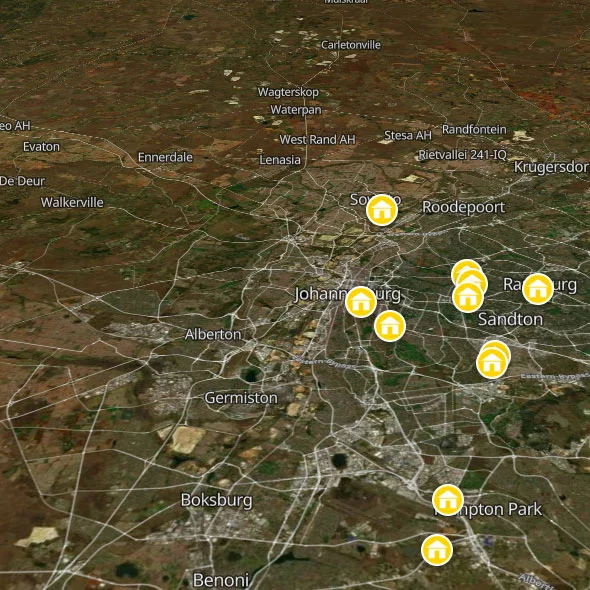
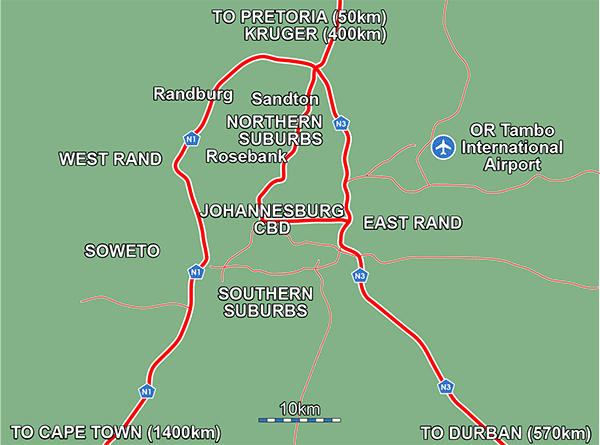
The single most important thing to understand about Johannesburg, before you arrive, is this: it does not work the way a European city works. You cannot stay somewhere central and walk to the interesting parts. There is no single "centre" from which everything radiates. The city is a vast, sprawling patchwork of distinct zones — some safe and welcoming, some genuinely dangerous — connected by motorways rather than pedestrian streets. The correct mental model is hub-and-spoke: you choose a safe hub to base yourself, and you travel out from it by Uber to the spokes that interest you.
This is not a deprivation. It is simply a different way of moving through a city. Uber in Johannesburg costs almost nothing — a 15-minute trip across the northern suburbs is €2–€3. Once you accept that the Uber is your street, and your hub is your neighbourhood, the city opens up.
Rosebank: The Best Base for First-Timers
Rosebank is, by some distance, the most logical base for a first-time visitor to Johannesburg. It is an upscale, walkable node — genuinely walkable, within its own boundaries — with a Gautrain station, two major malls (Rosebank Mall and The Zone), the Rosebank Sunday Market on the rooftop every week, excellent restaurants and coffee shops on the immediate streets, and a security presence that makes daytime street life feel genuinely relaxed. The Gautrain connection is the other decisive advantage: Sandton is 10 minutes by train, the airport is 30 minutes. You can land at OR Tambo, ride the Gautrain to Rosebank, check in, and be eating dinner within 90 minutes of wheels-down — without a single Uber, without navigating traffic, without any of the stress that typically accompanies arrival in an unfamiliar African city. For a solo traveller, a couple, or anyone visiting Johannesburg for the first time, Rosebank is the answer.
Parkhurst and Greenside: Safer, More Local
Adjacent to Rosebank, the leafy northern suburbs of Parkhurst and Greenside have their own "high streets" — 4th Avenue in Parkhurst, Greenside's Barry Hertzog Avenue — lined with boutiques, independent restaurants, coffee shops, and bars that have served their communities for decades. These streets are safe for walking during the day and early evening, with a neighbourhood quality that is the closest Johannesburg gets to the kind of European street culture you might be used to. Explorer Backpackers, the highest-rated hostel in the city, sits on Parkhurst's own 7th Street. If you want a quieter base with more local character than Rosebank's mall environment, the Parkhurst-Greenside corridor is ideal.
Melville: The Backpacker's Spiritual Home
Melville is the bohemian soul of the city — a slightly faded, genuinely characterful suburb where Wits academics, journalists, musicians, NGO workers, and long-stay travellers have been eating, drinking, and arguing since the 1990s. The strip of restaurants, bars, bookshops, and coffee shops along 7th Street and 4th Avenue is unlike anything else in Johannesburg: unpretentious, mixed, genuinely social, and a world away from the glass towers of Sandton or the curated cool of Maboneng. Saturday mornings here — coffee, a bookshop, the Melville Artisanal Market, an afternoon that turns into an evening without you noticing — are one of the best things Johannesburg offers. For travellers planning a stay of more than a week, Melville is where you begin to feel like you live in the city rather than visit it.
Sandton: The Richest Square Mile in Africa
Sandton is Johannesburg's financial district — the glass towers, the Nelson Mandela Square, the luxury hotels, Sandton City mall. It is extremely safe, extremely polished, and almost entirely irrelevant to backpacker travel except as a transport node (the Gautrain station) and as a shopping destination if you need to replace equipment. If you are here for the culture, the food, and the human experience of Johannesburg, Sandton is not where you live — it is where you change trains.
Maboneng: The Creative Island
Maboneng — "place of light" in Sotho — is the most talked-about neighbourhood in Johannesburg, and it deserves its reputation. A regenerated precinct on the eastern edge of the CBD, it is a dense, walkable island of galleries, rooftop bars, street art, independent restaurants, and cultural energy unlike anything else in the city. Curiocity Backpackers, on Fox Street, is among the best-reviewed hostels in Africa. On a Saturday evening or a Sunday market morning, the energy in Maboneng is something you will not find in Rosebank or Sandton — it is raw, creative, cosmopolitan, and specifically African in a way that the northern suburbs are not.
However: Maboneng is an island. The precinct itself is well-managed and secure, with 24-hour private security on every corner. The streets immediately surrounding it are not. You cannot walk from Maboneng to Braamfontein. You cannot stroll to the nearest shop two blocks away without a considered assessment of which two blocks. The drive in from the northern suburbs, through the CBD, passes through areas that experienced travellers describe as genuinely uncomfortable. This is not reason to avoid Maboneng — it is reason to arrive by Uber directly to the precinct, stay within its boundaries, and leave by Uber. Do not walk outside the designated Maboneng blocks without a local who knows exactly where the boundary lies. One block can be a trendy café; the next can be a serious-risk street. Ask your hostel to be specific about the boundaries before you go out on foot.
For post-Covid context: Maboneng went through a difficult period during and immediately after the pandemic, with several businesses closing and the street-market scene thinning. Reviews from 2024–2025 suggest the precinct has largely recovered its energy, particularly on weekends, but it is quieter midweek than its pre-2020 peak. Curiocity specifically continues to operate at a high standard and is an excellent base for exploring the precinct. For travellers who specifically want the inner-city cultural experience — and who understand and respect the precinct's boundaries — it remains one of the most compelling places to stay in the city.
Soweto: The Essential Day Trip
Soweto is not a suburb. It is a city within a city — 30 kilometres southwest of the CBD, home to between 1.5 and 3 million people, and the cultural and political heartland of the entire country. The Hector Pieterson Memorial, Vilakazi Street (where both Mandela and Desmond Tutu lived), the Orlando Towers, the shisa nyama culture of a Sunday afternoon — none of it is replicable anywhere else. Go. Go with a guide. Do not attempt to navigate it alone. Your hostel will have recommended operators — use them. Lebo's Soweto Backpackers, in Orlando West, is the exceptional option for anyone who wants to stay in Soweto itself rather than visit it as a day trip — and it is consistently the highest-rated hostel in the greater Johannesburg area.
The Music: What Johannesburg Sounds Like
Johannesburg invented kwaito — and that matters more than it sounds. Emerging in the Soweto townships in the early 1990s, built on slowed-down house music overlaid with Zulu, Sotho, and Tswana vocals delivered in a deliberately casual style that carried equal parts pleasure and defiance, kwaito was the sound of young Black South Africans saying: we survived, we are still here, and we are going to celebrate on our own terms. Artists like Brenda Fassie, TKZee, and Mandoza built a genre so specific to its time and place that it cannot be fully explained — it has to be heard in a room where people who grew up with it are present.
Today, Johannesburg's clubs run on amapiano — the log-drum, smooth-piano genre that emerged from the East Rand townships around 2014 and has since gone genuinely global. But Joburg's version is harder and more urban than anything you'll hear elsewhere, mixed with afrohouse and gqom. The jazz scene, rooted in the Sophiatown era of the 1950s, has never stopped — The Orbit in Braamfontein programmes live jazz five nights a week. The annual Jazz in the Lights festival at the Zoo in March is one of the city's great outdoor events. Konka in Soweto is the destination for amapiano at its loudest and most celebratory. Melville's 7th Street provides the relaxed end of the spectrum. Whatever your register, Johannesburg has music that belongs only to this place.
The Elephant in the Room: Inequality
South Africa has the highest Gini coefficient — the standard measure of income inequality — of any country that keeps reliable records. Johannesburg, as the economic capital, is where that inequality is most starkly visible.
You will eat a good breakfast in a Rosebank café for the price of a London bus ticket and drive past an informal settlement on the way. You will go to Soweto, and your guide will describe growing up in a two-room house with nine family members with a matter-of-factness that makes the description more devastating, not less. You will try to tip well and feel that the gesture is both necessary and wildly insufficient at the same time.
The city is not asking for your guilt. It is asking for your attention. Spend money at locally owned businesses. Tip well and directly. Book township tours with community-based operators rather than large commercial companies. Talk to people. Listen more than you speak. Understanding even a fraction of the history will make your time here significantly more real than if you treat the inequality as an unfortunate backdrop to an otherwise enjoyable trip.
Johannesburg FAQs For Backpackers
When is the best time to go?
Johannesburg sits at 1,750 metres above sea level on the highveld plateau — and the climate is nothing like what Europeans expect from a subtropical African city. Summers (October–March) are hot (25–30°C) but also the season of dramatic afternoon thunderstorms: the kind that arrive without warning, turn the sky yellow-green, drop an enormous quantity of rain in forty minutes, and clear as if they never happened. This reorganises your afternoon plans periodically but is not a problem — the storms are spectacular and the air afterwards, washed clean at altitude and smelling of red earth and jacaranda, is one of the sensory things you will remember.
Winters (June–August) are dry and can be genuinely cold — sunny days of 18–20°C followed by nights that drop near freezing. This shocks people who imagined Africa as uniformly warm. Pack a proper layer. The upside: crystal clear skies and extraordinary light.
The best time for most backpackers is September–November: warm, pre-storm season, the jacaranda trees in the northern suburbs in full purple flower (genuinely worth seeing — the whole city smells different), and the city at full operating energy. The Jazz in the Lights festival happens annually in March at the Johannesburg Zoo — worth building a trip around if it falls within your window.
Where should I stay?
First-timers and safety-conscious travellers: Rosebank or Parkhurst. The Gautrain access, the walkable streets, and the security infrastructure of the northern suburbs make this the most stress-free base. Explorer Backpackers in Parkhurst is consistently the highest-rated hostel in the city on every major platform.
For the classic backpacker experience: Melville. Social, walkable within the suburb, great street life on 7th, more local character than Rosebank. The best choice for longer stays where you want to feel embedded in a neighbourhood rather than insulated in a mall district.
For the inner-city cultural experience: Maboneng — but only if you understand the precinct boundaries and commit to moving by Uber rather than on foot beyond them. Curiocity Backpackers on Fox Street is excellent. Do not be casual about navigating to or from this area on foot.
For the deepest South Africa experience: Lebo's Soweto Backpackers in Orlando West. Not a transit option — a cultural immersion. Give it at least two nights and take every tour on offer. Consistently the highest-rated hostel in the wider Johannesburg area on most platforms.
For the airport, first or last night: The East Rand cluster — Backpackers Connection, Brown Sugar, Mikasa Sukasa — are all within 15–20 minutes of OR Tambo and eliminate the stress of the first or last Joburg transit. Alternatively, use the Gautrain from the airport directly to Rosebank (30 minutes) and stay there from night one.
What does it cost?
Johannesburg is significantly cheaper than any comparable city in Western Europe. A craft beer in a Melville or Rosebank bar: €1.50–€2.50. A sit-down meal: €6–€12. A shisa nyama plate of grilled meat with pap in Soweto: €2–€4. An Uber across the northern suburbs: €1.50–€3. The Apartheid Museum: approximately €6. A guided Soweto bicycle tour from Lebo's: approximately €20–€30. A full day in Pilanesberg: entrance approximately €12 plus hire car. The purchasing power of a European budget in Johannesburg is transformative — you can eat, drink, and experience this city at a quality that would be simply unaffordable at home.
Getting around: Uber, Gautrain, or hire car?
Uber and Bolt are the non-negotiable transport tools. The city is not walkable between districts, distances are significant, and private ride-hailing is cheap, reliable, and safe. Confirm plate and driver name before getting in. Never take an unmarked vehicle that approaches you at a rank.
The Gautrain is world-class — fast, air-conditioned, safe. It connects OR Tambo Airport to Marlboro, Sandton, Rosebank, Park Station (CBD), and Hatfield in Pretoria. The airport-to-Rosebank journey takes approximately 30 minutes and is the optimal arrival route for anyone staying in the northern suburbs. The airport-to-Sandton leg takes 15 minutes. Use it for airport transfers and Sandton-to-Rosebank hops. It does not reach Maboneng, Soweto, Melville, or Parkhurst — Uber covers those gaps.
Hire car: Useful for day trips to Pilanesberg, the Cradle of Humankind, and the Magaliesberg. Not recommended for navigating central Johannesburg — traffic is heavy, the carjacking risk at certain traffic lights is real, and parking requires engaging with the informal "car guard" culture (tip R5–R10 and your car will be watched; don't tip and the outcome may be different). If you hire a car, keep windows up in slow traffic and do not drive unfamiliar CBD streets at night.
Minibus taxis: How the majority of Johannesburg moves. Efficient, cheap, and entirely reliant on local knowledge — specific hand signals, informal ranks, an unwritten fare structure. Not the right system for a first-time visitor. Use the Rea Vaya BRT (Bus Rapid Transit) on specific inner-city routes if your hostel recommends it for a particular journey; otherwise, Uber is the answer.
I'm arriving by bus. What do I need to know about Park Station?
This is one of the most important warnings in this entire guide, and it comes from direct experience: do not walk outside Park Station.
Park Station is Johannesburg's central transport hub for long-distance buses (Greyhound, Intercape, Translux) and commuter trains. It sits in the CBD, in one of the highest-risk areas in the city for tourist mugging. The immediate streets around the station — particularly the Market Street side — are genuinely dangerous in a way that is not obvious from inside the building. Multiple travellers have been assaulted within one or two blocks of the station, including in broad daylight. One block from the entrance is not a safe buffer. It is enough distance to be seriously vulnerable.
The correct procedure if you are arriving or departing by bus at Park Station: book your Uber before you leave the building, give the driver the Rissik Street entrance as your pickup point (which keeps you within the station precinct), and go directly from the building to the car. Do not step outside to look for your driver. Do not walk to find food. Do not assess the area. You will stand out immediately as a tourist — large backpack, unfamiliar with the surroundings, probably consulting your phone — and you will be a target. The walk takes thirty seconds; the consequences can be severe. Many long-distance bus operators have shifted departures to the OR Tambo area, which is significantly safer — check with your operator whether your service departs from Park Station or from the airport bus terminal before you travel.
Do I need to go to Soweto, or can I skip it?
You should go to Soweto. The question is how, not whether. Go with a community-based tour operator — your hostel will have specific recommendations — or go directly by Uber to a specific, known destination (the Hector Pieterson Museum, Vilakazi Street, or a shisa nyama in Orlando). What you should not do is attempt to navigate Soweto independently without local guidance. The formal tourist sites — Vilakazi Street, the Mandela House, the Hector Pieterson Memorial — are well-trafficked and safe to visit. The roads connecting them are not all the same, and a wrong turn in an unfamiliar township is the kind of mistake that can have serious consequences. A guide removes this risk entirely and adds value that no independent visit can match: the stories, the context, and the human connection are what make Soweto the essential experience it is.
How do I get from the airport to my hostel?
By Gautrain or Uber — never by the metered taxis operating outside the arrivals hall, which are significantly more expensive and, in some documented cases, have been involved in "following" incidents where criminals track tourists from the airport to their accommodation. The Gautrain departs from a station directly connected to OR Tambo's international terminal and reaches Sandton in 15 minutes, Rosebank in approximately 30. Buy a Gautrain card at the station (loaded with credit) before boarding. If your hostel is in Melville, Parkhurst, or a suburb not on the Gautrain line, take the train to Rosebank or Sandton and book an Uber from there — this is the safest and most cost-effective arrival route.
If you book an Uber directly from the airport: use the designated Uber pickup zones inside the terminal, confirm your driver's name and plate on the app before approaching any vehicle, and do not accept a lift from anyone who approaches you independently.
What is load shedding and will it affect me?
Load shedding is South Africa's system of scheduled rolling power cuts — a consequence of decades of under-investment in Eskom, the state power utility — and Johannesburg gets it more severely than Cape Town, which has its own supplementary municipal energy capacity. In 2024–2025, South Africa went through extended periods of Stage 0 (no cuts) after emergency infrastructure repairs, but this may not hold. Download the EskomSePush app the moment you land — it gives you the scheduled outage timetable up to two weeks in advance, suburb by suburb. All decent hostels have inverters or generators. Restaurants and bars in Rosebank, Melville, and the northern suburbs are well-equipped. It is an inconvenience, not a crisis, and most travellers adapt within a day.
Is cannabis legal?
South Africa's Constitutional Court decriminalised the private use and personal cultivation of cannabis by adults in 2018 — you can legally use it in a private space, such as a hostel room, if the hostel permits it. You cannot legally buy or sell it, and public consumption remains a criminal offence. An informal network of "cannabis clubs" and unlicensed outlets operates across Johannesburg; these function in a legislative grey area. A formal regulated retail market had not been established as of early 2026. Use common sense, particularly in the northern suburbs where police attitudes are less permissive than in Cape Town.
What languages will I hear?
More than anywhere else in South Africa, because Johannesburg is the country's migration hub. Zulu and Sotho are the dominant languages in the township and working-class areas. Afrikaans is spoken in the suburban and Afrikaner community circles. English is the commercial and professional lingua franca and is spoken by virtually everyone in the tourist zones. In Maboneng, Braamfontein, and the northern suburbs you will also hear Shona (Zimbabwean migrants), Amharic and Oromo (Ethiopian community), French (DRC and Central African diaspora), and a rotating selection of European languages from other backpackers. The linguistic diversity is itself a signal of how the city functions as a continental hub — Johannesburg is where Africa comes to work.
A few words of township slang are immediately useful: yebo (yes, agreed), howzit (hello, how are you — this one is universal), lekker (nice, good, enjoyable — imported from Cape Town Afrikaans but used everywhere), eish (an all-purpose expression of surprise, frustration, or commiseration), sharp sharp (okay, understood, all good). Using these — even badly — is invariably received warmly.
Is Johannesburg LGBTQ+ friendly?
South Africa has the most progressive constitution in the world on LGBTQ+ rights — same-sex marriage has been legal since 2006. In practice, Johannesburg's northern suburbs (Rosebank, Melville, Greenside) have an established and visible LGBTQ+ social scene, and open same-sex couples are comfortable in these environments without significant risk. The inner-city and township areas require more situational awareness — the theoretical legal protection does not always translate to uniform social acceptance at street level. The annual Joburg Pride parade, held in Rosebank each October, is one of the largest in Africa. For LGBTQ+ travellers, the northern suburbs provide the most consistently comfortable environment.
Can I visit Alexandra Township?
Alexandra — "Alex" — is one of Johannesburg's oldest and most historically significant townships, adjacent to Sandton and, famously, separated from Africa's richest square mile by one road. Nelson Mandela lived in Alexandra as a young man. It has a rich and complex history. It also has a severe infrastructure deficit, high population density, and levels of social tension that make it significantly more volatile for independent visitors than Soweto. Do not attempt to visit Alexandra without a local tour operator who has established relationships in the community and knows the current situation on the ground. The contrast between Alexandra and Sandton — two minutes apart — is the starkest illustration of Johannesburg's inequality anywhere in the city. Understanding that contrast, through a guided visit, is genuinely worthwhile. Understanding it by wandering in alone is not a safe way to do it.
What food should I try?
Shisa nyama: Grilled meat over coals at an open-air braai attached to a bottle store. This is the definitive Johannesburg eating experience and it is at its best in Soweto on a Sunday. Point at what you want, eat it standing or sitting, wash it down with cold beer from the crate. Costs almost nothing. Tastes extraordinary.
Bunny chow: A hollowed-out quarter loaf of white bread filled with curry — a Durban Indian invention that has spread nationwide. Available from takeaway joints across Johannesburg's working-class areas and from the better market food stalls. Filling, cheap, and very good.
Pap and chakalaka: Stiff maize porridge (pap) served with chakalaka — a spiced relish of beans, tomato, peppers, and chilli. The staple of the township kitchen and the base of almost every shisa nyama plate. Simple, sustaining, and specifically South African.
Boerewors: The classic South African farm sausage — a spiralled, coarsely minced beef and pork sausage seasoned with coriander and clove, grilled over coals. Available everywhere from upmarket Rosebank butchers to petrol station forecourts. The quality range is enormous. At the top end it is one of the best things you will eat in Africa.
The Neighbourgoods Market / Rosebank Sunday Market food stalls: Both markets have food vendor sections where you can eat your way through South African, Ethiopian, Nigerian, Zimbabwean, and Cape Malay cuisines in a single sitting. Budget about €8 and eat widely.
Safety In Johannesburg
Johannesburg has a serious crime problem and pretending otherwise would be irresponsible. The vast majority of travellers who visit with the right knowledge, in the right areas, with the right habits, have a trouble-free experience. But the margin for casual inattention is much smaller than in Cape Town, and significantly smaller than in any European city. Here is what you actually need to know.
The Hub Principle: Tourist-Friendly Areas And No-Go Zones
Stay in these areas:
Rosebank — Upscale, walkable, Gautrain-connected, highly policed. The safest daytime street environment in Johannesburg for an international visitor. Walk freely during the day; use Uber after dark for any journey longer than the immediate restaurant strip.
Parkhurst and Greenside — Leafy, affluent, residential. The 4th Avenue strips are safe in daylight and early evening. Standard urban awareness applies on quieter residential streets after dark.
Melville (7th Street and immediate area) — Active street life from morning to late evening. The bar and restaurant strip has a natural safety from its constant foot traffic. Standard precautions on quieter residential streets adjacent to the main strip.
Sandton — Safe and heavily policed. Less relevant to backpackers but excellent for the Gautrain and for shopping (Sandton City has a vast outdoor gear section if you need to replace kit).
Maboneng Precinct (within the designated blocks only) — Safe inside the precinct, with 24-hour private security. Do not walk outside the precinct boundary. Arrive and depart by Uber. Ask your hostel exactly which streets constitute the boundary before you walk anywhere. One block outside the boundary is a fundamentally different environment.
Avoid these areas independently:
The Johannesburg CBD (general) — During the day, certain specific areas (Gandhi Square, certain commercial streets) are manageable, but the CBD is a labyrinth where one wrong turn puts you in a high-risk situation without warning. Explore the CBD only via the City Sightseeing Red Bus (hop-on hop-off, safe, guided), with a reputable walking tour operator, or with a local who knows the specific current conditions. Do not navigate it independently by foot.
Hillbrow and Berea — High-density, high-crime. Architecturally fascinating; genuinely dangerous for independent exploration. Exceptional guided walking tours exist for these neighbourhoods — they are worthwhile, and they should be the only way you enter.
Yeoville — Once Johannesburg's bohemian heart, now volatile. The Rockey Street market is culturally significant but the mugging risk for solo and paired tourists is high. Guided visits only.
Alexandra Township — Not to be visited independently. Guided tours only, with an operator who has current, specific community relationships.
Anywhere on foot after dark outside your immediate hub neighbourhood — The rule is universal: after dark, Uber between destinations. This applies in Rosebank, in Melville, everywhere. The distance does not matter. The Uber costs R30. Use it.
Your Phone: The Primary Target
Phone snatching is the single most common crime affecting visitors, and it has become increasingly brazen — motorbike riders who mount pavements to snatch phones from hands at walking speed operate in busy areas including Rosebank, Melville, and wherever tourist foot traffic concentrates. The rule is absolute: keep your phone in your pocket when you are on the street. Check your map before you leave, not while you walk. Use your phone inside a café, a shop, or a building. A crossbody bag with a zip rather than a backpack with an external pocket. If your phone is taken: do not resist.
Carjacking: Real, Avoidable, Location-Specific
Carjackings happen overwhelmingly at three points: traffic lights in slower-moving areas, underground parking structures, and quiet residential streets after dark. If you are driving: windows up at red lights, do not stop on an empty street if you can avoid it, and if you feel followed, drive to the nearest petrol station rather than your accommodation. Most visitors who hire cars in Johannesburg never encounter this. Knowing the risk profile and adjusting your behaviour is not paranoia — it is what every Johannesburg resident does every day.
Park Station: Do Not Walk Outside
Already covered in the FAQs above, but worth repeating as a standalone safety point because it catches people who didn't read that section: the streets surrounding Park Station are among the most dangerous in the city for tourists. Multiple documented muggings occur within one and two blocks of the station, including during the day. Book your Uber from inside the building, use the Rissik Street entrance as the pickup point, and go directly to the car. Do not step outside to assess the area. Your large backpack marks you immediately as a tourist.
ATMs: Indoors Only
Card skimming and robbery at ATMs are more prevalent in Johannesburg than in most other South African cities. Use ATMs inside banks or inside shopping malls only — never freestanding street machines. Shield your PIN always. Inform your European bank before you travel that you will use your card in South Africa; many banks freeze South African transactions as suspicious, and resolving this from inside a Johannesburg shopping mall is easier than it sounds but entirely avoidable if you call ahead.
Fake Police: A Specific Documented Scam
Plain-clothes individuals who flash what appears to be a police badge and claim you are under investigation for a drug or currency offence — requesting to inspect your passport and wallet — are not police. Real South African Police Service officers carry stamped SAPS identification and do not conduct random tourist stops in plainclothes on the street. If this happens: do not hand over your passport or wallet. Ask to be taken to the nearest police station. Say it calmly and specifically. The confrontation typically ends immediately. Call 10111 if it does not.
OR Tambo Airport: Followers
A documented pattern at OR Tambo involves criminals identifying tourists in the arrivals hall, following them to their accommodation, and robbing them there. This makes your choice of airport transport directly relevant to your security: a Gautrain journey — where your destination is not visible to anyone watching you at the airport — is more secure than a taxi where a driver knows your accommodation address and that information could be communicated. Use the Gautrain if your hostel is on the line; use an Uber booked from within the arrivals terminal if not. Stay aware of whether you are being followed, particularly on the first and last days of your trip.
Further Reading
Ready to map out the rest of your adventure? For more general info on backpacking South Africa, see our comprehensive home page. We also highly recommend checking out our expert backpacking advice section to make sure you stay safe and save money on the road. If you need help structuring your travel routes, take a look at our suggested itineraries for tours of South Africa. For more info on backpacking, including access to our offline app and interactive PDF guide, head over to our resources page.












 SHARE (opens in a new tab)