
Search South Africa Backpacker Hostels
Filter backpackers hostels by digital nomad suitability, solo female traveller friendliness, safety, surfing, camping, value for money, party atmosphere, african culture experiences, adventure activities and nature experiences.
Where To Go, What To See and How Much It'll Cost
Use our wizard to plan your trip, based on what you want to see and do, and your budget. Costs calculated according to 2026 prices.
Welcome to our backpacking guide of Cape Town!
Discover moreBackpacking Cape Town
You've probably seen photographs of Cape Town. You may even have thought: okay, looks impressive, I get it. You do not get it, not from a photograph. Not even close.
The thing about Cape Town that no image adequately conveys is the scale. This is a city built inside an amphitheatre. A flat-topped sandstone mountain — one thousand metres high, three kilometres wide — rises directly behind the city centre and simply dominates everything. From the sea, from the beaches, from every street corner, it is always there, turning slowly in its own cloud, watching. At night, it is lit from below and glows amber. In summer, a white cloud pours over its edge in a waterfall that never reaches the ground. From the summit, both the Indian and Atlantic oceans are visible at the same time.
This is your first morning: you wake up in a hostel on Kloof Street, you step outside, you look up, and there it is. That mountain. And in that moment, you understand that you are a very long way from home, on a continent you don't know yet, in a city unlike anything that exists in the northern hemisphere. That feeling — of complete disorientation and complete aliveness — is what Cape Town gives you on day one. Most people never quite recover from it. They keep coming back.
Read More
What Kind of Place Is This, Exactly?
Cape Town is the oldest city in South Africa and one of the most geographically extraordinary cities on earth. It occupies a narrow peninsula that stretches 75 kilometres south from the city centre into the convergence zone of the Atlantic and Indian Oceans — two entirely different bodies of water that crash into each other at the Cape of Good Hope. The Atlantic side is turquoise, freezing cold, and flanked by mountains; the Indian Ocean side is warmer, wilder, and flecked with penguin colonies and great white sharks. The city is wedged between the mountain and the sea, which means that no matter where you are in Cape Town, you are always within sight of something that will stop you mid-sentence.
It is also a deeply complex city. Beautiful in a way that can make you forget, for a moment, the weight of its history and the sharpness of its present-day inequalities. The most staggering wealth in sub-Saharan Africa exists here, ten minutes' drive from some of the most overcrowded informal settlements on the continent. You will feel this tension from the moment you arrive. The right response is not to look away from it. The right response is to pay attention, ask questions, and let the city's complexity be part of what you experience rather than something you manage around.
Cape Town will challenge you. It will also absolutely thrill you. Both things will be true at the same time, every single day. Welcome.
The City's Origin Story: It Started as a Salad
Long before any European set foot here, the Cape Peninsula was home to the Khoisan people — specifically the Goringhaicona clan, semi-nomadic hunter-gatherers and pastoralists who called this place Hui !Gaeb: "the place where clouds gather." They had been here for thousands of years. They watched the first Portuguese ships round the cape in 1488 under Bartolomeu Dias — who named it Cabo das Tormentas, the Cape of Storms, after nearly being wrecked — and they watched more ships come, year after year, for the next 164 years. They were not consulted on what happened next.
In 1652, the Dutch East India Company (VOC) sent Jan van Riebeeck to the Cape with one of the most prosaic mandates in colonial history: go grow vegetables. The sea route between Europe and the spice islands of the East Indies was a four-month, scurvy-ravaged nightmare. Sailors were dying of vitamin deficiency. The Cape, roughly halfway along the route, was the logical place to build a kitchen garden, a water station, and a repair depot. Van Riebeeck wasn't supposed to colonise Africa. He was supposed to grow lettuce.
What began as a cabbage patch became, within a generation, a full colony. Settlers spread beyond the fort's boundaries. The Khoisan, who had initially traded cattle with the Dutch, found their grazing lands enclosed and their herds taken. Enslaved people were imported from Madagascar, Mozambique, India, and the Dutch East Indies — a forced migration that would give Cape Town its extraordinarily diverse genetic and cultural makeup and, ultimately, its unique cuisine, its languages, and its hybrid identity. The Castle of Good Hope, completed in 1679 and the oldest surviving building in South Africa, was not built to defend against elephants. It was built to keep the enslaved population in and rival European navies out. Walk past it on the Grand Parade today and you are walking past the physical origin point of modern South Africa.
The Company's Garden — the vegetable patch that started it all — is still there, in the middle of the CBD, now a lush public park with ancient oak trees and famously fearless squirrels. It is four minutes' walk from the Long Street backpacker strip. The fact that this city's origin story sits directly alongside its party district is very Cape Town.
The Cape Malay, the Bo-Kaap, and the Language You'll Hear
One of the first things you'll notice in Cape Town is that the accent is unlike anything else in South Africa, and unlike anything else in the world. Cape Town has its own dialect of Afrikaans — and its own brand of English, heavily inflected by that Afrikaans — that reflects the city's layered history. Words like lekker (nice, good, delicious, enjoyable — a word that does everything), braai (barbecue), boet (bro), yoh (an all-purpose expression of surprise or appreciation), and eina (ouch, or "that hurts") will enter your vocabulary within 48 hours. The phrase you will hear most often, from everyone, is "shame" — which in Cape Town means approximately the opposite of what you think it means. "Ag shame" is an expression of sympathy and warmth. When a local says "shame, man" about a baby or a lost puppy, they mean something like "how sweet" or "poor thing." Do not be confused by this. It is one of the more charming linguistic features of the place.
The Bo-Kaap — the neighbourhood of steep, cobbled streets and neon-painted houses immediately above the CBD — is the historic heart of Cape Town's Cape Malay community, the descendants of the enslaved people and political prisoners brought here from the Dutch East Indies in the 17th and 18th centuries. The community maintained its Islamic faith through two centuries of colonial prohibition, developed its own dialect of Afrikaans (the oldest written form of the language), and created what is today called Cape Malay cuisine: the most distinctive and delicious cooking in South Africa, a fusion of Indonesian, Indian, African, and Dutch flavours. A bowl of Cape Malay curry — richly spiced with cinnamon, cardamom, and dried apricot; served over fragrant yellow rice with sambal and atchar — costs about €3 from the family-run restaurants on Wale Street and will rearrange your understanding of what a curry can be. Walk up from Long Street on a Sunday morning when the mosques are calling and the smell of koesisters (syrup-soaked twisted doughnuts) is drifting out of every other window. It is extraordinary.
Understanding the City: Five Zones, Five Worlds
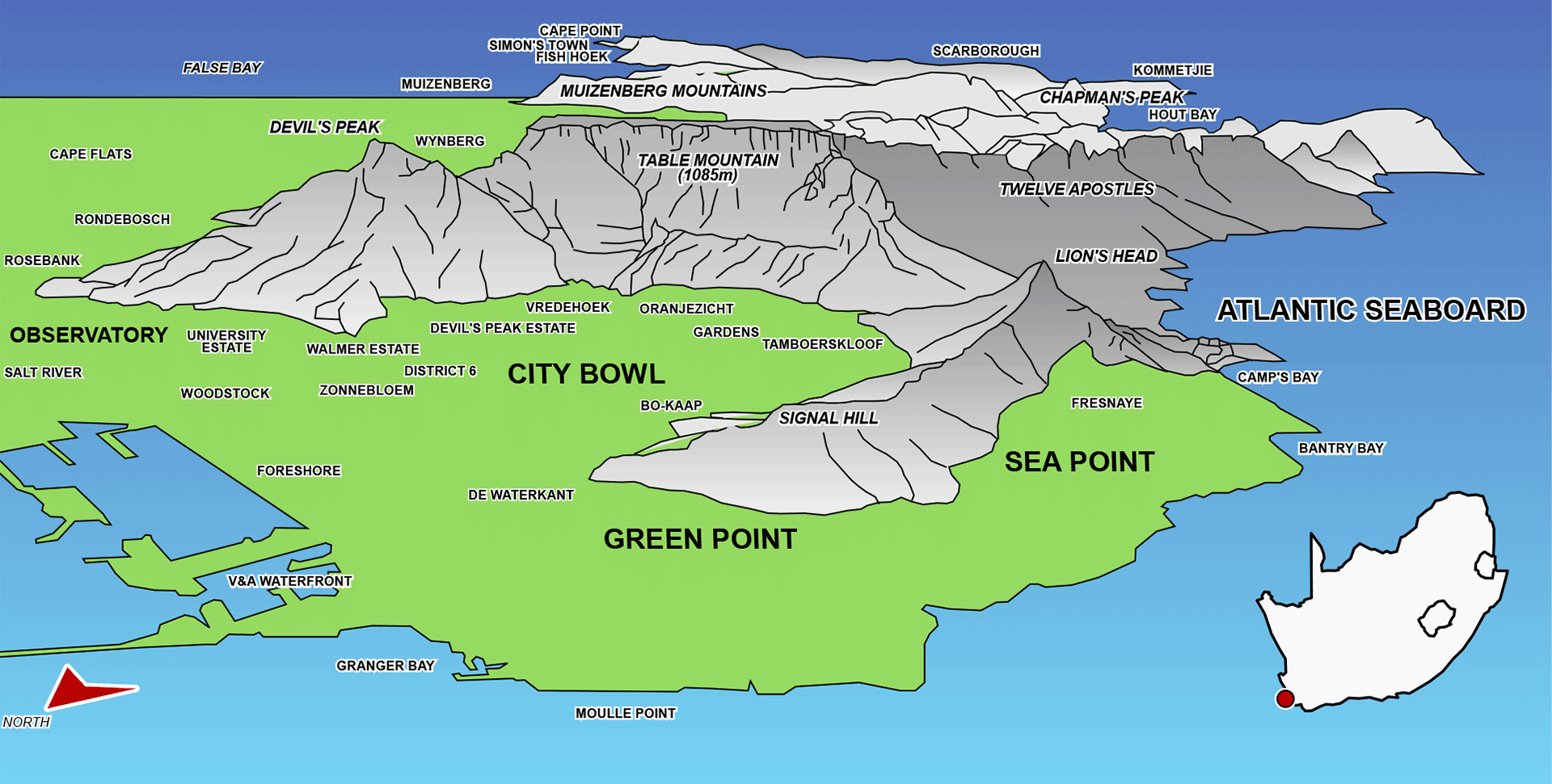
Cape Town is not one city. It is a collection of sharply different neighbourhoods divided by mountains, motorways, and a history of forced racial geography. For a backpacker, understanding these zones is the difference between a good trip and a legendary one.
The City Bowl: Where You'll Live
The City Bowl is the central valley cradled between Table Mountain, Devil's Peak, and Lion's Head. This is where the majority of backpacker accommodation sits, where the nightlife concentrates, and where you'll spend most of your time when you're not on a beach or a mountain. Long Street is the traditional backpacker artery — loud, colourful, sometimes sketchy after midnight, always alive. Kloof Street, running parallel up the slope of the mountain, is where you go for good coffee, better bars, and the feeling that Cape Town is a city that genuinely functions. Bree Street sits between them and has become the city's most interesting restaurant and craft beer strip in the last decade. The three streets form a triangle that contains more good food, good music, and good people-watching per square metre than almost anywhere else in Africa.
The Atlantic Seaboard: Where You'll Go for Sunsets
From the V&A Waterfront, the Atlantic Seaboard runs south along the base of the Twelve Apostles mountain range through Green Point, Sea Point, Bantry Bay, Clifton, and Camps Bay. This is the expensive, beautiful, slightly unreal side of Cape Town — all sundowner bars, white sand coves, and impractically attractive people. The water here is glacially cold (the Benguela Current comes directly from Antarctica), but nobody is swimming on the Atlantic Seaboard anyway; they're sitting on the rocks at Clifton with a cold beer, watching the sun go down over the ocean in colours that do not look like they belong to this planet. The Sea Point Promenade — 11km of oceanfront path — is free, endlessly social, and one of the great urban walks in the world at dusk.
Observatory ("Obs"): Where the Real City Lives
Observatory is the neighbourhood that Cape Town's creative class — musicians, artists, students, activists, people who make their own clothes and grow herbs on their windowsills — calls home. It sits on the southern slopes above the railway line, a 10-minute Uber from the City Bowl, and it looks completely different: peeling Victorian houses, independent record shops, a permanent smell of something cooking, bars with no signage and doors that open onto courtyards. The Armchair Theatre on Lower Main Road is the spiritual home of Cape Town's alternative music scene, with live bands on most nights, a firepit in the courtyard, pool tables, and a crowd that is roughly 50% local and 50% travellers who came for one drink and are still there at 1:00 AM. The Obs café strip is also the cheapest eating on the Cape Town social scene — bunny chow, biltong rolls, breakfast plates — in a neighbourhood that has not yet discovered what a flat white costs in the City Bowl.
The Northern Suburbs: Kite Country
Drive north from the city past the port and the industrial flatlands and you arrive at Bloubergstrand (translated from Afrikaans, it means "Blue Mountain Beach", a wonderfully exotic name which describes the view of Table Mountain very aptly) and Big Bay, on the western shore of Table Bay. This is where the Cape Doctor blows hardest — the fierce south-easterly wind that rakes the city from November to March — and it is, as a consequence, one of the premier kiteboarding destinations on the planet. Between December and February, the sky above Kite Beach is literally filled with hundreds of kites, the surfers below are foil-boarding at 40km/h, and the Table Mountain view across the bay is the most famous photograph in South Africa. There are beginner kite schools along the beachfront that will have you water-starting in three days. If that's not your thing, come at sunset for the view, which costs nothing.
The Southern Suburbs and False Bay: The Other Ocean
Over the mountain — through De Waal Drive or through the Southern Suburbs — lies a completely different coastline. False Bay faces east, is warmed by the Agulhas Current, and is the side of Cape Town that actually swims. Muizenberg is where South African surfing was born: a wide beach with a long, gentle right-hand break and a strip of Victorian beach huts painted in candy colours that have become one of the most reproduced images in the country. Beginners learn to surf here in the mornings. At the southern end of False Bay, Simon's Town is a Victorian naval town with a colony of 3,000 African penguins on the beach at Boulders, and Kalk Bay is a working fishing village with the best fish-and-chips in the southern hemisphere and an antique bookshop that will swallow your entire afternoon.
The Music: What's Actually Playing
You need to know this before you go out, because the music in Cape Town is not what you expect, and it is better than what you expect.
The dominant sound on Cape Town's dance floors right now is amapiano — a genre born in South African townships around 2014, built on a bed of deep log-drum bass lines, smooth piano riffs, and rolling percussion, with short, often repeated vocal hooks that sit on top like something between jazz and gospel. It is one of the most genuinely original musical forms to emerge anywhere in the world in the last decade, and it has now crossed into global mainstream consumption via streaming platforms and has been interpolated by artists from Drake to Beyoncé. But the version of amapiano that plays in Cape Town clubs — louder, harder, faster than the studio recordings — is something different again. When a Cape Town crowd is fully in it, the dance floor moves as a single organism. If you have never experienced it, prepare to be converted within approximately one song.
Alongside amapiano is gqom — Cape Town's own hard-edged adaptation of a form that originated in the Durban townships. Cape Town gqom is darker, more industrial than the Durban original, built on synths and strings layered over church hymn melodies, and has been dubbed "Emo Gqom" or "Gospel Gqom" by locals. The distinction between gqom and amapiano matters in the same way that the distinction between drum and bass and garage matters — they share a family tree, but they feel completely different on a dance floor. Coco on Loop Street is the home of the harder sound. Modular in Observatory is where the electronic and techno crowd goes. The Armchair is where anything can happen on a Friday night and usually does.
What makes Cape Town's music scene remarkable is that this is not imported culture. It came from the townships of Khayelitsha, Gugulethu, and Langa — from a generation of young Black South Africans who took the electronic music tools available to them and built something that is now genuinely influencing global pop. Hearing it live in the city where it was made, in a club that mixes backpackers and Capetonians from across the city's social divides, is one of those experiences that you will want to describe to people when you get home and will find you cannot adequately.
The Elephant in the Room: Inequality
Cape Town is the most unequal city in one of the most unequal countries in the world — and South Africa has the highest Gini coefficient (the standard measure of income inequality) of any country that keeps reliable records. You will feel this in ways that are difficult to prepare for. You will eat a beautiful breakfast in a garden café in Gardens and, twenty minutes later by Uber, be driving past informal settlements that stretch to the horizon. You will walk past people sleeping in doorways on streets that are otherwise some of the most photogenic in the world. You will go on a tour led by a person your own age who grew up in a township under conditions so different from your own as to seem fictional, and they will explain this calmly and with pride and you will not quite know what to do with that information.
There is no simple way to navigate this, and no guide can tell you how to feel about it. What we can say is this: the city is not asking for your guilt. It is asking for your attention and your respect. Spend money at local businesses. Tip well and directly — service workers in Cape Town earn wages that would be considered poverty pay in most of the countries our readers come from. Book your township tours with community-based operators rather than large commercial companies. Talk to people. Don't just photograph them. The inequality is real, it is structural, and it is the product of a very specific history. Understanding even a fraction of that history will make your time in Cape Town significantly richer than if you simply enjoy the view and move on. And the view is spectacular. Both things are true.
Cape Town FAQs for Backpackers
When is the best time to go?
Cape Town summers (December–March) are long, hot, and electric. Days are 14 hours of sunlight, evenings stay warm until midnight, and the energy in the hostels and bars is at its absolute peak. The Cape Doctor wind is also at its strongest in December and January — if it is blowing hard (and it can blow hard enough to close the cable car and make beach-sitting feel like a sand-blasting), head to Clifton 4th Beach or Llandudno, which are sheltered by the mountain. January and February are the best months for the kiteboarding and surfing scene at Blouberg.
The sweet spots for backpackers are October–November and March–April: warm, mostly dry, significantly less crowded, and with hostel rates that can be 30–40% cheaper than peak season. These shoulder months are when Cape Town feels most like itself rather than a city performing for tourists.
Winter (June–August) is cool, rainy, and — for the right traveller — deeply atmospheric. The mountain is regularly in cloud, the fynbos is in flower, the whale season starts in False Bay (June–November is the prime window for southern right whales), and the hostels are quiet enough that you get the place to yourself. If you are coming for surfing, hiking, or doing the Winelands without crowds, winter is underrated.
Where should I stay?
City Bowl / Kloof Street area
The default choice, and for good reason. You are at the foot of the mountain, walking distance to the best bars, restaurants, and coffee shops, and central to everything. This is where the majority of Cape Town's best backpacker accommodation sits. If you want nightlife, culture, and the social energy of people who are all going through the same disorienting first-week-in-Africa experience simultaneously, stay here.
Sea Point / Green Point
Better for active types who want to run the promenade in the morning and be near the Atlantic beaches. Slightly less central, more residential, and with a very different (calmer) energy. Some of Cape Town's best mid-range hostels are here.
Observatory
If you are staying for longer than two weeks and want to feel like you live in Cape Town rather than visit it, stay in Obs. Cheaper, more local, better music, and a bus ride from everything else. The Armchair is your living room.
Muizenberg
For surfers only. It is 45 minutes from the City Bowl without traffic and a different world entirely — small, community-focused, and built around the morning surf. If you are here to learn to surf and don't care about nightlife, this is your neighbourhood.
Blouberg / Northern Suburbs
For watersports. A great place to learn to kite surf, and with the iconic views of Table Mountain that you see in the brochures, but far from the main city action.
What does it cost to go out?
Cape Town is extraordinarily cheap by European and Australian standards. A craft beer at a Kloof Street bar: €1.50–€2.50. A cocktail at one of the nicer spots: €4–€6. Entry to most clubs: free or €2–€5. A full meal at a sit-down restaurant that would cost €25 in Amsterdam costs €8–€12 here. A Cape Malay curry from a Bo-Kaap family restaurant costs about €3. Uber across the city costs €2–€4. This gap between what you're used to paying and what things actually cost here is one of the genuinely transformative pleasures of being in Cape Town on a backpacker budget. You can afford to eat well, drink well, and experience the city properly in a way that would be impossible in London, Paris, or Sydney.
What is load shedding and will it ruin my trip?
Load shedding is South Africa's system of scheduled rolling power cuts — a consequence of decades of under-investment in Eskom, the state electricity provider. Good news: Cape Town has significantly reduced the frequency and duration of load shedding compared to the rest of the country, and in 2025 the city went through long periods of Stage 0 (no cuts) due to increased municipal renewable energy capacity. Bad news: it has not been fully eliminated, and when it does kick in, it typically runs for 2.5-hour blocks, twice a day. Download the EskomSePush app the moment you land — it will tell you exactly when and where the power will be off. Most decent hostels have inverters or generators that keep Wi-Fi and essential lighting running. It is an inconvenience, not a crisis, and most travellers barely notice it.
Getting around: Uber, bus, or hire car?
Uber and Bolt are the primary transport tools for backpackers in Cape Town, and they are ludicrously cheap. A 10-minute Uber across the City Bowl costs about €1.50. From the City Bowl to Camps Bay (a 15-minute drive with spectacular mountain views): about €3. Use Bolt to compare prices and get the better deal, especially at peak times.
MyCiTi buses are reliable, cheap, and good for the main routes along the Atlantic Seaboard and to Blouberg. They require a MyConnect card loaded with credit. Useful for getting to Camps Bay or Sea Point during the day without paying Uber surge pricing. Not useful for anything south of the CBD (Muizenberg, Simon's Town, Cape Point).
Metrorail trains: Avoid. They are unreliable, run to irregular schedules, and are not safe for tourists on most routes, particularly the Southern Line.
Hire car: Essential if you want to see the Peninsula properly — Chapman's Peak, Cape Point, the wine farms, the Boulders penguin colony, Hout Bay. Pick up at the airport (all major companies represented), drive on the left, and understand that the N2 to the airport is a road where smash-and-grab incidents happen at red lights. Keep windows up in slow traffic.
What is the Cape Doctor?
The Cape Doctor is the local name for the fierce south-easterly wind that blows through Cape Town from roughly November to March. It is named partly because it clears the city's air of pollution and partly because it is so powerful that it feels like an assault. In full force, it can throw you off your stride on the street, rip hats off heads, and make a beach afternoon miserable. But it also creates the famous "Tablecloth" — the white cloud that spills over the flat top of the mountain and cascades down the front face without ever reaching the ground, evaporating in the warmer air below. It is one of the most beautiful things you will see in Cape Town, and it happens because of the same wind that is spoiling your beach day. The Doctor can blow for three days straight or vanish overnight. Watch the mountain: if the Tablecloth is forming, head to a sheltered beach (Clifton, Llandudno) or up into the city.
Is cannabis legal?
In 2018, South Africa's Constitutional Court decriminalised the private use and personal cultivation of cannabis by adults — meaning you can legally use it in a private space such as a hostel room (if the hostel permits it). However, you cannot legally buy or sell it, and smoking in public — on the street, on the beach, in a park — remains a criminal offence. You will see pop-up "cannabis clubs" and unlicensed "dispensaries" around the City Bowl, particularly on Long Street. These operate in a legal grey area. A formal regulated retail market was still in the legislative pipeline as of early 2026. Use common sense: the law is clear on public consumption, whatever the vibe on the street suggests.
Is the tap water safe?
Yes. Cape Town's tap water is treated to a high standard and is safe to drink throughout the tourist areas of the city. You do not need to buy bottled water. That said, the city has been on recurring water-scarcity alert since the near-catastrophic "Day Zero" drought of 2017–2018, when the city came within weeks of running out of municipal water entirely. Conservation habits are embedded in local culture. Take short showers. Don't run the tap. The city will appreciate it and so will the Western Cape's increasingly stressed water catchments.
The penguins. Tell me about the penguins.
African penguins. Boulders Beach. Simon's Town. About 45 minutes' drive down the False Bay coast from the City Bowl. A colony of approximately 3,000 of them living on a public beach, completely unbothered by human presence, waddling between beach towels and nesting in the dune scrub. Yes, you can swim in the same water. Yes, they will swim alongside you and investigate your feet. No, they do not bite unless you provoke them (they do bite if you provoke them — they have a grip like a pair of pliers). The entry fee to the National Park section of the beach is small. The free section immediately adjacent to the park, reachable by walking past the navy base, gives you much the same experience without the boardwalk crowds.
While in Simon's Town: beware the baboons. The Cape Peninsula's baboon troops are legally protected, have learned that humans mean food, and have zero fear of people. If a baboon sees you carrying anything edible — or anything that looks like it might be edible, including a backpack or a shopping bag — it will take it. They are astonishingly fast and strong. Keep car windows up on the baboon-traffic sections of the road. This is not wildlife tourism; it is wildlife that has adapted completely to coexisting with tourism, which is a different and more complicated thing.
Are there sharks?
Yes, but the risk is managed and well below what the reputation suggests. The Atlantic side (Camps Bay, Clifton) is consistently too cold for sharks — the Benguela Current keeps the water at 12–16°C, which is outside the comfort zone of great whites. The False Bay side (Muizenberg, Fish Hoek) is warmer and does have great white activity; the Shark Spotters programme deploys observers on the mountain above the beach and uses a flag system visible from the water: green flag means all clear; white flag means a shark has been spotted — clear the water. In recent years, False Bay's great white population has dramatically declined — researchers believe the primary cause is a pair of orcas that moved into the area around 2017 and have since killed and eaten the livers of several great whites, causing the remaining sharks to relocate. The Cape whale watching cruises now regularly encounter these orcas. Conservation science is wild.
Safety In Cape Town
Cape Town requires a level of street awareness that most visitors from Western Europe, Scandinavia, or Australia are simply not used to. It is not a city where you switch off. That said, the majority of the tourists who pass through Cape Town every year — hundreds of thousands of them, many of them solo and in their twenties — have a completely trouble-free visit. The risks are real and manageable, not random and unavoidable. Here is what you actually need to know.
The Most Common Crime: Your Phone
Phone snatching is the number-one crime affecting tourists in Cape Town, and in 2025–2026 it has taken a new and more aggressive form: thieves on motorbikes who ride onto pavements and grab phones from hands at speed. This is happening in broad daylight in ostensibly safe areas, including Kloof Street, the V&A Waterfront vicinity, and along the Sea Point promenade. The rule is simple: keep your phone in your pocket when you are walking. Check your map before you leave, not while you walk. If you need to navigate, use your phone inside a café, a shop, or against a wall with your back protected. A moment's carelessness costs you everything — not just the phone, but the photos, the contacts, the banking apps. Use a crossbody bag with a zip, not a backpack with an external pocket.
Long Street After Midnight
Long Street is the engine of Cape Town's backpacker nightlife and it is worth every minute of it — but it is also a pickpocket corridor and a street where the "hugger mugger" technique (a stranger approaches with apparent friendliness, hugs you, and removes your wallet in the process) is common after midnight. Go, enjoy yourself, but keep your phone in a front pocket, carry only the cash you intend to spend, and — critically — do not walk the length of Long Street alone after 1:00 AM. Walk with people. Take an Uber from bar to bar after midnight rather than walking. The street is not dangerous in the way that some areas of the city are dangerous. It is pick-pocket dangerous, which is manageable with attention.
The Cape Flats: A Clear-Eyed View
The Cape Flats — the vast, flat terrain southeast of the city where the townships of Khayelitsha, Gugulethu, Nyanga, Mitchells Plain, and Manenberg are located — are where the majority of Cape Town's population lives, and where South Africa's gang violence is most concentrated. It is emphatically not a place for independent tourist wandering. That said, it is home to extraordinary community life, music, food, art, and people, and visiting it through a reputable community-based tour operator is not only safe but one of the most worthwhile things you can do in Cape Town. The distinction is critical: don't go alone, don't go spontaneously, and don't go with a large commercial bus tour either. Go with a small, locally run operator whose guides are from the community you're visiting. Your hostel can recommend them. Mzoli's Place in Gugulethu — a legendary township braai restaurant that draws a mixed crowd of locals and visitors on Sundays — is the exception: a specific, well-known venue that can be visited by taxi directly, without wandering.
Table Mountain Muggings: Real And Avoidable
Muggings on Table Mountain's lower trails — particularly the paths running from the lower cable car station toward the Platteklip Gorge entrance, and the trails near Rhodes Memorial — are an established and ongoing reality. The perpetrators work in groups and target solo hikers and pairs. The solution is straightforward: hike in groups of four or more, stick to the busy main trails (Platteklip Gorge is always populated), use the SafetyMountain tracking WhatsApp group (widely used by local hikers, ask at your hostel for the current number), and do not hike alone. The muggings almost exclusively happen on isolated sections. On a busy trail with other people around, you are very unlikely to have a problem.
GPS And The N2
When driving to or from Cape Town airport (or anywhere south of the city), Google Maps may suggest routes through townships to save a few minutes. It is not aware of which roads are safe for tourists to transit at night. Stick to the N1 and N2 highways, use the R300 or the N7 as directed, and if Google Maps suggests a shortcut through Crossroads or any informal settlement at night, ignore it. In slow traffic on the N2 particularly, keep windows up and do not leave bags visible on seats.
Further Reading
Ready to map out the rest of your adventure? For more general info on backpacking South Africa, see our comprehensive home page. We also highly recommend checking out our expert backpacking advice section to make sure you stay safe and save money on the road. If you need help structuring your travel routes, take a look at our suggested itineraries for tours of South Africa. For more info on backpacking, including access to our offline app and interactive PDF guide, head over to our resources page.

Quick Facts

November to March for summer beach weather, long days, and outdoor living. October and April are ideal for fewer crowds and still-good weather.

Scenery (mountains + ocean), beaches, hiking, wine tasting, nightlife, and adventure sports like surfing and paragliding.

The rotating cable car ride to the top of Table Mountain with panoramic city and ocean views.

The coastal train line from Cape Town Station to Simon's Town — part of the Southern Line — passing through seaside cliffs, small stations, and quiet beach towns. Slow, scenic, and often overlooked.

Lion's Head Hike for sunrise or sunset views, relax at Clifton Beach, or explore the city’s neighbourhoods on foot.

3–5 days for the city highlights, or 7+ days if you want to include the Cape Peninsula, wine region, and hiking routes.

High by South African standards. Expect around €80–€180 per day depending on accommodation style, activities, and dining choices.

Uber works best. Average rides within the city cost roughly €3–€10, with longer trips (like to the beaches or Table Mountain base areas) around €10–€20.

Boulder Beach (penguins), Lion's Head (sunrise/sunset hike), Bloubergstrand (Table Mountain across the bay), Kalk Bay harbour (fishing boats + coastal charm), and the top of Table Mountain itself.
Things To Do In Cape Town

1. The Mountain (Non-Negotiable)
You are going to climb Table Mountain. This is not a suggestion. It is a geographical inevitability. The only question is how.
Platteklip Gorge (the classic route, 2–3 hours up)
The most popular hiking route to the summit, and for good reason — it is well-marked, consistently busy (meaning safer), and the views that open behind you as you climb are increasingly absurd. At the top, you are standing on a plateau so flat that you can play cricket on it, looking down at a city that appears to have been designed by a set designer rather than built by humans. The cable car takes you back down for about €15. Or hike down the same way in half the time.
Lion's Head Sunset Hike (the social event)
Every clear evening, hundreds of people — locals, tourists, people of every age and background — make the 1.5-hour spiral hike to the summit of Lion's Head for sunset. The path involves chains and ladders near the top, which sounds alarming and is mildly exhilarating. The summit at sunset, with the Atlantic turning gold below you and the city lights beginning to flicker on across the bowl, is one of those collective experiences that Cape Town does better than any city I can think of. On a full moon, people do it at night with headlamps. The full moon hike is, by multiple accounts, even better.
Read More

Top-Rated Cape Town Tours on GetYourGuide.com
Lion's Head or Table Mountain Hike
From ZAR765
Table Mountain, Penguins & Cape Point
From ZAR893
48-Hour Hop-on, Hop-off City Tour
From ZAR373
Robben Island / Nelson Mandela Tour
From ZAR1,280
Tandem Paragliding Adventure
From ZAR1,750
City Scenic Helicopter Tour
From ZAR2,650
Cape Town Hostel Directory
Hostels listed on Booking.com and Hostelworld
All Hostels
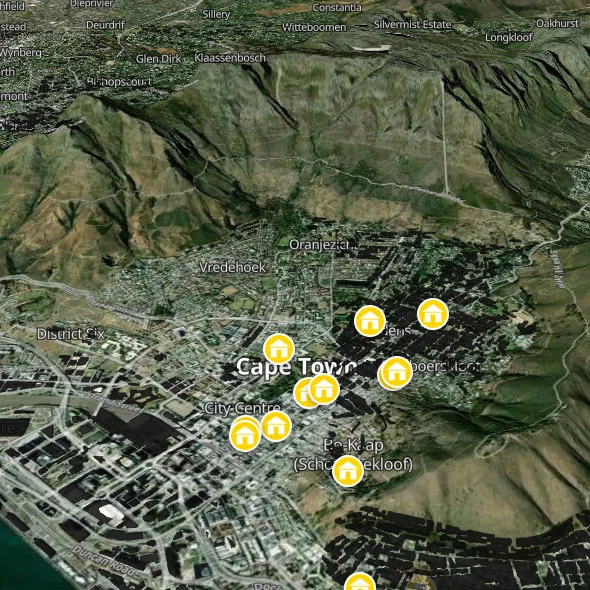
We're the only guide that lists all the hostels, with their full contact details, in case you want to book direct, plus useful info such as Safety Ratings and Value For Money, Solo Female Friendliness, and Digital Nomad scorecards.
SEE OUR
Preparation
Preflight Checklists Safety Money Medical Embassies Cannabis & The Law Useful AppsIn-Country
Emergencies Transport Food & Drink Language African Etiquette Fun & Games Onward TravelSpecific Interests
Festivals & Clubs Surfing Digital Nomads Overlanding Cycle Touring Volunteering Language SchoolsSelf-Drive Itineraries
1 Week: The Cape Loop 2 Weeks: The Whistlestop Tour 2 Weeks: The Northeast Triangle 2 Weeks: The Grand Cape Loop 2 Weeks: The Wild North 2 Weeks: The Road Less Travelled 3 Weeks: The Backpacker's Bible 3 Weeks: Coast & Karoo 3 Weeks: Off The Beaten Track 1 Month: The Rainbow Nation 3 Months: The Full MontyTours & Day Trips
Cape Town Winelands West Coast Garden Route Karoo Route 62 The Overberg Sunshine Coast Durban Drakensberg Zululand Kruger Johannesburg Eswatini LesothoPDF Hostel Guide
A compact interactive PDF with a clickable map and every hostel's contact details. No wifi needed — just save it to your phone.
Download PDF (opens in a new tab)(Interactive PDF — 800kb)
Full Backpackers Bible App
The complete guide installed as an app icon on your home screen. Maps, regions, advice, tours, and hostel reviews — fully offline.
Get the App →(Progressive Web App — free)
 SHARE (opens in a new tab)